Fossick for opalised Cretaceous marine fossils at White Cliffs, NSW. Public Crown Land areas allow licensed collecting of opalised bivalves, belemnites, and more.

White Cliffs Opal Fossicking: Opalised Marine Fossils in Outback New South Wales

Introduction

White Cliffs sits in the far northwest of New South Wales, roughly 290 kilometres northeast of Broken Hill, and it holds two overlapping records: Australia’s oldest continuously operated commercial opal field, established in 1889, and one of the few places in the world where Cretaceous marine fossils have been converted entirely to precious opal. The same geological process that produced the gem-quality opal here also replaced the shells, bones, and bodies of creatures that lived in the shallow Eromanga Sea 110 million years ago. The result is fossil material that is both scientifically significant and visually striking.

Visitors come to White Cliffs to fossick in the public opal fields, explore the underground dugout homes that residents carved into the hillsides to escape the extreme heat, and examine the opalised specimens on display and for sale in the town’s opal shops. This guide covers access to the fossicking areas, what types of opalised fossils occur here, the geological setting that produced them, the rules that apply to public fossicking, and the practical information needed to visit safely.

Location and Directions

Address

White Cliffs, New South Wales 2836. The town sits in Unincorporated Far West NSW, administered by the Far West Regional Council. The fossicking areas are scattered around the town on Crown Land leased for mining.

Directions

From Broken Hill, drive northeast along the Silver City Highway for approximately 90 kilometres to Wilcannia, then continue east on the Barrier Highway briefly before turning north onto the White Cliffs Road. The total distance from Broken Hill is approximately 290 kilometres. From Bourke, travel west along the Mitchell Highway to Cobar, then northwest via the Barrier Highway to Wilcannia, and north to White Cliffs — approximately 450 kilometres in total.

The road from Wilcannia to White Cliffs (approximately 100 kilometres) is sealed but narrow and single-lane in sections. Drive carefully and give way to road trains. A conventional two-wheel-drive vehicle is adequate for the main road, but accessing individual mining leases around town may require care on rough tracks. Fill your fuel tank in Broken Hill or Cobar before departing, as fuel availability at White Cliffs can be limited. Parking is informal around town on the open red earth; there are no designated car parks at the fossicking areas.

What Fossils You’ll Find

The fossils at White Cliffs occur within the Cretaceous Griman Creek Formation and the Finch Clay Member, marine sediments laid down in the Eromanga Sea. What makes them unusual is that the original fossil material — shell, bone, and organic structure — has been partially or wholly replaced by precious opal through a process of silicification. This opalisation is the same process that created the gem opal mined commercially here.

Bivalve shell shapes.jpg
Bivalve shell shapes.jpg. Photo: Alva Åkerlind 01 via Wikimedia Commons (CC0)

Bivalve shells are the most commonly encountered opalised fossils. Species of Inoceramus (a large ribbed clam widespread in Cretaceous seas) and smaller bivalves appear as opalised casts and moulds in the clay sediments. Many show the characteristic blue, green, and gold colour play associated with White Cliffs potch opal.

Belemnites — the internal guards of extinct squid-like cephalopods — occur as cylindrical opalised rods within the sediment. Their cigar-shaped form makes them recognisable even when the original calcite has been completely replaced.

Ammonites are less common but do occur. These coiled cephalopods appear as flat spiral forms, often showing the original suture pattern of the shell partitions as dark lines through the opal replacement material.

On rare occasions, miners have uncovered fragments of opalised vertebrate material — fish bones, and in exceptional cases, portions of marine reptile remains. These significant specimens are typically sold to museums or private collectors rather than remaining accessible in the public fossicking areas.

When fossicking in the public areas, look for opalised material in the spoil heaps left by previous mining activity. Freshly turned earth after rain sometimes exposes new material on the surface. Most fossils here are found as loose pieces in disturbed sediment rather than in bedrock.

Geologic History

The Ancient Environment

The fossils at White Cliffs formed in the Cretaceous period, approximately 100 to 115 million years ago, during the Albian and Cenomanian stages. At this time, a vast shallow inland sea — the Eromanga Sea — covered much of inland Australia, stretching from the present Gulf of Carpentaria in the north to the present Murray-Darling Basin in the south. The sea was warm, shallow, and highly productive, supporting abundant bivalves, cephalopods, fish, and larger marine reptiles including plesiosaurs and ichthyosaurs.

The sediments accumulated as fine muds and sands on the seafloor. The Griman Creek Formation, which hosts the opal deposits, represents these shallow marine and marginal marine environments. Organisms that died in the sea settled into the soft seafloor sediment and were buried.

The opalisation process occurred much later, during the weathering of the rock sequence. Silica-rich groundwater percolated through the buried sediments and slowly replaced the original calcium carbonate of shells and bones with hydrated silica — opal. This replacement was sometimes complete and sometimes partial, resulting in fossils that range from pure gem opal to opal-replaced bone with original structure still visible under magnification.

How White Cliffs Became a Fossil Fossicking Site

Commercial opal mining began at White Cliffs in 1889 following the discovery of gem-quality stones by kangaroo hunters. Miners worked the shallow Cretaceous sediments with picks and shovels, cutting drives and shafts through the soft rock. As mining expanded across the landscape, opalised fossils emerged alongside the gem material as an inevitable by-product. For most of the field’s early history, fossils were either discarded or sold informally through the opal trade. Over time, scientific attention to the opalised vertebrate specimens in particular grew, and a number of significant finds entered museum collections. Today the public fossicking areas designated around the town allow visitors to search the disturbed ground and spoil heaps from earlier mining operations without requiring a mining lease of their own.

Visiting Rules and Regulations

Is Fossil Collecting Allowed?

Public fossicking at White Cliffs is permitted in designated fossicking areas on Crown Land under the NSW Fossicking Act 1998. A NSW Fossicking Licence is required for anyone aged 18 or over. Licences are available online through the NSW Resources Regulator or from Service NSW. The licence costs a small annual fee and authorises fossicking for minerals and gemstones — including opalised fossils — using hand tools only. You may keep what you find in the fossicking areas.

You must not fossick on active mining leases without the lease holder’s written permission. The boundaries of leases are marked with pegs; do not cross into a leased area. Under the NSW National Parks and Wildlife Act, significant vertebrate fossil material (particularly opalised marine reptile bones) may be subject to additional protection. If you find what appears to be a significant vertebrate specimen, contact the Australian Museum or the NSW NPWS for guidance before removing it.

Recommended Equipment

For surface fossicking in the spoil heaps, a small trowel or hand pick, a stiff brush for cleaning specimens, and a container for your finds are all you need. A magnifying glass helps identify opalised material against plain potch. Wear sturdy footwear — old mining shafts can be hidden beneath surface rubble, and collapses have occurred. A hat, high-SPF sunscreen, and a long-sleeved shirt are essential; the White Cliffs area receives intense UV radiation year-round. Carry at least two litres of water per person at all times. A basic first aid kit is recommended for any remote NSW fossicking trip.

Safety

White Cliffs is genuinely remote. The nearest hospital with emergency services is in Wilcannia, 100 kilometres south, or Broken Hill, 290 kilometres southwest. Avoid fossicking on hot days — summer temperatures regularly reach 45°C and above. The greatest physical hazard at White Cliffs is old, unmarked mine shafts. These shafts can be as deep as 15 metres and may not be visible from the surface. Never walk on ground that appears recently disturbed unless you can clearly see what is beneath your feet. Do not enter any mine shaft. Keep children within close sight at all times. Mobile coverage exists in town but is patchy in the surrounding field areas. Tell someone your plans before heading out.

Sources

Talbragar Fossil Site: NSW’s Only Jurassic Fish Beds near Gulgong

Introduction

The Talbragar Fossil Site, located on a dry hillside near Gulgong in central New South Wales, holds a record that no other site in the state can match: it is the only known Jurassic fish locality in New South Wales, and one of the most significant Jurassic terrestrial deposits in Australia. The fine-grained freshwater limestone preserved here captures a moment from approximately 160 million years ago with exceptional clarity. Fish skeletons, some complete to the last scale, lie within the stone alongside insect wings, conifer needles, and seed fern fronds that fell into the same ancient lake. Over 25 distinct species have been described from this site, including fish, insects, and plants with affinities to both Gondwanan and Laurasian lineages.

The site is gazetted as a Crown Land Reserve for fossil preservation and is managed by the NSW National Parks and Wildlife Service. Access requires prior arrangement; this is not a drop-in destination. But for visitors prepared to do the groundwork, Talbragar offers the chance to stand at an in-situ Jurassic lake bed and see the original fossil-bearing limestone in its geological context. This guide covers how to arrange access, what fossil taxa are present, the geological setting that produced them, and what rules apply to visitors.

Archaeomaene tenuis (Woodward 1895).jpg
Archaeomaene tenuis (Woodward 1895).jpg. Photo: Oilshale via Wikimedia Commons (CC0)

Location and Directions

Address

Talbragar Fossil Site (Crown Reserve), Talbragar River area, near Gulgong, New South Wales 2852. The site is located on private pastoral land that contains a gazetted Crown Land Reserve; access is via the landowner’s property.

Directions

Gulgong is located approximately 270 kilometres northwest of Sydney via the Great Western Highway and the Castlereagh Highway through Mudgee. From Gulgong, the Talbragar Fossil Site is reached via unsealed rural roads; the exact route and access gate details are provided by the NSW National Parks and Wildlife Service or the landholder when arranging a visit. Do not attempt to locate the site independently without prior authorisation, as it requires crossing private property.

A conventional two-wheel-drive vehicle can reach the site under dry conditions, but the unsealed tracks become difficult after rain. Four-wheel drive capability is recommended if visiting during or after wet weather. Fuel and supplies are available in Gulgong or Mudgee before departure. There are no facilities at the site — no toilets, water, or shelter.

What Fossils You’ll Find

The Talbragar deposit preserves a lacustrine (lake) assemblage of exceptional quality. The calm, oxygen-depleted conditions at the bottom of the ancient lake inhibited scavenging and bacterial decomposition, allowing soft tissues and articulated skeletons to be preserved in fine-grained limestone.

Fossil Fish 1.jpg
Fossil Fish 1.jpg. Photo: Gary Todd via Wikimedia Commons (CC0)

Fish are the dominant component of the assemblage and the group for which the site is most significant. Cavenderichthys talbragarensis is an extinct ray-finned fish known only from this locality. Aphnelepis australis is preserved here as complete articulated skeletons showing exceptional detail, including scale patterns and fin rays. Eight fish species in total have been described from Talbragar, representing multiple lineages of Jurassic freshwater and lacustrine fish.

Plants contribute 16 species to the known assemblage. The most notable is Agathis jurassica, a conifer related to the living Wollemi Pine (Wollemia nobilis). The occurrence of an Agathis ancestor here contributes to understanding the deep evolutionary history of this iconic Australian genus. Other conifers belong to the Araucariaceae family. Pentoxylon australicum and Rissikia talbragarensis, a seed fern, also occur in the deposit. Plant material arrives as fallen leaves, needles, and reproductive structures that drifted into the lake.

Insects represent at least eight orders in the Talbragar assemblage, including dragonflies, hemipterans, wasps, flies, and beetles. Insect preservation in Jurassic deposits is globally rare; the Talbragar specimens contribute to tracking insect diversification in the Mesozoic.

All fossil material visible at the site is in-situ within the limestone beds. Individual specimens are not prominent from a standing distance — the fossils are typically a few centimetres in size and require close examination. The limestone exposure itself, and the layered structure of the beds, is the primary visual feature of the site.

Geologic History

The Ancient Environment

The Talbragar fossils are preserved in the Talbragar Fish Bed, a member of the Purlawaugh Formation, dated to the Late Jurassic period approximately 155 to 160 million years ago, during the Oxfordian to Tithonian stages. At this time, central New South Wales was part of the eastern margin of Gondwana, positioned at moderate southern latitudes with a warm to humid climate — quite different from the dry, semi-arid landscape that characterises the region today.

The depositional environment was a shallow, quiet lake or deep lagoon with stratified water chemistry. The absence of sedimentary flow structures indicates still water with no significant current. Periodic stratification of the water column — likely driven by thermal or chemical gradients — created anoxic conditions at the lake bottom, inhibiting the scavenging and decay that would otherwise destroy soft-bodied organisms. Fish that died in the lake sank to the bottom and were buried in the fine carbonate mud. Leaves, insects, and pollen from the surrounding forests blew or fell into the lake and were preserved in the same way.

The surrounding landscape was forested with Jurassic conifers and seed ferns that are now extinct, though their relatives survive in relict form as the Wollemi Pine and related Araucariaceae.

How Talbragar Became a Fossil Viewing Site

The Talbragar Fossil Fish Bed was first documented in the 1880s during geological surveys of the Gulgong area. Early collections of fish specimens reached the Australian Museum in Sydney, where they attracted scientific attention for the quality of their preservation. Subsequent research described multiple fish and plant species from the locality. The site’s scientific significance led to its gazettal as a Crown Land Reserve for fossil preservation under New South Wales land management legislation. Management responsibility sits with the NSW National Parks and Wildlife Service, which controls scientific access through the permit system. The fossils remain in situ in the limestone beds; no material is removed under normal visiting conditions.

Visiting Rules and Regulations

Is Fossil Collecting Allowed?

Fossil collecting is strictly prohibited. The Talbragar Fossil Site is a gazetted Crown Land Reserve managed for the preservation of its palaeontological heritage. Under the NSW National Parks and Wildlife Act 1974, it is an offence to damage, destroy, or remove any fossil or geological material from a protected site. Scientific research at the site requires a permit from the NSW NPWS.

Access to the site by members of the public requires prior arrangement with the NSW National Parks and Wildlife Service (Hunter Region office) or, in some cases, directly with the landowner through whose property access is gained. Do not approach the site without this prior authorisation. The site is for in-situ viewing only — you may observe, photograph, and examine the limestone beds, but you may not mark, collect from, or disturb the rock surface in any way.

Recommended Equipment

A hand lens or magnifying glass is strongly recommended — most fish and insect specimens require close examination to see detail. Bring your own drinking water, as there is none at the site. Wear sunscreen and a hat; the site is exposed to full sun with little shelter. Sturdy footwear is appropriate for the rural paddock terrain. A notebook and camera will allow you to document what you observe for your own reference. Check weather conditions before departing Gulgong, as unsealed access tracks can become impassable very quickly after rain.

Safety

The site is on private rural property in inland New South Wales. Hazards include eastern brown snakes and other venomous species — watch where you step and do not place hands into rock crevices or under debris. In summer, temperatures in central NSW regularly exceed 38°C; schedule visits for early morning and carry sufficient water. Inform someone of your itinerary before departing. Mobile coverage is unreliable in the Talbragar area. The nearest hospital is in Mudgee, approximately 30 kilometres south.

Sources

Wellington Caves: Birthplace of Australian Palaeontology, NSW

Introduction

Wellington Caves holds a specific and well-earned title: the site where Australian palaeontology began. In 1830, explorer Thomas Mitchell recovered fossil bones from these Devonian limestone caves and sent them to the Natural History Museum in London, where they were identified by Richard Owen as belonging to extinct giant marsupials. That exchange launched a scientific field and opened a new chapter in understanding Australian prehistory. The caves themselves are spectacular — kilometre-scale limestone passages decorated with columns, stalactites, and flowstones — and the Pleistocene fossil deposits they contain are among the richest in the Southern Hemisphere, with remains of Diprotodon, Thylacoleo carnifex (the marsupial lion), Procoptodon (giant short-faced kangaroo), and dozens of other species now extinct.

Three separate guided cave tours operate at Wellington, each covering different passages and geological features. This guide covers the drive from Sydney and Dubbo, the tour options and current fees, what fossil material is viewable during each tour, and the regulations that govern the site.

Grose Valley, NSW, Australia - April 2013.jpg
Grose Valley, NSW, Australia – April 2013.jpg. Photo: Diliff via Wikimedia Commons (CC BY-SA 3.0)

Location and Directions

Address

Wellington Caves, 2733 Caves Road, Wellington, New South Wales 2820.

Directions

From Sydney, take the Great Western Highway (A32) west to Bathurst, then continue on the Mitchell Highway (A32/B55) northwest to Wellington. Total distance from Sydney is approximately 355 km, taking around 4 hours by road. From Dubbo, head south on the Mitchell Highway for approximately 50 km. Wellington township is the main reference point; Wellington Caves is located 8 km south of the town centre on Caves Road.

Parking is available on-site in a sealed car park near the visitor centre. There is no charge for parking. The site has coach and caravan parking. Facilities at the caves include a café, a holiday park with cabin and powered site accommodation, a wildlife and education centre, and picnic grounds.

What Fossils You’ll Find

Wellington Caves contains Pleistocene fossil deposits of exceptional richness. The fossil material accumulated over hundreds of thousands of years as animals fell into natural vertical shafts in the limestone and were subsequently flooded by the rising water table, leading to rapid burial and preservation in fine-grained sediment.

Diprotodon skeleton, from Stromer, E. (1910). Lehrbuch der Paläozoologie. Vol. 2.jpg
Diprotodon skeleton, from Stromer, E. (1910). Lehrbuch der Paläozoologie. Vol. 2.jpg. Photo: Ernst Stromer via Wikimedia Commons (Public domain)

Diprotodon optatum — the largest marsupial that ever lived, reaching the size of a rhinoceros — is represented by multiple individuals in the Wellington deposits. Skull fragments and limb bones have been recovered from several of the cave chambers.

Thylacoleo carnifex, the marsupial lion, is known from complete skulls recovered at Wellington. Its dentition — reduced incisors and large, blade-like premolars acting as carnassials — identifies it as an apex predator despite its relationship to herbivorous possums and wombats.

Procoptodon goliah, the giant short-faced kangaroo standing up to 2 metres tall, has been identified from limb bones and jaw fragments. Several species of large macropods are present in the assemblage, reflecting the diversity of the Pleistocene grassland and woodland fauna that lived across central New South Wales.

The Phosphate Mine tour passes through workings from 1914 to 1918, when bone-bearing phosphate-rich sediments were mined for agricultural fertiliser. The bones in the matrix are Pleistocene megafauna remains, and during the Phosphate Mine tour you can see fossil bones still visible in the mine walls at close range.

Wellington Caves also sits within Devonian limestone. The limestone itself contains marine fossils from approximately 360 to 415 million years ago, though these are not the primary visitor draw and are difficult to spot without a hand lens and a guide’s assistance.

Geologic History

The Ancient Environment

The limestone in which Wellington Caves are developed was deposited during the Devonian Period, approximately 360 to 415 million years ago, in a shallow tropical sea that covered much of central New South Wales. Carbonate sediments — the shells, skeletons, and excretions of marine organisms — accumulated on the seafloor and were compressed over millions of years into the dense limestone now visible in the cave walls. The rock type is Silurian to Devonian reef limestone, and the original marine fauna is preserved as moulds and calcite replacements within the rock matrix.

The Pleistocene fossil deposits are much younger — generally dated to between approximately 40,000 and 500,000 years ago. During this period, central New South Wales supported open woodland and grassland vegetation, and the megafauna that lived in these habitats were diverse and abundant. The vertical shafts and sink holes that characterise the surface above the cave system acted as natural pitfall traps. Animals that fell in — or were washed in during flood events — were preserved in the accumulating sediment inside the caves.

How Wellington Caves Became a Fossil Viewing Site

Cave development at Wellington began when acidic groundwater, charged with carbon dioxide from soil, began dissolving the Devonian limestone along joints and fractures. This process, known as karstification, has been operating for millions of years and has produced the multi-level passage system now explored on guided tours. The fossil deposits were first scientifically documented in 1830 when Thomas Mitchell collected bones from Bone Cave and forwarded them to London. Richard Owen’s identification of the material as giant marsupials made Wellington internationally significant overnight. The site has been open to visitors in various forms since the nineteenth century and today is managed by Wellington Caves Reserve, a NSW Government asset. Ongoing research by university and museum teams continues to document new species from the deposits.

Visiting Rules and Regulations

Is Fossil Collecting Allowed?

Fossil collecting is strictly prohibited. Wellington Caves is a protected site under the NSW Heritage Act 1977 and the Commonwealth EPBC Act 1999. All fossil material in the caves is protected for scientific research and public education. Removing any material, including loose rock fragments, is an offence. Visitors may observe fossil material during guided tours and photograph the cave environment.

Recommended Equipment

Enclosed footwear is required for all cave tours — thongs, sandals, and open-toed shoes are not permitted inside the caves. The cave temperature is a constant 17°C year-round, which feels cool in summer and relatively mild in winter. Bring a light jacket. Tours are guided, so no specialist equipment is required. Cameras without flash are generally permitted; confirm with your guide at the start of the tour. The Phosphate Mine tour is the most accessible, being suitable for wheelchairs and prams. Cathedral and Gaden caves involve steps and uneven surfaces and are not wheelchair accessible.

Safety

All tours at Wellington Caves are led by trained guides. Do not enter any cave passage without a guide. The caves contain natural hazards including uneven floors, low ceilings in some sections, and areas of potential flooding during heavy rain. Persons with claustrophobia should discuss their concerns with staff before booking a tour. Threatened bent-wing bats (Miniopterus schreibersii) roost in the cave system — do not disturb bat colonies or attempt to enter restricted bat habitat areas. Tour bookings are recommended to secure a place, particularly during school holidays and long weekends.

Sources

Lightning Ridge: The World’s Only Opalised Dinosaur Fossils, NSW

Introduction

Lightning Ridge produces something that exists nowhere else on Earth: dinosaur bones replaced by precious black opal. When a Cretaceous animal died in the shallow inland sea or along its shoreline roughly 100 million years ago, sediment buried its remains and slowly, over millions of years, silica-rich groundwater replaced the original bone material with opal. At Lightning Ridge, where the groundwater chemistry and the overlying Cretaceous sediments conspired to produce gem-quality black opal, the result is fossils that are simultaneously scientific specimens and precious gemstones.

The town of Lightning Ridge sits in far northwestern New South Wales, a full day’s drive from Sydney. It has been an opal mining settlement since the early twentieth century, and opalised fossils have been turning up in mining shafts ever since. The Australian Opal Centre now houses the largest public collection of opalised fossils in the world, and the town offers multiple ways for visitors to engage directly with its fossil heritage — from museum displays to supervised dig experiences. This guide covers the drive from Sydney, what species are documented from the area, the geology that produced this unique form of preservation, and the current access options for visitors.

Open Cut Opal Mine at Lightning Ridge - panoramio.jpg
Open Cut Opal Mine at Lightning Ridge – panoramio.jpg. Photo: Joy Engelman via Wikimedia Commons (CC BY-SA 3.0)

Location and Directions

Address

Australian Opal Centre, 1 Apollo Street, Lightning Ridge, New South Wales 2834.

Directions

From Sydney, take the A1 Pacific Highway or Western Motorway to Dubbo, then continue north on the Newell Highway (B55) to Narromine, Nyngan, and then north on the Castlereagh Highway (B84) to Lightning Ridge. Total distance from Sydney is approximately 770 km — allow 8 to 9 hours of driving. The road is sealed all the way but passes through remote outback terrain for the final 200 km. Fuel up at Walgett (75 km south of Lightning Ridge) as a precaution, as services in Lightning Ridge are limited compared with major centres.

Lightning Ridge has a small commercial centre on Morilla Street with accommodation, a supermarket, service stations, and restaurants. The Australian Opal Centre is on Apollo Street, a short walk from the main street. Parking is available in the unsealed car park adjacent to the centre. The opal fields and registered fossicking areas are located throughout the township and surrounding areas — the Visitor Information Centre on Morilla Street can provide current maps of publicly accessible fossicking zones.

What Fossils You’ll Find

The fossils recovered from Lightning Ridge come from the Griman Creek Formation and the overlying Finch Clay Member, both of Cretaceous age (approximately 95 to 105 million years old). The diversity of vertebrate life represented in the opalised material is extraordinary given that most Cretaceous deposits in Australia preserve only fragmentary or isolated material.

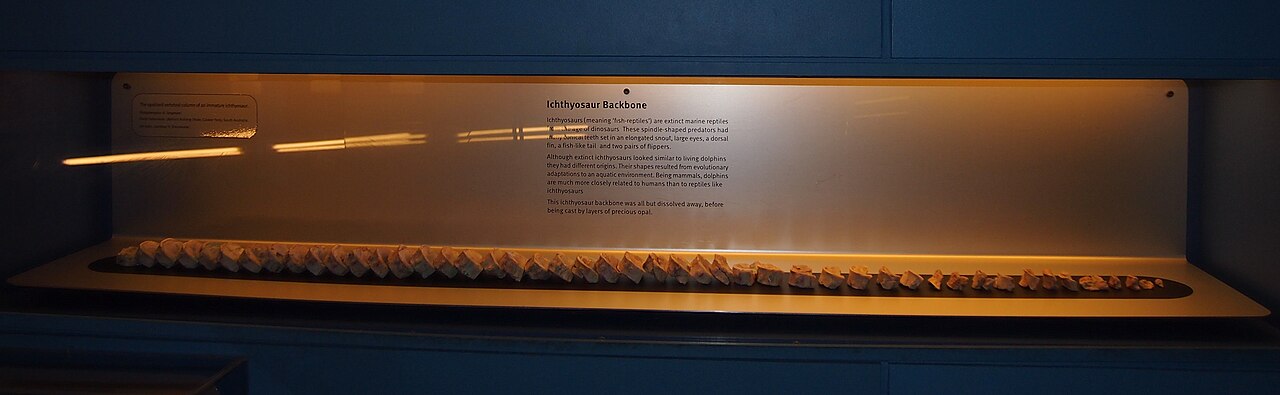
Opalised Ichthyosaur backbone.jpg
Opalised Ichthyosaur backbone.jpg. Photo: Bahudhara via Wikimedia Commons (CC BY-SA 3.0)

Opalised dinosaur bones are the site’s defining feature. The ornithopod Weewarrasaurus pobeni, described from an opalised jawbone, represents a new genus unique to Lightning Ridge. Fostoria dhimbangunmal is an opalised iguanodontian ornithopod known from multiple individuals found together in a single mining shaft — the first evidence of a herd or family group from the Australian Cretaceous. The megaraptorid theropod Australovenator wintonensis was first described from Winton but a specimen nicknamed Lightning Claw, a large-clawed megaraptorid theropod, was recovered from Lightning Ridge opal mining shafts, demonstrating that apex predators of this type ranged across the region. Ankylosaur elements have also been documented.

Opalised mammals include Steropodon galmani, described in 1985 from a lower jaw with three molar teeth — this was the first Mesozoic mammal ever documented from Australia. The jaw resembles that of the modern platypus, suggesting an early monotreme affinity. Additional monotreme material has since been recovered from the same beds.

Other opalised fauna includes three species of crocodilian, plesiosaur elements (marine reptiles that inhabited the Eromanga Sea), pterosaur fragments, bony fish, turtles, and a diverse invertebrate fauna including bivalves, gastropods, and trace fossils. Opalised plant material — including pinecones — is also present.

Some Lightning Ridge fossils are transparent, meaning the opal that replaced the original bone is itself gem-quality and transparent. These are, to date, the only known transparent fossils of large vertebrates anywhere in the world.

Geologic History

The Ancient Environment

The fossil-bearing sediments at Lightning Ridge were deposited approximately 95 to 105 million years ago during the mid-Cretaceous Period (Albian to Cenomanian stages). At that time, a vast shallow inland sea known as the Eromanga Sea covered much of central and eastern Australia. Lightning Ridge sat on or near the western shoreline of this sea, in a zone of shallow marine to marginal environments — river deltas, mudflats, swamps, and open water.

Dinosaurs, crocodilians, and small mammals inhabited the coastal and fluvial environments at the sea’s margin. When these animals died, some were buried in fine-grained sediment in low-oxygen conditions that discouraged bacterial decay. Over millions of years, silica-rich groundwater percolated through the sediment column and, under specific chemical conditions, silica gel filled pore spaces in bones before hardening into opal. The local groundwater chemistry at Lightning Ridge, enriched by the weathering of volcanic rocks in the region’s geological history, was particularly well suited to producing precious opal rather than common opal or silica replacement alone.

How Lightning Ridge Became a Fossil Collecting Site

Opal was first discovered at Lightning Ridge around 1902, and commercial mining began shortly after. Miners working vertical shafts and horizontal drives through the Cretaceous sediments encountered opalised bones alongside gem opal from the beginning, though for decades these were often discarded or traded informally. The scientific significance of the material became clear in 1985 when Steropodon galmani was described — the first Mesozoic mammal from Australia — from a jaw recovered by a miner. This discovery drew palaeontologists to Lightning Ridge in earnest. The Australian Opal Centre, opened in 2019 after years of community effort and fundraising, now provides a permanent institutional home for the opalised fossil collection and serves as a research centre in partnership with universities and museums.

Visiting Rules and Regulations

Is Fossil Collecting Allowed?

Fossicking for opal — and potentially opalised fossils — is permitted on publicly accessible Crown Land fossicking areas within and around Lightning Ridge. You do not need a permit to fossick on designated Crown Land fossicking areas in New South Wales, but you are limited to hand tools and small-scale operation under the NSW Mining Act 1992. Larger-scale fossicking or the use of machinery requires a Fossicking Licence from the NSW Department of Regional NSW.

It is important to understand that opalised fossils discovered during fossicking are subject to both mining law and the NSW Heritage Act 1977. Scientifically significant fossils — particularly those that could represent new species or important specimens — should be reported to the Australian Opal Centre or the Australian Museum. Removing a scientifically significant fossil without reporting it may constitute an offence. The Australian Opal Centre can provide current guidance on the legal framework for opalised fossil finds.

Private mining leases cover the majority of productive opal fields. Do not enter leased land without the explicit permission of the lease holder.

Recommended Equipment

For fossicking on public Crown Land areas, bring a geological hammer, chisels, safety goggles, and work gloves. The sediment at Lightning Ridge is often soft and crumbly, making hand tools effective for surface scraping and shallow excavation. A small brush is useful for clearing loose material around potential specimens. Sun protection is essential — Lightning Ridge is in outback New South Wales and temperatures regularly exceed 40°C in summer. Carry adequate water; facilities on the opal fields themselves are limited. The Australian Opal Centre’s supervised dig experience provides all necessary tools and guidance for visitors who prefer a structured introduction.

Safety

The opal fields contain numerous open mine shafts, many of which are unmarked. Walk carefully on the fields and do not approach shaft openings. Keep children and pets close at all times. Do not enter any shaft without proper equipment, a trained partner, and knowledge of underground mining safety procedures. The NSW Mine Safety Regulation requires that shafts be capped when not in use, but compliance is variable in abandoned workings. Summer temperatures in Lightning Ridge can be extreme. Plan outdoor fossicking activities for early morning and carry significantly more water than you think you need.

Sources