
Introduction
Lightning Ridge produces something that exists nowhere else on Earth: dinosaur bones replaced by precious black opal. When a Cretaceous animal died in the shallow inland sea or along its shoreline roughly 100 million years ago, sediment buried its remains and slowly, over millions of years, silica-rich groundwater replaced the original bone material with opal. At Lightning Ridge, where the groundwater chemistry and the overlying Cretaceous sediments conspired to produce gem-quality black opal, the result is fossils that are simultaneously scientific specimens and precious gemstones.
The town of Lightning Ridge sits in far northwestern New South Wales, a full day’s drive from Sydney. It has been an opal mining settlement since the early twentieth century, and opalised fossils have been turning up in mining shafts ever since. The Australian Opal Centre now houses the largest public collection of opalised fossils in the world, and the town offers multiple ways for visitors to engage directly with its fossil heritage — from museum displays to supervised dig experiences. This guide covers the drive from Sydney, what species are documented from the area, the geology that produced this unique form of preservation, and the current access options for visitors.

Location and Directions
Address
Australian Opal Centre, 1 Apollo Street, Lightning Ridge, New South Wales 2834.
Directions
From Sydney, take the A1 Pacific Highway or Western Motorway to Dubbo, then continue north on the Newell Highway (B55) to Narromine, Nyngan, and then north on the Castlereagh Highway (B84) to Lightning Ridge. Total distance from Sydney is approximately 770 km — allow 8 to 9 hours of driving. The road is sealed all the way but passes through remote outback terrain for the final 200 km. Fuel up at Walgett (75 km south of Lightning Ridge) as a precaution, as services in Lightning Ridge are limited compared with major centres.
Lightning Ridge has a small commercial centre on Morilla Street with accommodation, a supermarket, service stations, and restaurants. The Australian Opal Centre is on Apollo Street, a short walk from the main street. Parking is available in the unsealed car park adjacent to the centre. The opal fields and registered fossicking areas are located throughout the township and surrounding areas — the Visitor Information Centre on Morilla Street can provide current maps of publicly accessible fossicking zones.
What Fossils You’ll Find
The fossils recovered from Lightning Ridge come from the Griman Creek Formation and the overlying Finch Clay Member, both of Cretaceous age (approximately 95 to 105 million years old). The diversity of vertebrate life represented in the opalised material is extraordinary given that most Cretaceous deposits in Australia preserve only fragmentary or isolated material.
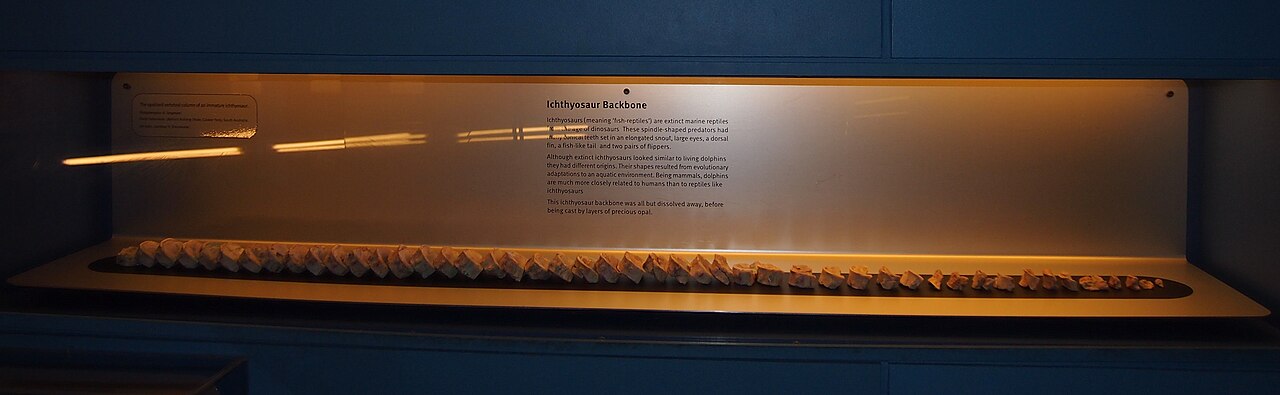
Opalised dinosaur bones are the site’s defining feature. The ornithopod Weewarrasaurus pobeni, described from an opalised jawbone, represents a new genus unique to Lightning Ridge. Fostoria dhimbangunmal is an opalised iguanodontian ornithopod known from multiple individuals found together in a single mining shaft — the first evidence of a herd or family group from the Australian Cretaceous. The megaraptorid theropod Australovenator wintonensis was first described from Winton but a specimen nicknamed Lightning Claw, a large-clawed megaraptorid theropod, was recovered from Lightning Ridge opal mining shafts, demonstrating that apex predators of this type ranged across the region. Ankylosaur elements have also been documented.
Opalised mammals include Steropodon galmani, described in 1985 from a lower jaw with three molar teeth — this was the first Mesozoic mammal ever documented from Australia. The jaw resembles that of the modern platypus, suggesting an early monotreme affinity. Additional monotreme material has since been recovered from the same beds.
Other opalised fauna includes three species of crocodilian, plesiosaur elements (marine reptiles that inhabited the Eromanga Sea), pterosaur fragments, bony fish, turtles, and a diverse invertebrate fauna including bivalves, gastropods, and trace fossils. Opalised plant material — including pinecones — is also present.
Some Lightning Ridge fossils are transparent, meaning the opal that replaced the original bone is itself gem-quality and transparent. These are, to date, the only known transparent fossils of large vertebrates anywhere in the world.
Geologic History
The Ancient Environment
The fossil-bearing sediments at Lightning Ridge were deposited approximately 95 to 105 million years ago during the mid-Cretaceous Period (Albian to Cenomanian stages). At that time, a vast shallow inland sea known as the Eromanga Sea covered much of central and eastern Australia. Lightning Ridge sat on or near the western shoreline of this sea, in a zone of shallow marine to marginal environments — river deltas, mudflats, swamps, and open water.
Dinosaurs, crocodilians, and small mammals inhabited the coastal and fluvial environments at the sea’s margin. When these animals died, some were buried in fine-grained sediment in low-oxygen conditions that discouraged bacterial decay. Over millions of years, silica-rich groundwater percolated through the sediment column and, under specific chemical conditions, silica gel filled pore spaces in bones before hardening into opal. The local groundwater chemistry at Lightning Ridge, enriched by the weathering of volcanic rocks in the region’s geological history, was particularly well suited to producing precious opal rather than common opal or silica replacement alone.
How Lightning Ridge Became a Fossil Collecting Site
Opal was first discovered at Lightning Ridge around 1902, and commercial mining began shortly after. Miners working vertical shafts and horizontal drives through the Cretaceous sediments encountered opalised bones alongside gem opal from the beginning, though for decades these were often discarded or traded informally. The scientific significance of the material became clear in 1985 when Steropodon galmani was described — the first Mesozoic mammal from Australia — from a jaw recovered by a miner. This discovery drew palaeontologists to Lightning Ridge in earnest. The Australian Opal Centre, opened in 2019 after years of community effort and fundraising, now provides a permanent institutional home for the opalised fossil collection and serves as a research centre in partnership with universities and museums.
Visiting Rules and Regulations
Is Fossil Collecting Allowed?
Fossicking for opal — and potentially opalised fossils — is permitted on publicly accessible Crown Land fossicking areas within and around Lightning Ridge. You do not need a permit to fossick on designated Crown Land fossicking areas in New South Wales, but you are limited to hand tools and small-scale operation under the NSW Mining Act 1992. Larger-scale fossicking or the use of machinery requires a Fossicking Licence from the NSW Department of Regional NSW.
It is important to understand that opalised fossils discovered during fossicking are subject to both mining law and the NSW Heritage Act 1977. Scientifically significant fossils — particularly those that could represent new species or important specimens — should be reported to the Australian Opal Centre or the Australian Museum. Removing a scientifically significant fossil without reporting it may constitute an offence. The Australian Opal Centre can provide current guidance on the legal framework for opalised fossil finds.
Private mining leases cover the majority of productive opal fields. Do not enter leased land without the explicit permission of the lease holder.
Recommended Equipment
For fossicking on public Crown Land areas, bring a geological hammer, chisels, safety goggles, and work gloves. The sediment at Lightning Ridge is often soft and crumbly, making hand tools effective for surface scraping and shallow excavation. A small brush is useful for clearing loose material around potential specimens. Sun protection is essential — Lightning Ridge is in outback New South Wales and temperatures regularly exceed 40°C in summer. Carry adequate water; facilities on the opal fields themselves are limited. The Australian Opal Centre’s supervised dig experience provides all necessary tools and guidance for visitors who prefer a structured introduction.
Safety
The opal fields contain numerous open mine shafts, many of which are unmarked. Walk carefully on the fields and do not approach shaft openings. Keep children and pets close at all times. Do not enter any shaft without proper equipment, a trained partner, and knowledge of underground mining safety procedures. The NSW Mine Safety Regulation requires that shafts be capped when not in use, but compliance is variable in abandoned workings. Summer temperatures in Lightning Ridge can be extreme. Plan outdoor fossicking activities for early morning and carry significantly more water than you think you need.
Sources
- https://australianopalcentre.com.au/
- https://australianmuseum.net.au/learn/australia-over-time/fossil-sites/lightning-ridge/
- https://www.lightningridge.nsw.gov.au/visit/
- https://www.environment.nsw.gov.au/topics/parks-reserves-and-protected-areas/park-management/fossicking
- https://en.wikipedia.org/wiki/Lightning_Ridge,_New_South_Wales
- https://doi.org/10.1038/s41598-019-39909-5