

The Pilbara Stromatolites are among Earth’s oldest fossils, dating back almost 3.5 billion years to the Archean Eon. Pilbara stromatolites are dated primarily through radiometric dating of the surrounding rocks (such as uranium-lead and isotope studies) to give ages around 3.43–3.48 billion years, consistent with Paleoarchean chronologies.
These ancient microbial structures represent some of the earliest evidence of life on our planet and provide crucial insights into the origin and evolution of life. The stromatolites are dome-shaped layered structures built by communities of cyanobacteria (blue-green algae) that were among the first organisms to perform photosynthesis, gradually transforming Earth’s atmosphere by producing oxygen.

The Pilbara region contains multiple stromatolite sites within iron-rich rock formations that formed before oxygen was abundant in the atmosphere. These stromatolites are unburied, undisturbed, and represent the best-preserved ancient crustal rocks on Earth. The structures are significant not only for understanding early Earth history but also as analogues for potential fossils that might be found on Mars.
The landscape is hauntingly beautiful but remote, extreme, and sometimes dangerous. The region is sparsely populated with vast red pindan soils and endless panoramas. Visiting requires careful preparation for harsh desert conditions.
Geological Setting and Ancient Climate:
The stromatolites are preserved in the Pilbara Craton, some of Earth’s oldest exposed rocks. They occur in iron-rich chert and sedimentary formations deposited in ancient shallow seas over 3 billion years ago.
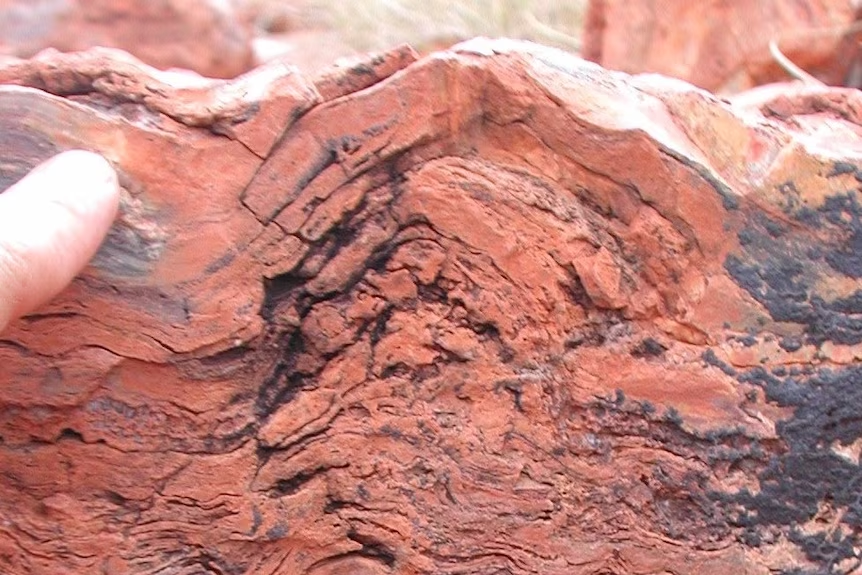
The Archean climate was dramatically different from today, with no oxygen in the atmosphere, intense volcanic activity, and bombardment by meteorites. The stromatolite-building cyanobacteria were crucial in beginning the process of oxygenating the atmosphere.
Discovery and Research History:
Pilbara stromatolites were first recognized as ancient life forms in the 1960s and have been extensively studied since. They remain subjects of ongoing research into the earliest life on Earth and astrobiology. Researchers A. C. Allwood, Malcolm R. Walter, Ian W. Burch, and Balz S. Kamber have published detailed studies of 3.43 billion-year-old stromatolite reefs in the Strelley Pool Chert. NASA and ESA teams have studied Pilbara stromatolites as analogues for astrobiological research relevant to Mars missions.
Visiting Information:
Getting There: Pilbara stromatolite sites are located in remote areas of the Pilbara region in northwestern Western Australia. Access typically requires 4WD vehicles and desert driving experience. There are also other stromatolites are accessible at Shark Bay. Unlike the living marine stromatolites at Shark Bay’s Hamelin Pool Marine Nature Reserve (which grow today in hypersaline waters and can be viewed via boardwalks), Pilbara stromatolites are ancient fossils preserved in rock and not living. Shark Bay’s stromatolites are younger and biologically active, while Pilbara’s are billions of years old and studied for deep-time biosignatures.
Hamelin Pool (which has many stromatolites) can be accessed from the Shark Bay Road 27km from the North West Coastal Highway. The road is sealed apart from a short unsealed two-wheel drive section to the carpark. It is an easy 750 m return walk between the carpark and stromatolites.
In addition to Hamelin Pool, which you visit by yourself, you can also snorkel to other stromatolites nearby: Shark Bay Eco Tours.

The Pilbara region’s climate is hot and arid year-round, with extremely high summer temperatures and a more moderate winter season (May–September) often recommended for field visits due to cooler weather and lower risk from heat exposure. There are monsoonal rains in summer, which can make remote access difficult and occasionally dangerous.
For Pilbara, there are no major visitor facilities directly at ancient stromatolite sites because they are remote and scientifically sensitive. Travelers typically base themselves in towns like Marble Bar or Port Hedland, and may use 4WD tour operators familiar with remote outback access. Camping and outback accommodation are available in these regional centers, but organized guided tours are specialized rather than mainstream.
What You’ll Find and Paleontology of the Area:
Ancient stromatolite formations in a dramatic, otherworldly landscape. Visiting protected reserves requires permission from authorities. The region features stunning geological formations, gorges, and unique ecosystems.
What are Stromatolites?
Microbial mats are complex ecosystems where different species of bacteria and other microbes work together in communities that depend upon each other. In specific conditions, the communities trap particles and create stone. When this happens, microbial mats become microbialites. Sometimes microbialites form taller, layered structures called stromatolites.
The shape and texture of microbial mats is affected by exposure, and the depth / movement of water. Between high and low tide tides, structures need to cope with being under water for hours and then exposed to the air for hours. Water movement also shapes the structures.
Microbial mats have been around for over 75% of the Earth’s history. Over the last 2 billion years, cyanobacteria in microbial mats influenced evolution by breathing oxygen into the atmosphere. During the mass extinction of dinosaurs, microbial mats were among the last to be affected and the first to move into niches left empty by other species.
Fossil Collecting Rules and Regulations:

Absolutely no collecting permitted. The stromatolites are protected for their scientific significance. Visitors may observe and photograph with appropriate permissions.
Sources:
https://www.expedia.com.au/The-Pilbara.dx6052252
New to fossil hunting? Start here! Beginner's Guide to Fossil Hunting!
Have questions? Check out our Frequently Asked Questions.