identification
How to Identify Fossils You Find
By Edward Chen · Updated 31 July 2026
Fossil identification starts with form, continues with geology, and resolves with comparison. The single most useful piece of information you can apply before picking up a fossil is knowing what formations are exposed at the site you're visiting, because a site's geology tells you what's possible. A Cambrian limestone doesn't produce ammonites. A Jurassic shale doesn't produce trilobites. Knowing the age and rock type of your site eliminates most wrong guesses before you start.
From there, identification follows a simple sequence that works for most common fossil types.
Step 1: what type of organism does it look like?
Start with the broadest classification. Is it:
Coiled or spiralled? Likely an ammonite (flat-coiled, with visible suture lines on the outer surface) or a gastropod (helical coil like a snail shell, no suture lines on the outer surface). Ammonites are extinct. Gastropods still exist in modern form, comparing your find to a modern snail is a useful first filter.
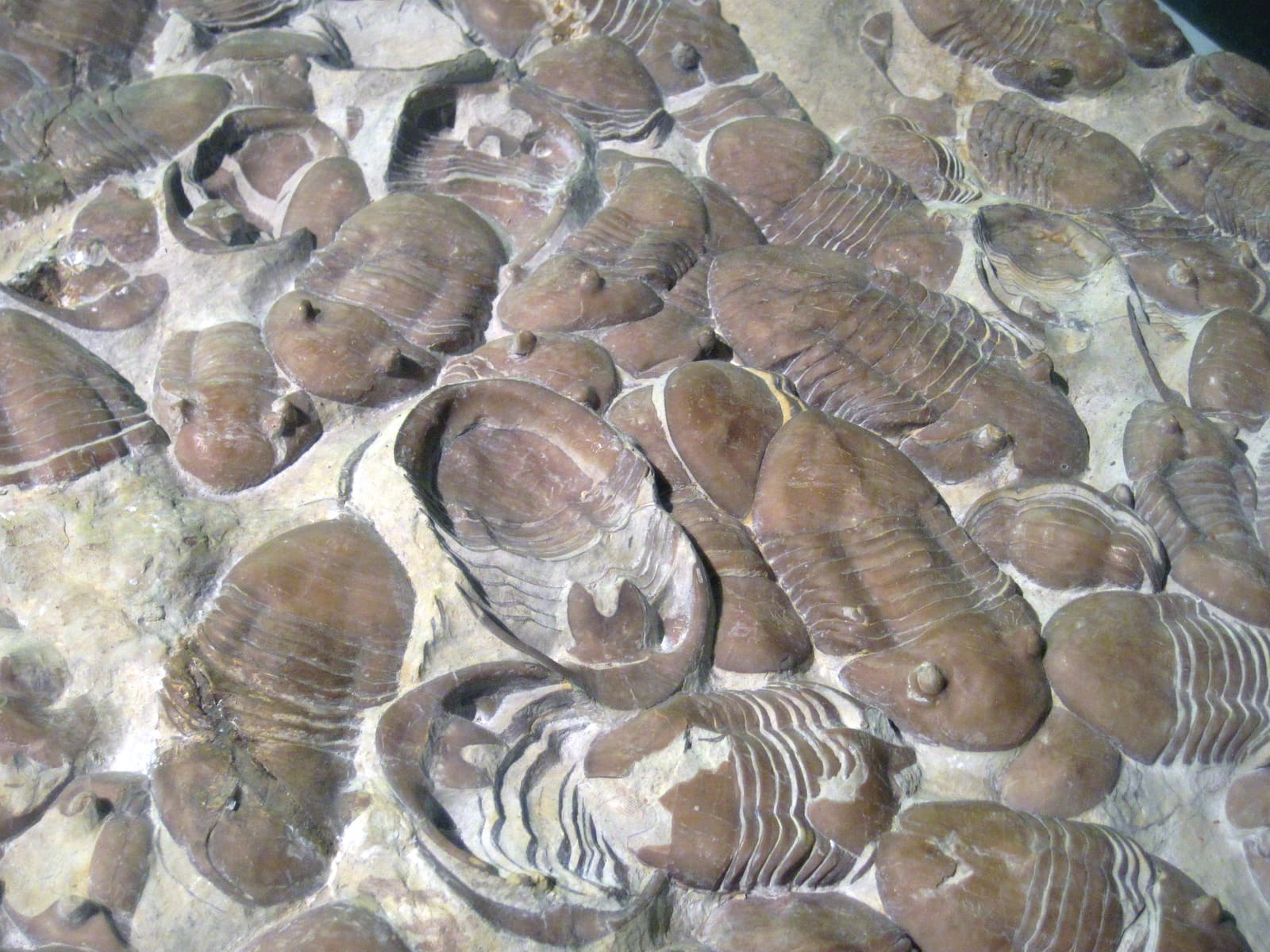
Segmented? Could be a trilobite (three-lobed structure visible from above, with a distinct head, thorax, and tail), a crinoid stem (circular or pentagonal cross-section, stacked disc-like ossicles), or occasionally a crustacean.
Blade-shaped and cylindrical? Belemnites, the internal guard of a squid-like animal common in Jurassic and Cretaceous marine sediments, are usually cigar-shaped, sharp at one end, and grey to brown in colour. They're one of the most commonly found fossils on UK beaches.
Flat and striated? Possibly a brachiopod (two valves with radial or concentric markings), a bivalve (two matching curved shells), or a piece of fossil wood (with visible grain structure).
Irregular, porous, or sponge-like? Could be a coral (often with hexagonal cell structure visible on the surface), a sponge, or a bryozoan (lace-like structure with regular small pores).
Smooth, dense, and heavy? If significantly denser than surrounding rock and creamy-brown in colour, possibly bone material.
A 10× hand lens makes the surface detail that separates these groups visible in the field.
Step 2: cross-reference with the site geology
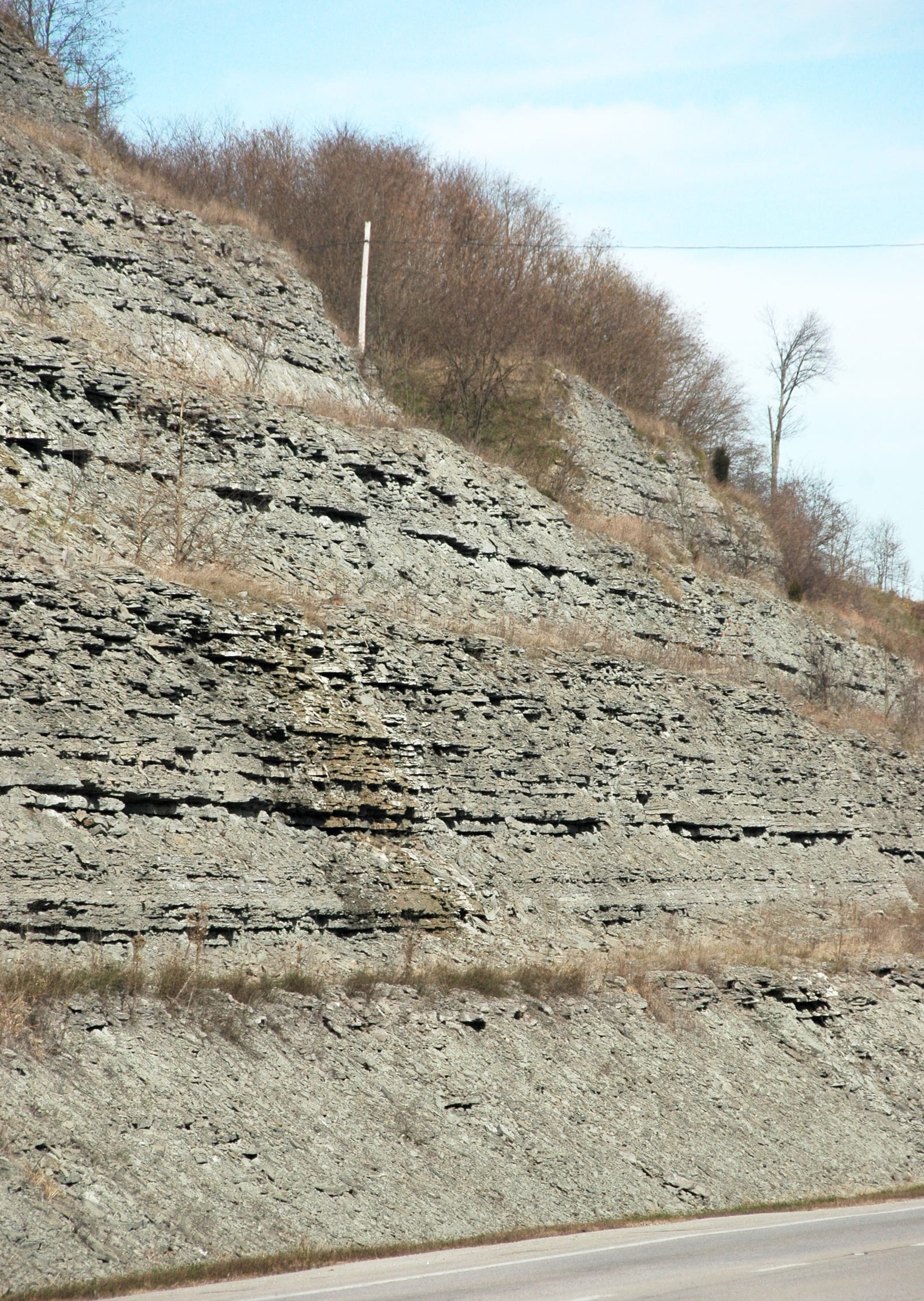
Once you have a candidate group, cross-reference with what's documented at the site. If you're at Charmouth on the Jurassic Coast, the geology is Blue Lias and the Shales-with-Beef, the common fossil groups are ammonites (Psiloceras, Arnioceras), belemnites, bivalves, and occasional ichthyosaur vertebrae. A coiled fossil from Charmouth is almost certainly an ammonite. A coiled fossil from the same shape found on a Cambrian limestone site would be a gastropod, because Jurassic ammonites don't occur in Cambrian rock.
This logic applies to every site. The GFH site guides list the fossil types documented at each location, which gives you the shortlist of what you're likely to be looking at before you start.
Step 3: field guides and reference photographs
For common species, a good field guide resolves most identifications. Collins Gem Fossils (Fowler, revised edition) covers the most common European species with photographs and basic descriptions. State-specific guides exist for US material: Fossils of Ohio (Hoare, Steller, Fossils of Ohio) covers Caesar Creek and adjacent Ordovician sites, Fossil Shark Teeth of the World (Renz) covers shark tooth identification by species.
The key to using field guides effectively is to identify at the level you can actually support with the specimen in hand. An ammonite from Charmouth may be identifiable to genus (Arnioceras, Promicroceras) based on the rib pattern. Identifying it to species requires knowing the exact whorl proportions and suture detail. Stop at the level where your evidence runs out rather than guessing the most specific name.
Step 4: the online community
The Fossil Forum (thefossilforum.com) is the most reliable online identification resource. Post a clear photograph showing the top, underside, and side of the specimen, with the site location and formation information. Experienced collectors, including professional paleontologists who participate in the forum, will typically provide an identification within hours.
Photograph requirements that improve identification speed: a coin or ruler in frame for scale, clean specimen without dirt obscuring surface detail, multiple angles, taken in natural light rather than flash (which washes out surface texture).
iNaturalist has a palaeontology component, though it is less comprehensive than The Fossil Forum for invertebrates. For shark teeth specifically, FossilEra's identification resources and their searchable database by species are useful supplements.
Step 5: museum services
For specimens that remain uncertain, particularly potential vertebrate material, unusual species, or anything with scientific interest, natural history museums provide identification services. In the UK, the Natural History Museum in London offers an online enquiry service. Whitby Museum, Dinosaur Isle on the Isle of Wight, and Dorset County Museum will examine specimens brought in by visitors and provide identifications. In the US, the Smithsonian's Department of Paleobiology and state natural history museums (Cleveland Museum of Natural History, Florida Museum of Natural History) accept identification requests.
Museum identification is most useful for specimens from formations the museum actively studies, Whitby Museum is the obvious resource for Yorkshire Jurassic material. The Carnegie Museum of Natural History in Pittsburgh is useful for Appalachian and Midwest material.
The most commonly misidentified objects
Several natural objects are regularly mistaken for fossils:
- Concretions: Rounded grey-brown balls or ovals that form around a nucleus in sediment. Dense, heavy, no biological structure when broken open (though concretions sometimes do contain fossils, examine the broken surface carefully).
- Flint nodules: Black, waxy-surfaced rock common in chalk and limestone. No biological structure.
- Iron staining: Orange-brown patches on rock that can look like bone or shell on a quick look. No biological structure visible with a lens.
- Worm tubes (Serpula, Ditrupa): Tubular calcareous structures attached to rock that resemble some fossils but are normally smooth and unbranched.
Where to go next
For site-specific guidance on what you're likely to find and how to recognise it, the GFH guides include fossil type descriptions for each site. The Yorkshire Coast guide covers ammonite and belemnite identification specific to Yorkshire Jurassic sites. The Ohio guide covers Ordovician trilobite and brachiopod recognition at Caesar Creek and adjacent sites.
Frequently asked questions
- How do I tell if something is a fossil or just a rock?
- Use a 10× hand lens to look for biological structure: ammonite suture lines, bone pore texture, the radial or concentric pattern of brachiopod shells, or cellular grain in fossil wood. The most common lookalikes are concretions (rounded dense balls with no internal structure), flint nodules (waxy black surface), and iron-stained rock (orange-brown patches with no biological patterning). If no biological structure is visible under magnification, it is probably not a fossil.
- How do I identify an ammonite?
- Ammonites have a flat, planispiral coil and distinctive suture lines — the zigzag or fluted lines where the internal dividing walls (septa) met the outer shell — visible on the surface. Gastropods also coil, but helically like a modern snail, and show no suture lines on the outer surface. A 10× hand lens makes suture lines visible even on worn specimens.
- Where can I get help identifying a fossil I found?
- The Fossil Forum (thefossilforum.com) is the most reliable free identification resource. Post a photo showing the top, underside, and side of the specimen alongside the site location and rock formation; experienced collectors and professional palaeontologists typically respond within hours. In the UK, the Natural History Museum London offers an online enquiry service. Whitby Museum, Dorset County Museum, and Dinosaur Isle on the Isle of Wight will examine specimens brought in by visitors.