Country
Fossil hunting in South Korea
South Korea has more Cretaceous dinosaur footprints than almost anywhere. Goseong county carries about 5,000 individual tracks, and more than 1,900 of them lie in the Deokmyeong-ri Natural Monument alone. The geopark on the west coast holds the type specimen of a whole family of dinosaur eggs.
Sangjogam County Park at Goseong puts the museum and the trackways in the same place. The Goseong Dinosaur Museum opened on 9 November 2004 beside the footprint site, and the tracks lie on the beach below it. Opening runs 09:00 to 18:00 from March to October and 09:00 to 17:00 from November to February.
The tracks sit in the Cenomanian Jindong Formation. Research continues on them, including a recent report of a probable ankylosaur trackway, so the scientific account is still moving.
Jeonbuk West Coast UNESCO Global Geopark covers the other side of the country and exposes 2.5 billion years of history. Its dinosaur egg site on Wido island holds the holotype of the faveoloolithid oospecies Propagoolithus widoensis and shows colonial nesting across repeated horizons.
2 fossil sites
Updated 18 September 2026
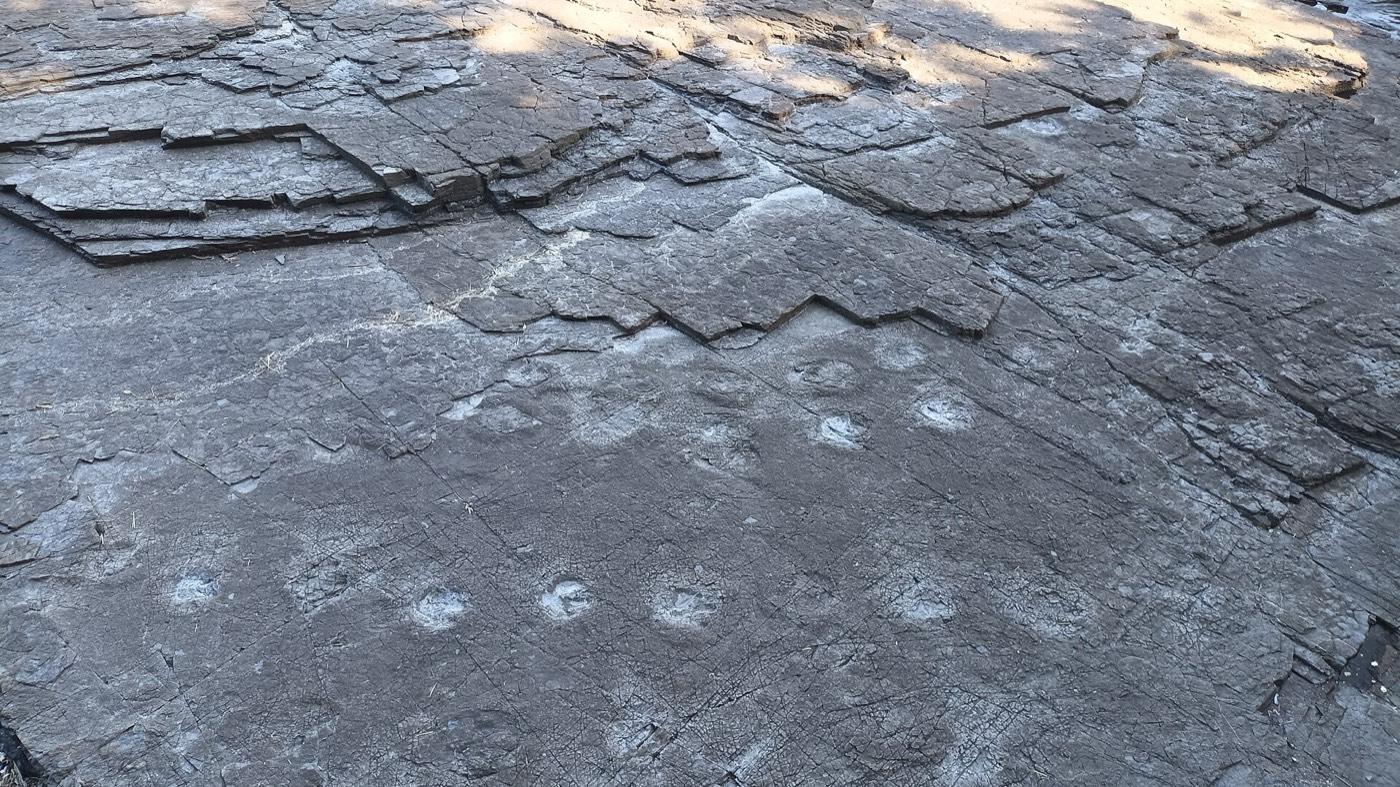
Sangjogam County Park Dinosaur Trackway Fossil Hunting Guide
South Gyeongsang, South Korea
Trace fossils, Dinosaur tracks, Bird tracks
Wido Dinosaur Egg Site Fossil Hunting Guide
North Jeolla, South Korea
Dinosaur eggs, Dinosaur nests
Frequently asked questions
- Where can you see dinosaur footprints in South Korea?
- At Sangjogam County Park in Goseong county, on the shore below the Goseong Dinosaur Museum. The Deokmyeong-ri Natural Monument there holds more than 1,900 tracks in the Cenomanian Jindong Formation.
- Does the Jeonbuk West Coast geopark charge admission?
- This page could not confirm the current charges. The geopark publishes its geosites as open ground, but ask the geopark before you plan around free entry or a free guide.