Chinchilla Fossil Museum Queensland Fossil Hunting Guide
Chinchilla Fossil Museum in QLD holds Australia's largest Pliocene collection, including fossils that proved the Komodo dragon evolved in Australia.
By Edward Chen · Updated 30 July 2026
Introduction
The Darling Downs town of Chinchilla, about 300 kilometres west of Brisbane, sits above one of the most scientifically consequential fossil deposits in Australia. The Chinchilla Sand preserves the largest, richest, and best-documented collection of Pliocene vertebrate fossils on the continent, spanning at least 63 species across 31 families. Among those species is Varanus komodoensis, the Komodo dragon. Fossils of this animal from the Chinchilla deposits, dated to approximately 3.8 to 4 million years ago, provided the first physical evidence that the world's largest living lizard originated in Australia before dispersing to Indonesia. That finding changed what biologists and palaeontologists understood about the species' evolutionary history.
Today, the Chinchilla Fossil Museum on Heeney Street preserves and interprets this deposit for the public. The museum holds the largest single Pliocene fossil collection in Australia and runs programmes that give visitors direct contact with specimens. This guide covers the museum's exhibits and programmes, the geology of the Chinchilla Sand, the specific animals you can expect to see, the regulations that govern fossil access in Queensland, and practical information for planning your visit.
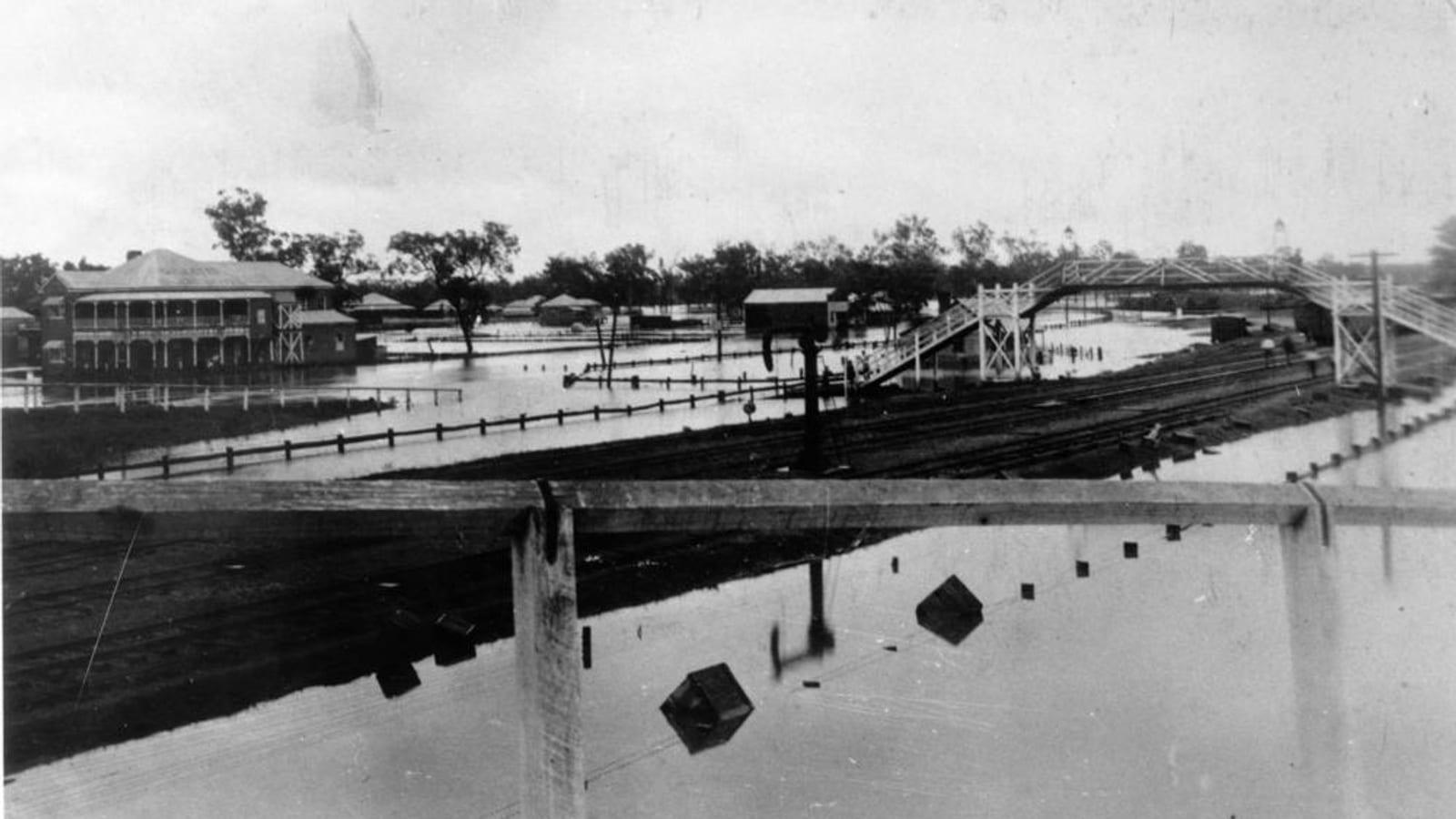
 Photo: Contributor(s): Queensland Newspapers Pty Ltd, Public domain, via Wikimedia Commons

Location and Directions
Address
Chinchilla Fossil Museum, 6 Heeney Street, Chinchilla QLD 4413.
Getting There
Chinchilla is located on the Warrego Highway (A2), the main road connecting Brisbane with Roma and Charleville. From Brisbane, drive west on the Warrego Highway through Toowoomba and Dalby. Chinchilla is approximately 300 kilometres from Brisbane and 50 kilometres west of Dalby. The drive takes roughly three to three-and-a-half hours from Brisbane under normal traffic conditions. From Roma, drive east on the Warrego Highway for approximately 165 kilometres. The Chinchilla Fossil Museum is in the town centre on Heeney Street, which turns off the main highway. The museum is clearly signposted from the Warrego Highway as you approach town. Parking is available on Heeney Street and in adjacent streets at no cost. The road is sealed and suitable for all vehicles year-round. Large vehicles including caravans and motor homes can navigate the town streets without difficulty.
What Fossils You'll Find
Varanus komodoensis (the Komodo dragon) is the discovery that gives Chinchilla its place in international palaeontology. The fossils recovered from the Chinchilla Sand deposits are the oldest known specimens of this species anywhere in the world, dating to approximately 3.8 to 4 million years ago. Their presence in Queensland demonstrates that the lineage leading to the modern Komodo dragon evolved in Australia from ancestors related to other large Australian monitor lizards, before the species expanded its range northward through the Indonesian archipelago. Genetic studies conducted after the fossil discovery confirmed this Australian origin hypothesis.
 Photo: Ghedoghedo, CC BY-SA 3.0, via Wikimedia Commons

Euryzygoma dunense is one of the most visually striking mammals in the collection. This diprotodontid marsupial had cheekbones so broad that its skull is wider than it is long, a proportion unusual among all mammals. Euryzygoma was a large browsing herbivore, roughly the size of a cow, and is thought to be ancestral to or closely related to the giant Diprotodon optatum of the Pleistocene. The well-preserved skull recovered from the Chinchilla deposits allows detailed study of cranial morphology that has informed reconstructions of the whole animal.
Quinkana was a terrestrial crocodile, very different from the aquatic freshwater crocodiles living in Queensland today. Built for life on land, Quinkana had legs positioned beneath the body and ziphodont teeth, serrated and blade-like, suited to slicing through the flesh of large mammals rather than gripping fish. It was a significant predator of the Pliocene landscape, capable of taking kangaroos and other medium to large marsupials.
Thylacoleo carnifex, the marsupial lion, is represented in the Chinchilla fauna. This is among the oldest records of the species, which became the apex mammalian predator of Australia during the Pleistocene. Thylacoleo had massive carnassial teeth formed from enlarged incisors and premolars rather than the molars used by placental carnivores, giving it a unique and powerful bite mechanism.
Bohra wilkinsonorum, a giant tree kangaroo, is another unusual element of the Chinchilla fauna. Modern tree kangaroos are restricted to rainforest environments in Queensland and New Guinea, but the presence of Bohra in the Chinchilla deposits shows that large arboreal kangaroos were part of the woodland and forest ecosystem of Pliocene Queensland.
Simosthenurus antiquus, one of the short-faced kangaroos, had a more robust skull and reduced muzzle compared with modern kangaroos. These animals were likely browsers of shrubs and trees rather than grazers of grass. Various species of Simosthenurus are found across Australian Pliocene and Pleistocene deposits.
Protemnodon, an extinct giant wallaby, is also present in the collection. Isotopic analysis of Protemnodon teeth from Australian Pliocene sites has shown that these animals consumed a mixture of C3 plants from forests and woodlands and C4 plants such as grasses, reflecting the mixed vegetation landscape of Early Pliocene Queensland.
Additional reptiles in the collection include giant pythons, chelid turtles in both long-necked and short-necked forms that lived in shallow lagoons and watercourses, and trionychid soft-shelled turtles. Fish including the Queensland lungfish (Neoceratodus forsteri) and plotosid catfish are also represented, confirming the presence of permanent or semi-permanent water bodies in the depositional environment.
Geologic History
The Ancient Environment
The fossils at Chinchilla are preserved in the Chinchilla Sand, a sequence of fluviatile deposits consisting of interbedded clay, sand, and conglomerate laid down in ancient river channels and floodplains. The deposits are Early to Mid Pliocene in age, dated to approximately 3.5 to 4.5 million years ago. This places them within the Zanclean and Piacenzian stages of the Neogene, a period when Australia's climate was significantly warmer and wetter than it is today, with much higher rainfall supporting eucalypt forests across what is now semi-arid southern Queensland.
Isotopic analyses of fossil teeth and carbonates from the Chinchilla Sand indicate that vegetation was mix of closed canopy forest and open woodland, with permanent to semi-permanent rivers and lagoons supplying water year-round. The presence of lungfish, turtles, and aquatic birds confirms the persistent nature of those water bodies. As the Pliocene progressed, the climate became progressively drier and cooler, shifting the landscape toward the more open vegetation communities that dominate the Darling Downs region today.
The Chinchilla Sand overlies older Tertiary sediments and is in turn overlain by Quaternary alluvial deposits. The fossils occur primarily in clay-rich units within the sand sequence, where rapid burial in waterlogged conditions allowed skeletal articulation to be maintained in some specimens and soft tissue outlines to be preserved in others.
How Chinchilla Became a Fossil Site
The Chinchilla fossil deposits have been known to collectors since the mid-1840s, making this one of the longest-running fossil localities in Australia by European collecting history. Material gathered over more than 150 years from properties throughout the Chinchilla district is now curated at the Queensland Museum in Brisbane, forming the largest single Pliocene collection in Australia. The deposit's scientific significance grew substantially when Komodo dragon fossils were identified in the collection, prompting a reappraisal of what were assumed to be animals native only to Indonesia. The Chinchilla Fossil Museum was established to bring the story of this deposit to the public and to maintain a regional centre for palaeontological education and outreach. The museum holds its own collection of locally recovered specimens and provides the primary public access point for engaging with the Chinchilla Sand fauna.
Visiting Rules and Regulations
Is Fossil Collecting Allowed?
The Chinchilla Sand deposits lie on private agricultural land in the Chinchilla district, and the fossil localities themselves are not open to independent public collecting. Under the Queensland Heritage Act 1992 and the Nature Conservation Act 1992, fossils in the ground are the property of the Crown. Removing them without a permit issued by the Queensland Department of Environment and Science is an offence. Access to the field localities also requires written permission from the relevant landowners.
The Chinchilla Fossil Museum is the appropriate public access point for engaging with these fossils. The museum runs hands-on programmes and educational experiences that give visitors genuine contact with Pliocene specimens in a supervised setting. Contact the museum before your visit to ask about current programme offerings, session times, and any additional fees for hands-on activities. Museum admission fees apply for entry to the displays.
If your interest in Queensland Pliocene fossils extends beyond what the museum offers, the Queensland Museum in Brisbane holds the primary research collection and welcomes enquiries from researchers and serious collectors.
Recommended Equipment
No specialist equipment is required for a museum visit. Wear comfortable walking shoes. During the warmer months between October and March, bring a hat and sunscreen for time spent outdoors around the museum grounds. Chinchilla can experience hot summers with temperatures above 35 degrees Celsius. Drink water regularly throughout the day. If you intend to explore Chinchilla National Park or the surrounding district, carry adequate water, a first aid kit, and a charged mobile phone. Fuel is readily available in Chinchilla.
Safety
Chinchilla is a small regional town with standard visitor services. The main safety considerations are weather-related. Summer heat on the Darling Downs can be intense. Flash flooding is possible during summer storm events, and the Warrego Highway can be affected by water over the road during significant rainfall. Check road conditions on 13 19 40 or the Queensland Traffic website before travelling in wet weather. Chinchilla National Park and surrounding bushland are home to eastern brown snakes and other venomous reptiles. Wear closed shoes and watch where you step if walking in scrub or grassland outside the town.
Sources
- https://www.museum.qld.gov.au/collections-and-research/explore/megafauna/
- https://www.museum.qld.gov.au/collections-and-research/
- https://www.app.pan.pl/article/item/app000422013.html
- https://en.wikipedia.org/wiki/Euryzygoma
- https://en.wikipedia.org/wiki/Quinkana
- https://en.wikipedia.org/wiki/Varanus\_komodoensis
- https://doi.org/10.1371/journal.pone.0044996
- https://en.wikipedia.org/wiki/Thylacoleo
- https://en.wikipedia.org/wiki/Bohra\_(mammal)
Nearby sites
 Lightning Ridge Opalised Dinosaur Fossils Fossil Hunting GuideOpalised dinosaur bones, Opalised mammals
 Mount Etna Caves National Park Fossil Hunting GuidePleistocene fossil assemblage, Invictokoala monticola
 Talbragar Fossil Site Jurassic Fish Gulgong Fossil Hunting GuideFish, Plants
 Wellington Caves Fossil Hunting GuideDiprotodon, Thylacoleo carnifex