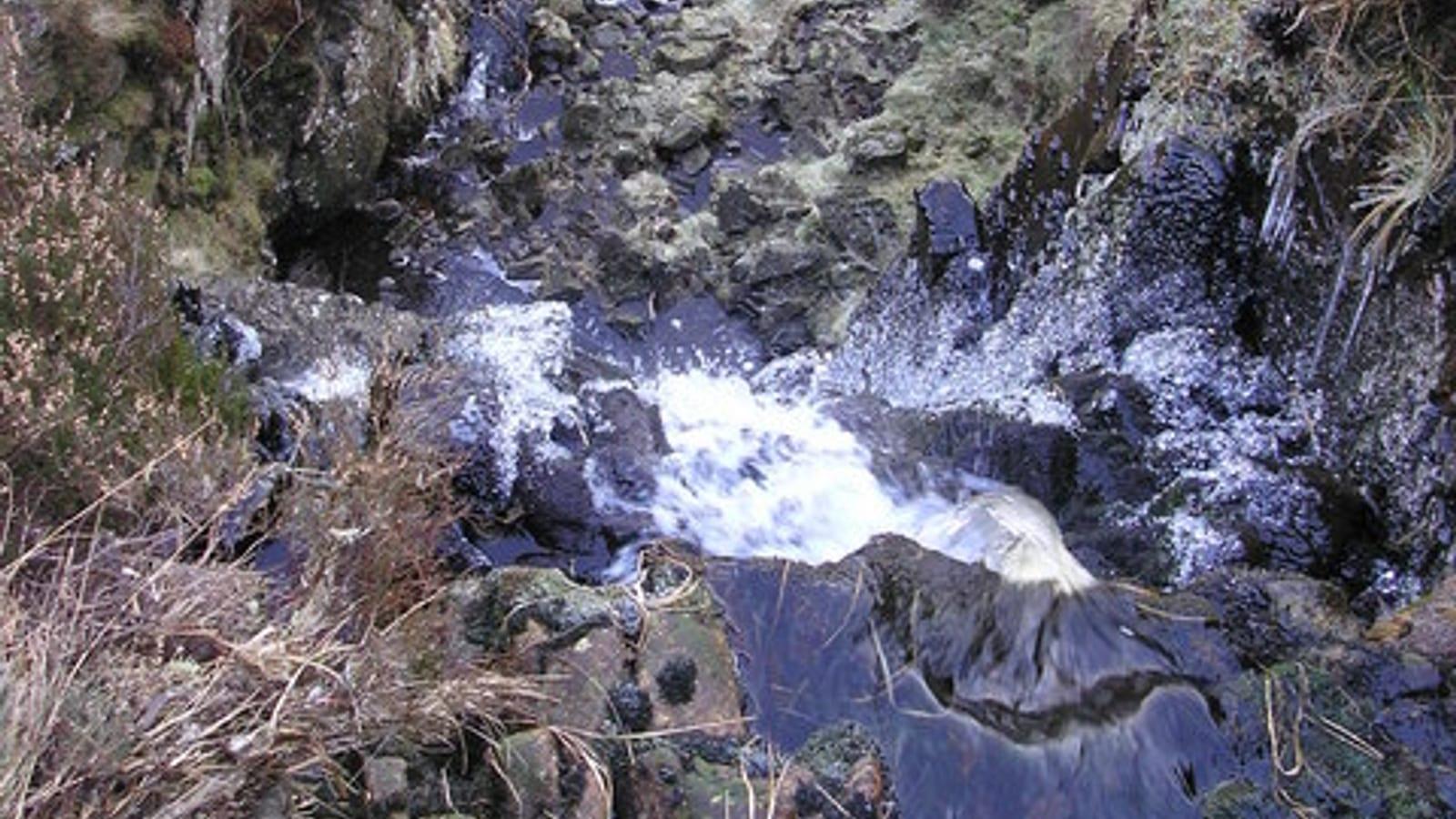
Dobs Linn Scottish Borders Fossil Hunting Guide
Image: Iain Lees (CC BY-SA 2.0)
Dobs Linn in the Scottish Borders contains the internationally ratified GSSP for the base of the Silurian, with abundant graptolites in black Ordovician shales.
By Edward Chen · Updated 30 July 2026
Introduction
Dobs Linn is one of the most scientifically significant fossil sites in the United Kingdom, and it is not well known among recreational collectors. The small stream valley in the Moffat Water hills of the Scottish Borders contains the Global Boundary Stratotype Section and Point (GSSP) for the base of the Silurian System: the internationally agreed reference point, or Golden Spike, that defines where the Ordovician period ends and the Silurian begins. The black graptolitic shales exposed here preserve the world's most extensively studied sequence of late Ordovician to early Silurian graptolites, spanning over 28 million years of deep ocean deposition.
The site is a SSSI. Careful surface collecting of loose shale is permitted, but the bedrock must not be damaged. Graptolites at Dobs Linn are genuinely abundant once you learn to recognise them, and the scientific context makes a visit here compelling even for collectors more accustomed to ammonites or dinosaur bones. This guide covers how to find the site, which graptolites occur in which beds, the geological history, and the current collecting rules.
 Photo: Iain Lees, CC BY-SA 2.0, via Wikimedia Commons
Location and Directions
Address
Dobs Linn, Moffat Water Valley, near Moffat, Dumfries and Galloway, Scotland. OS Grid Reference: NT 153 145. Approximate postcode: DG10 9LF.
Directions and Parking
From Moffat town centre, take the A708 northeast towards Selkirk, following the Moffat Water valley road. Drive approximately 13 miles northeast along the valley. Dobs Linn is a small stream valley on the north side of the road. Look for a small lay-by near an interpretation board on the roadside. Parking is very limited and the lay-by holds only a handful of vehicles. From the road, walk up the Dobs Linn stream from its confluence with the Moffat Water. The key exposures are in the gorge and stream sections, with the GSSP located 1.6 metres above the base of the Birkhill Shale in the stream section. The site can be difficult to locate without GPS coordinates or the OS grid reference NT 153 145. The track up the stream is unmarked and the terrain is rough moorland. Wear waterproof boots and carry a map or GPS device.
What Fossils You'll Find
Graptolites are the only fossils commonly found at Dobs Linn, and the site is for them. They appear as silvery or dark saw-tooth or twig-like impressions on the black shale surfaces. Splitting the shale along bedding planes exposes the fossils on flat surfaces, and in the better horizons they are genuinely abundant. The boundary beds at 1.6 metres above the base of the Birkhill Shale are particularly significant scientifically because they contain the zone fossil species Parakidograptus acuminatus and Akidograptus ascensus, the graptolites whose first appearance defines the base of the Silurian internationally.
Through the full sequence of the Birkhill Shale and underlying Moffat Shale Group, 135 metabentonite horizons (thin pale layers of altered volcanic ash) are interbedded with the black shales. These ash layers are useful markers for identifying your position in the sequence. Charles Lapworth used this exact exposure in the late 1870s to demonstrate the value of graptolites in biostratigraphy, establishing the zonation scheme that made graptolites one of the most important fossil groups for correlating Ordovician and Silurian rocks worldwide. Other graptolite genera found through the sequence include Nemagraptus gracilis, Climacograptus bicornis, and Dicellograptus sextans. Conodonts and chitinozoans also occur but are microscopic.
Bring paper for wrapping specimens, as Lapworth himself recommended. Shale impressions can be fragile and the contrast can fade on drying if the surface oxidises.
Geologic History
The Ancient Environment
The shales at Dobs Linn were deposited in deep water within the Iapetus Ocean, the ancient ocean that once separated what is now Scotland from England. The Iapetus Ocean was closing during the Ordovician and Silurian periods, with subduction consuming its floor and the continents converging toward the collision that would eventually produce the Caledonian mountain belt. The Birkhill Shale and Moffat Shale Group sediments accumulated at the ocean floor, probably several kilometres deep, in conditions of very low oxygen. This restricted bottom circulation prevented the decay of organic material settling from the surface, including the graptolites that floated in enormous planktonic colonies in the shallower waters above.
The sequence spans the Ordovician-Silurian boundary, dated to approximately 443 million years ago, and records one of the five major mass extinction events in Earth's history: the end-Ordovician extinction. The extinction is linked to a short but severe glaciation of the southern continent Gondwana, which cooled global temperatures and caused a fall then rise in sea levels. The graptolite fauna visible in the lower beds at Dobs Linn is dramatically more diverse than that in the immediate post-extinction beds, recording the extinction event precisely in the rock. A positive carbon isotope excursion in the uppermost Ordovician rocks here has been used to correlate the site with sections on every inhabited continent.
How Dobs Linn Became a Fossil Collecting Site
The Birkhill Shale outcrops naturally in the gorge of the Dobs Linn stream, where water erosion has cut down through the overlying greywacke formations and exposed the black graptolitic sequence. The stream continues to erode the gorge, regularly exposing fresh faces and loosening shale slabs. Charles Lapworth visited the site repeatedly from 1872 onwards and published his landmark description in 1878, transforming graptolite studies and establishing Dobs Linn as the essential reference section for the Ordovician-Silurian boundary. The GSSP was formally ratified by the International Union of Geological Sciences in 1984, placing a physical marker at the exact 1.6-metre level in the stream section.
Collecting Rules and Regulations
Is Fossil Collecting Allowed?
Dobs Linn is a SSSI. The SSSI designation means that operations likely to damage the special interest of the site require consent from NatureScot. Careful surface collecting of loose shale material that is already detached from the bedrock is generally considered acceptable under responsible access practices. You must not hammer or otherwise disturb the in-situ bedrock faces, particularly around the GSSP marker level. The site has international scientific significance and its integrity must be preserved. If in doubt, contact NatureScot's southwest Scotland office before visiting.
Recommended Tools
A geological hammer and thin chisels for splitting shale along bedding planes are the primary tools. Newspaper or tissue paper for wrapping specimens is essential, as Lapworth noted that the contrast of impressions can be lost on drying. A hand lens helps in identifying individual graptolite species. A camera is very useful for recording specimens in context before they are collected.
Safety
The walk up the Dobs Linn stream crosses rough, uneven moorland terrain. The stream banks can be slippery and the water levels rise quickly after rain. Wear waterproof boots and carry appropriate clothing for Scottish upland conditions, which can change rapidly. The site is remote. Carry a map, compass or GPS, and a charged mobile phone, though signal may be limited in the valley. Do not visit alone.