Hamar Laghdad Orthoceras Quarry Erfoud Fossil Hunting Guide
Image: Diego Delso (CC BY-SA 4.0)
Visit Hamar Laghdad Orthoceras Quarry near Erfoud, Morocco, to collect Devonian orthocerids, goniatites, and brachiopods from 390-million-year-old black limestone beds.
By Edward Chen · Updated 30 July 2026
Introduction
Eight kilometers east of Erfoud on the N13 highway, a low ridge of black limestone rises from the desert plain and contains one of the most fossil-dense Devonian exposures in the world. The Hamar Laghdad Orthoceras Quarry has been worked by Berber families for generations, and the stone they cut, dense with perfectly preserved straight-shelled nautiloids, now appears on tables, countertops, and museum display cases across five continents. For collectors, however, the quarry itself is the draw: loose slabs carpeting the quarry floor hold goniatites, orthocerids, and brachiopods in quantities you rarely encounter at a single site.
This guide covers exactly how to reach the quarry, what the collecting experience involves, which fossil types you will find and how to identify them, the Devonian geology that created these deposits, and current access arrangements including fees and export rules.
 Photo: Diego Delso, CC BY-SA 4.0, via Wikimedia Commons

Location and Getting There
Location
Hamar Laghdad is a limestone ridge located 8 km east of Erfoud, Drâa-Tafilalet region, southeastern Morocco. The quarry sits on the northern side of Route N13, the main highway connecting Erfoud to Rissani. GPS coordinates for the quarry entrance are approximately 31.448° N, 4.176° W. The nearest substantial town is Erfoud, which has hotels, restaurants, and fossil shops catering to visitors.
Getting There
From central Erfoud, drive east on Route N13 toward Rissani. After 8 km, watch for the kilometer-8 marker on your left. A quarry access track branches north (left) at that point and leads 500 metres across flat terrain to the quarry entrance. The track is unpaved but generally passable in a standard vehicle during dry conditions. A 4WD is advisable after rain. The drive from Erfoud town centre takes 10 to 12 minutes. Parking is informal on the flat gravel apron near the stone workshops at the quarry entrance. There are no formal parking fees.
What Fossils You'll Find
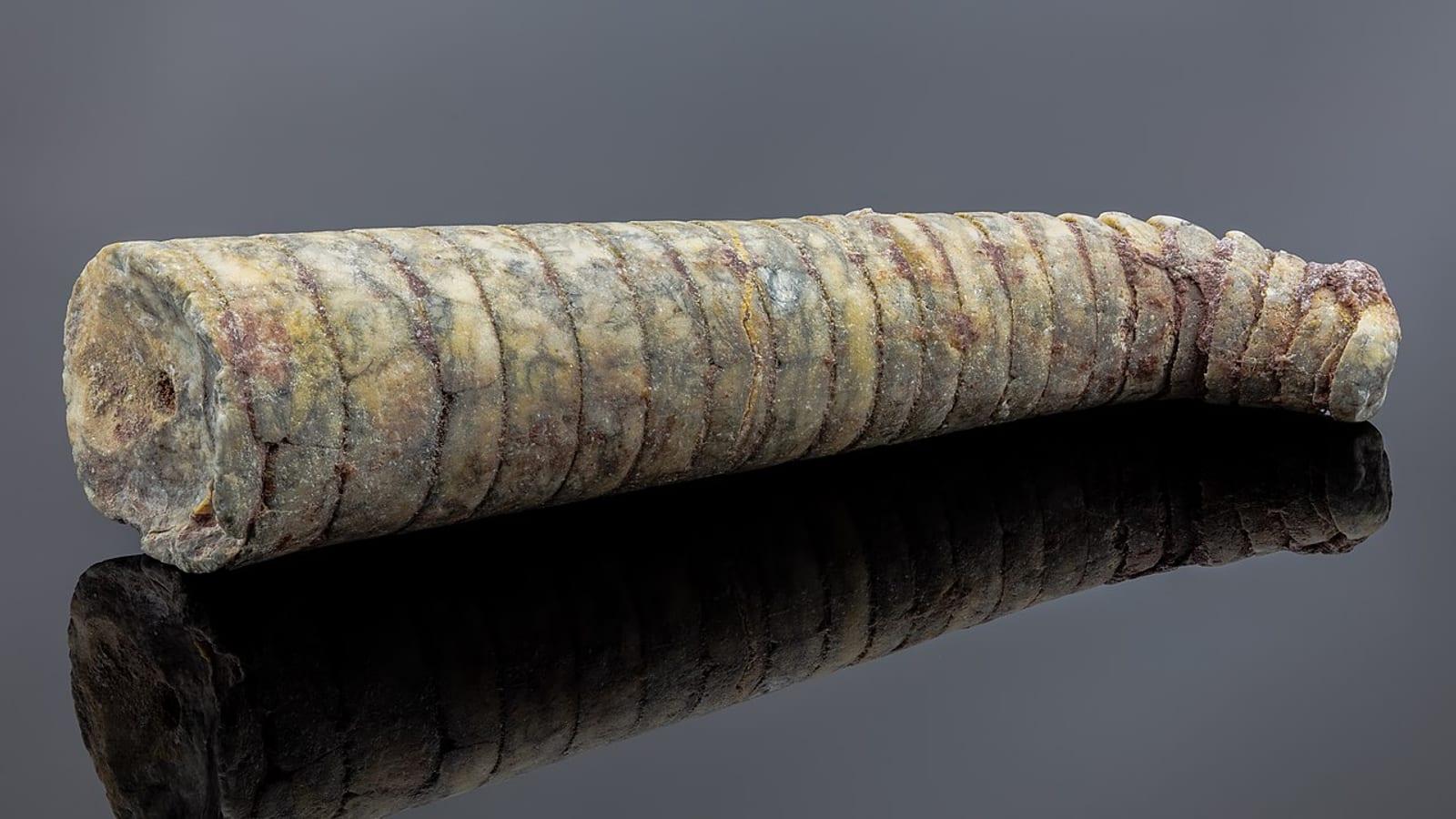
Orthoceras (straight-shelled nautiloids) dominate the assemblage here. These Devonian cephalopods grew long conical shells divided internally into chambers by thin walls called septa. In the black limestone of Hamar Laghdad, the shells are preserved in cross-section as grey-white ellipses, their chambered interiors clearly visible. Specimens range from a few centimetres to over a metre in length. You will find them aligned in bedding planes, often with multiple individuals packed closely together, a pattern consistent with current-sorting of empty shells after the animals died and sank.
 Photo: Diego Delso, CC BY-SA 4.0, via Wikimedia Commons

Goniatites appear alongside the orthocerids. These are early ammonoids characterised by simple, angular suture patterns visible where the chamber walls meet the outer shell. In the field, look for coiled discs 2 to 8 cm across with a distinctive zigzag seam running around the edge. They are less abundant than the orthocerids but turn up reliably in the loose material on the quarry floor.
Brachiopods occur as scattered valves, typically terebratulid and spiriferid forms. They are smaller than the cephalopods and easy to overlook, but worth collecting for the complete picture of the Devonian seafloor community. Occasional trilobite fragments, pygidium sections and head shields, appear in the matrix, though whole trilobites are rare at this locality compared to the dedicated trilobite sites near Alnif.
The quarry floor and waste-material piles are your best collecting ground. Freshly broken surfaces reveal fossils not visible on weathered exteriors, so scan both. The contrast between the pale fossil material and the dark matrix makes identification straightforward even for beginners.
Geologic History
The Ancient Environment
The rocks exposed at Hamar Laghdad belong to the Devonian Erfoud Formation, deposited approximately 393 to 382 million years ago, spanning the Eifelian and Givetian stages of the Middle Devonian. At that time, the region now occupied by the Draa-Tafilalt Basin lay beneath the warm, shallow waters of the Rheic Ocean, positioned in the tropical belt south of the paleoequator on the margin of the Gondwana supercontinent. Sea surface temperatures are estimated to have ranged between 25 and 30°C, and the ocean supported extraordinarily diverse marine communities.
The black coloration of the limestone results from elevated organic carbon content in the original sediment. Low oxygen levels on the seafloor, likely caused by stratified water masses that prevented circulation, inhibited bacterial decomposition and scavenging. Shells raining down from the water column above accumulated on this anaerobic seafloor and were buried rapidly in fine carbonate mud. Calcite replacement of original shell material produced the grey-white colour that contrasts with the dark matrix, and this replacement is responsible for the exceptional three-dimensional preservation that makes Hamar Laghdad specimens so recognizable.
How Hamar Laghdad Became a Fossil Site
Local Berber families have quarried the Hamar Laghdad ridge for ornamental limestone for at least four generations. The fossil content was initially treated as a decorative feature of the stone rather than the primary product. In the 1970s, French researchers working in the Erfoud region documented the deposit's paleontological significance, recording the high fossil density and the quality of three-dimensional preservation. Scientific expeditions through the 1980s and 1990s established the precise stratigraphic position and palaeoenvironmental context of the beds. By the 1990s, the commercial fossil market had recognised what the quarry produced, and the operation shifted toward supplying both ornamental slabs and individual collector specimens. Today the quarry runs parallel operations: large blocks feed the stone workshops where skilled artisans polish tabletops and sinks, while loose quarry material and selected blocks go to the collector trade. Active quarrying continues to expose new fossil horizons regularly.
Visiting and Collecting Information
Access and What to Expect
Hamar Laghdad is an active commercial quarry. Independent access is possible, but arranging a local guide through one of the Erfoud fossil shops or guesthouses is strongly recommended and will significantly improve your experience. A guide provides site introductions to the quarry workers, identifies the best current collecting areas, and handles any informal access fees. Guide fees typically range from 300 to 500 MAD (approximately 30 to 50 USD) per half-day, covering site access and collecting assistance. The quarry operates Monday through Saturday, roughly 8:00 AM to 5:00 PM. Friday prayer periods may result in a midday pause. Visiting Tuesday through Thursday avoids this.
Visitors may collect loose specimens from designated areas. A reasonable quantity for personal collection is up to 5 kg of material. You can also purchase prepared and polished specimens directly from the workshop at the quarry entrance, which offers everything from small tabletop slabs to large decorative pieces.
What to Bring
Bring at least 2 to 3 litres of water per person, there is no water supply at the quarry. Sun protection is essential: a wide-brimmed hat, long sleeves, and high-SPF sunscreen. The quarry floor is uneven black limestone that absorbs heat, so sturdy closed-toe boots are required. Bring a geology hammer and chisel if you plan to work matrix material. Specimen wrapping (newspaper or foam) protects finds on the drive back. All transactions at the quarry are cash-only in Moroccan dirhams. The nearest ATM is in Erfoud.
Safety and Practical Tips
Summer temperatures at Hamar Laghdad regularly exceed 42°C (108°F) by midday. Plan to arrive by 7:30 AM and leave the site by 11:00 AM during June through August. The rest of the year, temperatures are more manageable, but midday sun remains intense. The quarry floor has loose rock and uneven steps between bench levels. Watch your footing, particularly on freshly cut limestone edges. Active quarrying areas use manual tools, but heavy stone slabs are moved without warning, stay clear of any loading activity. The quarry workers are accustomed to visitors, but treat all working areas respectfully and follow any guidance the workers give about where you may and may not go.
There is no fixed tourist allowance for taking fossils out of Morocco. Article 116 of the 2015 Mining Code (Law 33-13) requires a permit for collecting and trading fossils, minerals, and meteorites, with the procedures set out in a 2019 implementing decree and the framework revised again in 2025. Enforcement is uneven, and small purchases from licensed dealers are commonly carried out without incident, but that is practice rather than an entitlement. Keep a receipt and a written description of each specimen and its origin, and check the current rules with the Moroccan ministry responsible for mines before you travel. Keep any receipts from purchases for customs if asked.
Sources
Nearby sites
 Erfoud Main Orthoceras Factory Quarry Fossil Hunting GuideOrthocerids, Goniatites
 Atchana Trilobite Mine Rissani Fossil Hunting GuideDevonian trilobites, Brachiopods
 Guelb el Mharch Mud Volcano Fossil Site Rissani Fossil Hunting GuideGuelb el Mharch, Tabulate corals
 Jbel el Mrakib Devonian Reef Site Rissani Fossil Hunting GuideJbel El Mrakib Devonian Reef Site, Coral reef fossils