Saredrar Orthoceras Quarry Tazzarine Alnif Fossil Hunting Guide
Image: Antonov (Public domain)
Visit Saredrar Orthoceras Quarry near Tazzarine, Morocco. Collect Devonian orthocerids and goniatites from black limestone beds; guide arranged from Alnif, 300–600 MAD.
By Edward Chen · Updated 30 July 2026
Introduction
The Saredrar Orthoceras Quarry near Tazzarine occupies the transitional zone between the Draa Valley and the open Saharan plains, roughly 8 km outside Alnif along the track toward Tazzarine. While the better-known orthoceras sites cluster near Erfoud, Saredrar draws collectors who want a less trafficked locality where the quarry operations remain small-scale and the relationship with the mining families is direct and personal. The site produces the same characteristic black Devonian limestone loaded with straight-shelled nautiloids, along with associated goniatites and brachiopods, but the quarry floor here yields individual slabs rather than industrial-scale blocks, and the collecting experience has a more improvised, exploratory character.
This guide covers the route from Alnif, the Devonian geological setting, which fossils occur and how to find them, and the practical details of arranging a visit.
 Photo: Antonov, Public domain, via Wikimedia Commons

Location and Getting There
Location
The Saredrar quarry is located approximately 8 km from Alnif along the unpaved track heading west-southwest toward Tazzarine, Drâa-Tafilalet region, southeastern Morocco. The quarry sits in open desert terrain with no permanent structures other than the working area itself. Tazzarine town is approximately 60 km further southwest along the same route. Most visitors use Alnif as their base.
Getting There
From Alnif centre, take the unpaved track heading toward Tazzarine. The quarry is reached after approximately 8 km, typically a 30-minute drive in a 4WD vehicle. The track is generally manageable in dry conditions but sandy sections can trap standard vehicles. Arrange a local guide in Alnif who can navigate and make introductions at the site. Several guide services operating from Alnif include Saredrar in their standard excursion routes, often combining it with other nearby localities for a full-day fossil outing.
What Fossils You'll Find
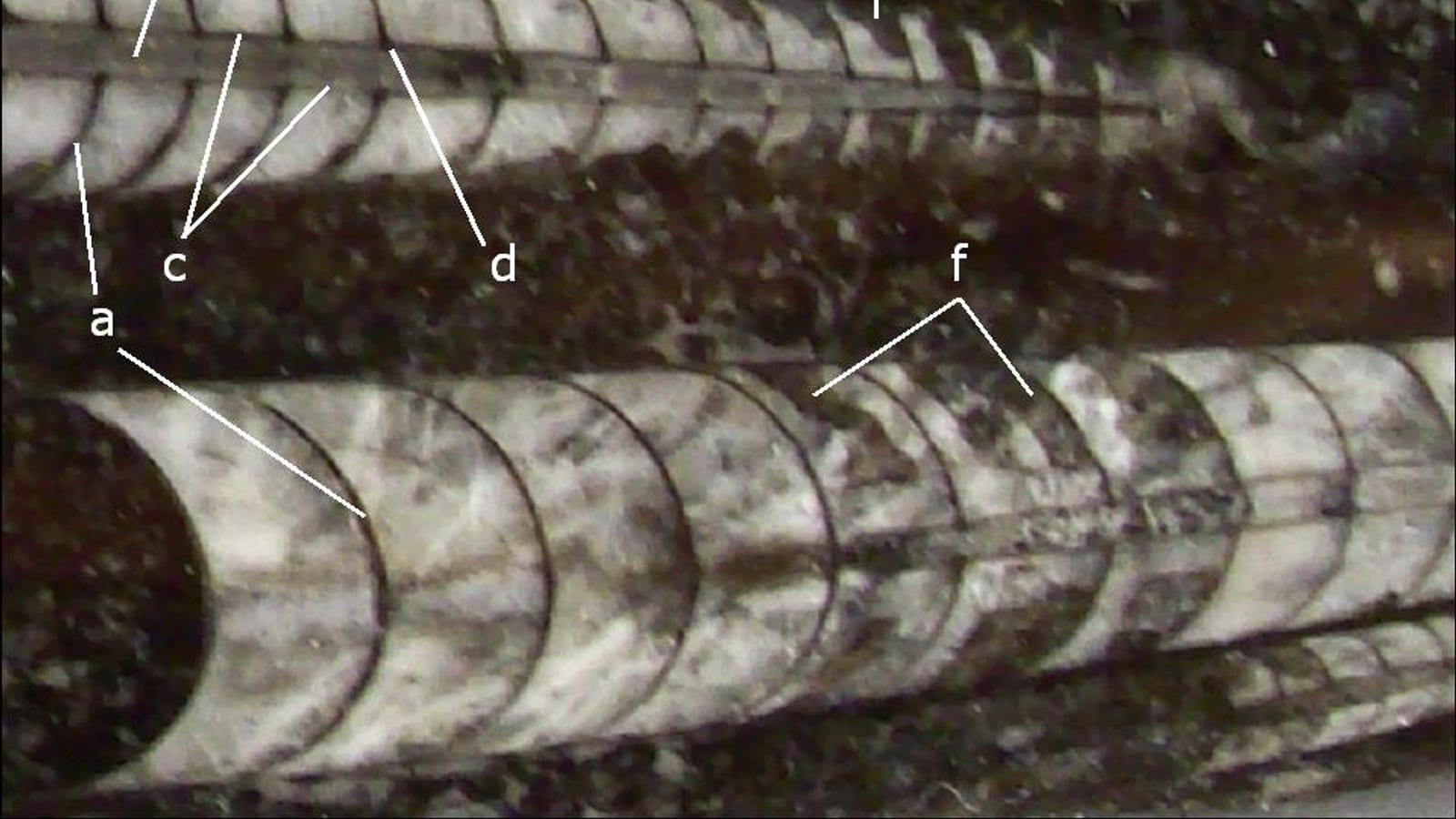
Orthocerids (straight-shelled nautiloids, commonly marketed as Orthoceras) are the defining fossil at Saredrar. The shells appear as elongated cross-sections in the polished limestone face, their chambered interiors visible as a series of curved partitions (septa) separated by smaller sections of body chamber. In unpolished quarry material, the shells are white to cream against the dark grey limestone matrix. Specimens range from thumbnail-sized juveniles to sections exceeding 40 cm in length.
Goniatites appear as coiled discs with angular suture lines around the periphery. They are noticeably less abundant than the orthocerids but occur throughout the same limestone beds. Sizes typically range from 2 to 6 cm diameter.
Brachiopods show up as scattered valves in the rock surface, both convex and flat forms depending on genus. They require a closer look to notice among the more visually dominant cephalopods. Occasional coral fragments appear in some beds, indicating proximity to reef-adjacent facies within the broader formation.
The quarry floor and freshly broken waste slabs are the most productive areas. Newly cut surfaces show fossils more clearly than weathered exterior faces, which develop a grey patina that obscures fine detail. Break open promising pieces along natural joints in the rock where available.
Geologic History
The Ancient Environment
The fossiliferous limestone at Saredrar belongs to formations deposited during the Devonian period, approximately 400 to 385 million years ago, broadly correlating with the Erfoud Formation and related units that occur across the Tafilalt Basin. During this time, the region lay beneath the warm, shallow-to-moderate-depth waters of the Rheic Ocean on the margin of Gondwana. Sediment accumulation alternated between fine carbonate muds during calm periods and coarser storm-transported material during episodic high-energy events. The black coloration of the fossiliferous layers reflects elevated organic carbon content from low-oxygen bottom conditions, the same preservation environment responsible for exceptional fossil quality across the broader Erfoud-Tafilalt region.
Cephalopod-rich beds like those at Saredrar formed when shells sinking from the water column above accumulated on the anaerobic seafloor and were incorporated into carbonate mud before decomposition or scavenging could destroy them. Current sorting aligned many shells parallel to bedding, producing the characteristic orientation visible in polished slabs.
How Saredrar Became a Fossil Site
Local families working the Alnif-Tazzarine corridor recognised fossil-bearing limestone at Saredrar as part of the broader regional pattern of orthoceras quarrying that expanded significantly in the 1980s when international demand for polished black limestone grew. The Saredrar site operates at smaller scale than the major quarries near Erfoud, which means quarry operations here remain family-run and visitor access is genuinely personal rather than commercial. Ongoing quarrying at the site continues to expose fresh fossil horizons as the worked area expands.
Visiting and Collecting Information
Access and What to Expect
Access to Saredrar requires arranging a guide in Alnif. Guide fees for a half-day excursion to Saredrar run approximately 300 to 600 MAD (30 to 60 USD), which covers transport, introductions, and collecting time. The site itself is informal: the quarry workers welcome visitors who arrive with a guide and are happy to show current working areas and direct you to productive loose material. You may collect loose specimens from the quarry floor. A reasonable personal quantity is up to 5 kg. Prepared and polished pieces are sometimes available for purchase directly from the workers at prices below what you would pay in Alnif or Erfoud shops.
What to Bring
Carry at least 2 to 3 litres of water per person. There is no water source at the quarry. Wear a hat, sunscreen, and long sleeves. Closed-toe boots are necessary on the quarry floor. Bring a geology hammer and chisel if you want to work matrix pieces, and newspaper or bubble wrap for wrapping specimens. Payment is cash only in Moroccan dirhams.
Safety and Practical Tips
Visit between October and April when temperatures are 20 to 30°C. Summer heat at this desert locality regularly exceeds 42°C by noon. The quarry terrain is manageable but has uneven steps and loose rubble. Watch your footing. The working area is small, so stay clear of any active cutting or moving of stone.There is no fixed tourist allowance for taking fossils out of Morocco. Article 116 of the 2015 Mining Code (Law 33-13) requires a permit for collecting and trading fossils, minerals, and meteorites, with the procedures set out in a 2019 implementing decree and the framework revised again in 2025. Enforcement is uneven, and small purchases from licensed dealers are commonly carried out without incident, but that is practice rather than an entitlement. Keep a receipt and a written description of each specimen and its origin, and check the current rules with the Moroccan ministry responsible for mines before you travel.
Sources
Nearby sites
 Bou Dib Fossil Site North Jbel Isoumour Alnif Fossil Hunting GuideBou Dib, Phacops
 Jbel Isoumour Trilobite Mine Alnif Fossil Hunting GuideJbel Isoumour, Psychopyge
 Jbel Tiskaouine Ordovician Trilobite Site Alnif Fossil Hunting GuideJbel Tiskaouine, Flexicalymene
 Cambrian Paradoxides Site North of Alnif Fossil Hunting GuideParadoxides, Cambropallas telesto