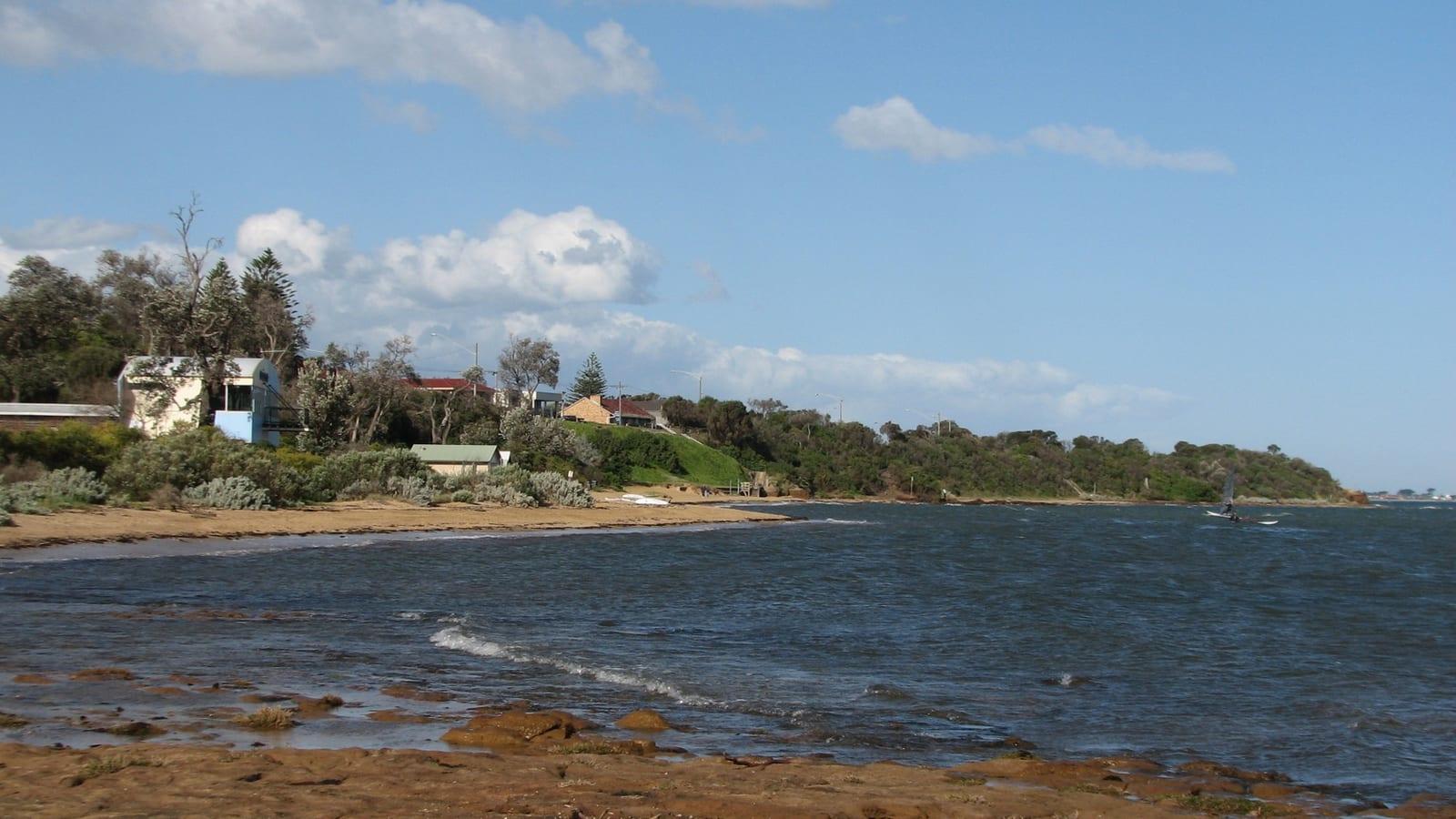
Beaumaris Bay Fossil Site Melbourne Fossil Hunting Guide
Image: Melburnian (CC BY 3.0)
Beaumaris Bay in Melbourne's suburbs is Australia's most productive marine fossil beach, where shark teeth, whale bones, and seal skulls erode onto a public foreshore year-round.
By Edward Chen · Updated 1 August 2026
Introduction
Beaumaris Bay sits in Melbourne's bayside suburbs, roughly 25 kilometres south of the city centre, but the cliffs lining this stretch of Port Phillip Bay contain the most productive marine fossil locality in Australia. The cliffs expose the Black Rock Sandstone, a Miocene-age marine unit deposited in shallow coastal waters between five and ten million years ago, and the fossils eroding from them onto the beach below represent over 140 vertebrate species, more marine mammal species than any other site in the country. Shark teeth, cetacean bones, seal skulls, penguin remains, and the occasional giant seabird bone wash out of the cliff face with every storm and high tide cycle. This is a working fossil site where new material appears regularly, and you do not need a permit or a fee to walk the beach and look. Museums Victoria maintains an identification guide specifically for Beaumaris and actively encourages collectors to report significant finds. If you are visiting Melbourne and want to spend a morning finding real fossils on a public beach, Beaumaris is the most productive option in the entire region. This guide explains what you are likely to find, how the geology works, the best times to visit, and the rules that apply.
Location and Directions
Address
Beaumaris Bay Fossil Site, Beach Road, Beaumaris VIC 3193, Australia. The fossil-bearing cliffs run along Beach Road between Beaumaris and Black Rock.
Directions
From central Melbourne, take the Nepean Highway (or EastLink/Monash Freeway then Nepean Highway) south towards Mentone and Mordialloc, then continue to Beaumaris. Beach Road runs along the foreshore. The most productive fossil cliff section lies between the Beaumaris Life Saving Club and the Black Rock area. Parking is available in several car parks along Beach Road, including at Beaumaris Life Saving Club and at the northern end of Black Rock. Street parking is also available on Beach Road itself. The cliff face and beach are accessible directly from Beach Road via a series of steps and ramps at regular intervals. By public transport, take the Frankston train line to Sandringham, then connect by bus towards Beaumaris. Check Public Transport Victoria (ptv.vic.gov.au) for current timetables. The site is flat and accessible once you reach the beach. The beach is free to visit at all times.
 Photo: Sourabh.biswas003, CC BY-SA 4.0, via Wikimedia Commons
_224J%2B58_Beaumaris,_Victoria,_Australia_Sea_creatures_and_landscape_21.jpg)
What Fossils You'll Find
The most commonly found fossils at Beaumaris are shark teeth. The assemblage includes teeth from Carcharocles megalodon, the giant shark that reached lengths of 15 to 18 metres, as well as teeth from smaller extinct species including Isurus hastalis (the broad-toothed mako), white sharks, sand tigers, and several smaller species. Megalodon teeth range from fragments to complete specimens several centimetres long. They are dark grey to black, triangularly shaped, and have serrated edges. After storms, shark teeth are the fossils most likely to be found along the strandline. Cetacean bones are the next most significant category. Beaumaris has produced more cetacean fossil species than any other Australian site. Baleen whale (mysticete) ear bones, called tympanic bullae, are among the most diagnostic and identifiable bones. They are dense, oval-shaped, and typically dark brown to black. Rib fragments and vertebrae from both baleen and toothed whales also occur. Seal bones are regularly found, with at least nine species represented in the scientific literature from Whalers Bluff Formation material in the broader region. Penguin bones have been collected here, including material attributed to extinct large penguins. Pelagornis bones represent the giant bony-toothed seabird with a wingspan estimated at 5 to 6 metres, one of the largest flying birds in Earth's history. Various bony fish remains include vertebrae, teeth, and skull fragments. Diprotodon and Zygomaturus bones also turn up on this coast, but both genera are Pleistocene and come from much younger deposits than the Miocene Black Rock Sandstone. The fossils are found in two ways: eroding directly from the cliff face (where you should not remove them, leave in-situ finds for museum reporting) and loose on the beach below the cliffs, particularly after storms and high tides. Concentrate your search on the strandline and in areas where wave wash has exposed the beach surface.
Geologic History
The Ancient Environment
The Beaumaris fossils are preserved in the Black Rock Sandstone Member of the Baxter Sandstone Formation, deposited during the Late Miocene, approximately 5 to 10 million years ago (Tortonian to Messinian stages). At that time, sea levels were higher than today and a shallow coastal marine environment covered the Beaumaris area. The water was warm and productive, supporting an exceptionally diverse marine fauna that included large sharks, whales, dolphins, seals, penguins, and giant seabirds. The sediments were deposited in relatively shallow water close to the ancient shoreline, which explains the preservation of coastal and shallow-water species alongside open-ocean types. Over the following millions of years, sea levels fell, the sediments were uplifted slightly, and the Beaumaris coastline developed into the bay system visible today. Ongoing wave erosion undercuts the soft sandstone cliffs, causing regular collapse events that expose fresh fossil material on the beach below.
How Beaumaris Bay Became a Fossil Collecting Site
Fossils have been collected from Beaumaris since the 19th century, and the site was central to the work of several of Australia's most important vertebrate palaeontologists. The ongoing exposure by natural coastal erosion means that the fossil supply at Beaumaris is self-renewing, the cliffs recede several centimetres per year on average, continuously releasing new material onto the beach. Museums Victoria formalised the site's status as a heritage fossil locality and developed a public education programme around it. The site operates as a free public collecting area under a reporting framework: loose beach material may be collected by the public, but significant specimens should be notified to Museums Victoria for scientific documentation and, where appropriate, donation to the collection. Interpretive signs along the foreshore explain the geology and fossil types, and the museum's free identification handbook is available for download.
 Photo: Rawairocks, CC BY-SA 4.0, via Wikimedia Commons

Visiting Rules and Regulations
Is Fossil Collecting Allowed?
Collecting loose fossils from the beach at Beaumaris is permitted for personal, non-commercial purposes. You may keep fossils that you find on the beach surface. You must not dig into, chip away at, or undermine the cliff face, the cliffs are both structurally unstable and protected as a heritage site. Under the Victorian Heritage Act 2017, the Beaumaris Fossil Site has heritage registration, which means that any activity involving excavation or removal of in-situ material requires approval. Loose beach material that has already eroded from the cliff does not require a permit for personal collection. Significant finds, particularly complete or near-complete bones, unusual species, or large shark teeth, should be reported to Museums Victoria (museum.vic.gov.au) for identification and potential scientific documentation. The site is on a public beach and there are no access fees or access restrictions.
Recommended Equipment
Bring a small container or zip-lock bag for any fossils you find. A hand lens (10x) helps with identification of small tooth serrations. The Museums Victoria identification handbook for Beaumaris fossils is available as a free PDF download and is worth printing or loading onto your phone before visiting. Wear sturdy flat shoes suitable for uneven rocky foreshore. A hat and sunscreen are necessary in summer. The beach is fully exposed. The best time to visit is within a day or two after a storm, which clears sand from the beach surface and washes new material down from the cliffs.
Safety
The Beaumaris cliffs are actively eroding and cliff falls occur without warning. Do not stand or walk directly below the cliff face, and do not attempt to climb the cliffs. Maintain a safe distance of at least five metres from the cliff base. The beach is fully tidal, check tide times before visiting, as the fossil-bearing area below the cliffs is most accessible at low tide. Port Phillip Bay has a moderate swell. Take care on the rock platforms when conditions are choppy. There are no specific environmental hazards beyond cliff fall and tidal conditions at this Melbourne suburban site.
Sources
- https://museumsvictoria.com.au/melbournemuseum/learning/resources/beaumaris-fossil-site/
- https://www.heritage.vic.gov.au/historic-places/beaumaris-fossil-site
- https://en.wikipedia.org/wiki/Beaumaris\_Bay
- https://palaeo-electronica.org/content/2022/3723-black-rock-pinniped-fossils
- https://en.wikipedia.org/wiki/Carcharocles\_megalodon
- https://en.wikipedia.org/wiki/Pelagornis
- https://www.museum.vic.gov.au/research/collections/natural-history/vertebrate-palaeontology
Nearby sites
 Flat Rocks Inverloch Dinosaur Dig Site Fossil Hunting GuidePolar dinosaurs, Early mammal teeth
 The Caves Inverloch Fossil Hunting GuideDinosaur bones and teeth, Early mammal teeth
 Eagles Nest Cape Paterson First Dinosaur Fossil Hunting GuideTheropod dinosaur material, Ornithopod dinosaurs
 Hamilton Grange Burn Fossil Hunting GuideMacropodids, Diprotodontids