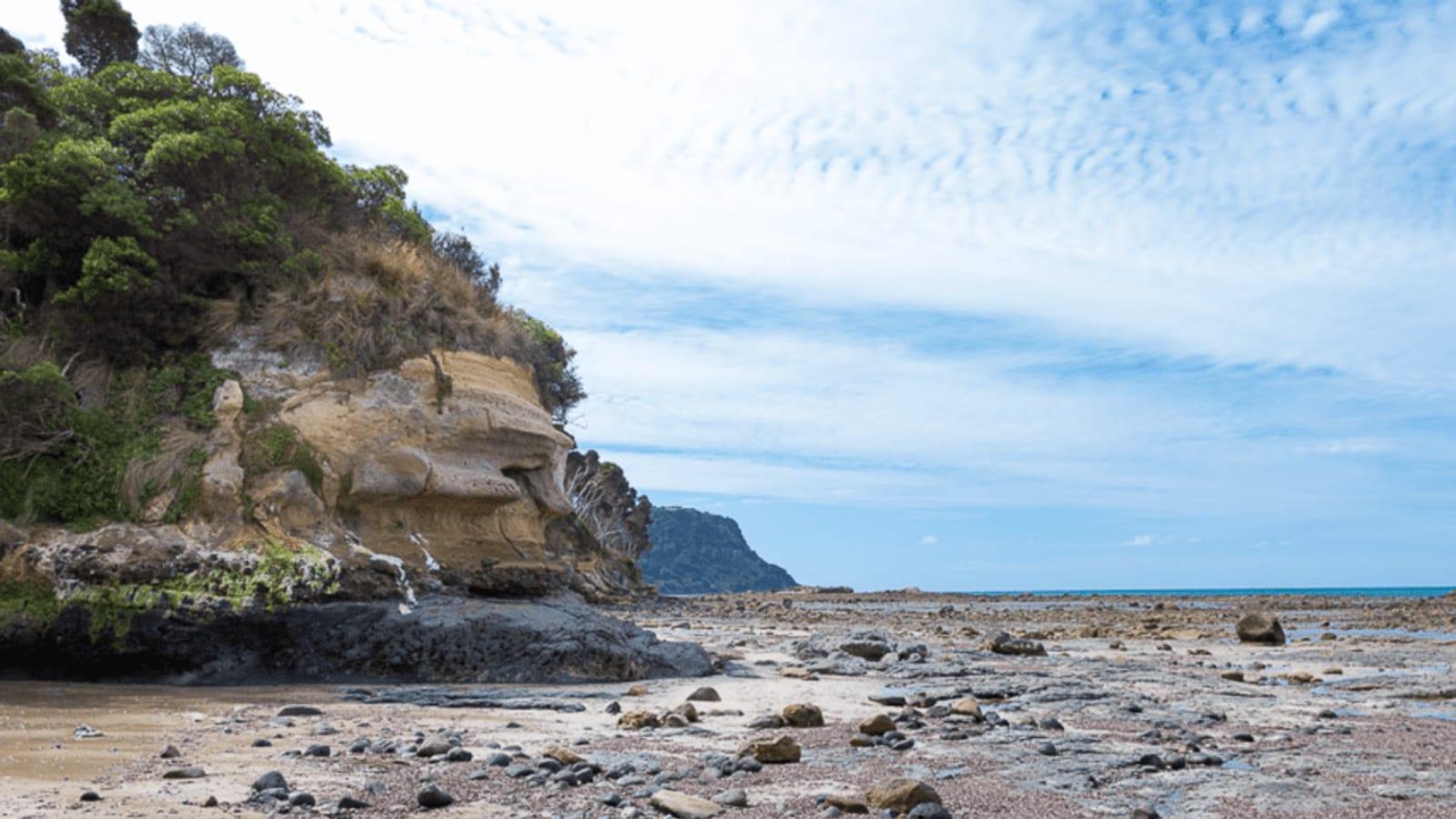
Fossil Bluff Wynyard Fossil Hunting Guide
Image: Gary Houston (CC0)
Fossil Bluff at Wynyard on Tasmania's northwest coast exposes the early Miocene Fossil Bluff Sandstone, rich in marine shells, resting on the Permian Wynyard Tillite. It is the discovery site of Wynyardia bassiana, Australia's oldest marsupial skeleton. Viewing only.
By Edward Chen · Updated 2 August 2026
Introduction
Fossil Bluff is a coastal headland at Wynyard on the northwest coast of Tasmania, and it holds two chapters of deep time stacked on top of each other. The grey-blue rock platform at the base is the Permian Wynyard Tillite, laid down by a tidewater glacier around 300 million years ago when Tasmania sat at high southern latitudes within Gondwana. Above it sits the yellow Fossil Bluff Sandstone, a shallow-marine deposit of the early Miocene, roughly 23 million years old, and it is this upper unit that carries the shells the site is named for.
The bluff earned its international standing in the mid-1800s, when a beachcomber found a partial skeleton in a fallen block of the sandstone. That animal, later named Wynyardia bassiana, is the oldest reasonably complete marsupial skeleton known from Australia. Collecting is not allowed here, so this is a place to read the cliff, examine the shells in the rock, and see where two very different worlds meet.
Location and Directions
Fossil Bluff lies at the end of Fossil Bluff Road in Wynyard, near 40.98°S, 145.73°E, about 20 km west of Burnie and a few minutes from the Wynyard town center. A car park sits above the beach, and a short track leads down to the shore and the base of the cliff.
The fossils and the tillite platform are best seen at low tide, when the wave-cut platform is exposed and you can walk to the contact between the two rock units. Check tide times before you go, since a high tide covers the platform and pushes you back against the cliff. Wynyard has fuel, food, and lodging.
 Photo: Gary Houston, CC0, via Wikimedia Commons

What Fossils You'll Find
The Fossil Bluff Sandstone preserves a shallow-marine fauna. Bivalves and gastropods, the clams and marine snails, are the most obvious fossils, weathering out of the yellow sandstone as shells and casts. Corals occur in distinct bands within the rock, and several species of echinoids, the sea urchins, are characteristic of the unit and among its more sought-after fossils to spot.
Hundreds of shells stand out from the cliff faces and the loose blocks at the base. The Permian tillite below, by contrast, is a glacial deposit and carries dropstones rather than a shelly fauna, so the marine fossils are confined to the sandstone above the contact. A geological guide leaflet is available from the Wynyard Visitor Centre to help with identification.
Geologic History
The lower unit records ice. Around 300 million years ago a tidewater glacier fed a thick pile of glacial sediment, the Wynyard Tillite, complete with stones dropped from floating ice into fine mud. Tasmania then lay near the South Pole as part of Gondwana.
The upper unit records a warm sea. By the early Miocene, roughly 23 million years ago, the region had drifted north and a shallow sea deposited the fossil-rich Fossil Bluff Sandstone across the older glacial rock. The marsupial Wynyardia was washed into that sea and buried in the sand. Later uplift and the erosion of the Bass Strait coastline cut the bluff and exposed both units in one cliff, which is why a single short walk crosses about 280 million years of missing time at the contact.
 Photo: Gary Houston, CC0, via Wikimedia Commons

Collecting Rules and Regulations
Fossil Bluff sits within a conservation area, and collecting fossils is prohibited. You may look at, touch, and photograph the fossils in the rock, but you must not remove specimens or hammer the cliff. The site is managed for its scientific and educational value, and the marsupial discovery makes it internationally important.
Treat the bluff as an outdoor museum. Leave shells, blocks, and the tillite platform undisturbed so the next visitors see what you saw.
Safety
Time your visit to a falling tide so you are not caught against the cliff by rising water. The wave-cut platform is slippery with algae in places, so wear shoes with grip and watch your footing. Rockfall from the cliff is a real hazard, so do not stand directly beneath overhangs or climb the faces. Bring sun protection and water, and note that dogs are allowed only with seasonal restrictions over summer.
Sources
https://parks.tas.gov.au/explore-our-parks/fossil-bluff-conservation-area https://www.warwyn.tas.gov.au/park-recreation/fossil-bluff-2/ https://shapingtasmania.tmag.tas.gov.au/M/object.aspx?id=28
Nearby sites
 Eagles Nest Cape Paterson First Dinosaur Fossil Hunting GuideTheropod dinosaur material, Ornithopod dinosaurs
 The Caves Inverloch Fossil Hunting GuideDinosaur bones and teeth, Early mammal teeth
 Flat Rocks Inverloch Dinosaur Dig Site Fossil Hunting GuidePolar dinosaurs, Early mammal teeth
 Painted Cliffs Maria Island Fossil Hunting Guidetrace fossils, sedimentary structures