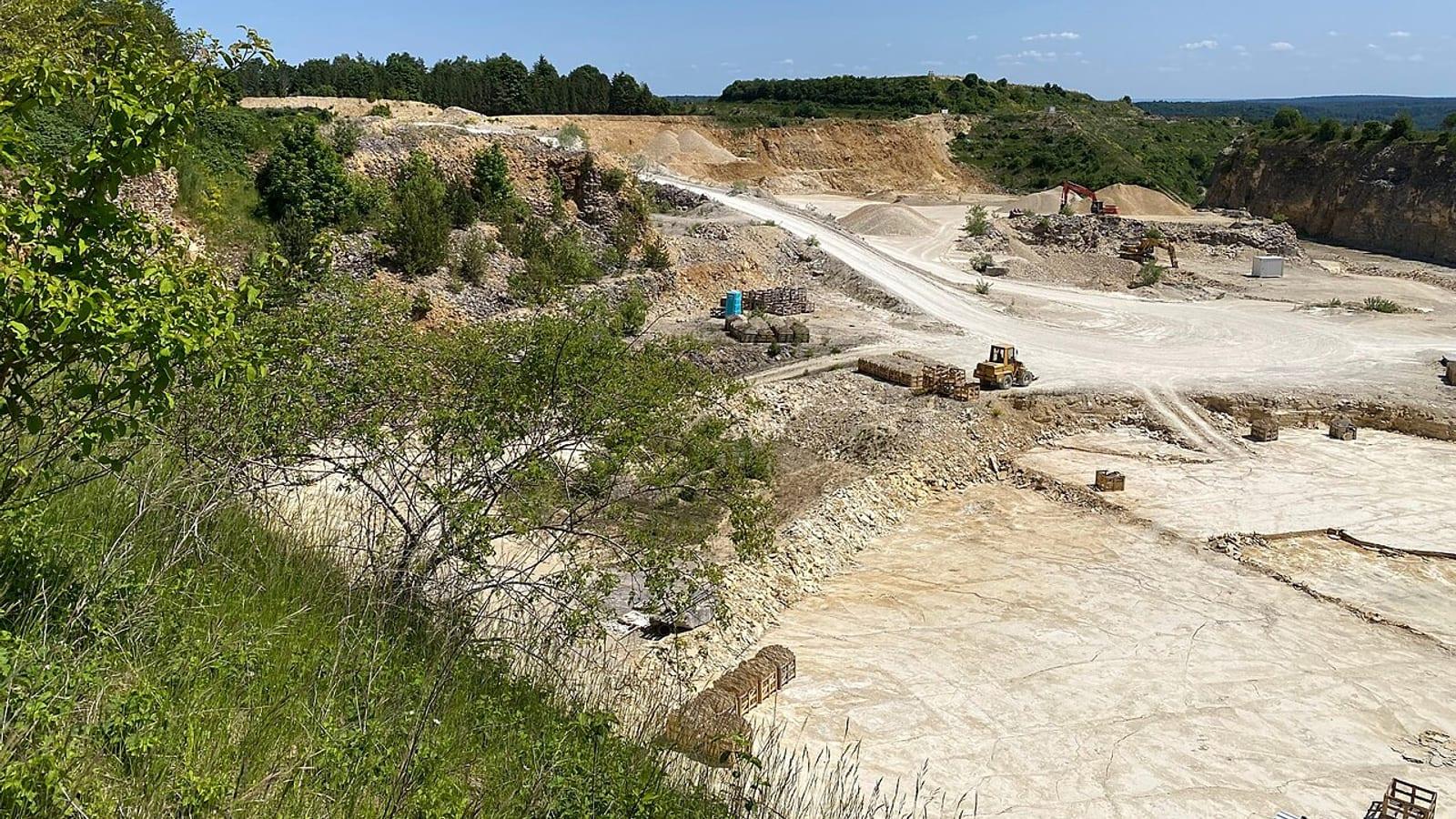
Steinbruch Schernfeld Jurassic Fossil Quarry Fossil Hunting Guide
Image: -wuppertaler (CC BY 4.0)
Steinbruch Schernfeld near Eichstätt exposes Tithonian plattenkalk with abundant Saccocoma crinoids, ammonites, and fish. Verify access before visiting this hilltop quarry.
By Edward Chen · Published 27 April 2026
Introduction
The hilltop quarry at Schernfeld overlooks the Altmühl Valley from a ridge in the Franconian Alb, and on a clear day the view alone justifies the drive. What makes it genuinely worth seeking out, however, is the Altmühltal Formation limestone exposed in its benches: fine-grained plattenkalk laid down in a tropical lagoon during the Tithonian Stage of the Late Jurassic, the same unit that produced the Solnhofen fossils, approximately 150 million years ago. The site is particularly noted for its abundant Saccocoma crinoids, free-floating feather stars that drifted in vast numbers through the Tethys Sea and settle into the rock in dense, delicate impressions when conditions were right. Ammonites, fish, and shrimp complete the typical assemblage.
Access at Steinbruch Schernfeld has historically varied with ownership and management. The quarry has operated with paid admission during some periods and been freely accessible or temporarily closed during others. Verifying current status before making a journey is strongly recommended. This guide covers the site's location, the fossils present, the geology of the Altmühltal Formation, and the practical information you need for a visit.
 Photo: -wuppertaler, CC BY 4.0, via Wikimedia Commons

Location and Directions
Address
Steinbruch Schernfeld is located in the village of Schernfeld, Landkreis Eichstätt, Bavaria, Germany. The quarry occupies the hilltop south of the village. No permanent postal address exists for the quarry itself. Use Schernfeld village as your navigation target and look for signs toward the Steinbruch at the southern edge of the settlement.
Directions
From Eichstätt, follow local roads approximately 6 km west-north-west to Schernfeld. The quarry access track leads uphill from the south end of the village. Parking is available at the hilltop in a small unpaved area adjacent to the quarry entrance.
From Ingolstadt, take the B13 north-west for approximately 35 km to Eichstätt, then continue as described above. Total distance is roughly 40 km.
From Munich, take the A9 north to the Lenting/Kösching exit, then the B13 north-west through Eichstätt and on to Schernfeld. Total distance is approximately 105 km and takes around 80 minutes.
From Nuremberg, take the A9 south to Greding, then follow roads southwest via the B13 to Eichstätt and on to Schernfeld. Allow approximately 80 km and 65 minutes.
Before you travel, confirm current access conditions by contacting the Eichstätt Tourist Information office: +49 8421 6001400, or check the Naturpark Altmühltal website (www.naturpark-altmuehltal.de) for any updated advisory.
What Fossils You'll Find
The Schernfeld quarry exposes the Altmühltal Formation, the principal plattenkalk unit of the Solnhofen Group, overlain elsewhere in the region by the Mörnsheim Formation. The fauna is characteristic of the Solnhofen-type lagerstätten.
 Photo: Kl833x9~commonswiki, CC BY-SA 4.0, via Wikimedia Commons

Saccocoma crinoids are the defining element of the Schernfeld assemblage and appear in greater abundance here than at most other Altmühltal localities. These pelagic feather stars lived in the water column rather than on the seafloor and sank to the lagoon bottom in dense accumulations after death. Individual specimens show the delicate branching arm structure preserved as pale impressions on the grey limestone surface. Look for horizon-specific concentrations where Saccocoma layers form distinct bands.
Ammonites occur throughout the collecting area, typically as internal moulds or calcite-filled steinkerns. Sizes range considerably, from small planispiral forms a few centimetres in diameter to larger specimens approaching 15 cm. The ribbing and keel on well-preserved examples are clearly visible on split surfaces.
Fish appear less frequently but are found regularly in productive beds. Preserved scales, fin rays, and occasionally articulated skeletons up to 10–15 cm long have been recovered. Look for silvery reflective patches on freshly split faces, which indicate fish scale material.
Shrimp and other crustaceans have been recorded from the site. They are uncommon but notable when found, as the delicate appendage structures are preserved in the fine-grained limestone.
Geologic History
The Ancient Environment
During the Tithonian Stage, approximately 150 million years ago, the region now occupied by the Franconian Alb sat within the tropical Tethys epeiric sea. The climate was warm and humid, with no polar ice caps and sea surface temperatures in the range of 22–26°C. The landscape was an archipelago of low carbonate platforms built by sponge-algae reefs, separated by shallow restricted lagoons and deeper inter-platform basins.
The Altmühltal Formation records deposition in one of those restricted lagoons, where evaporation periodically raised salinity and reduced dissolved oxygen at the sediment-water interface. These conditions were lethal to most bottom-dwelling fauna, which prevented scavenging and burrowing after organisms settled to the floor. Fine carbonate muds accumulated slowly under the anaerobic surface layer, entombing organisms with the detail that makes Solnhofen-type limestones so scientifically significant.
The rock type at Schernfeld is a micritic plattenkalk: even-grained, pale grey limestone that splits along bedding planes to reveal fossils. After deposition, the sediments were buried, cemented, and eventually uplifted as part of the Swabian-Franconian Alb during Alpine tectonics. Subsequent erosion of overlying beds brought the fossil-bearing horizons close to the present surface.
How Steinbruch Schernfeld Became a Fossil Collecting Site
Commercial limestone quarrying in the Schernfeld area began several centuries ago, driven by local demand for building stone and occasional interest in the plattenkalk as a potential lithographic material. The distinctive hilltop quarry expanded over the nineteenth and early twentieth centuries as mechanized extraction became feasible.
The fossiliferous nature of the Schernfeld beds attracted scientific attention at least as early as the late nineteenth century, when German paleontologists began systematically documenting the fauna of the Solnhofen Group. The abundant Saccocoma occurrences at Schernfeld provided data on pelagic crinoid distribution that contributed to understanding of Tithonian marine ecology.
As commercial quarrying operations wound down in the latter twentieth century, portions of the site became accessible to collectors and tourists. The hilltop location and panoramic views of the Altmühl Valley made it popular beyond purely paleontological interest. Access arrangements have shifted through successive ownership and management changes, resulting in the variable status that persists today. The Naturpark Altmühltal office in Eichstätt can advise on current conditions.
Collecting Rules and Regulations
Is Fossil Collecting Allowed?
Fossil collecting at Steinbruch Schernfeld is available when the site is open, but access is variable and must be verified before your visit. The quarry has operated with fee-based admission (typically €2–5 per person) during some periods and has been freely accessible or temporarily closed at other times depending on ownership and management status.
Contact the Eichstätt Tourist Information before travelling: +49 8421 6001400. You can also try the Schernfeld village administration (Gemeinde Schernfeld) for current information on quarry access. Do not make a special journey without confirming current status.
When the site is open, all specimens found in the limestone may be kept by the collector. There are no size limits in force for typical invertebrate material, but significant vertebrate finds should be reported in accordance with Bavarian natural heritage guidelines.
Recommended Tools
The plattenkalk at Schernfeld splits cleanly along bedding planes and does not require heavy equipment. A rock hammer (300–500 g) and a flat chisel or bolster are the standard collecting tools. Safety glasses are essential when splitting limestone. Bring several flat wooden wedges to help separate flaggy slabs without crushing fossils. A soft brush helps clear dust from revealed surfaces. Wrap specimens in newspaper for safe transport. A day pack with water, sun protection, and a first aid kit completes the kit.
Safety
The hilltop quarry involves exposed edges and steep slopes on multiple sides. Keep children within arm's reach at all times and do not approach the quarry face margins without confirming ground stability. The hilltop is exposed to wind, which can accelerate dehydration and cooling. Bring extra water and a wind layer regardless of forecast conditions. Rock hammer use requires safety glasses for every member of the group. Quarry surfaces are uneven and can be slippery when wet or during early morning frost.
Sources
- https://www.naturpark-altmuehltal.de
- https://www.eichstaett.de/tourismus
- https://en.wikipedia.org/wiki/Solnhofen\_Limestone (general formation context. Cross-referenced with Viohl 2015)
- https://www.geobiologie.uni-goettingen.de (Tithonian paleogeography reference)
Nearby sites
 Fossiliensteinbruch Blumenberg Eichstatt Fossil Hunting GuideAmmonites, Fish fossils
 Hobbysteinbruch Solnhofen Fossil Hunting GuideAmmonites, Fish fossils
 Fossiliensammelstelle Titting Free Fossil Hunting GuideAmmonites, Crinoid fragments
 Dinosaur Museum Altmuehltal Fossil Park Fossil Hunting GuideAmmonites, Crinoid fragments