Werkforum Dotternhausen Fossil Hunting Guide
Werkforum Dotternhausen sits on the western edge of the Swabian Alb in Baden-Württemberg, where the Holcim cement plant has been working the Toarcian.
By Edward Chen · Updated 27 July 2026
Introduction
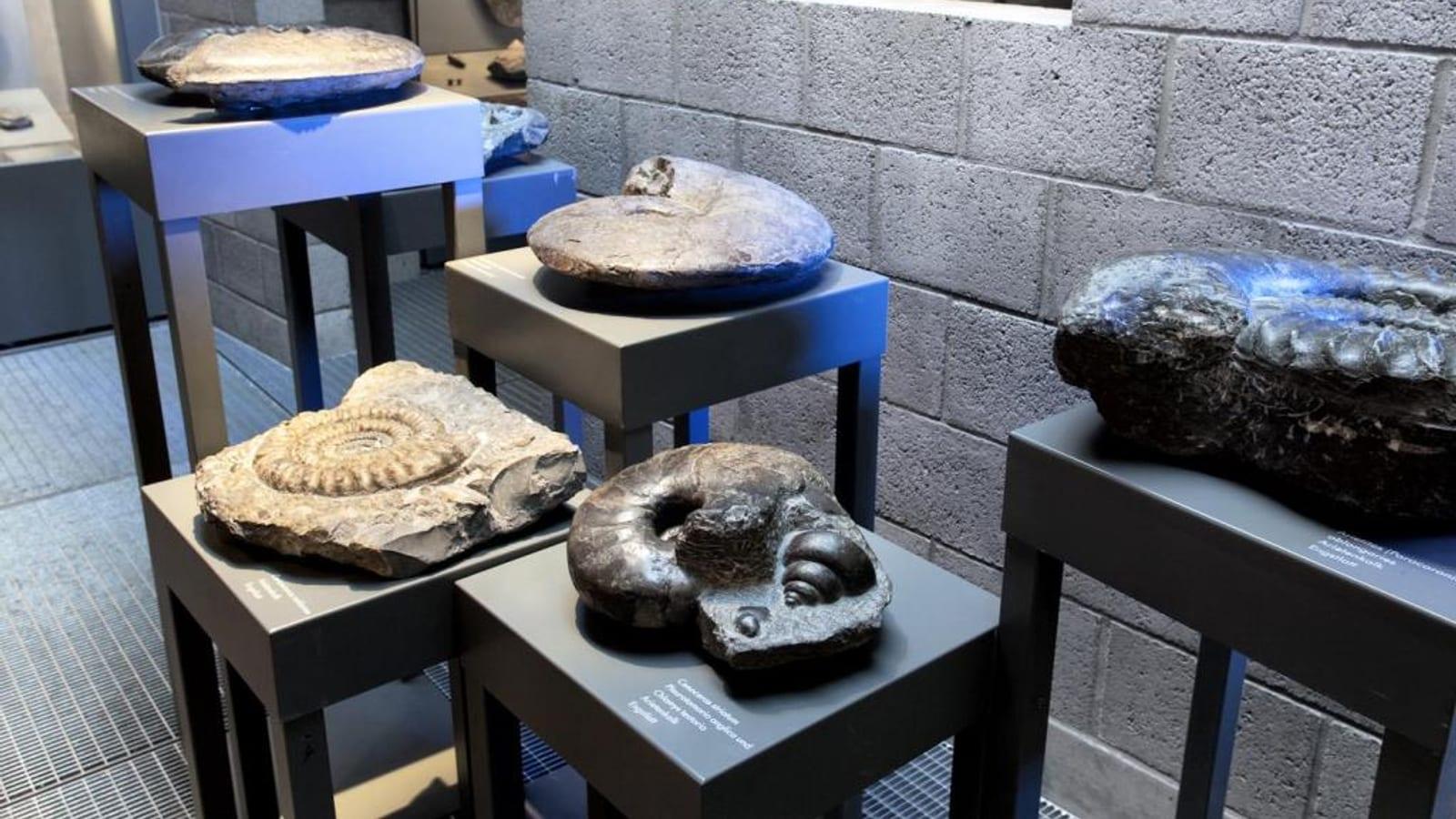
Werkforum Dotternhausen sits on the western edge of the Swabian Alb in Baden-Württemberg, where the Holcim cement plant has been working the Toarcian Posidonia Shale for cement and oil shale since 1939. The black, organic-rich shale here is one of the most productive Jurassic fossil units in Europe, and the company has long run a public-facing operation that combines a free natural-history museum with a free Klopfplatz, an outdoor "hammering yard" stocked with fresh shale slabs from the active quarry. Visitors split slabs and keep what they find. Ammonites turn up almost every session, belemnites are abundant, and the shale also produces fish, bivalves, crinoids, and occasional fragments of marine reptile bone. The museum itself displays prepared ichthyosaurs, marine crocodiles, and large ammonite plates from the same quarries. This guide covers how to reach Dotternhausen, what the Klopfplatz produces, the geology of the Toarcian anoxic event that preserved the fauna, and the rules that govern collecting at a working industrial site.
Location and Directions
Dotternhausen is a small village in the Zollernalbkreis district of Baden-Württemberg, on the southwestern edge of the Swabian Alb.
The address is Werkforum, Heerweg 5-7, 72359 Dotternhausen, Germany. From Stuttgart, take the A81 motorway south for about 80 kilometres towards Rottweil. Exit at Empfingen and follow the B27 federal road south for about 8 kilometres to Dotternhausen. The Werkforum is signed from the B27 and has its own visitor car park. From Tübingen, the B27 takes you straight south to Dotternhausen in about 50 kilometres. From Freiburg in the southwest, the route is A5 north, then east to the A81 at the Bad Dürrheim area, then north to the Rottweil exit and onto the B27 south, around 120 kilometres in total.
The Werkforum building houses the museum, the ticket desk, the shop, and the entrance to the Klopfplatz. The Klopfplatz itself is in an open yard adjacent to the museum, with covered work tables, hammering stations, and supplied shale slabs.
The site keeps reduced and seasonal hours. It is normally closed on Mondays and on some major German public holidays, with extra closures around Christmas. Always check the Holcim Süddeutschland Werkforum page for current opening times and special collecting events before driving out.
There are restrooms, a small gift shop, and parking on site. The village of Dotternhausen has cafes and a few small restaurants within a short drive.
What Fossils You'll Find
You collect from slabs of fresh Posidonia Shale (also called Posidonienschiefer) brought to the Klopfplatz from the active quarry. The shale splits cleanly along bedding planes, and most fossils sit flat between layers as compressed, often pyritic, films.
- Ammonites. The most reliable find. Harpoceras falciferum and Hildoceras bifrons are the two species used to define the substages of the Toarcian, and both are common at Dotternhausen. Dactylioceras commune is also widespread, often as multiple specimens on a single bedding plane. Diameters typically range from 1 to 8 centimetres.
- Belemnites. Abundant. The cigar-shaped calcite guards weather out as solid, robust fossils and are some of the easiest finds for first-time collectors.
- Bivalves. Thin-shelled Bositra (formerly called Posidonia) bivalves give the shale its name and cover many bedding surfaces in dense pavements.
- Fish. Articulated small bony fish, especially Leptolepis and Pholidophorus, occur on fresh slabs. Whole fish are uncommon but occur often enough that most regular visitors eventually find one.
- Crinoids. Seirocrinus and Pentacrinites fragments. Complete crinoid plates with stems and crowns are museum-grade. Small column fragments are common in the Klopfplatz.
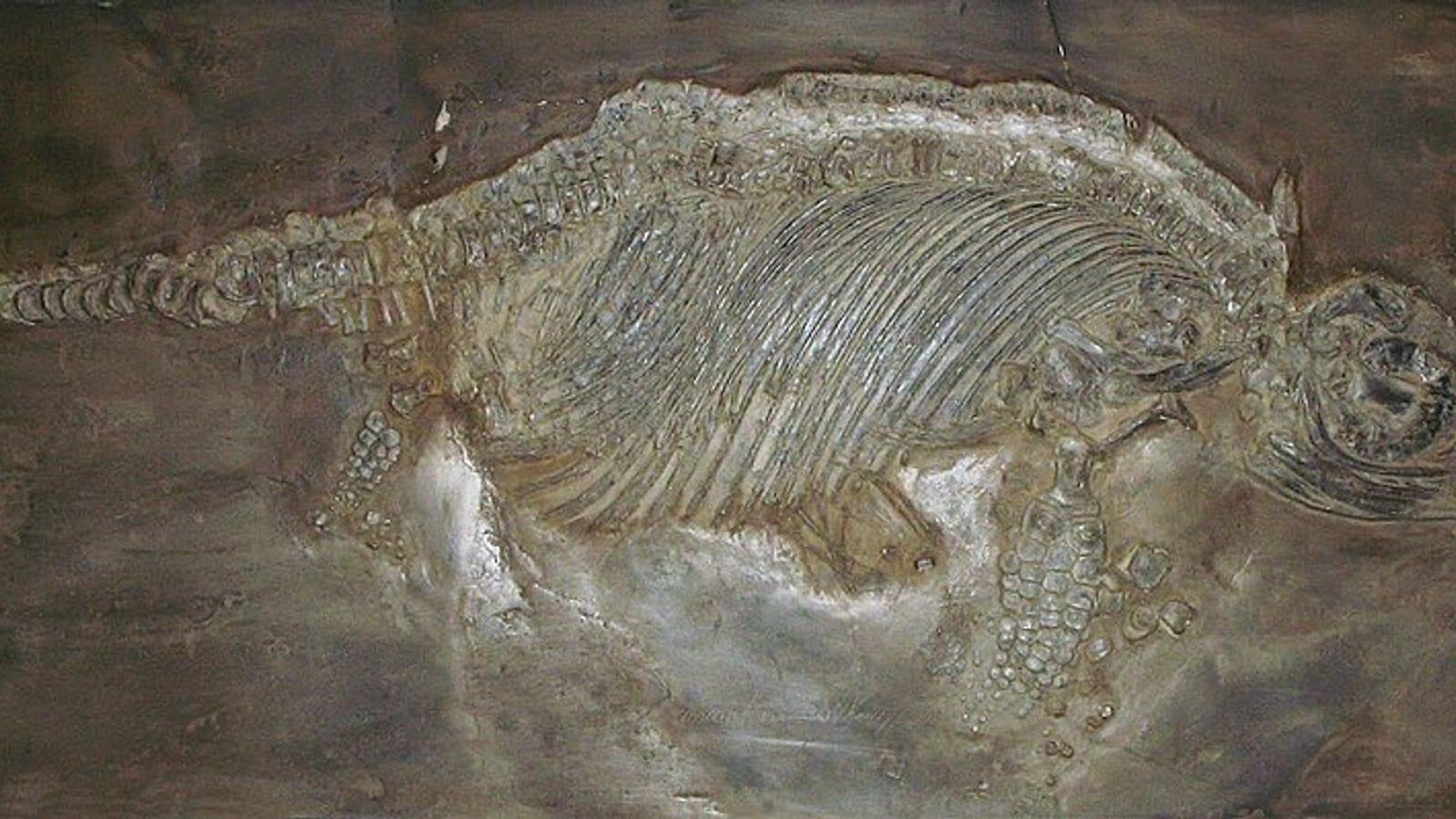
- Marine reptile bone. Small bone fragments of ichthyosaurs, plesiosaurs, and marine crocodiles turn up occasionally. Articulated material is rare and is normally retained by the operator.
- Insects, plants, and rare oddities. Wood, occasional driftwood with bored Teredo-like traces, and rare insects appear at low frequency.
The museum next door displays the highest-quality finds, including complete ichthyosaurs and marine crocodiles prepared on site. Looking through the museum first is the easiest way to learn what to look for in your slab.
Geologic History
The Posidonia Shale belongs to the Toarcian Stage of the Early Jurassic, deposited during the Toarcian Oceanic Anoxic Event roughly 183 to 182 million years ago. In the German stratigraphic system, the unit corresponds to the Lias epsilon, and the Posidonia Shale specifically to the Posidonienschiefer-Formation.
During the Toarcian, much of central and northwestern Europe was covered by an epicontinental sea, the southern margin of which connected to the Tethys Ocean. The seafloor across what is now southern Germany lay at moderate depth, perhaps a few tens to a few hundred metres. Global climate was warm, sea level was high, and ocean circulation in this restricted shelf sea was poor. Bottom waters became persistently low in oxygen and, in places, fully anoxic, accumulating a layer of fine, organic-rich black mud. The same event is recorded in the Whitby Mudstone of Yorkshire and in equivalent units across France, Switzerland, and Luxembourg.
The anoxic bottom kept scavengers and burrowing organisms out, which is why preservation in the Posidonia Shale is so good. Carcasses sank into the mud, were sealed off from oxygen, and survived as flat compressions with original carbonate or pyritised soft-tissue outlines. The bivalve Bositra lived as a near-bottom suspension feeder and at times covered the seafloor in dense layers. Above the seafloor, the water column was healthy: ammonites, belemnites, fish, and marine reptiles thrived and contributed steadily to the rain of organic material that eventually preserved them.
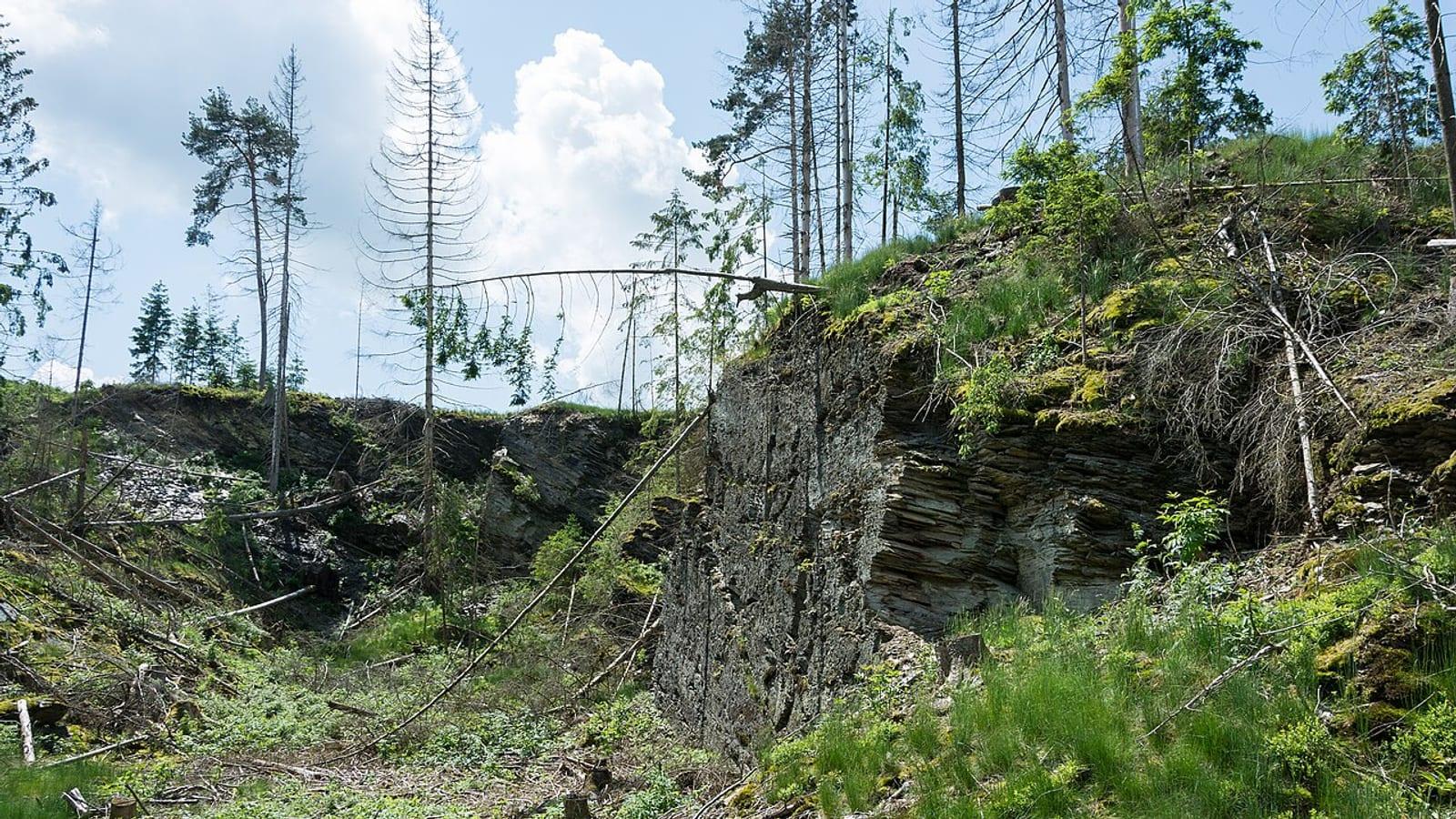
After the Toarcian, the rocks were buried and gradually compacted into the laminated, slightly oily black shale we see today. Cenozoic uplift along the Swabian Alb's structural front exposed the unit close enough to the surface that 19th and 20th century industry could quarry it. The shale's natural oil content makes it doubly useful as a cement raw material, since it both contributes mineral content and burns off some of its own fuel during cement production.
How Werkforum Dotternhausen Became a Fossil Collecting Site
The Dotternhausen quarry has been operated since 1939 by the local cement works, now part of the Holcim group as Holcim Süddeutschland. From the start, quarry workers were turning up well-preserved fossils, and the company put in place a professional fossil preparation department to recover, study, and preserve the best specimens.
In 1989 the company opened the Werkforum, a public-facing centre combining a free natural history and industrial heritage museum with the free Klopfplatz collecting yard. The arrangement allows visitors to see prepared museum-grade specimens and then go next door and collect their own from the same beds. The preparation lab continues to work with researchers from the University of Tübingen and other institutions on significant ichthyosaur and marine crocodile finds, and these specimens often end up on display in the museum's main hall.
The model has held up: collecting has been continuous for over thirty years, the museum has expanded several times, and the public Klopfplatz remains one of the few places in Germany where members of the public can legally hammer fresh Posidonia Shale.
Collecting Rules and Regulations
Public collecting is allowed only at the Klopfplatz. The active quarry itself is not open to visitors.
- Check in at the Werkforum reception. Both the museum and the Klopfplatz are free, and hammers, chisels, and safety glasses are lent out at reception at no charge. Confirm current arrangements and opening times on the Werkforum website before visiting.
- Tools are provided: rock hammers, splitter wedges, work surfaces, and safety glasses. Safety glasses are mandatory whenever you are striking a hammer.
- Bring sturdy containers and newspaper or bubble wrap to protect specimens on the journey home.
- Stay inside the marked Klopfplatz boundary. Do not enter the quarry, climb stockpiles, or cross any internal fences. The site is an active industrial operation and unauthorised access can lead to closure of the public collecting programme.
- All invertebrate finds and small fish may be kept for personal collections. Significant vertebrate material, especially partial or complete ichthyosaurs, plesiosaurs, marine crocodiles, or other articulated tetrapod remains, must be reported to staff and is normally retained by the Holcim preparation lab for scientific study.
- Photography for personal use is allowed throughout the museum and Klopfplatz. Commercial photography requires permission.
- The site is wheelchair-accessible at the museum and shop level. The Klopfplatz has a partly hard surface and is usable by most visitors with mobility aids.
Nearby Alternative: SchieferErlebnis Dormettingen
About 3 km northwest in Dormettingen, the SchieferErlebnis park offers a second public collecting area in the same Toarcian Posidonia Shale. Searching the shale and keeping your finds is free, including 180-million-year-old ammonites. You may bring your own hammer and chisel, and the park lends tools at the restaurant entrance for a small fee or deposit while supplies last. The park adds walking paths and family facilities around the old oil-shale workings, which makes it an easy second stop on a Dotternhausen trip or a fallback when the Werkforum is closed. Check the SchieferErlebnis website for current hours and any event-day arrangements.
Safety
The Klopfplatz is a hammering yard, so the hazards are the ones that come with striking rock, and the site manages them well.
Safety glasses are mandatory whenever a hammer is in your hand, and reception lends them free along with the hammers and chisels. Posidonia Shale splits into thin plates with sharp edges and throws small fragments when struck. Wear the glasses even for a light tap, and keep other people out of the arc of your swing.
Wear closed shoes and gloves. The shale edges cut, the slabs are heavier than they look, and dropped rock on an open toe is the most common injury in any hammering yard. The dust marks soft fabrics permanently, so do not wear anything you care about.
Children must be supervised at all times. The yard is set up to be family-friendly, but hammers and shale shards are not, and an unsupervised child with a hammer is the one thing that would put this arrangement at risk.
Stay inside the marked Klopfplatz boundary. The quarry beyond it is an active cement operation with heavy plant, blasting, and steep faces.
Pyrite is present in many Posidonia specimens, and pyritic shale oxidises in storage, producing acid that destroys the fossil and can damage what is stored beside it. Wash your hands before eating, and keep new material dry and separate until you know how it behaves.
The yard is partly covered, but the Swabian Alb is cold and wet for much of the year. Take a warm layer and waterproofs, and check the Werkforum opening times before driving out, since the site closes on Mondays and around some German public holidays.
Sources
- Holcim Süddeutschland. "Werkforum Dotternhausen and Fossilienfundstelle." https://www.holcim-sued.de/de/werkforum/fossilienfundstelle
- Zollernalb Tourism. "Fossilienmuseum Dotternhausen mit Klopfplatz." https://www.zollernalb.com/attraktionen/fossilienmuseum-dotternhausen-mit-klopfplatz-ead9362fef
- Gemeinde Dormettingen. "Fossilien-Klopf- und Sammelplatz, SchieferErlebnis." https://www.schiefererlebnis.de/aktivitaeten/fossilien-klopf-und-sammelplatz/
- Hauff, B. and Hauff, R.B. Das Holzmadenbuch. Holzmaden, 1981 (standard reference for Posidonia Shale fauna of southwest Germany).
- Röhl, H.-J., Schmid-Röhl, A., Oschmann, W., Frimmel, A., and Schwark, L. "The Posidonia Shale (Lower Toarcian) of SW-Germany: an oxygen-depleted ecosystem controlled by sea level and palaeoclimate." Palaeogeography, Palaeoclimatology, Palaeoecology, 2001.
- Landesamt für Geologie, Rohstoffe und Bergbau Baden-Württemberg (LGRB). "Posidonienschiefer-Formation." https://www.lgrb-bw.de/
- University of Tübingen, Department of Geosciences. Posidonia Shale research pages.
Nearby sites
 Schiefererlebnis Dormettingen Fossil Klopfplatz Fossil Hunting GuideAmmonites
 Nusplingen Plattenkalk Museum Fossil Klopfplatz Fossil Hunting Guideangel sharks, pterosaurs
 Urweltsteinbruch Holzmaden Posidonia Shale Fossil Hunting GuideAmmonites, Ichthyosaur
 Schieferbruch Kromer Ohmden Posidonia Shale Fossil Hunting GuideAmmonites, Belemnites