Lyme Regis Church Cliffs Fossil Hunting Guide
Image: Colin Smith (CC BY-SA 2.0)
Church Cliffs at Lyme Regis exposes Early Jurassic Blue Lias with ammonites, belemnites, and marine reptile remains on the Dorset UNESCO World Heritage coastline.
By Edward Chen · Updated 30 July 2026
 Photo: David Smith, CC BY-SA 2.0 via Wikimedia Commons
Introduction
Church Cliffs at Lyme Regis are where Early Jurassic palaeontology effectively began. The Blue Lias cliffs east of the town harbour produced the first scientifically recognised ichthyosaur skeleton, excavated by Mary Anning in 1811 and 1812 when she was around 12 years old. The same cliffs and foreshore continue to yield ammonites, belemnites, bivalves, fish, and occasional marine reptile remains from sediments deposited in a warm subtropical sea approximately 200 million years ago. Church Cliffs form the western anchor of the Charmouth Mudstone exposures that extend east towards Charmouth, and the Blue Lias Formation here is both the type locality for that formation name and a critical reference section for Lower Jurassic stratigraphy worldwide. This guide covers how to reach the site, what you will find, and how to collect within the rules that apply to this UNESCO World Heritage Site.
Lyme Regis offers supporting facilities that make it one of the most approachable fossil sites in Britain. The town has car parks, fossil shops, the Lyme Regis Museum (in Mary Anning's former home), and cafes within walking distance of the collecting area.
 Photo: MichaelMaggs, CC BY-SA 3.0, via Wikimedia Commons
Location and Directions
Address
Church Cliffs, accessed from Lyme Regis town centre and harbour, Lyme Regis, Dorset DT7 3JQ, England.
Directions and Parking
Lyme Regis is reached from the A35 between Bridport and Axminster. Take the A3052 into town. Several car parks serve the site, ranging in distance from the beach. The most convenient for Church Cliffs is Cobb Gate Car Park (postcode DT7 3QD), with 17 spaces about 100 metres from the museum. This is small and fills early in summer. Monmouth Beach Car Park (postcode DT7 3LE) offers 282 combined spaces (with Cabanya Car Park) at the seafront with public toilets and EV charging. For longer stays at lower cost, Holmbush Car Park (postcode DT7 3HX, 393 spaces) and Charmouth Road Car Park (postcode DT7 3DR, 386 spaces) are both a ten-minute walk downhill to the beach. Most car parks are pay and display accepting cash or card. The JustPark app works at most Dorset Council sites.
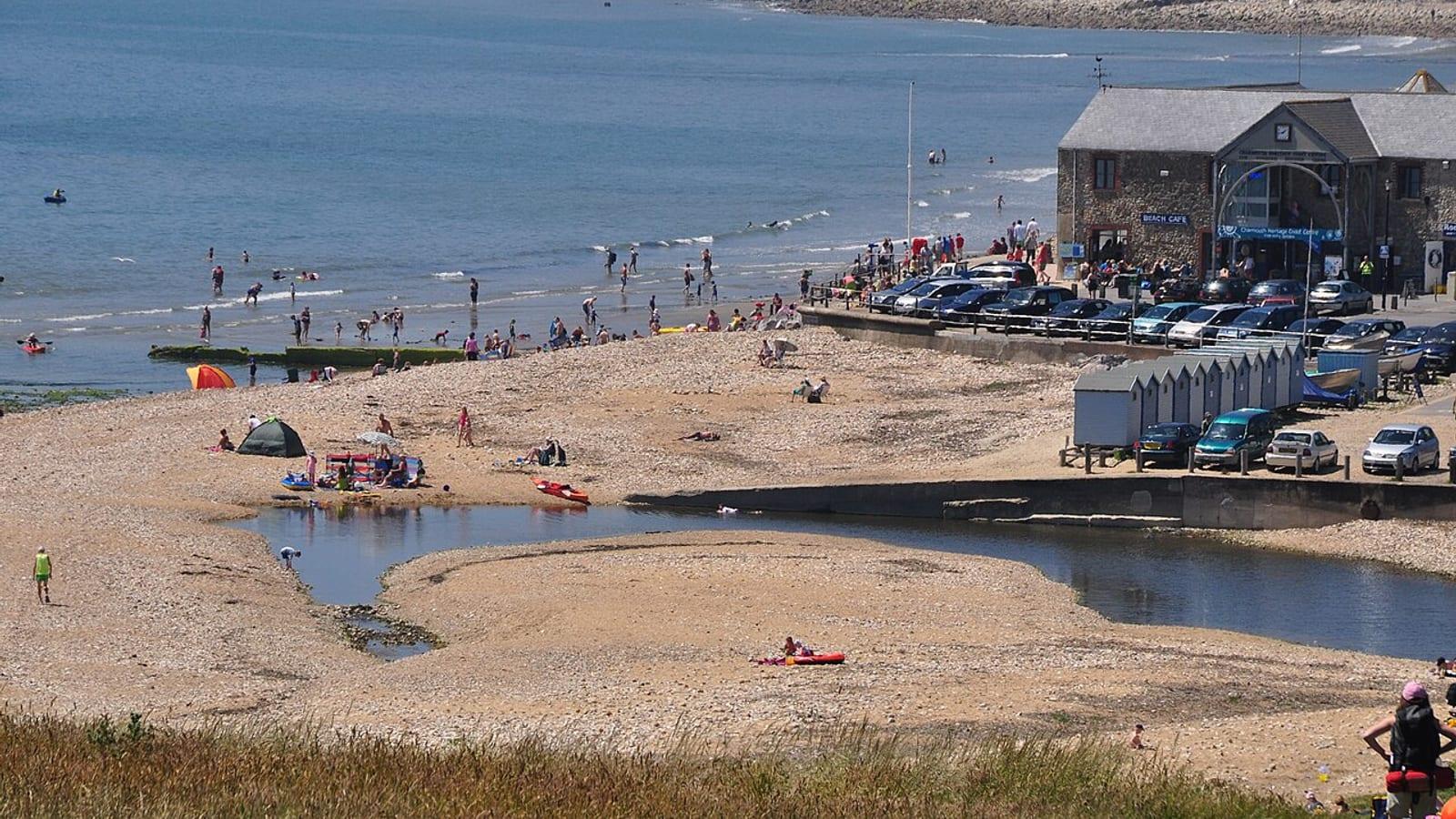
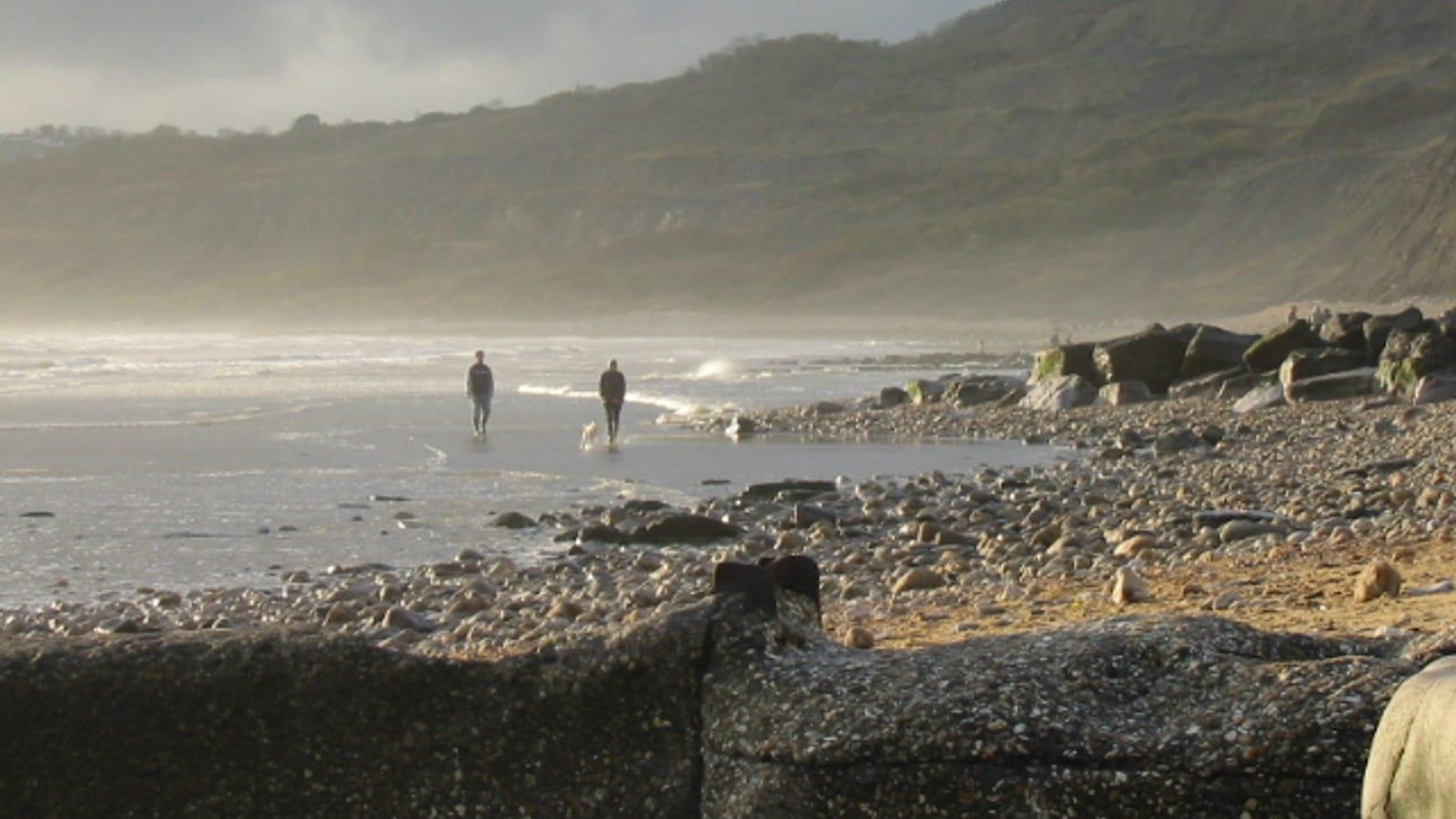
From any car park, walk to the harbour and then east along the foreshore. Church Cliffs are the layered Blue Lias cliffs visible immediately east of the town, characterised by alternating bands of grey limestone and darker shale. Access to the foreshore is straightforward at low and mid tide. At high tide, the beach narrows significantly and foreshore access is lost. Plan your visit within two hours of low water for maximum collecting time. A tide table is available from the Heritage Coast Centre at Charmouth or from standard online sources.
What Fossils You'll Find
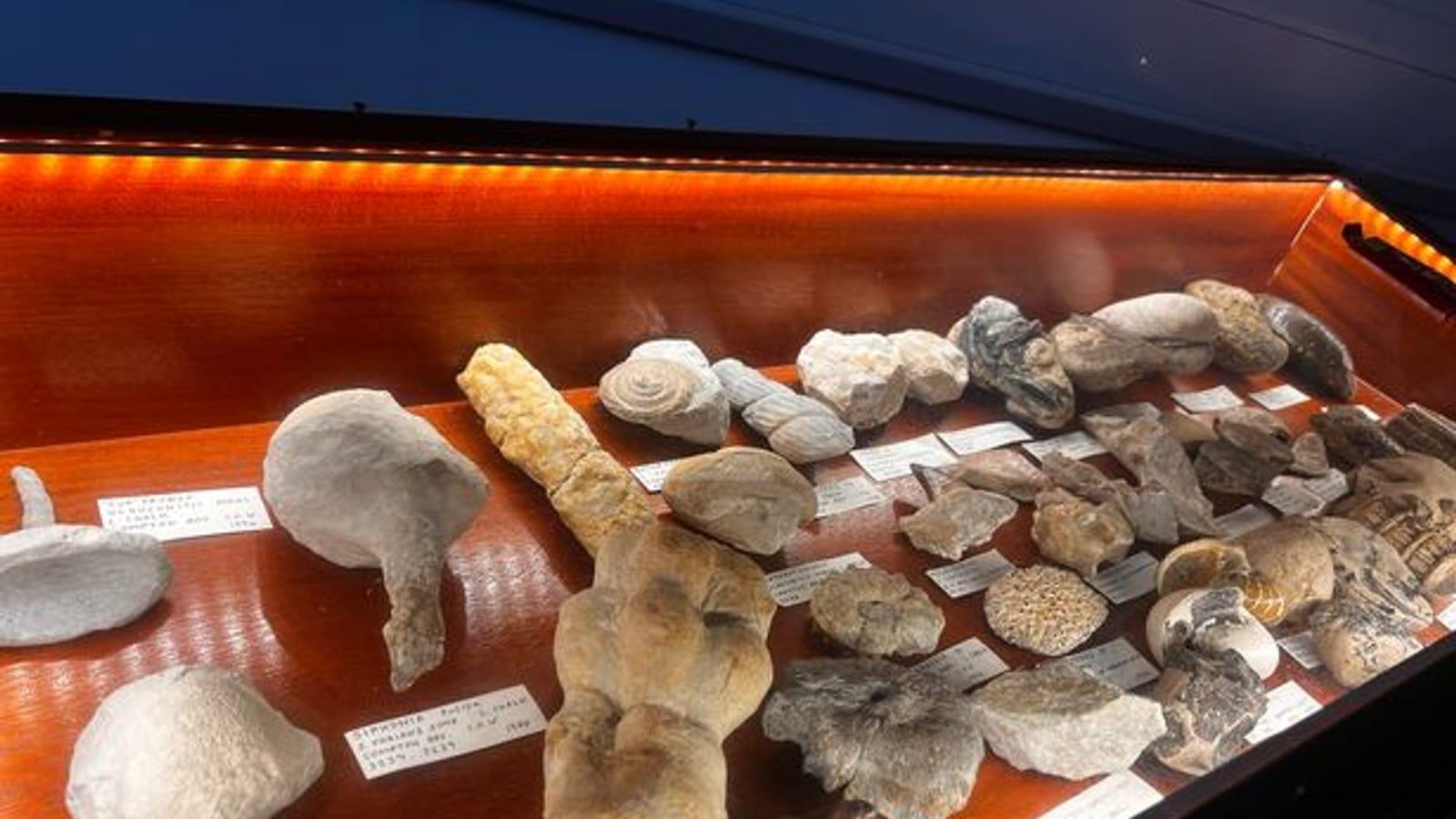
Belemnites are extremely common and require no particular skill to find. The bullet-shaped calcite guards wash out of the shale and accumulate on the foreshore in large numbers. They are useful as a calibration find: if you can find belemnites, you are in a productive area.
Bivalves including the distinctive curved oyster Gryphaea, sometimes called the Devil's Toenail, are abundant in the limestone beds. They are robust and preserve well. Other bivalve species are common in the shale.
Crinoids occur as disarticulated ossicles and occasional partial stems in the limestone. Complete specimens are rare but recognised by their star-shaped cross section. Brachiopods and gastropods are present but less common than the above.
Marine reptile remains, including ichthyosaur vertebrae, ribs, and occasional skull or flipper elements, are found infrequently but regularly enough that Church Cliffs has a reputation for producing them. The majority of significant reptile finds come from nodules in the upper shale units rather than directly from cliff faces. If you find what appears to be a large vertebra or bone, do not attempt to extract it from rock. Photograph it in situ and report it to the museum.
Fish remains including scales and teeth are found in the finer shale layers. Coprolites (fossilised droppings) are also present. Mary Anning worked with geologist William Buckland to identify these correctly, and they are still found here today.
"Ammonite, belemnite and crinoid fossils are plentiful and easily found on these beaches. The famous fossil collector Mary Anning found the first correctly identified Ichthyosaur skeleton and the first two nearly complete Plesiosaur skeletons here.". Visit Dorset
 Photo: Linas Juozėnas, CC BY-SA 4.0, via Wikimedia Commons
Geologic History
The Ancient Environment
The Blue Lias Formation at Church Cliffs was deposited during the earliest Jurassic period, in the Hettangian and Sinemurian stages, approximately 201 to 190 million years ago. Britain at this time lay at a paleolatitude of around 30 to 35 degrees north, roughly equivalent to modern Morocco, in a warm, shallow subtropical sea. The supercontinent Pangaea was beginning to break apart, and the Atlantic Ocean was only beginning to open. The sea that covered southern Britain was warm, with surface water temperatures estimated at 15 to 20 degrees Celsius, supporting diverse marine life including ichthyosaurs, plesiosaurs, ammonites, fish, and abundant invertebrates.
The characteristic alternation of limestone and shale that makes the Blue Lias so recognisable results from cyclic variations in sea level and productivity driven by orbital forcing, the same Milankovitch cycles that drive modern ice ages. During limestone-forming periods, calcareous organisms thrived in better-oxygenated conditions. During shale-forming periods, the seafloor became oxygen-depleted and organic matter accumulated in the dark muddy sediment, creating conditions favourable for preserving soft tissues and creating black shales that are now important petroleum source rocks in the Wessex Basin and the North Sea.
How Church Cliffs Became a Fossil Collecting Site
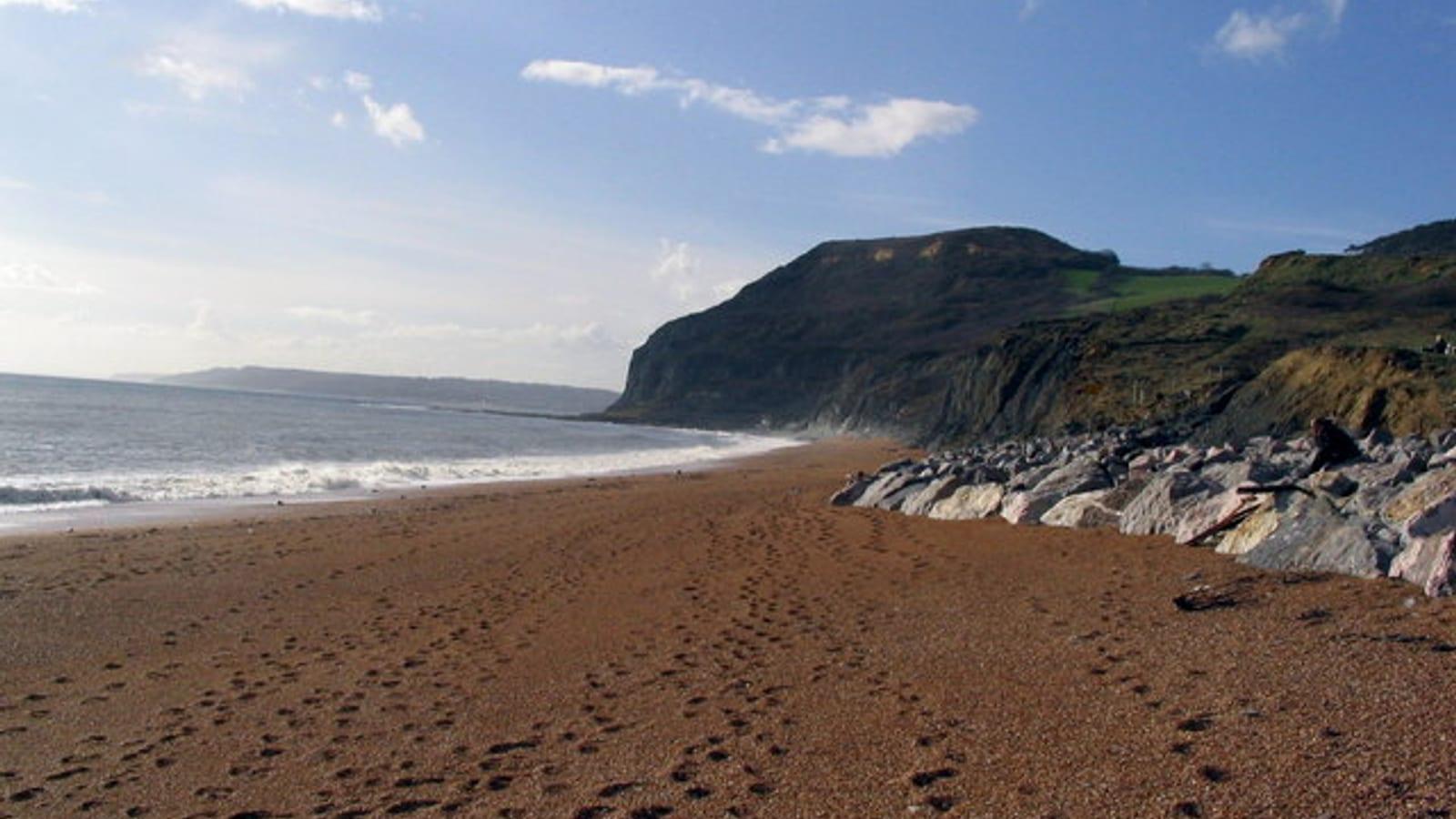
The cliffs at Church Cliffs are subject to continuous natural erosion by wave action and weathering. The Blue Lias is a relatively soft rock, and winter storms and high tides regularly undercut the cliff base, triggering falls that release fossil material onto the foreshore. The foreshore is then scoured by the sea, breaking down the fallen blocks and distributing individual fossils across the beach. This ongoing process means that new material is available after every significant storm. The same erosion makes the cliffs themselves dangerous, and fresh falls can be unpredictable.
Collecting Rules and Regulations
Is Fossil Collecting Allowed?
Collecting loose fossils from the beach and foreshore at Church Cliffs is permitted and does not require a permit. This is standard foreshore access in England: you are allowed to pick up loose material already on the beach for personal, non-commercial use. The site carries SSSI designation and is part of the UNESCO Jurassic Coast World Heritage Site. Both of these designations prohibit hammering cliff faces, breaking in-situ rock, and any bulk or commercial extraction. You must not use tools on the cliff or in-situ bedrock. Collecting for personal use from loose beach material is legal and widely practised here. If you find significant vertebrate material such as ichthyosaur or plesiosaur bones, you are encouraged to report it to the Lyme Regis Museum, which has expert staff who can assess the find and see that it is properly documented.
Recommended Tools
Bring a small trowel or wooden spatula to shift loose shingle and examine material near the cliff base. A hand lens at 10x magnification is useful for examining small specimens. Bring sealable bags, small boxes padded with tissue or foam for fragile finds, and a bucket or container to rinse specimens in seawater on the beach. A geological hammer is not necessary and should not be used on cliff faces or in-situ rock at this site.
Safety
Church Cliffs are actively eroding and rockfall is a genuine hazard. Do not stand beneath the cliff face at any time. The most productive collecting is done on the open foreshore, away from the cliff base. The foreshore becomes dangerously inaccessible at high tide. Always check tide times before going onto the beach east of the harbour. The foreshore here consists of irregular limestone ledges, loose shingle, and boulders. Ankle injuries are common among visitors not wearing appropriate footwear. Wear waterproof boots with ankle support. The path along the top of Church Cliffs is unfenced and close to the edge in places. Keep children away from the cliff top.