Spain Fossil Sites Guide
6 Best Fossil Sites in Spain
Spain protects its best fossil localities instead of opening them to collectors. Five of the six sites here are viewing only, and Atapuerca admits visitors on a booked guided tour. None of the six permits collecting, so plan a trip around rock in place rather than a bag of finds. What Spain gives you instead is the footprint, or ichnite, on the bedding plane where the animal made it, backed by regional museums that hold the bones. Most of the outdoor tracksites cost nothing to walk, and the museums charge between 3 and 7.21 euros.

6 fossil sites
Updated 1 October 2026
Rift basins, a karst lake, and a cave sequence
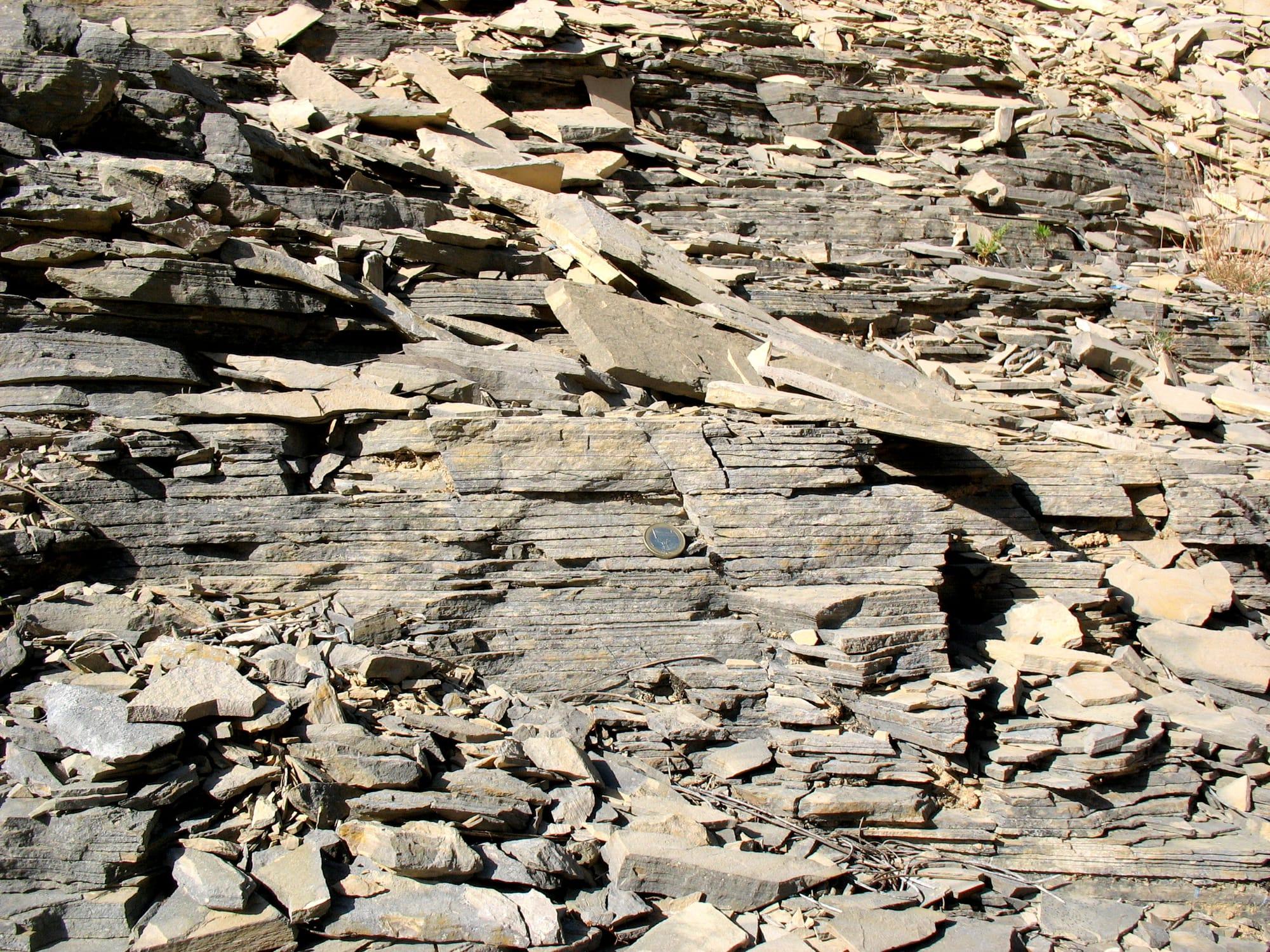
Four of these six sites record the same geological story from different angles. As Iberia pulled away from the European plate in the latest Jurassic and Early Cretaceous, rift basins opened across the interior and filled with river, lake and marsh sediment. The Cameros Basin took in the Tera and Oncala groups around Salas de los Infantes, dated to roughly 150 to 125 million years, and the Enciso Group at Enciso, dated to roughly 135 to 118 million years. At Galve the stacked Villar del Arzobispo and El Castellar formations cover a comparable interval on a coastal plain with meandering rivers and seasonally dry mudflats. In each case dinosaurs crossed damp lake and channel margins, flood pulses buried the prints under fresh sand, and the surfaces hardened. The Asturian coast at La Griega preserves the same process in the Kimmeridgian Tereñes Formation, where lagoon mud took sauropod prints up to 125 cm across.
The other two sites sit outside that pattern. Las Hoyas formed in shallow alkaline karst lakes on an Early Cretaceous subtropical floodplain, and the 2023 Journal of the Geological Society overview by Buscalioni and Fregenal-Martínez reads the deposit as three zones: a marginal swamp, a shallow lacustrine belt, and a deep anoxic basin where microbial mats and rapid carbonate precipitation locked whole animals onto bedding planes. That is why the fur of Spinolestes xenarthrosus and the feathers of Eoalulavis hoyasi survive. Atapuerca is younger by two orders of magnitude. Groundwater dissolved uplifted Cretaceous to Eocene limestone into a cave network, the Arlanzón valley cut down and opened the entrances, and sediment with bones and stone tools filled them passively from about 1.4 million years ago to the Holocene. Alpine compression later inverted the Iberian basins, and modern streams and quarries expose the productive beds at all six localities.
- 1
Atapuerca Archaeological Site Fossil Guide
Castile and León, Spain
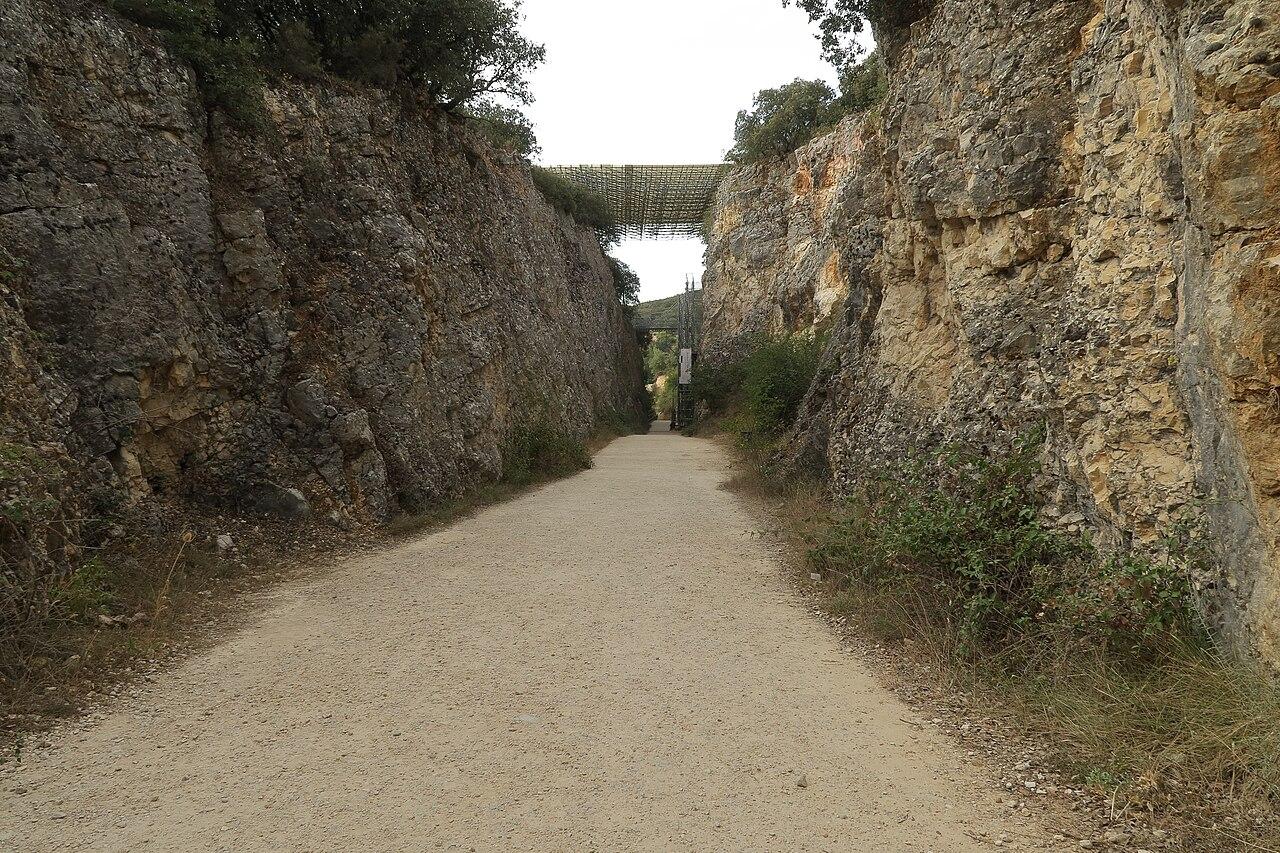
Guided toursHominin remainsHomo antecessorCave bearsThe Sierra de Atapuerca is a low limestone ridge about 20 km east of Burgos, and its cave fills hold the deepest early-hominin record in Europe. UNESCO inscribed the site in 2000 as Site 989. A jaw fragment from Sima del Elefante is dated to roughly 1.2 to 1.4 million years and read as the oldest hominin material in western Europe, and the Gran Dolina excavation is the type locality of the species named from level TD-6 at about 800,000 years. Access is by booked guided tour only, staged from the site access center at Ibeas de Juarros, with a site bus up to the Trinchera del Ferrocarril and no independent vehicle access. Nothing may be collected or touched, and the original fossils are on display at the Museum of Human Evolution in central Burgos.
Read the full guide → - 2
Las Hoyas Lagerstätte Fossil Hunting Guide
Cuenca, Castilla-La Mancha, Spain
Viewing onlyConcavenator corcovatus (carcharodontosaurid)Iberomesornis romerali (early bird)Spinolestes xenarthrosus (mammal)Las Hoyas is the soft-tissue site on this list, an Early Cretaceous lake deposit in the Serranía de Cuenca with more than 20,000 cataloged fossils. The laminated limestone of the La Huérguina Formation has preserved mammal fur, dermal spines, feather impressions, a theropod throat sac and gut contents. The field site itself is gated and closed outside scheduled research work, so the visit is the Museo de Paleontología de Castilla-La Mancha in Cuenca, which holds the type specimens and charges 5 euros for an adult. Cuenca is about an hour from Madrid on the high-speed line, which makes this the easiest site here to reach without a car. Go for prepared specimens under glass rather than rock in the field.
Read the full guide → - 3
Salas de los Infantes Dinosaur Sites Fossil Hunting Guide
Burgos, Castile and León, Spain
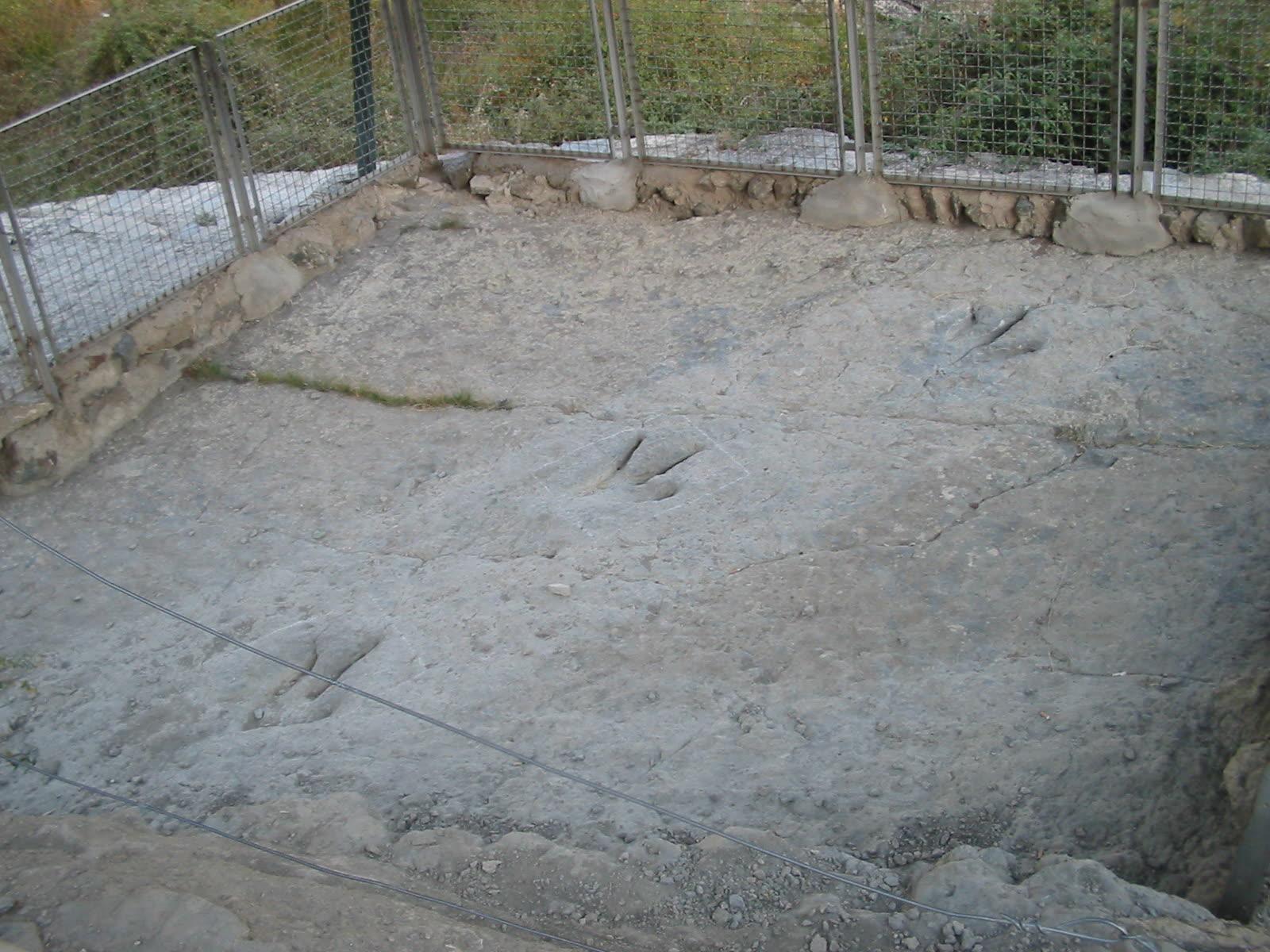
Viewing onlyDemandasaurus darwini (sauropod)Europatitan eastwoodiIniestapodus burgensis (theropod track)Salas de los Infantes is the densest cluster of tracksites in this guide, with more than 60 of them mapped across the hills of southeastern Burgos along with 15 bone localities. The Costalomo surface alone carries 239 Lower Cretaceous footprints and supplied the type material for a theropod ichnospecies named in 2014. The Las Sereas megafield adds stegosaur, sauropod and theropod trackways on several bedding planes. A signposted driving itinerary, the Land of Dinosaurs Route, links the sites across about 60 km of paved and gravel road, and the trailside stops are free. The Dinosaur Museum on the town plaza charges 3 euros and holds the two sauropod type specimens described from the district.
Read the full guide → - 4
Galve Dinosaur Trail Fossil Hunting Guide
Teruel, Aragón, Spain
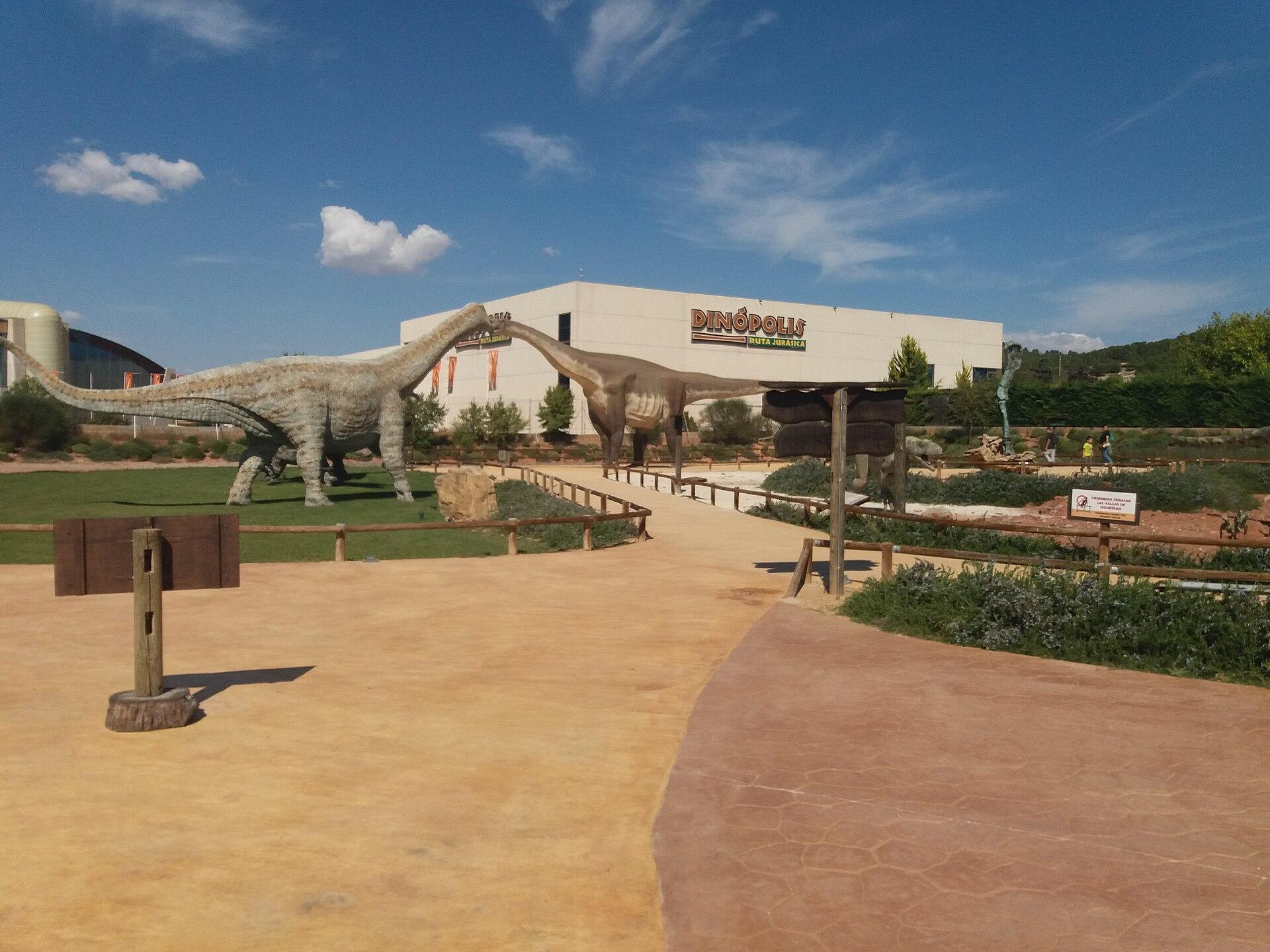
Viewing onlySauropod trackwaysTheropod footprintsOrnithopod footprintsThe Sendero de los Dinosaurios at Galve is the best single walk on this list, a free 3 km loop through the Maestrazgo UNESCO Global Geopark with four protected tracksites and five life-size reconstructions along it. The largest sauropod print at the Las Cerradicas stop measures about 80 cm across, and parallel ornithopod trackways there are read as a small herd. Galve also matters historically, because the hillside above the village produced the first dinosaur ever named from Spain, found in 1958 and described in 1987. Allow two to three hours for the loop plus the stops, and add the village museum for the body fossils at 3 euros. Walking on the trackway surfaces is not permitted, and nothing may be collected.
Read the full guide → - 5
Playa de La Griega Fossil Hunting Guide
Asturias, Spain
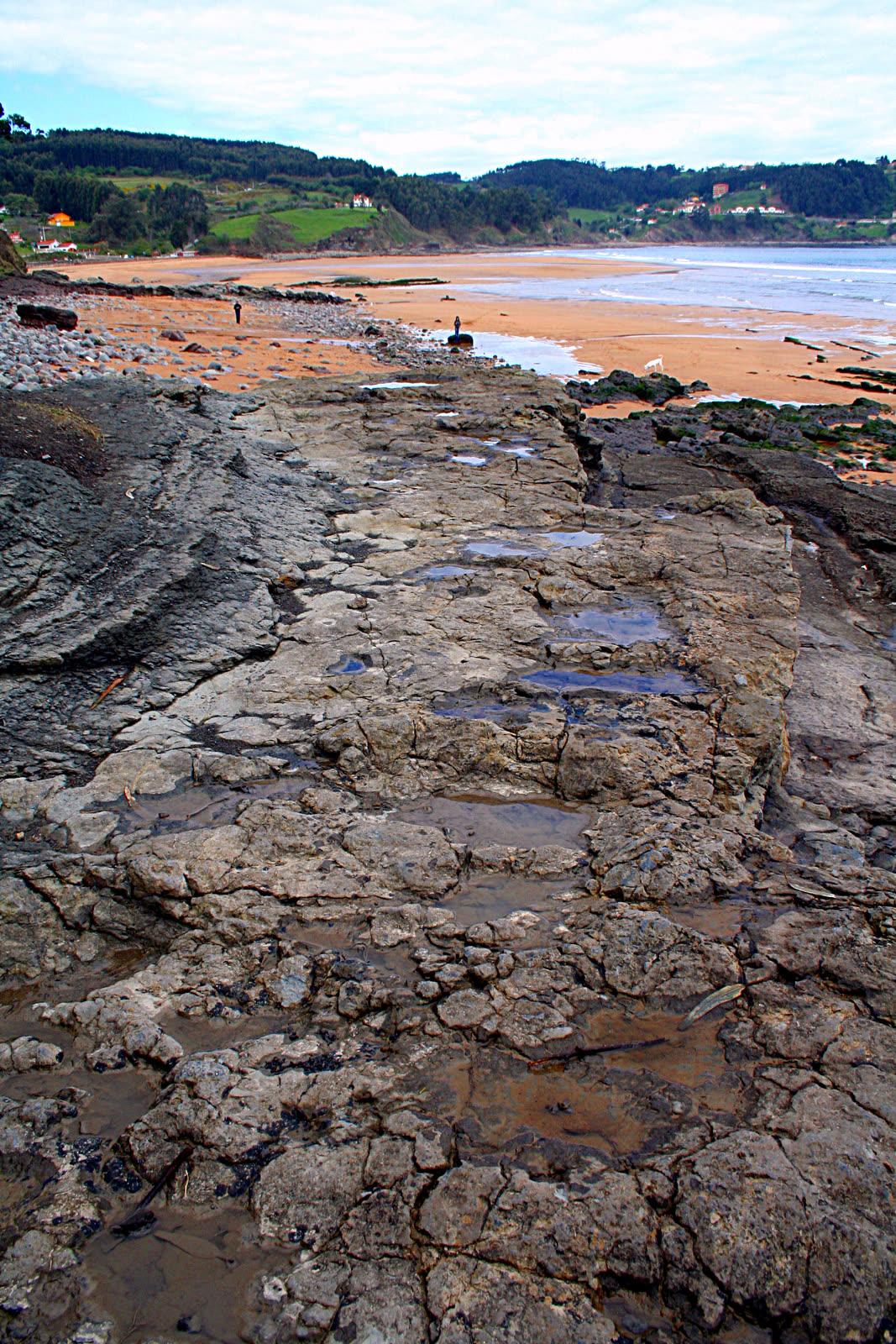
Viewing onlySauropod footprintsDinosaur trackwaysFreshwater gastropodsPlaya de La Griega is the one coastal site in this guide, and the sauropod prints on the limestone platform at the east end of the beach are the largest Jurassic tracks recorded anywhere, according to Spain's geological survey. Measured pes impressions run from 98 to 125 cm across, each ringed by a rim of mud the animal pushed out as it stepped. A municipal trail of about 1.5 km leads from the east side of the beach to a staircase above the platform, free of charge, with roughly 125 m of ascent. Check a tide table first, because the return along the sand depends on the water. The tracks are a protected Natural Monument, so look and photograph but do not dig, mark or remove anything.
Read the full guide → - 6
Valdecevillo and the Enciso Dinosaur Tracks Fossil Hunting Guide
La Rioja, Spain
Viewing onlyDinosaur tracksTheropod tracksOrnithopod tracksEnciso holds about 1,400 recorded dinosaur tracks in the Early Cretaceous Enciso Group, and Valdecevillo is the place to start on them. A trail climbs past four sheltered theropod prints from animals 7 to 10 m long, three parallel ornithopod trackways read as two adults with a juvenile between them, and a 59-track sauropod sequence with both hand and foot prints. A circular 7 km walk of about 1 hour 50 minutes links Valdecevillo to La Senoba and to La Virgen del Campo, where 506 tracks share a boardwalked surface with skin marks, tail drags and swim traces. The open-air sites cost nothing. The Centro Paleontológico de Enciso charges 5 euros for an adult and runs guided visits at noon on Saturdays and Sundays, which need booking in advance.
Read the full guide →
Planning your visit
When to visit
April through October suits the five inland sites. Salas de los Infantes stands at about 970 m and the Galve trail at about 1,000 m, both with winter frost and occasional snow, and the Las Hoyas valley near 1,200 m can hold ice on its access road. Summer reverses the problem, with 28 to 32 degrees Celsius and almost no shade on open mudstone slopes, so start early. Atapuerca opens most days from April to November, with excavation in June and July and regular English-language tour slots in summer, which you should confirm when booking. The Centro Paleontológico de Enciso opens Wednesday to Sunday, and the Cuenca and Salas museums close on Mondays. La Griega answers to the tide rather than the calendar, and its lifeguard service runs from 1 July to 8 September.
What to bring
Leave the hammer at home, because no site here allows collecting and several ask you to stay behind a chain barrier. Take closed shoes with a firm sole and good grip instead: the trackway slabs are smooth limestone that turns slick when wet, the Atapuerca ridge carries loose scree, and the climb above Valdecevillo is steep. Carry water, a hat and sun cover for every inland walk, since shade is scarce at all of them. Bring a printed map of the Land of Dinosaurs Route around Salas, where mobile coverage is intermittent on the outlying tracksite roads, and a tide table for La Griega. Carry small cash for museum admission and your booking confirmation for Atapuerca, where tour numbers are limited. Tell the Atapuerca visitor center in advance about mobility limits, because the terrain rules out some routes.
Rules and access
Spain protects fossil localities as cultural heritage, not as a collecting resource. Atapuerca, Las Hoyas, the Salas tracksites and the Galve sites are all declared Bienes de Interés Cultural under Spanish Law 16/1985 on Spanish Historical Heritage, with Atapuerca additionally a UNESCO World Heritage Site since 2000. Castilla y León Law 12/2002 adds regional paleontological protection around Salas, La Rioja Decree 34/2000 covers 15 Enciso sites, and Asturian Decree 45/2001 made the coastal ichnite sites a Natural Monument, later a Special Area of Conservation under Decree 170/2014. Removing fossils, sediment or rock from any of them is an offense, and the regional governments require that collecting elsewhere in these formations be reported to the relevant culture department. Research teams dig under regional permit, and no route to such a permit exists for a visitor. In practice: stay on marked paths and boardwalks, keep off the trackway surfaces, photograph freely for personal use, and request drone permission in advance from the Junta de Castilla y León or the Maestrazgo geopark office.
Getting there
Madrid Barajas is the practical gateway for all six, and five of them need a car. For Atapuerca and Salas, drive the A-1 north to Burgos, then 20 minutes east on the N-120 to Ibeas de Juarros for the Atapuerca site bus, or an hour southeast on the N-234 to Salas de los Infantes. Cuenca is the exception: the high-speed line reaches Cuenca-Fernando Zóbel in about an hour from Madrid and an hour and a quarter from Valencia, with a short taxi ride into the city for the museum. Galve lies 35 km north of Teruel by the A-23, the N-420 and two local roads, about 45 minutes from Teruel and two and a half hours from Zaragoza airport. Enciso is about 72 km from Logroño near the Soria border, and the first 1.8 km of the dinosaur trail follows the Enciso to Cornago road, so walk the verge and watch for traffic. For La Griega, take the AS-257 out of Colunga toward Lastres and turn off to the beach after about 1 km, where a car park holds more than 100 vehicles.
These six are every Spanish site documented here so far. Browse the full index of Spanish fossil sites for the current list, which grows as new localities are researched and published.
Frequently asked questions
- Can you collect fossils in Spain at these sites?
- No. None of the six sites in this guide permits collecting, and that is the single most important thing to know before you travel. Five are viewing only and Atapuerca is reached on a booked guided tour. The tracksites at Salas de los Infantes, Galve and Enciso are protected as Bienes de Interés Cultural under Spanish Law 16/1985 on Spanish Historical Heritage, which makes removal of fossils or rock an offense. The Las Hoyas field site carries the same designation and is gated. The La Griega footprints are a Natural Monument under Asturian Decree 45/2001. Research collection happens at several of these localities, but only under permits issued by the regional governments.
- What is an ichnite?
- An ichnite is a fossil footprint, and the term is the one the Spanish site literature and signage use. It is a trace fossil rather than a body fossil, which means it records behavior rather than anatomy. Spain's headline fossil attractions are overwhelmingly ichnite sites: nine protected Asturian localities hold 446 tracks between them, Enciso has about 1,400, and more than 60 mapped tracksites surround Salas de los Infantes. A print also cannot be collected in any sensible way, because it is part of the rock surface, which is one reason these sites are managed for viewing.
- Which Spanish fossil sites are free to visit?
- The outdoor tracksites mostly are. The Sendero de los Dinosaurios at Galve, the signed trailside stops on the Land of Dinosaurs Route around Salas de los Infantes, the Enciso sites including Valdecevillo and La Virgen del Campo, and the beach trail to the La Griega footprints all cost nothing. The indoor collections charge modest admission: 3 euros at the Museo de Dinosaurios in Salas and at the Museo Paleontológico de Galve, 5 euros at the Museo de Paleontología de Castilla-La Mancha in Cuenca and at the Centro Paleontológico de Enciso, and 7.21 euros at the Museo del Jurásico de Asturias, which is free on Wednesdays. Atapuerca is ticketed through the Museum of Human Evolution in Burgos.
- When is the best time to visit the Spanish tracksites?
- April through October for the inland sites. Salas de los Infantes sits at about 970 m and Galve at about 1,000 m, so both carry overnight frost and occasional snow in winter, and the Las Hoyas valley lies near 1,200 m with snow and ice on the access road. Summer brings the opposite problem, with temperatures around 30 degrees Celsius and very little shade on open mudstone slopes. Walk early in the day in July and August. Atapuerca opens most days from April to November, and the excavation runs in June and July, when visitors sometimes see archaeologists at work in the trench. La Griega is a coastal site governed by the tide rather than the season.
- Where are the body fossils from these sites displayed?
- In six regional museums, which is why most Spanish fossil trips pair a walk with a gallery. The Museum of Human Evolution in Burgos holds the Atapuerca hominin fossils and the Excalibur handaxe. The Museo de Paleontología de Castilla-La Mancha in Cuenca holds the Las Hoyas type specimens, including a mounted skeleton of Concavenator corcovatus. The Museo de Dinosaurios in Salas de los Infantes holds the type material of Demandasaurus darwini and Europatitan eastwoodi. The Museo Paleontológico de Galve holds the original Aragosaurus ischiaticus material from the Las Zabacheras site. The Museo del Jurásico de Asturias at Colunga covers the Asturian Jurassic, and the Centro Paleontológico de Enciso interprets the La Rioja tracks.
Recommended resources
- Museo de la Evolución Humana: Atapuerca visit · Books the guided tours of the Trinchera del Ferrocarril and the combined ticket with the Burgos museum, and publishes the site calendar.
- Fundación para el Estudio de los Dinosaurios en Castilla y León · Runs the Salas de los Infantes Dinosaur Museum and publishes the printed Land of Dinosaurs Route map covering Costalomo, Las Sereas and the other Burgos tracksites.
- Centro Paleontológico de Enciso · The visitor center for the La Rioja tracksites, with current hours, ticket prices and the booking contact for the weekend guided visits.
- Instituto Geológico y Minero de España: La Griega site record · The Spanish geological survey's technical record for the Colunga tracksite, with the access description and the track measurements.