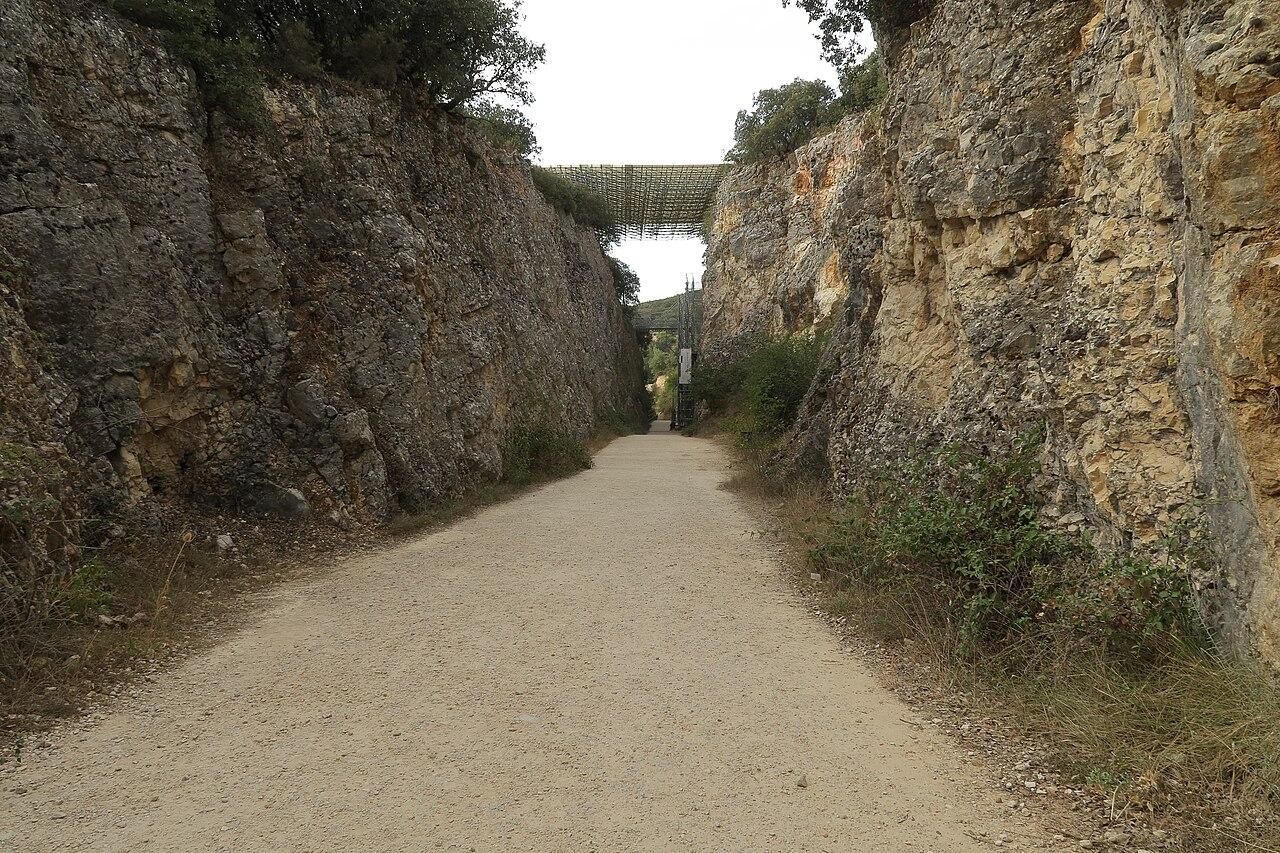
Atapuerca Archaeological Site Fossil Guide
Image: Malopez 21 (CC BY-SA 4.0)
The Sierra de Atapuerca caves near Burgos, Spain, are the leading early-hominin site in Europe. Sima del Elefante and Gran Dolina have produced fossils of Homo antecessor (800,000 years) and what may be Europe's oldest hominin remains (1.4 Ma). Guided tours of the in-situ Trinchera del Ferrocarril excavation operate year-round.
By Edward Chen · Updated 31 July 2026
Introduction
The Sierra de Atapuerca is a low limestone ridge about 15 km east of Burgos in north-central Spain, riddled with karst caves filled by Pliocene–Pleistocene sediment that has produced the most extensive early-hominin fossil record in Europe. UNESCO inscribed the Atapuerca archaeological site as a World Heritage Site in 2000 (Site #989) on the strength of three localities, Sima del Elefante, Gran Dolina, and Sima de los Huesos, that together span the last 1.4 million years of human evolution.
Excavations are still active each summer, and visitors can join guided tours of the Trinchera del Ferrocarril (Railway Trench), a man-made cut from an abandoned mineral railway that exposed the cave fills and remains the focus of fieldwork. Finds are conserved and displayed at the Museum of Human Evolution (MEH) in central Burgos. The Atapuerca visitor experience pairs the museum with the in-situ site visit.
This guide covers the in-situ tour, the geology, and how to plan a one- or two-day visit from Burgos or Madrid.
Location and Directions
Atapuerca village sits roughly 20 km northeast of Burgos in the Autonomous Community of Castile and León. The archaeological park is reached from the nearby village of Ibeas de Juarros.
Directions to Atapuerca
The visit is organised through three connected facilities: the Site Access Centre (CAYAC) in Ibeas de Juarros, the Experimental Archaeology Centre (CAREX) in Atapuerca village, and the Museum of Human Evolution (MEH) in Burgos. Many visitors book a combined ticket through MEH.
From Burgos, drive about 20 minutes east on the N-120 to Ibeas de Juarros. CAYAC has paid parking and is the staging point for the site bus that runs visitors up to the Trinchera del Ferrocarril. Independent vehicle access to the dig is not permitted.
The guided tour itself lasts about one hour, in Spanish (with regular English-language slots in summer. Verify when booking). It walks visitors past the open excavation faces of Sima del Elefante, Gran Dolina, and other localities. During the active field season (typically June–July), visitors can sometimes see archaeologists working in the trench. The site is open most days April–November. Check the MEH calendar before travelling.
 Photo: Thilo Parg, CC BY-SA 4.0, via Wikimedia Commons

What Fossils You'll See
The Atapuerca cave system preserves a notable Pleistocene continental record spanning the appearance and evolution of humans in Europe.
The guided tour walks visitors past the principal fossil-bearing layers in turn. The first stop is the Sima del Elefante locality, where excavators have worked the lower red level TE-9 since the late 1990s. A partial jawbone catalogued ATE9-1 and several flake-stone tools recovered here are dated to roughly 1.2 to 1.4 million years ago and are interpreted as the oldest known hominin remains anywhere in western Europe. A short walk further along the Railway Trench leads to the Gran Dolina excavation, the type locality of Homo antecessor, a species named in 1997 on the basis of fossils from level TD-6 (the so-called "Aurora stratum"), dated to about 800,000 years and interpreted as a possible common ancestor or close relative of Neanderthals and modern humans. The Aurora stratum has produced more than 80 hominin specimens belonging to at least six individuals, with butchered child remains providing the earliest evidence of cannibalism in the European fossil record.
Further into the Sierra, but accessed only by researchers, lies the Sima de los Huesos ("Pit of Bones"), a 13-metre-deep vertical shaft at the bottom of the Cueva Mayor cave system. The Sima has produced the world's largest sample of pre-Neanderthal hominin remains: more than 7,000 bones representing at least 28 individuals, all dated to around 430,000 years and now interpreted as an early Neanderthal-lineage population. Researchers also recovered an Acheulean quartzite handaxe nicknamed "Excalibur" from the Sima, the earliest known symbolic object in the European record. The site is presented on tour signage and at the Museum of Human Evolution rather than visited directly. Closer to the tour route, Cueva Mayor and Galería preserve Middle and Upper Pleistocene cave-bear (Ursus deningeri) and large-carnivore assemblages, with hominin Mousterian and later cultures stratified above the Lower Pleistocene material.
Stone tools change in style up-section in step with the hominin transitions. The oldest layers preserve simple Mode 1 Oldowan flake industries. Acheulean handaxes appear in the upper Gran Dolina levels and dominate Galería. Mousterian flake industries characterise the Middle Pleistocene cave fills. Faunal remains alongside the hominins include the southern mammoth (Mammuthus meridionalis), Mosbach horse (Equus mosbachensis), large bovids (Bison schoetensacki), cave hyena, sabre-toothed cat (Homotherium latidens), and abundant cave bears, a fauna that documents the Mediterranean grasslands of the early-to-middle Pleistocene Iberian peninsula. The original hominin fossils, the Excalibur handaxe, and many of the associated mammal remains are displayed at the Museum of Human Evolution in central Burgos.
As the Museum of Human Evolution describes the site, the caves of the Sierra de Atapuerca contain an extensive fossil record of the earliest human beings in Europe, from nearly a million years ago up to the Common Era.
 Photo: Fernando Losada Rodríguez, CC BY-SA 4.0, via Wikimedia Commons
.jpg)
Geologic History
The Atapuerca karst developed in Cretaceous–Eocene shallow-marine limestones that were uplifted during the Cenozoic Iberian compression and slowly dissolved by groundwater into a complex underground network of caves, shafts, and chambers. As the Arlanzón River valley downcut through the Quaternary, cave entrances on the ridge sides opened to the surface and began to fill passively with sediment carried in by gravity, slope wash, and animal traffic. The lowest fossil-bearing fills date to about 1.4 million years ago at Sima del Elefante and the youngest archaeological layers continue into the Holocene, giving Atapuerca an unusually deep continuous record by European standards.
The Trinchera del Ferrocarril, the "Railway Trench", was cut in the early 20th century to carry a mineral railway across the ridge from the iron mines at the Demanda massif to the steel works at Sagunto. The line was abandoned before completion, but its cuttings accidentally bisected the cave-fill stratigraphy and produced the vertical cross-sections that researchers have worked ever since. The Gran Dolina exposure in particular owes its existence to railway engineers, who left the once-buried cave fills exposed as a cliff face that has weathered and slumped over a century of seasonal cycles.
Excavation in the modern sense began with Trinidad Torres in 1976 at Sima de los Huesos and with Emiliano Aguirre's broader project from 1978. The Equipo Investigador de Atapuerca (Atapuerca Research Team), led jointly since 1991 by Juan Luis Arsuaga, José María Bermúdez de Castro, and Eudald Carbonell, has driven much of modern European Pleistocene paleoanthropology and has trained two generations of Spanish and international researchers at the site. The team won the Príncipe de Asturias Prize for Scientific and Technical Research in 1997, and Atapuerca remains one of the world's most intensively studied paleoanthropological localities.
How Atapuerca Came to Be Protected
The site was declared a Bien de Interés Cultural (Site of Cultural Interest, the highest tier of Spanish heritage protection) in 1991, inscribed as a UNESCO World Heritage Site in 2000 (Site #989), and is now managed jointly by the regional government of Castile and León (Junta de Castilla y León), the Fundación Atapuerca, and the Museum of Human Evolution in Burgos. Active excavation continues each summer in June and July, after which the trench is covered for the winter.
 Photo: Mario Modesto Mata, CC BY-SA 3.0, via Wikimedia Commons

Collecting Rules and Regulations
Is Fossil Collecting Allowed?
No. The site is protected at the highest level of Spanish heritage law (Bien de Interés Cultural) and as a UNESCO World Heritage Site. All collection is restricted to the research team.
Key Points:
- In-situ visit only via guided tour booked through MEH / CAYAC
- No collecting, hammering, touching of fossil bone, or stone-tool removal
- Photography permitted at most stops. Guide will indicate restrictions
- Pair the site visit with the Museum of Human Evolution in Burgos
- Verify English-language tour availability when booking
Safety
Atapuerca is visited on booked guided tours run from the visitor centres, and the guides manage access to the excavations. The sites themselves are working archaeological trenches in a karst ridge, not a park, and the tour structure exists partly for that reason.
Follow the guide and stay on the walkways. The Trinchera cuts and the cave entrances have steep sides, open excavation faces, and drops that are not fenced in the way a museum would fence them. Do not step off the marked route, do not lean over trench edges, and keep children close.
Footing is uneven and often dusty or slick. The ridge is limestone with loose scree in places, and the walk between the sites is on rough ground. Wear closed shoes with a firm sole rather than sandals, and expect a reasonable amount of walking in the open.
Dress for a Castilian summer. The Burgos plateau is exposed with little shade, summer temperatures are high, and the sun at this altitude is strong. Carry water, wear a hat, and use sun protection. Outside summer the same ridge is cold and windy, so bring layers, and note that tours run in most weather.
Book ahead rather than arriving on spec, since numbers are limited and the excavation season affects what can be visited. Tell the visitor centre in advance about mobility limitations, because the terrain rules out some routes. Nothing may be collected or touched at any of the sites.
Sources
Nearby sites
 Salas de los Infantes Dinosaur Sites Fossil Hunting GuideDemandasaurus darwini (sauropod), Europatitan eastwoodi
 Valdecevillo and the Enciso Dinosaur Tracks Fossil Hunting GuideDinosaur tracks, Theropod tracks
 Playa de La Griega Fossil Hunting GuideSauropod footprints, Dinosaur trackways
 Las Hoyas Lagerstätte Fossil Hunting GuideConcavenator corcovatus (carcharodontosaurid), Iberomesornis romerali (early bird)