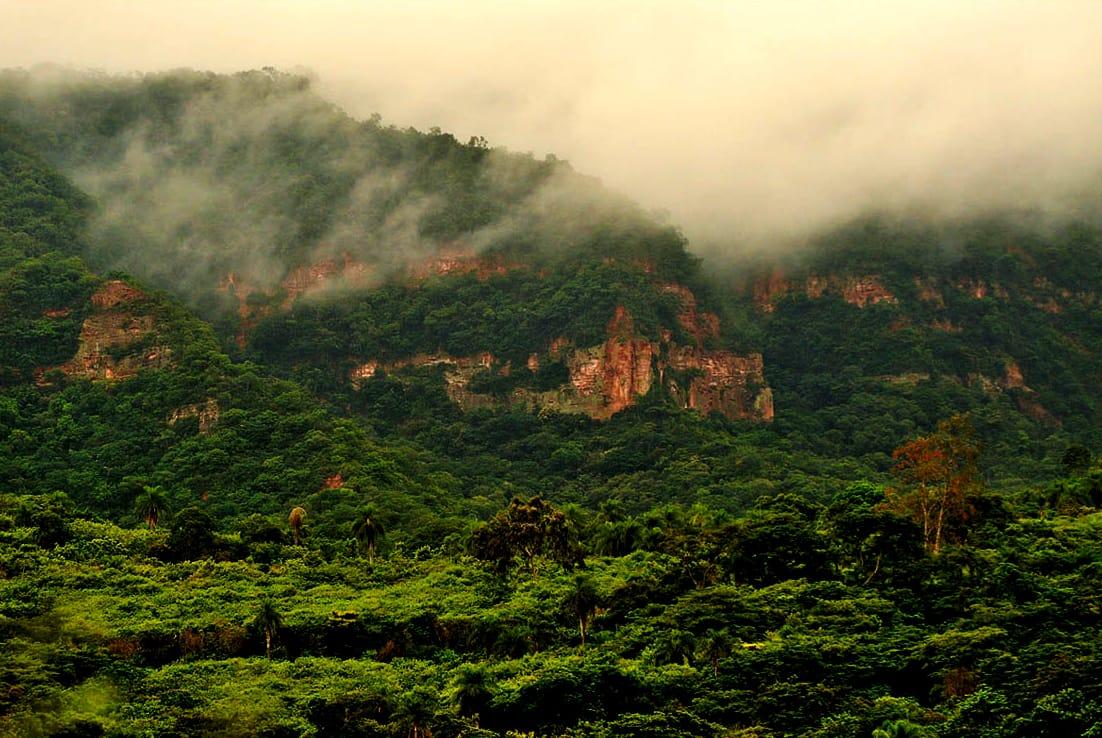
Araripe Geopark Fossil Guide
Image: Wikimedia Commons (CC BY-SA)
The Araripe UNESCO Global Geopark in southern Ceará, Brazil, covers 3,796 km² of the Araripe Basin and contains the Crato and Romualdo Lagerstätten, Cretaceous deposits that hold the world's largest concentration of pterosaur fossils, fine-scale fish, insects, and the earliest flowering plants. Collecting is illegal under Brazilian law.
By Edward Chen · Updated 31 July 2026
Introduction
The Araripe UNESCO Global Geopark in southern Ceará was the first geopark designated in the Americas (2006) and one of the world's best-known Cretaceous fossil regions. Its 3,796 km² spans six municipalities, Barbalha, Crato, Juazeiro do Norte, Missão Velha, Nova Olinda, and Santana do Cariri, across the Araripe Basin.
The Crato and Romualdo formations within the Santana Group are designated Konservat-Lagerstätten preserving fine-scale Aptian–Albian fossils: complete pterosaurs with wing membranes and crests, articulated fish in calcareous concretions, insects with original colour patterns, the earliest flowering plants, and rare dinosaur remains. Under Brazilian federal law (Decree-Law 4.146/1942), all fossils are property of the state and may not be removed.
Eleven public geosites and the Plácido Cidade Nuvens Museum of Paleontology in Santana do Cariri allow visitors to view fossils in situ and in displays.
Location and Directions
The Geopark is centred on the Cariri region in the southern interior of Ceará, about 500 km south of Fortaleza.
Directions to the Araripe Geopark
The most common base is Juazeiro do Norte or Crato, both reached by air from Fortaleza, Brasília, São Paulo, or Recife (Juazeiro do Norte / Orlando Bezerra de Menezes Airport). From there, regional roads connect the 11 official geosites, including Pontal de Santa Cruz (panoramic overlook), Pedra Cariri (the famous limestone quarrying area), Floresta Petrificada do Cariri (petrified forest), and the Parque dos Pterossauros.
The Museum of Paleontology "Plácido Cidade Nuvens" of the Regional University of Cariri (URCA) in Santana do Cariri is the best single starting point and receives roughly 40,000 visitors per year. It exhibits articulated Tropeognathus, Anhanguera, and Tapejara pterosaurs and many of the formation's signature fish.
 Photo: Otávio Nogueira, CC BY 2.0 via Wikimedia Commons

What Fossils You'll See
The Crato Formation (the older unit, deposited as finely laminated lacustrine limestone) and the overlying Romualdo Formation (younger, with fossils preserved inside calcareous concretions) together preserve a freshwater-to-marginal-marine lagoonal system that periodically dried out and killed entire fish and pterosaur communities en masse.
The Araripe pterosaur fauna is the largest single concentration of flying reptiles known anywhere in the world. The geopark and the Plácido Cidade Nuvens Museum display the long-snouted Anhanguera and Tropeognathus, both fish-eaters with sail-like crests at the front of the jaw. The fan-headed Tapejara wellnhoferi and the striking Tupandactylus imperator (whose huge soft-tissue crest can measure more than half a metre tall) represent the toothless tapejarids and are local icons of the Cariri region. The slender Tupuxuara and the long-billed Thalassodromeus sethi, initially interpreted as a skim-feeder analogous to the modern skimmer bird, are also frequent finds. Many pterosaur specimens preserve wing membrane, soft-tissue crests, and skin patterns rarely seen elsewhere in the fossil record.
The Crato platy limestone is best known for its fish fauna. Common species include the elongate Vinctifer comptoni, the heavily armoured Calamopleurus cylindricus, the bulldog-jawed Cladocyclus, Notelops and Rhacolepis (both close relatives of modern bonytongues), and the coelacanths Axelrodichthys araripensis and Mawsonia gigas, the last among the largest coelacanths known. Soft-bodied invertebrate preservation in the Crato laminites is internationally famous. Insects from more than 20 orders, scorpions, spiders, isopods, ostracods, and the small freshwater shrimp Dastilbe occur in abundance, often retaining original colour patterns or iridescent cuticle. The platy limestones also preserve the earliest flowering plants known from South America: the small angiosperms Klitzschophyllites and Cratonia, plus ferns, cycads, gnetaleans, and araucarian conifers.
The Romualdo nodules have produced rarer but striking theropod dinosaurs: the spinosaurid Irritator challengeri, the compsognathid Mirischia asymmetrica, and the basal coelurosaur Santanaraptor placidus. Turtles (Araripemys), crocodyliforms, snakes, and a small flying-fish-style fish-eating bird (Iberomesornis-like) round out the vertebrate fauna.
"The Araripe Geopark holds the world's largest concentration of pterosaur remains, records of more than 20 orders of fossilized insects, and fossils of the first flowering plants." UNESCO
 Photo: Hannes Grobe, CC BY 3.0 via Wikimedia Commons

Geologic History
The Araripe Basin formed during the Early Cretaceous (Berriasian–Aptian) rifting that broke apart the supercontinent Gondwana and opened the South Atlantic Ocean. As Africa and South America pulled apart, a series of intracontinental rift basins developed across what is now northeast Brazil, accumulating thick stacks of continental and marginal-marine sediment. The Santana Group at the top of the basin fill was deposited between roughly 115 and 108 million years ago in a shallow tropical lagoonal system that was repeatedly cut off from the open Tethys-derived sea by tectonic, eustatic, and salinity changes. Periodic isolation, evaporation, anoxia, and stratification of the water column produced mass-mortality events that killed entire pelagic communities and rapidly buried them in fine, oxygen-poor carbonate muds.
The result is a pair of textbook Konservat-Lagerstätten: the Crato Formation laminites preserve soft tissue, colour patterns, and the most delicate insect cuticle, while the Romualdo Formation nodules preserve three-dimensional fish, pterosaur, and dinosaur skeletons inside calcareous concretions formed within weeks of death. Tertiary uplift of the Borborema province during the late Cenozoic raised the basin to its current position roughly 800 metres above sea level, exposing the Santana Group across the steep flanks of the Chapada do Araripe plateau where it now crops out and is quarried.
Commercial quarrying of Crato laminite for paving stone ("Pedra Cariri") and floor tile has long produced fossils as an accidental by-product, and an active illegal export trade has sent thousands of Brazilian Cretaceous specimens to private and institutional collectors worldwide since the 1970s. Brazilian heritage law (Decree-Law 4.146/1942) prohibits all such export, and Brazilian authorities have worked with INTERPOL and foreign museums on high-profile repatriations, most famously the 2022 return of the tapejarid pterosaur Tupandactylus navigans from Germany.
How the Araripe Geopark Came to Be Protected
The Geopark was created in 2006, the first in the Americas, by the State of Ceará in partnership with the Regional University of Cariri (URCA), with strong support from local municipalities, federal heritage agencies, and UNESCO. It re-validated its Global Geopark status under UNESCO's new International Geosciences and Geoparks Programme in 2015. Eleven public geosites are designated for in-situ visitor access, ranging from active and abandoned quarries to scenic overlooks of the Chapada do Araripe escarpment. The Plácido Cidade Nuvens Museum of Paleontology at URCA in Santana do Cariri receives roughly 40,000 visitors a year and is the primary repository for Araripe research collections.
 Photo: Ermell, CC BY 4.0 via Wikimedia Commons

Collecting Rules and Regulations
Is Fossil Collecting Allowed?
No. All fossils in Brazil are federal property. Collection and export by tourists is illegal.
Key Points:
- View fossils at the 11 designated geosites and the Plácido Cidade Nuvens Museum
- Removing or buying fossils for export violates Brazilian law
- Active quarries are working sites, entry by tourists requires permission
- Hire a local Geopark-accredited guide for the geosite circuit
Safety
The Araripe Geopark spans nearly 3,800 square kilometres across six municipalities, so this is a region rather than a site, and conditions vary considerably between its geosites.
Heat and sun. The Cariri region of southern Ceará is hot and strongly sunlit year-round, and many geosites are open ground with little shade. Carry water, use sun protection, wear a hat, and plan visits for the earlier part of the day.
Quarry faces are unstable. The Santana and Crato exposures include working and disused quarries with steep, layered faces that shed rock. Do not climb them, do not stand beneath an overhang, and keep to the areas the geopark designates for visitors. Active quarries are industrial sites and are not open to the public.
Getting between sites needs planning. Distances are long, roads vary in quality, and signage is not consistent. A local guide is genuinely worthwhile and is the normal way to visit, both for navigation and because guides know which geosites are currently accessible.
Snakes and scorpions are present in the caatinga scrub, so wear closed shoes and watch where you step and reach. Carry insect repellent.
Note that Brazilian law makes fossils property of the state, and removing them is a criminal matter that is actively enforced in this region, given the history of illegal export from the Araripe Basin. Look and photograph only.
Sources
Nearby sites
 Vale dos Dinossauros (Sousa Basin) Fossil Hunting GuideSauropod trackways, Theropod footprints
 Peirópolis, Uberaba Fossil Hunting GuideDinosaurs, Titanosaurs
 Paleorrota Geopark Fossil Hunting GuideStaurikosaurus pricei (early dinosaur), Hyperodapedon (rhynchosaur)
 Quarta Colônia Geopark Fossil Hunting GuideEarly dinosaurs, Cynodonts