Paleorrota Geopark Fossil Hunting Guide
Image: Sergio Kaminski (CC BY-SA 3.0)
Paleorrota Geopark in central Rio Grande do Sul, Brazil, links a series of municipal fossil sites and roadside outcrops in the Santa Maria, Caturrita, and Sanga do Cabral formations that record the late Permian to Late Triassic rise of synapsids, rhynchosaurs, and the earliest dinosaurs. Several geosites are free to visit.
By Edward Chen · Updated 1 August 2026
Introduction
Paleorrota Geopark spans about 83,000 square kilometres across central Rio Grande do Sul in southern Brazil. The geopark is built around the highway BR-287, locally branded the Rota das Origens or Highway of Dinosaurs, that runs through a corridor of fossil-bearing late Permian and Triassic outcrops between São Pedro do Sul, Santa Maria, São João do Polêsine, and Faxinal do Soturno. The rocks span an interval of roughly 50 million years and record the post-Permian recovery of land vertebrates, the radiation of rhynchosaurs and cynodonts, and the appearance of the earliest dinosaurs around 233 million years ago. The geopark includes several open-air geosites with roadside interpretive panels, four municipal fossil museums, and the Centro de Apoio à Pesquisa Paleontológica da Quarta Colônia (CAPPA), the active research centre that curates new material from the wider region. Public sites are free or charge only a small municipal admission. The active dig sites at the Janner, Niemeyer, and Buriol localities are restricted to the research team. Collecting is illegal under Brazilian federal law (Decree-Law 4.146/1942 and Law 6.938/1981). This guide covers how to plan a circuit, what to see at each accessible site, the Triassic geology of the Paraná Basin, and the rules that apply.
Location and Directions
Rio Grande do Sul is the southernmost state of Brazil. The geopark corridor is reached from Porto Alegre, the state capital, by the BR-287 highway westward toward Santa Maria. The drive from Porto Alegre to Santa Maria takes about three and a half hours.
The recommended base for visiting Paleorrota is the city of Santa Maria, which has a regional airport (Aeroporto Regional de Santa Maria), several hotels, and the Museu de Ciências Naturais Walter Alberto Egler at the Universidade Federal de Santa Maria.
CAPPA, the active research centre, is at Rua Maximiliano Vizzotto 598 in São João do Polêsine, about 50 kilometres east of Santa Maria. GPS is 29.6172 degrees south, 53.4233 degrees west. The centre runs scheduled public visiting hours and group tours by prior arrangement.
The Geosites circuit can be done as a self-driven loop in two to three days from Santa Maria. Main stops include:
The Sítio Paleontológico do Cerrito do Bruno, a roadside outcrop of the Caturrita Formation near Faxinal do Soturno, where rhynchosaur material was first identified.
The Sítio Janner near Agudo, a dinosaur-bearing locality in the Santa Maria Formation. The site is gated, but the access road has a viewpoint and panels.
The Niemeyer site near São João do Polêsine, with cynodont specimens documented in the surrounding stratigraphy.
The Museu Vicente Pallotti in São João do Polêsine and the Museu Padre Daniel Cargnin in Mata, two municipal museums that hold prepared specimens.
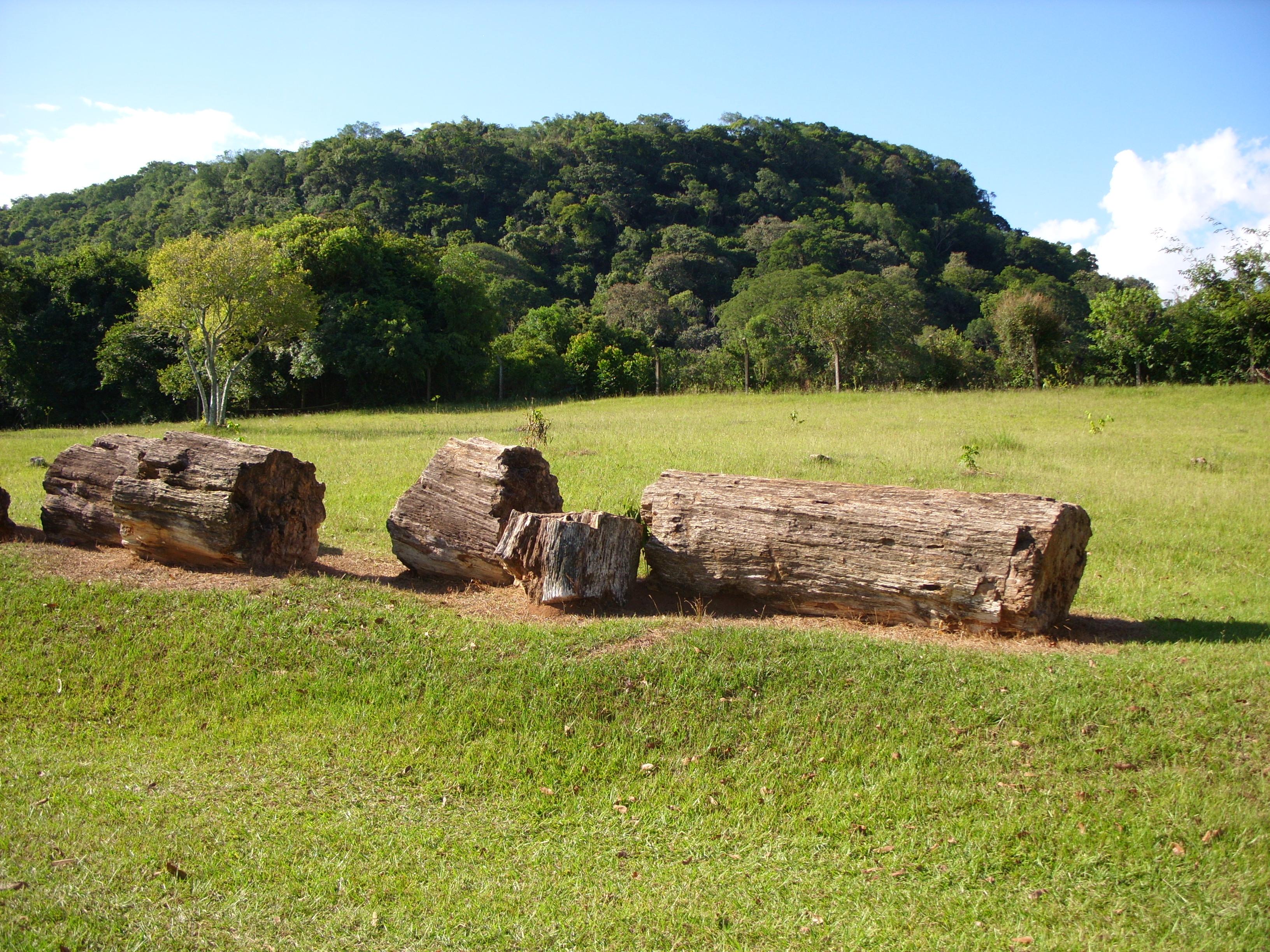
The Mata Petrified Forest at the Mata Geosite, near Mata, with permineralised Triassic trunks of Dadoxylon exposed on the surface inside a fenced municipal park.
Site entry is free at the roadside geosites and the open-air outcrops. The municipal museums charge small admissions, typically 5 to 10 Brazilian reais.
What Fossils You'll Find
You will not collect at Paleorrota. What you can do is visit a network of indoor museums and outdoor geosites that together cover the full Triassic vertebrate succession of the Paraná Basin. Identifications below follow the CAPPA species list and the published Paleontological Sites of Santa Maria literature.
- Staurikosaurus pricei. One of the oldest known dinosaurs, described in 1970 from a partial skeleton recovered near Santa Maria. The species is roughly contemporaneous with Eoraptor and Herrerasaurus from Argentina.
- Saturnalia tupiniquim. An early sauropodomorph from the Santa Maria Formation, described in 1999.
- Sacisaurus agudoensis. A small bipedal silesaurid described from the Caturrita Formation in 2006. The species is among the closest known sister taxa to dinosaurs.
- Hyperodapedon mariensis. A common rhynchosaur with a beak-like jaw and multi-row tooth pavement, from the Hyperodapedon assemblage zone of the Santa Maria Formation.
- Dinodontosaurus turpior. A large dicynodont synapsid from the Dinodontosaurus assemblage zone, present at multiple geosites.
- Exaeretodon riograndensis. A large cynodont synapsid from the Carnian Santa Maria succession, with several articulated skeletons recovered.
- Teyumbaita. A late-occurring rhynchosaur described in 2009 and one of the youngest of the group.
- Dadoxylon and other plant remains. The Mata Petrified Forest preserves silicified trunks up to 2 metres in diameter on a Triassic floodplain surface.
The CAPPA research centre holds the active reference collection and is the most reliable single stop for prepared display specimens.
Geologic History
The geopark sits on the southern edge of the Paraná Basin, a large intracratonic basin that filled with continental and shallow marine sediments from the late Carboniferous through the Early Cretaceous. The Paleorrota corridor exposes five named formations of late Permian and Triassic age, recorded in the regional CPRM/SGB geological survey.
The Rio do Rasto Formation, late Permian, contains marine and lacustrine deposits with bivalves and fish.
The Sanga do Cabral Formation, Early Triassic, records a sandy fluvial system with procolophonid reptiles and early archosauromorphs.
The Santa Maria Formation, Middle to Late Triassic, contains the Dinodontosaurus assemblage zone (mid Triassic Ladinian, dominated by dicynodonts and cynodonts) and the Hyperodapedon assemblage zone (Late Triassic Carnian, dominated by rhynchosaurs together with the earliest dinosaurs).
The Caturrita Formation, latest Carnian to early Norian, records floodplain sandstones and mudstones with silesaurids, late dicynodonts, and the Mata Petrified Forest flora.
The Mata Sandstone, Norian, caps the local Triassic succession.
After Triassic deposition, the basin was draped by Jurassic and Cretaceous strata, then uplifted along the South Atlantic margin during the opening of the Atlantic Ocean. Modern erosion has exposed the Triassic units in scarps and roadcuts along the BR-287 corridor.
How Paleorrota Became a Fossil Site
The first scientific descriptions came from Friedrich von Huene of the University of Tübingen, who collected near Santa Maria during the 1920s and published a monograph on the Triassic reptiles of Brazil in 1942. Llewellyn Ivor Price, working with the Brazilian Geological Survey, described Staurikosaurus pricei in 1970 from material recovered earlier near Santa Maria. Research expanded through the late twentieth century under Mario Costa Barberena and José Bonaparte's networks, with major contributions from the UFRGS in Porto Alegre and the UFSM in Santa Maria.
The Paleorrota project was launched in the early 2000s as a regional tourism and heritage initiative coordinated by the universities, municipal governments, and the Brazilian Geological Survey. The geopark designation followed in 2005. CAPPA was inaugurated in 2014 as the principal regional research and curation centre. Aspirational UNESCO Global Geopark accreditation has been pursued by the consortium.
Collecting Rules and Regulations
Collecting is prohibited. All fossils in Brazil are property of the federal state under Decree-Law 4.146/1942, and the National Heritage Institute (IPHAN) regulates protected paleontological sites. The CPRM/SGB (Brazilian Geological Survey) maintains the geosite list within Paleorrota.
Practical rules:
- Roadside geosites and open-air outcrops are free to visit. Stay behind the chain barriers and stick to the marked viewing zones.
- The active dig sites (Janner, Niemeyer, Buriol) are gated and accessible only during scheduled public events or by prior arrangement with CAPPA.
- The municipal museums charge small admissions and welcome photography of specimens.
- Drones require advance permission from CAPPA or the responsible municipality.
- Research collection is restricted to teams working under IPHAN permit.
- The Mata Petrified Forest is a fenced municipal park. Walking off the marked path or touching the trunks is not permitted.
Safety
The geopark sits in a humid subtropical zone. Summer (December through February) temperatures reach 32 degrees Celsius with high humidity. Winter (June through August) is mild but rainy. The recommended visiting window is April through October.
The BR-287 highway is paved and well maintained, but secondary access roads to outlying geosites are dirt and can become slick after heavy rain. A standard sedan can reach most accessible sites in dry weather.
Watch for snakes including the pit viper Bothrops jararaca around outcrops and on petrified forest trails. Wear closed boots and stay on the marked paths.
The geopark corridor has full mobile-phone coverage along the BR-287 and in the towns. CAPPA staff in São João do Polêsine can advise on current site conditions.
Sources
- Wikipedia summary of CPRM/SGB heritage docs, "Paleontological Sites of Santa Maria." https://en.wikipedia.org/wiki/Paleontological_Sites_of_Santa_Maria
- Wikipedia, "Paleorrota." https://en.wikipedia.org/wiki/Santa\_Maria\_Formation
- Companhia de Pesquisa de Recursos Minerais (CPRM/SGB). https://www.cprm.gov.br/
- Langer, M.C. et al., 1999. "A New Early Dinosaur (Saurischia: Sauropodomorpha) from the Late Triassic Santa Maria Formation of Brazil." Comptes Rendus de l'Académie des Sciences, 329.
- Soares, M.B. et al., 2011. "Cenozoic and Mesozoic Tetrapods of Rio Grande do Sul." Revista Brasileira de Paleontologia, 14.
- Centro de Apoio à Pesquisa Paleontológica da Quarta Colônia (CAPPA), UFSM. Visitor information accessed June 2026.
Nearby sites
 Araripe Geopark Fossil GuidePterosaurs, Fish
 Vale dos Dinossauros (Sousa Basin) Fossil Hunting GuideSauropod trackways, Theropod footprints
 Talampaya National Park Fossil Hunting GuideDicynodonts (Dinodontosaurus), Cynodonts (Massetognathus)
 Ischigualasto Provincial Park Fossil GuideEarly dinosaurs, Eoraptor