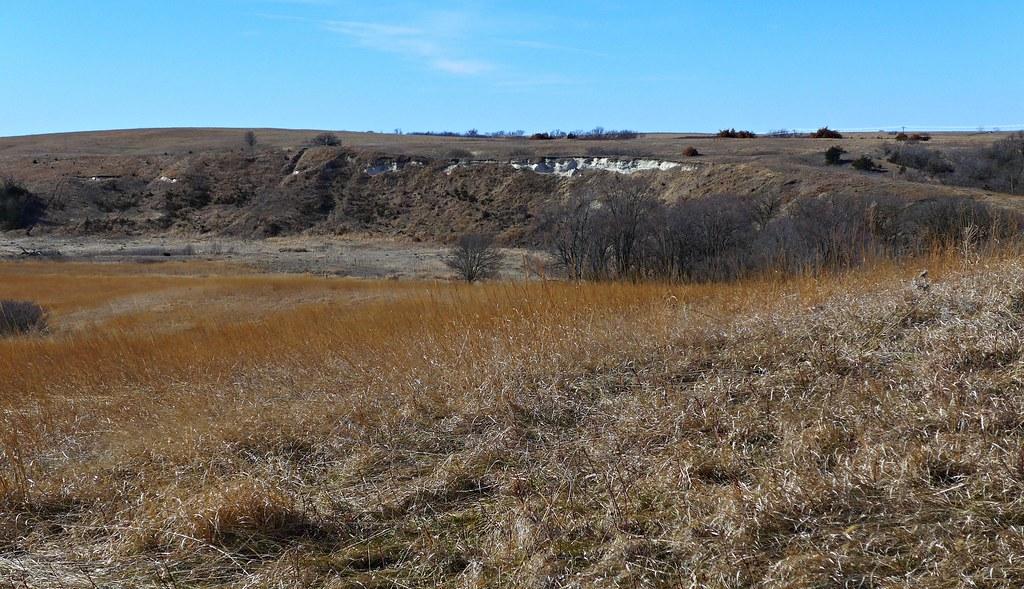
Ashfall Fossil Beds State Historical Park Fossil Hunting Guide
Image: Raymond M. Coveney, … (CC BY-SA 3.0)
Ashfall Fossil Beds State Historical Park preserves a 12-million-year-old Miocene waterhole death assemblage buried in volcanic ash from the Bruneau Jarbidge supervolcano. More than 200 articulated mammal skeletons remain in place inside the Hubbard Rhino Barn excavation shelter. Viewing-only.
By Edward Chen · Updated 3 August 2026
Introduction
Ashfall Fossil Beds State Historical Park sits on 360 acres of rolling prairie in Antelope County, Nebraska, about 6 miles north of the village of Royal. The park preserves a late Miocene waterhole that filled with ash from a supervolcanic eruption in southwestern Idaho roughly 12 million years ago. Animals that drank from the pond inhaled airborne ash, developed hypertrophic pulmonary osteodystrophy, and died over a period of weeks. Their carcasses settled into the wet ash at the bottom of the waterhole and were buried in the same eruptive sequence. The result is one of the best-preserved Miocene vertebrate Lagerstätten in North America, with more than 200 articulated skeletons still in their original position in the ash bed. The active excavation is enclosed by the Hubbard Rhino Barn, a roofed shelter that lets visitors look down on paleontologists at work from a viewing walkway. The park is run by the University of Nebraska State Museum in partnership with Nebraska Game and Parks. Collecting is prohibited. Visitors come to see the in-place skeletons of barrel-bodied rhinos, three-toed horses, camels, and birds laid out in the ash exactly where they died. This guide covers visiting hours, the fauna in the bed, the volcanic story, and the rules that apply.
Location and Directions
Ashfall lies in northeastern Nebraska, about 100 miles northwest of Norfolk and 200 miles northwest of Omaha. From US Highway 20 at Royal, turn north on 517 Avenue and drive 6 miles on a gravel road to the park entrance.
The visitor center is at 86930 517 Avenue, Royal, Nebraska 68773. GPS for the visitor center is 42.4244 degrees north, 98.1581 degrees west. Parking is gravel and free. From the visitor center, a short paved path leads to the Hubbard Rhino Barn excavation shelter and a smaller fossil preparation building.
The park is open seasonally. Standard hours run from early May through mid-October. The barn closes from mid-October through April 30 to protect the active excavation from winter conditions. Check the Nebraska Game and Parks page for current opening dates before driving out.
A standard park entry permit is required, plus an additional Ashfall admission fee at the visitor center. Annual Nebraska park permits are accepted toward the park entry portion. The closest fuel and food are at Royal and Orchard. There is no lodging on site. Camping is not permitted in the park.
What Fossils You'll Find
You will not collect at Ashfall. What you can do is walk above the original ash bed, see articulated skeletons of more than half a dozen mammal species still in burial position, and watch active preparation work in the visitor center lab. Counts and identifications below are from the University of Nebraska State Museum and the NPS National Natural Landmark file.
- Teleoceras major. A barrel-bodied, short-legged rhinoceros that dominates the bed. More than 100 articulated Teleoceras skeletons have been exposed in the Hubbard Rhino Barn, including adults, juveniles, and unborn calves preserved in their mothers' rib cages.
- Cormohipparion occidentale, Pseudhipparion gratum, Pliohippus pernix, and other three-toed horses. Five horse genera are present in the bed, an unusually wide sample of late Miocene equids in one place.
- Procamelus and Aepycamelus. Two camel genera, including the long-necked giraffe-camel Aepycamelus, are represented by articulated skeletons.
- Saber-toothed deer (Longirostromeryx wellsi). A small artiodactyl with prominent upper canines, present as articulated specimens.
- Dogs and ambush carnivores. Material from Leptarctus and from the small canid Epicyon has been recovered.
- Birds and turtles. Three bird species, including the crowned crane Balearica, and two turtle species, have been documented from the bed.
Specimens at all preparation stages, from raw ash blocks to mounted casts, are on display in the visitor center. The 1990 publication by Michael Voorhies in National Geographic remains the most accessible overview.
 Photo: James St. John, CC BY 2.0, via Wikimedia Commons
_skull_(Ash_Hollow_Formation,_Miocene,_11.83_Ma;_Ashfall_Fossil_Beds,_Nebraska,_USA)_3.jpg)
 Photo: James St. John, CC BY 2.0, via Wikimedia Commons
_1.jpg)
Geologic History
The ash bed sits in the Cap Rock Member of the Ash Hollow Formation, part of the Ogallala Group of the Great Plains. The unit is dated to 11.86 million years ago, in the middle of the Clarendonian North American Land Mammal Age, late Miocene.
The Bruneau Jarbidge volcanic centre in what is now southwestern Idaho, about 1,000 miles to the west, was the source of the ash. The eruption that buried Ashfall was a caldera-forming event of VEI 8 magnitude that distributed rhyolitic ash over much of the western and central United States. Plinian fall thickness at Ashfall reached about 1 metre.
The animals that died at the Ashfall waterhole did not die from immediate impact. They lived for days to weeks after the ash arrived, breathing in fine glass particles that caused hypertrophic pulmonary osteodystrophy, a thickening of the bone surfaces visible on most of the recovered skeletons. As individual animals weakened and died, they sank into the wet ash at the bottom of the pond. Smaller bodied animals were buried first, larger animals last. The complete stratigraphic order is still visible in the barn, with bird and turtle skeletons in the lowest layer and full-grown rhinos at the top.
The waterhole sat in a broad savanna near a slow-flowing river, with grasses, sedges, and scattered hackberry trees forming the surrounding cover. Pollen recovered from the ash matches a mid-grass prairie with patches of riparian woodland.
How Ashfall Became a Fossil Site
Michael Voorhies, a paleontologist at the University of Nebraska State Museum, found a baby rhino skull weathering out of a gully on Melvin Colson's farm in 1971. Voorhies recognised the in-place preservation and began systematic excavation in 1978. The Nebraska legislature established the State Historical Park in 1991, and the first Hubbard Rhino Barn opened in 1994 to enclose the active dig. A larger shelter replaced it in 2009. Excavation continues each summer under the Nebraska State Museum, and prepared specimens are catalogued into the museum collection at the University of Nebraska in Lincoln.
The site was designated a National Natural Landmark by the National Park Service in 2006, recognising the bed as a geological and paleontological feature of national standing.
Collecting Rules and Regulations
Collecting is prohibited. Ashfall Fossil Beds State Historical Park is owned by the State of Nebraska and managed by Nebraska Game and Parks Commission and the University of Nebraska State Museum. Removing or disturbing any fossil material on the property is prohibited under Nebraska Revised Statutes and the park's research-collection-only policy.
Practical rules:
- Stay on the paved walkway inside the Hubbard Rhino Barn. The walkway is wheelchair accessible.
- Photography for personal use is permitted in the barn and across the grounds.
- A Nebraska state park entry permit plus the Ashfall admission fee is required for entry. Annual park permits cover the park entry portion only.
- Pets are not permitted in the barn or visitor center. Service animals are welcome.
- Drones are not permitted in the park.
- The park is closed mid-October through April 30.
Safety
The active dig is enclosed and climate controlled. Outside, the park grounds are exposed prairie with little shade. Summer temperatures can reach 95 degrees Fahrenheit, and afternoon thunderstorms are common in June and July. Carry water on warm days.
Watch for prairie rattlesnakes off the paved paths. Stay on the marked trail between the visitor center and the barn. Cell coverage is weak across the park.
The gravel access road on 517 Avenue can become slick in heavy rain. A standard passenger car is fine in dry conditions.
Sources
- Nebraska Game and Parks Commission, "Ashfall Fossil Beds." https://outdoornebraska.gov/location/ashfall-fossil-beds/
- National Park Service, "Paleontology of Ashfall Fossil Beds National Natural Landmark." https://www.nps.gov/articles/000/paleontology-of-ashfall-fossil-beds-national-natural-landmark.htm
- Voorhies, M.R., 1990. "Ancient Ashfall Creates a Pompeii of Prehistoric Animals." National Geographic, January 1990.
- Tucker, S.T. et al., 2014. "The geology and paleontology of Ashfall Fossil Beds, a late Miocene Lagerstätte in Nebraska." University of Nebraska State Museum.
Nearby sites
 Badlands National Park Fossil GuideTitanotheres, Oreodonts
 Fossil & Prairie Park Preserve Fossil Hunting GuideBrachiopods, Corals
 Castle Rock Badlands Fossil Hunting GuideInoceramus (giant clams), Foraminifera
 The Mammoth Site of Hot Springs Fossil Hunting GuideColumbian mammoth (Mammuthus columbi), Woolly mammoth (Mammuthus primigenius)