The Mammoth Site of Hot Springs Fossil Hunting Guide
Image: Jeff the quiet (CC0)
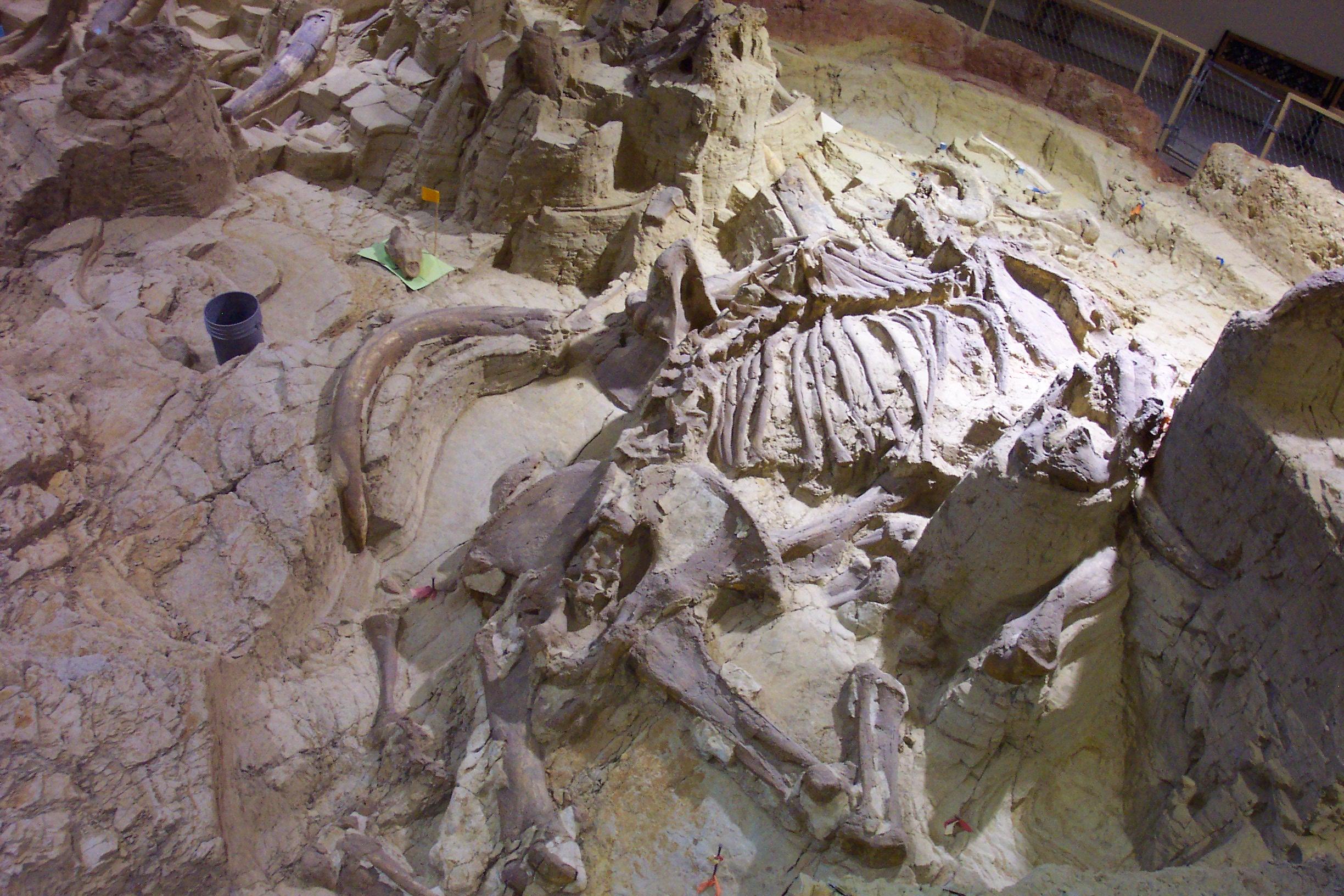
The Mammoth Site of Hot Springs preserves a Pleistocene karst sinkhole in the southern Black Hills that trapped at least 61 mammoths around 140,000 years ago. The skeletons remain in their original burial position under the indoor Bonebed Shelter and are visible on the self-guided tour.
By Edward Chen · Updated 1 August 2026
Introduction
The Mammoth Site of Hot Springs is a privately operated nonprofit museum and active fossil dig on the south edge of the city of Hot Springs, South Dakota, in the southern Black Hills. The site preserves a late Pleistocene karst sinkhole that opened in the Madison Limestone roughly 140,000 years ago and slowly filled with sediment over an interval of about 300 to 700 years. During that time, mammoths and other large mammals fell into the steep-sided pond at the bottom and could not climb back out. The bones of at least 61 individual mammoths, including 58 Columbian mammoths and 3 woolly mammoths, have been documented in the bone bed, along with single individuals of short-faced bear, camel, llama, wolf, and giant rodent. The skeletons remain in burial position under a heated indoor shelter known as the Bonebed Building, which was constructed over the dig in 1985 and lets visitors walk an elevated boardwalk around the open excavation. The site was discovered by a bulldozer operator during housing-development grading in 1974 and has been a working research dig every summer since 1975. This guide covers visiting hours and fees, the species in the bed, the karst geology, and the rules that apply.
Location and Directions
Hot Springs sits at the south end of the Black Hills, about 60 miles south of Rapid City. From Rapid City, take US-79 south to Hot Springs, then turn west on US-18 Bypass. The site is on the south side of the bypass at the western edge of town.
The address is 1800 Highway 18 Bypass, Hot Springs, South Dakota 57747. GPS is 43.4231 degrees north, 103.4906 degrees west. Parking is paved, free, and includes large vehicle and RV spaces.
The visitor centre, gift shop, and Bonebed Building all sit under one roof. The self-guided tour follows a level, fully accessible boardwalk around the open excavation. A 25-minute introductory film runs on a loop in the auditorium. The Junior and Advanced Paleontologist programs run as scheduled summer activities and provide hands-on simulated digging for younger visitors.
The site is open year round, with extended summer hours from late May through Labor Day and shorter hours from September through May. Admission at the time of writing is 15 US dollars for adults 13 to 59, 14 US dollars for ages 60 and over and for active or retired military, 13 US dollars for ages 4 to 12, and free for children 3 and under. Annual memberships are available.
The closest commercial airport is Rapid City Regional Airport. Fuel, food, and lodging are widely available in Hot Springs. Wind Cave and Custer State Park are within 30 miles for visitors planning a longer Black Hills trip.
What Fossils You'll Find
You will not collect at the Mammoth Site. What you can do is walk an elevated boardwalk above the active excavation and see articulated mammoth skeletons exposed in the dirt under stadium-style preparation lighting.
- Mammuthus columbi (Columbian mammoth). At least 58 individuals documented in the bone bed, almost all subadult or young adult males in their teens and twenties. The dominance of young males suggests behaviour similar to modern African elephant bachelor groups.
- Mammuthus primigenius (woolly mammoth). Three individuals identified by tooth morphology, including a notable mature individual exposed near the south wall of the excavation.
- Arctodus simus (short-faced bear). A single articulated skeleton, one of the most complete Arctodus specimens recovered in North America. The carcass appears to have entered the sinkhole separately from the mammoths.
- Camel (Camelops). Skeletal material from a single individual recovered from the upper bone bed.
- Llama, wolf, peccary, and prairie dog material. Single individuals or partial skeletons of each.
- Fish and snails. Aquatic invertebrates and small fish bones in the lower clay layer of the sinkhole fill, recording the standing pond at the bottom.
The visitor centre exhibits include casts of complete Mammuthus columbi and Mammuthus primigenius skeletons mounted for size comparison, plus a working preparation lab visible through glass.
Geologic History
The sinkhole formed in the Madison Limestone, a thick Mississippian carbonate that underlies the Black Hills. Warm artesian water rising along faults dissolved a near-vertical cavity in the limestone roughly 140,000 years ago, during the Sangamonian interglacial. The cavity intersected the surface as a steep-sided pond about 36 metres long and 21 metres wide, with vertical or overhanging walls.
Over the next 300 to 700 years, animals that came to drink or that stepped onto the rim slid down the slick Spearfish red shale that lined the upper walls and could not climb out. Carcasses accumulated on a soft mud floor at the base of the pond. As the cavity filled with washed-in red mud, sand, and bone, it eventually sealed itself off from the surface. Later uplift and erosion of the surrounding landscape exposed the cylindrical fill in cross section, which is the structure that surface grading exposed in 1974.
The bone bed is dated using uranium-thorium ages on cave carbonates, on the surrounding Madison Limestone, and on tooth-enamel chemistry. Most recent published dates centre on 140,000 years ago, within the Sangamonian Stage of the late Pleistocene.
The Madison Limestone karst system is widespread in the southern Black Hills. Wind Cave National Park and Jewel Cave National Monument lie in the same regional carbonate aquifer, and both contain large solution voids related to the same hydrothermal history.
How the Mammoth Site Became a Fossil Site
Phillip Anderson, a heavy equipment operator preparing a housing pad on the west edge of Hot Springs, exposed a large white tusk fragment in his bulldozer cut on 26 June 1974. The landowner, George Hanen, contacted Dr Larry Agenbroad of Chadron State College, who confirmed the find as a Pleistocene mammoth and arranged for a research excavation to begin in 1975. The non-profit Mammoth Site of Hot Springs, Inc., was incorporated in 1974 to protect the bone bed. The Bonebed Building was constructed over the excavation in 1985.
Excavation continues every summer under a team of staff and student paleontologists. The collection is curated on site and used in active research collaborations with the University of South Dakota, Northern Arizona University, the South Dakota School of Mines and Technology, and the Smithsonian. The site joined the American Alliance of Museums accreditation list in 2001.
Collecting Rules and Regulations
Collecting is prohibited. The Mammoth Site is privately owned by the nonprofit Mammoth Site of Hot Springs, Inc. Removing any fossil, sediment, or rock from the property is not permitted.
Practical rules:
- Stay on the elevated boardwalk inside the Bonebed Building.
- Photography for personal use is permitted throughout the building.
- Standard admission applies. Annual memberships and reciprocal museum memberships are accepted at the entry desk.
- Pets are not permitted in the building. Service animals are welcome.
- Drones are not permitted on the property.
- The site is open year round, but check the official site for current hours before driving long distances.
Safety
The site is fully indoor and climate controlled. Boardwalks are level and accessible, and seating is provided at intervals.
The active excavation surface is uneven and contains fragile bone. Lean over the railing only as needed for photographs. Do not throw objects into the dig area.
Hot Springs sits at about 3,400 feet elevation. Visitors arriving from sea level may notice mild altitude effects on the short outdoor walks between the parking lot and the visitor centre. Summer storms in the southern Black Hills can produce hail and high winds with little warning.
Sources
- The Mammoth Site of Hot Springs, "Visit." https://mammothsite.org/visit/
- Agenbroad, L.D., 1990. "The Mammoth Site of Hot Springs, South Dakota: An Alternative to Continental Glaciation as a Cause of Mammoth Mortality." Mammoth Site Scientific Papers, Volume 1.
- Carnegie Museum of Natural History, "A Visit to the Mammoth Site, Hot Springs, SD." https://carnegiemnh.org/mammoth-site-hot-springs-sd/
- Laury, R.L., 1980. "Paleoenvironment of a Late Quaternary Mammoth-Bearing Sinkhole Deposit, Hot Springs, South Dakota." Geological Society of America Bulletin, 91.