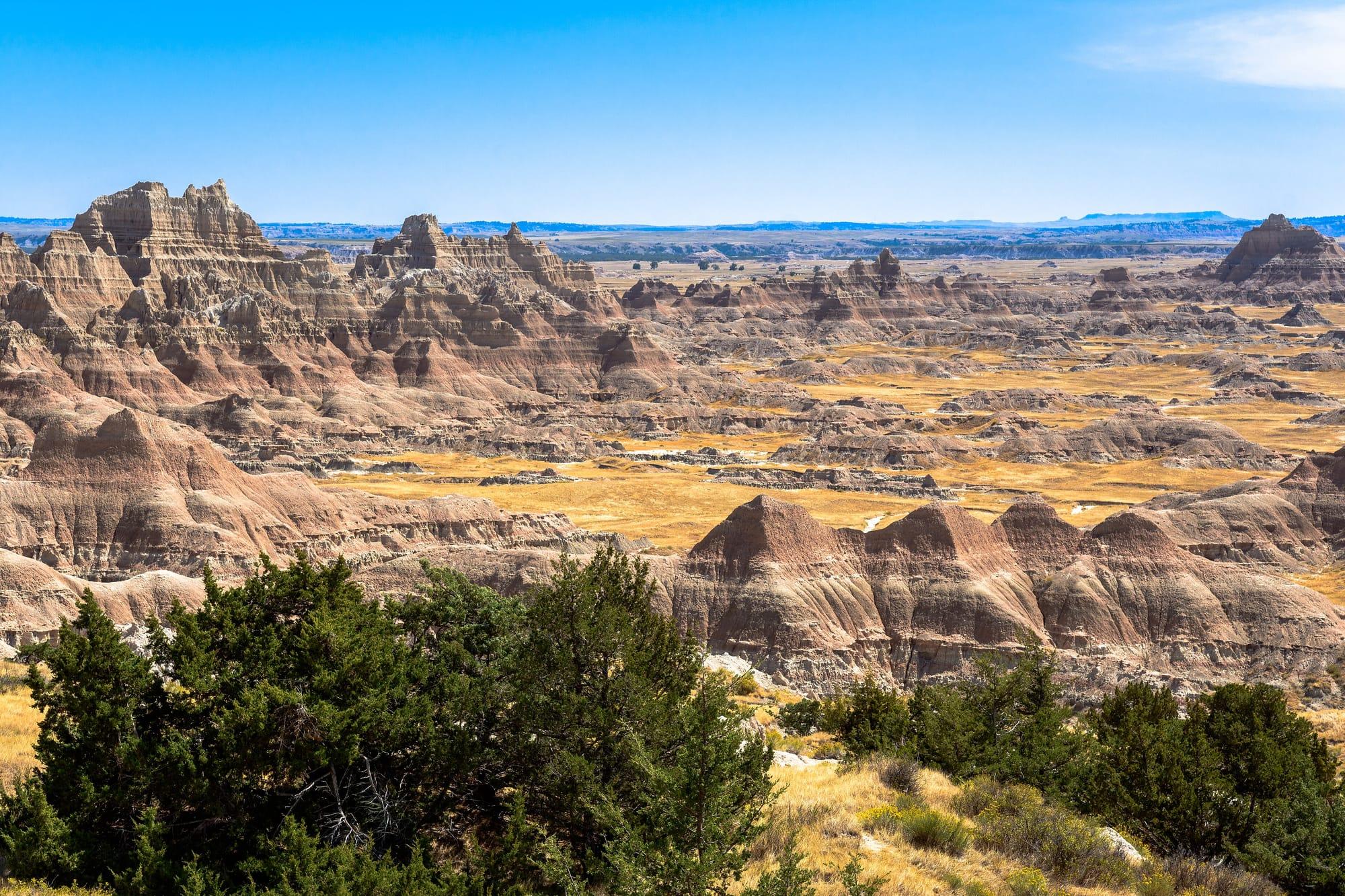
Badlands National Park Fossil Guide
Image: National Park Service (Public Domain)
Badlands National Park in South Dakota contains the world's richest collection of Oligocene vertebrate fossils in the White River Group, approximately 36 to 28 million years old, preserving titanotheres, oreodonts, early horses, camels, and saber-toothed nimravids in dramatic eroded badlands terrain. Fossil viewing is free; collection is prohibited.
By Edward Chen · Updated 31 July 2026
Introduction
Badlands National Park in southwestern South Dakota protects one of the most significant paleontological landscapes in North America. The dramatic eroded formations rising from the Great Plains are not merely striking scenery but an actively eroding archive of Oligocene life, continuously revealing new fossils from the White River Group as wind and rain cut into the soft sediments. According to the NPS Geodiversity Atlas, the park contains the world's richest collection of Oligocene-age vertebrate fossils, with more than 250 vertebrate species represented in its formations.
The area now included within the park is widely described as the birthplace of vertebrate palaeontology in the American West. Scientific expeditions arrived in the 1840s, and by the mid-19th century the White River Badlands had yielded 77 of the 84 distinct species of animals then known in the entire North American fossil record. Institutions including Yale University and the American Academy of Sciences sent repeated collecting expeditions to the region throughout the late 1800s, supplying the great natural history museums of the East Coast with their early mammal displays.
Today the fossils are protected. No collecting is permitted within a national park. The park offers instead a landscape where fossils emerge naturally from the eroding hillsides and can be seen in outcrop on trails, along roadsides, and across the open terrain. When a fossil is found, it should be left in place and reported to park staff, who regularly monitor and record new exposures.
Photo: Smithsonian National Museum of Natural History, CC0, via Smithsonian Open Access
Location and Directions
Badlands National Park is located in Pennington and Jackson counties in southwestern South Dakota, approximately 75 miles east of Rapid City on Interstate 90. The two main highway access points are Exit 110 (Cactus Flat) on I-90, which leads to the Northeast Entrance and the Ben Reifel Visitor Center, and Exit 131 (Wall), from which Highway 240 enters the park from the north.
The Ben Reifel Visitor Center at 25216 Ben Reifel Road in Interior, South Dakota, is the primary entry point. It contains exhibits on the geology, palaeontology, and ecology of the park, a bookshop, and ranger staff. The visitor centre is the best starting point for first-time visitors to orient themselves with the park layout.
From Rapid City, take I-90 east to Exit 110 and follow Highway 240 south into the park. The drive from Rapid City to the visitor centre takes about one hour. From Sioux Falls, take I-90 west for approximately 300 miles to the same exit. The town of Wall, South Dakota, sits adjacent to the northern park boundary and offers the nearest concentration of accommodation, fuel, and services.
The Badlands Loop Road (Highway 240) passes through the most accessible fossil terrain in the park, with multiple overlooks and trailheads along its length. The road is 30 miles long and connects the two I-90 access points, forming a loop route through the heart of the formations.
 Photo: Eekim, CC0 via Wikimedia Commons

What Fossils You'll Find
The fossil fauna of the White River Badlands is dominated by Oligocene mammals that lived on broad forested floodplains during a time when the Great Plains region was considerably more humid than it is today. According to the NPS, more than 50 species of herbivores and 14 species of carnivores have been identified in the Eocene and Oligocene strata, primarily from the Brule Formation.
The largest and most iconic animals from the Badlands are the titanotheres (also called brontotheres), rhinoceros-like perissodactyls that reached the size of modern elephants and carried paired bony horns on their skulls. Titanothere skulls and limb bones turn up regularly in the Chadron Formation, the older Eocene unit beneath the main Brule beds. The titanotheres are among the most frequently mentioned animals from this site and their remains are common enough that the park's palaeontology exhibits feature them prominently.
Oreodonts are perhaps the most abundant fossil vertebrate in the park. These pig-sized, sheep-like artiodactyls grazed and browsed across the Oligocene floodplains in enormous numbers, and their bones are present at almost every fossiliferous level in the Brule Formation. Oreodont skulls are a classic Badlands find, appearing in eroded bank faces and wash channels. The NPS notes that an oreodont skull was being prepared in the park's fossil preparation laboratory at the time of documentation.
Early horses from the genus Mesohippus and its relatives appear in the Brule Formation. These were small, three-toed browsers resembling a medium-sized dog, far removed in body plan from the large single-toed grazers they would eventually evolve into. The White River Badlands record an important phase in early horse evolution, and the park's specimens have contributed to understanding of how horses adapted to changing grassland environments through the Oligocene.
Early camels, including Poebrotherium wilsoni, occur in the Brule Formation. Research published on specimens from the park has used dental morphology and isotopic analysis to reconstruct the dietary habits of these early camelids and correlate them with Oligocene climate reconstructions. Other herbivores include early rhinoceroses and various rodents.
Reptiles including tortoises and crocodilians occur in the formation, as do birds. The park also preserves trace fossils including burrows and root casts from the Oligocene soil horizons visible as pale bands in the cliff faces.
Geologic History
The rocks exposed in Badlands National Park record approximately 75 million years of Earth history, from shallow marine Cretaceous sediments at the base through Eocene and Oligocene terrestrial deposits to relatively recent erosional landforms. The marine portion includes the Pierre Shale, a dark grey Cretaceous mudstone deposited in the Western Interior Seaway that once split North America from the Gulf of Mexico to the Arctic.
The White River Group, which contains the fossil-rich beds most visitors come to see, sits above the Pierre Shale and represents a return to terrestrial conditions. The group is divided into several formations deposited between roughly 37 and 28 million years ago. The Chamberlain Pass Formation at the base represents the transition from marine to terrestrial conditions. The Chadron Formation above it, laid down in Eocene river systems and floodplains, is the source of titanothere remains and preserves a warmer, more heavily forested environment than the younger beds above. The Brule Formation, Oligocene in age and the richest source of fossil vertebrates in the park, records a shift toward more open, seasonally dry conditions as the region began its long transition toward the semi-arid Great Plains of today. The Sharps Formation, the youngest of the White River Group units in the park, represents the later Oligocene as grasslands became more established.
The distinctive badland topography formed through accelerated erosion beginning within the last million years. The White River and its tributaries cut down through the soft sediments, and the alternating hard and soft layers eroded at different rates to produce the pinnacles, gullies, hoodoos, and buttes that define the landscape. Erosion continues at about one inch per year on average, constantly exposing new fossil material and destroying old exposures.
 Photo: w_lemay, CC BY-SA 2.0 via Wikimedia Commons

Fossil Preparation Laboratory
The Ben Reifel Visitor Center includes a working fossil preparation laboratory that is open to the public during staffed hours. Visitors can watch professional palaeontologists clean and stabilise fossils recovered from the park using fine picks and air scribes. Staff are available to answer questions about the fossils being worked on and about the palaeontology of the Badlands more generally.
This is one of the few places in the national park system where members of the public can observe active professional fossil preparation work in progress. The lab is inside the visitor centre building and visible through a window from the main exhibit hall. No separate ticket or fee is required to view the lab.
Photo: Smithsonian National Museum of Natural History, CC0, via Smithsonian Open Access
Collecting Rules and Regulations
No fossil collecting is permitted anywhere within Badlands National Park. All fossil resources on National Park Service land are protected under the Paleontological Resources Preservation Act of 2009, as well as the NPS Organic Act. Removal of any fossil, rock, or natural object from federal national park land is a federal violation.
If you find a fossil while hiking in the park, the NPS asks that you leave it exactly in place, photograph it if possible, note the GPS location, and report it to park staff at the visitor centre. New fossil discoveries are a regular occurrence in the park and many significant specimens have been reported by members of the public.
Park entry fees apply. There is no additional charge to visit the visitor centre or the preparation laboratory.
Safety
The Badlands terrain looks accessible from a distance but can be deceptive on foot. The clay-rich soils in the formations become extremely slippery when wet and nearly impassable after rain. Erosional gullies that appear shallow can become maze-like. If you leave the maintained trails to explore the open terrain, take compass bearings before entering the formations, as landmarks become difficult to identify at ground level.
Summer temperatures routinely exceed 38 degrees Celsius and the open terrain offers little shade. Dehydration is a genuine risk on longer hikes. The NPS recommends carrying at least one litre of water per hour in hot weather. There are no water sources in the backcountry. Afternoon thunderstorms are common in summer and the open ridgelines are exposed to lightning.
Winter conditions can be severe. Blizzards occur from November through March and the park roads may close without warning. Check road conditions before visiting in winter. The shoulder seasons of May and September are generally the most comfortable for extended hiking.
Sources
https://www.nps.gov/articles/000/paleontology-badl.htm https://www.nps.gov/articles/nps-geodiversity-atlas-badlands-national-park-south-dakota.htm https://www.nps.gov/badl/learn/nature/geology-paleontology.htm
Nearby sites
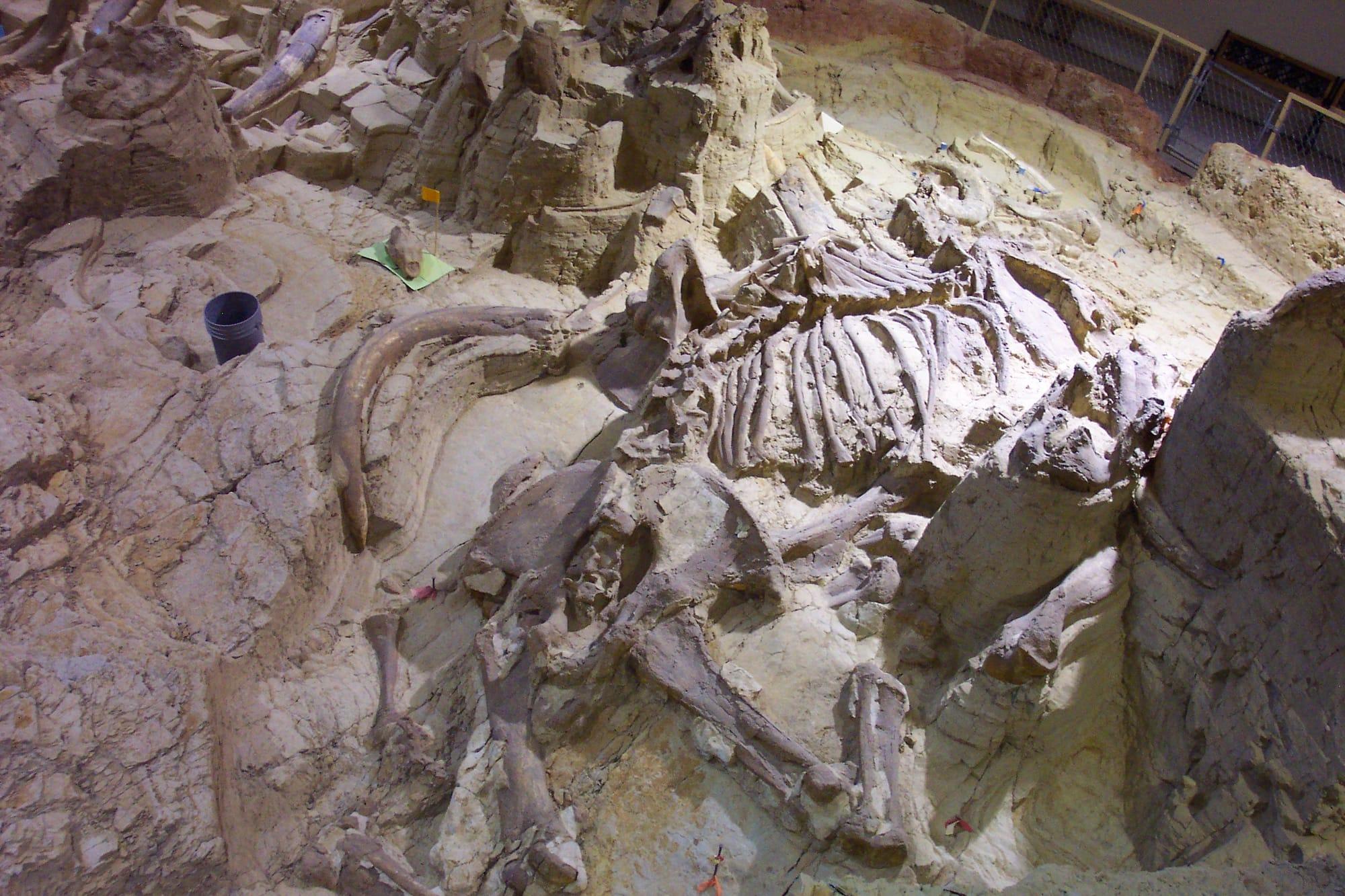 The Mammoth Site of Hot Springs Fossil Hunting GuideColumbian mammoth (Mammuthus columbi), Woolly mammoth (Mammuthus primigenius)
 Agate Fossil Beds National Monument Fossil Hunting GuideMenoceras arikarense, Stenomylus hitchcocki
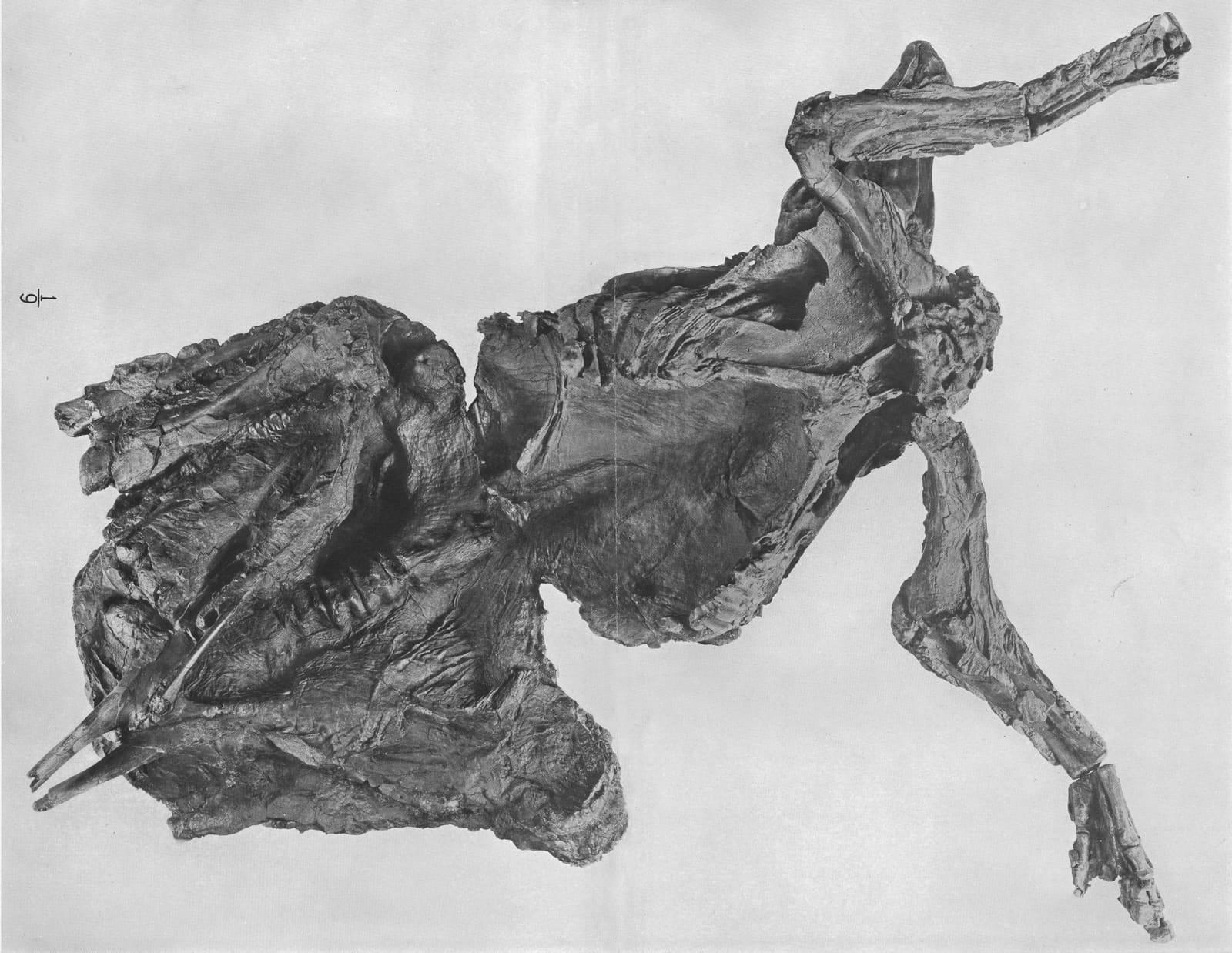 Lance Creek Fossil Hunting GuideTriceratops, Tyrannosaurus rex
 Como Bluff Fossil Hunting GuideSauropod bones, Stegosaurus