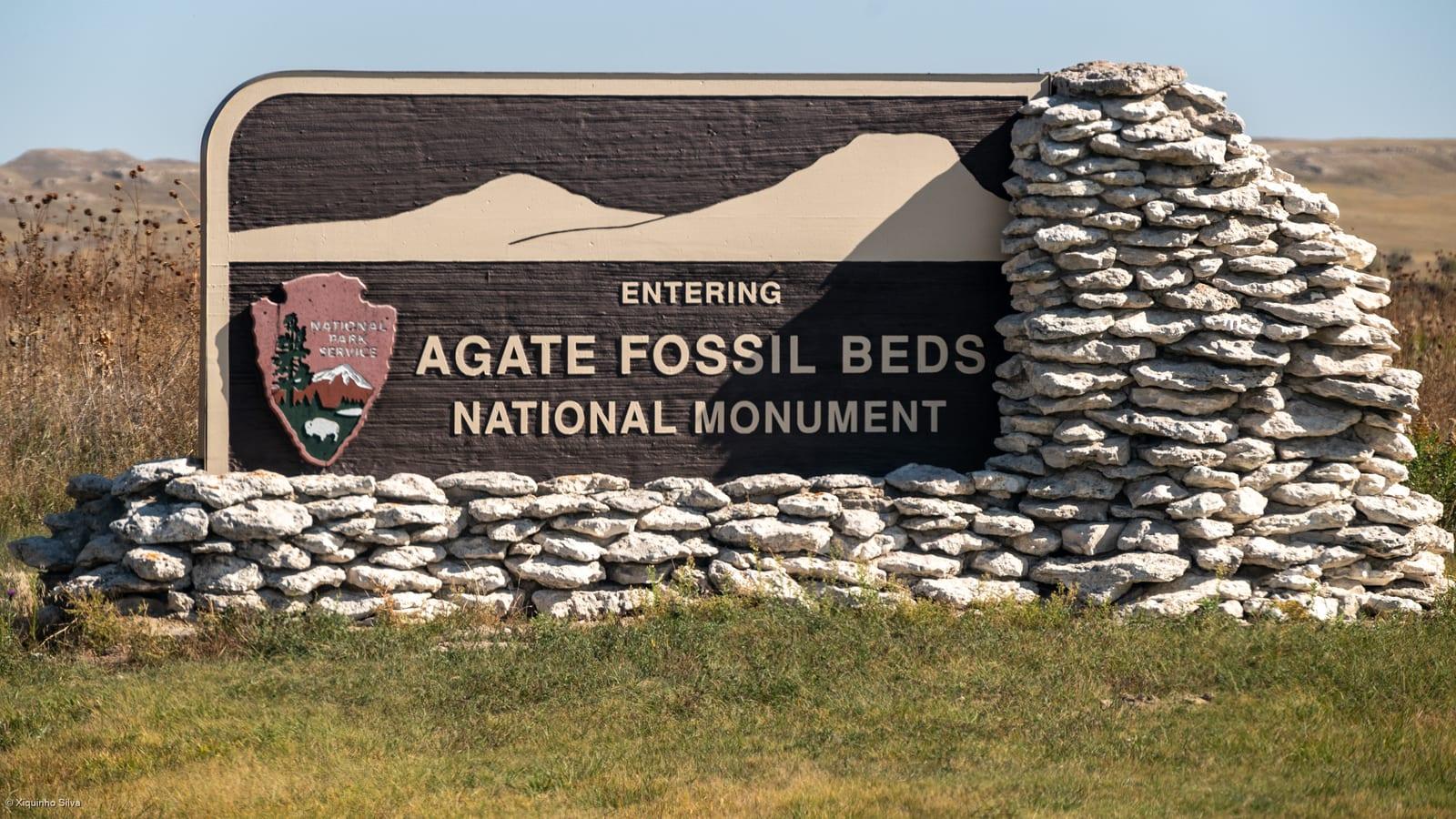
Agate Fossil Beds National Monument Fossil Hunting Guide
Image: xiquinhosilva (CC BY 2.0)
Agate Fossil Beds National Monument sits in the rolling shortgrass prairie of the Niobrara River valley in northwestern Nebraska, about 22 miles south of Harrison.
By Edward Chen · Updated 1 August 2026
 Photo: xiquinhosilva, CC BY 2.0 via Wikimedia Commons

Introduction
Agate Fossil Beds National Monument sits in the rolling shortgrass prairie of the Niobrara River valley in northwestern Nebraska, about 22 miles south of Harrison. The hills above the river preserve one of the densest accumulations of early Miocene mammal bones ever found, along with a feature found almost nowhere else: the Daemonelix corkscrew burrows of the small extinct beaver Palaeocastor. Generations of paleontologists have worked the bone beds on University Hill and Carnegie Hill since the 1890s, recovering thousands of skeletons of the small two-horned rhinoceros Menoceras, the slender gazelle-camel Stenomylus, and the bizarre clawed chalicothere Moropus. The site is a unit of the National Park Service. Collecting is federally prohibited, and the visitor experience is built around two interpretive trails that lead to the historic quarry hillside and to a stretch of bluff where the fossil burrows are exposed in cross section. This guide covers how to reach the monument, what you will see in the bone beds and along the trails, the geological story of the Harrison Formation, and the rules that govern a viewing-only NPS site.
Location and Directions
The visitor center sits on the south side of Nebraska Highway 29, midway between the small towns of Harrison and Mitchell in Sioux County, Nebraska. The mailing address is 301 River Road, Harrison, Nebraska 69346.
From Harrison, drive about 22 miles south on Highway 29. From Mitchell, drive roughly 34 miles north on Highway 29. The monument entrance is signed on the highway. A short paved entrance road leads from Highway 29 down into the Niobrara valley to the visitor center parking area.
The closest major airports and full-service towns are Scottsbluff, Nebraska (about an hour south by car) and Rapid City, South Dakota (roughly two and a half hours north). There are no fuel stations, restaurants, or lodging at the monument itself. Cell coverage is weak across most of Sioux County, so download maps before leaving Harrison or Mitchell.
From the visitor center, two short paved trails reach the fossil exposures. The Fossil Hills Trail runs about 2.7 miles round trip across the prairie to the base of University Hill and Carnegie Hill, where the historic bone-bed quarries are visible as scarps cut into the hillside. The Daemonelix Trail is a separate 1-mile loop that begins from a small parking pullout west of the visitor center and leads to a section of bluff where the corkscrew burrows are exposed in the rock face. Both trails are exposed prairie with little shade. Carry water, sun protection, and watch for prairie rattlesnakes from late spring through early fall.
The monument is open year round, but the visitor center is staffed seasonally. Hours and trail access can be reduced in winter, and high winds, snow, or wet clay surfaces can close the trails on short notice. Check the NPS Agate Fossil Beds page before driving out. There is no entrance fee.
 Photo: NPS staff, Public domain, via Wikimedia Commons
.jpg)
What Fossils You'll Find
 Photo: James St. John, CC BY 2.0 via Wikimedia Commons
%20(Harrison%20Formation%2C%20Lower%20Miocene%3B%20Nebraska%2C%20USA)%201%20(31727574103).jpg)
You will not collect at Agate Fossil Beds. What you can do is walk to bone-bed exposures and burrow casts that are preserved in place. The assemblage is one of the most studied early Miocene faunas in North America.
- Menoceras arikarense. A small, two-horned rhinoceros that died here in herds during prolonged drought. Skulls, jaws, vertebrae, and limb bones from Menoceras dominate the University Hill and Carnegie Hill bone beds, often packed in jumbled, cross-bedded sandstone.
- Stenomylus hitchcocki. A slender, gazelle-like camel about the size of a small deer. The bones are concentrated in their own dedicated layer at the historic Stenomylus Quarry on the north side of the valley and represent another mass-mortality event.
- Moropus elatus. A horse-sized chalicothere with curved claws on its forelimbs and hooves on its hindlimbs. Articulated Moropus skeletons are among the most sought specimens recovered from the site, and casts are mounted in the visitor center.
- Dinohyus (Daeodon) hollandi. A massive entelodont, sometimes called a hell pig, known from a partial skull and limb material found in the bone bed.
- Palaeocastor. A burrowing beaver about the size of a modern prairie dog. The corkscrew burrows of this animal, named Daemonelix (devil's corkscrew) by O.C. Marsh in 1891, are exposed along the Daemonelix Trail. Some burrow casts contain articulated Palaeocastor skeletons in the terminal chamber.
- Other taxa. Fragmentary remains of the bear-dog Daphoenodon, the small horse Parahippus, the oreodont Merychyus, and various rodents and carnivores have been recovered from the same layers.
Inside the visitor center, the Cook Collection of Plains Indian artifacts and several full mounted skeletons supplement the in-place exposures.
"In the early 1900s, paleontologists unearthed the Age of Mammals when they found full skeletons of extinct Miocene mammals in the hills of Nebraska. species previously only known through fragments. Agate is the world's leading source of full-skeleton specimens of Miocene mammals.". National Park Service
Geologic History
The bone-bearing rocks at Agate sit in the Harrison Formation, the upper of the major early Miocene units in the Arikaree Group of western Nebraska. Radiometric dates and biostratigraphy place the formation at roughly 23 to 19 million years old, in the Arikareean North American Land Mammal Age.
Through this interval, the High Plains were a broad, slowly aggrading savanna sloping eastward off the rising Rocky Mountains. Rivers braided across the plain, dropping channel sands and overbank silts. Volcanic ash drifted in repeatedly from arc volcanoes far to the west, and altered ash gives much of the Harrison Formation its pale, fine-grained, tuffaceous character. The climate was strongly seasonal, with wet summers and long dry winters, and the vegetation was an early grassland with scattered woodlands along the water courses.
The University Hill and Carnegie Hill bone beds are interpreted as a drought-driven mass mortality. As surface water dried back to a few persistent springs and waterholes, herds of Menoceras concentrated around the remaining water and many died in place. Their carcasses were later reworked by a flood pulse that shed sand and gravel across the plain, mixing the bones into the dense, jumbled accumulation seen today. The Stenomylus Quarry preserves a separate event in a different bed.
The Daemonelix burrows record dry-ground colonies of Palaeocastor that dug deep, helical shafts into firm tuffaceous sand. After the colonies were abandoned, the open burrows filled passively with sediment, and the fill cemented harder than the surrounding rock. As the modern Niobrara River cut down through the Harrison Formation, the cemented burrow casts now stand out as upright corkscrews against softer, weathered host rock.
How Agate Fossil Beds Became a Fossil Collecting Site
This is a designated paleontological monument, not a former quarry. Bones eroding out of the bluffs above the Niobrara had been known to homesteaders and Lakota in the 1880s, and the rancher James Cook, who owned the property, brought the bone beds to scientific attention in 1891. Excavations by O.C. Marsh of Yale, the American Museum of Natural History, the Carnegie Museum, the University of Nebraska, and Amherst College followed in the late 1890s and early 1900s. The hills are still named for the institutions that worked them. Major collections of Menoceras, Stenomylus, and Moropus from these excavations sit in museums across the country.
The Cook family donated and protected the site for decades, and in 1965 Congress established Agate Fossil Beds National Monument under the National Park Service. Active research excavations are still permitted at intervals under federal authorization, but the visible exposures along the two trails are managed for in-place preservation rather than collection.
Collecting Rules and Regulations
Collecting is federally prohibited. Agate Fossil Beds is a unit of the National Park Service. Removing, damaging, or disturbing any paleontological resource on NPS land is a federal offense under the Paleontological Resources Preservation Act of 2009 and 36 CFR 2.1. This includes vertebrate bones, invertebrate fossils, and trace fossils such as the Daemonelix burrow casts. Penalties include fines and possible imprisonment.
Practical rules:
- Stay on the paved Fossil Hills Trail and Daemonelix Trail. Do not climb on the bluffs, the bone-bed exposures, or the burrow casts.
- Photography for personal use is welcomed throughout the monument.
- There is no entrance fee.
- The visitor center, restrooms, and water fountains are seasonal. Outside the open season the trails may still be walkable, but services are closed.
- Carry water on every visit. Summer temperatures regularly exceed 95 degrees Fahrenheit and there is almost no shade on either trail.
- Watch for prairie rattlesnakes, fast-changing prairie storms, and lightning on exposed ground.
- Drones are not permitted in the monument under standard NPS regulations.
Safety
Agate Fossil Beds is a quiet monument in open prairie, and the risks are those of exposure and distance rather than terrain.
There is no shade on the trails. The Fossil Hills and Daemonelix trails cross open shortgrass prairie with nothing to shelter under. Nebraska summers are hot and the wind is persistent, so carry water, wear a hat, and use sun protection. Winter brings severe cold and wind chill, and the monument is sometimes affected by snow and ice.
Watch the weather. This is open plains country where thunderstorms build quickly and visibly, and there is nowhere to shelter on the trails. Turn back early rather than late, and note that lightning is the real danger on an exposed ridge.
Rattlesnakes are present on the prairie and the hillsides in the warmer months. Stay on the trails, watch where you step, and keep children close.
The monument is remote. Harrison, about 22 miles north, is a small town, and services in this corner of Nebraska are widely spaced, so arrive with fuel and supplies. Mobile coverage is unreliable.
The trails are packed surface with some gradient on the Fossil Hills route, so wear proper shoes. Everything here is federally protected, so the fossils in the hills are to be looked at rather than collected, and that applies to loose material on the ground as well as anything in place.
Sources
- National Park Service, "Agate Fossil Beds National Monument." https://www.nps.gov/agfo/index.htm
- National Park Service, "Paleontology at Agate Fossil Beds." https://www.nps.gov/agfo/learn/nature/index.htm
- Hunt, R.M. Jr., 1990. "Taphonomy and Sedimentology of Arikaree (Lower Miocene) Fluvial, Eolian, and Lacustrine Paleoenvironments, Nebraska and Wyoming." Geological Society of America Special Paper 244.
- Martin, L.D. and Bennett, D.K., 1977. "The Burrows of the Miocene Beaver Palaeocastor, Western Nebraska, USA." Palaeogeography, Palaeoclimatology, Palaeoecology 22.
- Nebraska Game and Parks Commission, "Sioux County and the Pine Ridge." https://outdoornebraska.gov/
Nearby sites
 Lance Creek Fossil Hunting GuideTriceratops, Tyrannosaurus rex
 The Mammoth Site of Hot Springs Fossil Hunting GuideColumbian mammoth (Mammuthus columbi), Woolly mammoth (Mammuthus primigenius)
 Como Bluff Fossil Hunting GuideSauropod bones, Stegosaurus
 Badlands National Park Fossil GuideTitanotheres, Oreodonts