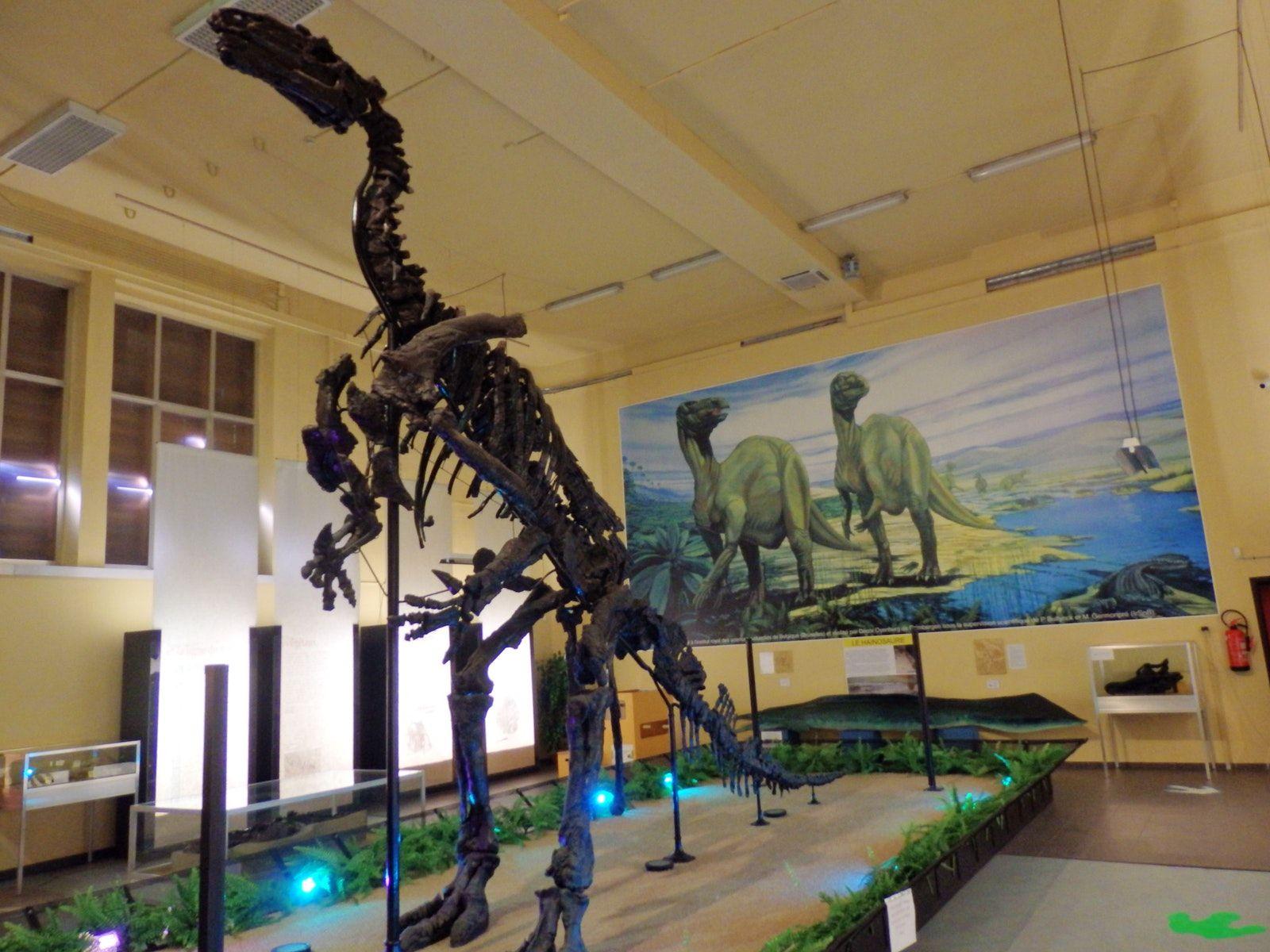
Bernissart Iguanodons (RBINS, Brussels) Fossil Hunting Guide
Image: Ben2 (CC BY-SA 3.0)
In 1878 miners working a coal seam at Bernissart, southern Belgium, broke into a 322-metre-deep pocket of Early Cretaceous clay packed with the articulated skeletons of more than 30 Iguanodon. The find revolutionised understanding of dinosaurs and remains the founding collection of the Royal Belgian Institute of Natural Sciences in Brussels. The mine itself closed and flooded long ago; the fossils are viewable in the RBINS Dinosaur Gallery.
By Edward Chen · Updated 31 July 2026
Introduction
Bernissart is a small commune in the province of Hainaut in southwestern Belgium, near the French border, about 70 kilometres southwest of Brussels. The town is permanently inscribed in the history of vertebrate paleontology because of a 1878 discovery in the now-closed Sainte-Barbe coal mine: at a depth of 322 metres below the surface, miners cutting a gallery through a Cretaceous clay-filled karst pocket exposed dozens of articulated skeletons of the iguanodontian ornithopod Iguanodon bernissartensis. Over the following three years roughly 30 skeletons were excavated, plus material later assigned to Mantellisaurus atherfieldensis, fish, turtles, crocodyliforms, and plant material. The collection was entrusted to the Belgian state and reassembled at what is now the Royal Belgian Institute of Natural Sciences (RBINS) in Brussels, where it is the centrepiece of one of the most important dinosaur displays in the world.
Visitor access today is via the RBINS Dinosaur Gallery. The Bernissart mine itself closed in 1921, flooded shortly thereafter, and is not accessible. The town of Bernissart preserves a small local museum (the Iguanodon Museum) that documents the discovery and the mining history. This guide focuses on the RBINS Dinosaur Gallery and provides the geological and historical context.
Location and Directions
The Royal Belgian Institute of Natural Sciences is at Rue Vautier 29, 1000 Brussels, in the Leopold Park district adjacent to the European Parliament. The nearest metro stations are Maelbeek and Trône. The museum is also a short walk from Brussels-Luxembourg railway station. Admission is paid. Standard adult tickets typically run €15-€20 depending on temporary exhibitions, with reductions for students, seniors, and children. The museum is open Tuesday through Sunday and is closed Mondays.
The town of Bernissart itself, in Hainaut, is accessible from Brussels by car (about 70 minutes via the E19/A8 motorway) or by train via Mons. The local Iguanodon Museum is in a converted house in the town centre. Opening hours are limited and visiting requires advance contact.
Visit experience at RBINS
The Dinosaur Gallery occupies a purpose-built two-storey hall in the heart of the museum. The Bernissart Iguanodons stand in a tall climate-controlled glass case approximately 300 square metres in area, with the largest skeletons posed in the now-outdated upright "kangaroo" stance that 19th-century anatomist Louis Dollo first reconstructed for them. Subsequent paleontological reinterpretation has placed iguanodontians in a more horizontal quadrupedal-to-bipedal posture, but the museum has retained the original upright mounts for their historical importance. Eight Iguanodon bernissartensis specimens are displayed standing. Additional specimens are displayed prone, with one specimen mounted on a horizontal platform in roughly the position it was found in the mine. Mantellisaurus specimens are displayed nearby, and a single articulated Iguanodon is mounted on its original block exactly as it was excavated. Around the Iguanodons the gallery presents a comprehensive walk through dinosaur diversity, with skeletons of Plateosaurus, Tyrannosaurus rex (cast), Pachycephalosaurus, hadrosaurs, ceratopsians, and other taxa.
 Photo: Ronny Mg, CC0 via Wikimedia Commons

What Fossils You'll Find
The Bernissart fossils come from a Lower Cretaceous fluvial-and-lacustrine clay deposit that filled a karstic sinkhole in Carboniferous limestone. The clay is referred to the Wealden facies and is dated to the Barremian and earliest Aptian (about 125 to 122 million years ago). The pocket appears to have been a deep, restricted, low-oxygen wetland in which a population of iguanodontians repeatedly accumulated, possibly during episodic floods, and were buried in fine clay that preserved articulated skeletons in three dimensions with bones encrusted by pyrite. The pyrite preservation is one of the diagnostic features of the deposit and one of the long-running conservation challenges at the RBINS, since pyrite oxidises to gypsum in air and progressively destroys the bones unless they are kept in stable low-humidity conditions.
The dinosaur fauna of Bernissart is dominated by two iguanodontian species: the large Iguanodon bernissartensis, with adults reaching about 11 metres long and 4 to 5 metres tall, and the smaller Mantellisaurus atherfieldensis (originally identified as a smaller species of Iguanodon and reassigned in 2006). The total documented count is approximately 30 individuals across both species, all from the single Bernissart pocket. Other vertebrate fossils from the same pocket include the freshwater shark Hybodus, the bony fish Lepidotes, turtles, crocodylomorphs (Bernissartia and Theriosuchus), small lizards, and isolated theropod material. Plant fossils include conifer cones, fern and cycad-like fronds, and pollen.
"As the first complete skeletons ever discovered, they gave scientists and the public an impressive demonstration of what dinosaurs really looked like." Royal Belgian Institute of Natural Sciences
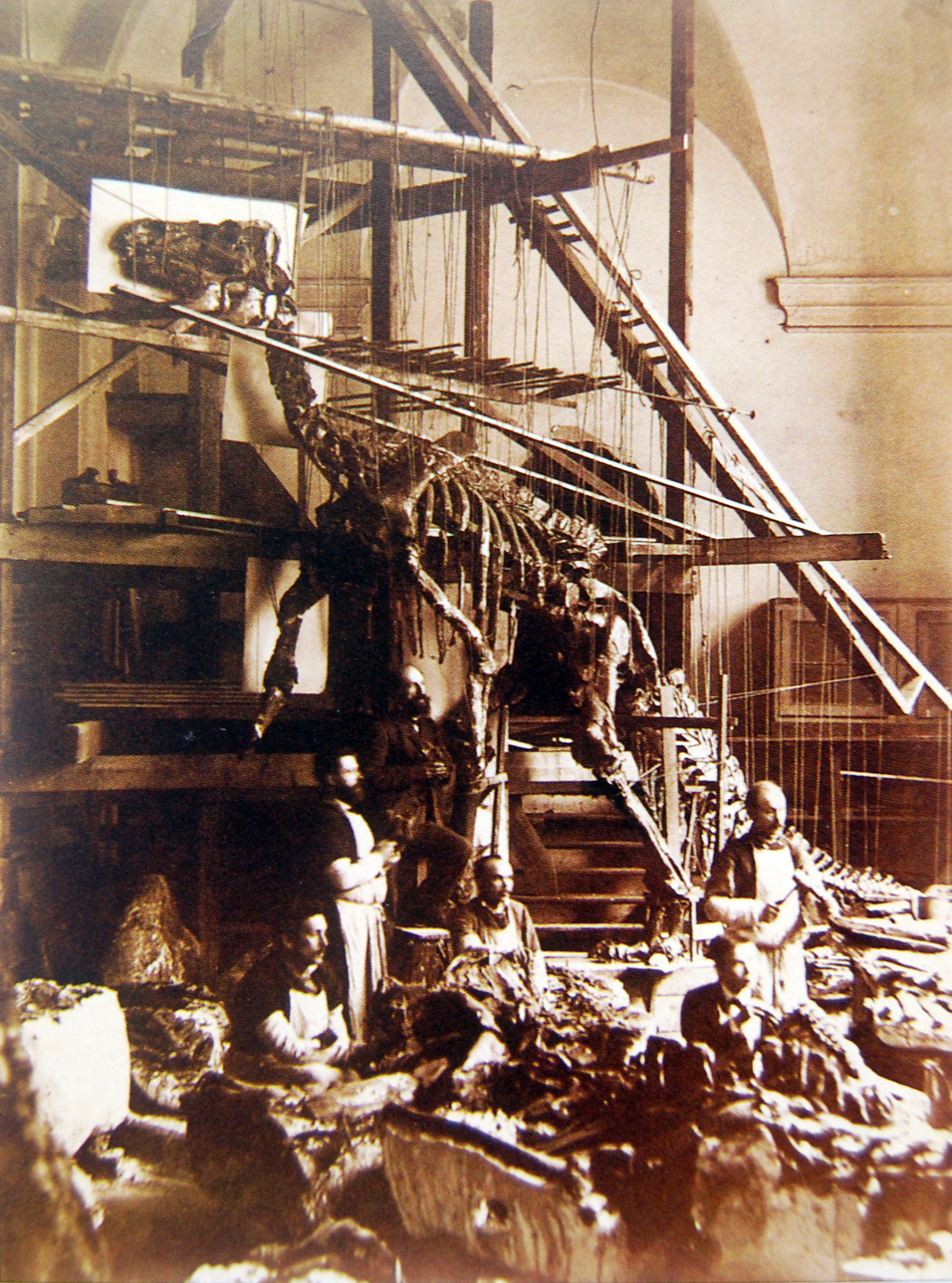 Photo: Aimé Rutot, Public domain via Wikimedia Commons

Geologic History
During the Early Cretaceous, much of what is now southern Belgium and northern France was a low-lying terrain of Carboniferous limestone karst, dotted with sinkholes and small lakes. The Bernissart sinkhole was one such depression, and it accumulated freshwater clays, peat, and plant debris over a period of perhaps several hundred thousand years during the Barremian-Aptian. The dinosaurs that fell into or visited the sinkhole, whether in episodic mass mortality events or in slow accumulation across many seasons, were preserved in articulated condition by the low-oxygen, fine-grained, rapidly-depositing sediment of the lake bottom. As the surrounding landscape evolved through the Cretaceous and Tertiary, the sinkhole and its fossiliferous fill were buried under younger sediments and ultimately under thick Carboniferous-age coal-bearing strata that became the target of 19th-century mining.
The 1878 discovery was an accident. Miners cutting a horizontal gallery through what they expected to be coal-bearing rock at 322 metres below the surface encountered an unexpected clay pocket and broke through into the fossiliferous fill. The first bones recovered were initially thought to be gold and silver before being identified as bone. The mine's chief engineer halted production and notified the Belgian Royal Museum (now RBINS), which dispatched paleontologist Louis De Pauw to lead what would become a three-year excavation. The Iguanodons were extracted in plaster jackets, broken into roughly 600 numbered blocks for transport, and reassembled in Brussels by Louis Dollo, who became the world's foremost authority on iguanodontian anatomy on the strength of the collection.
How Bernissart became a Belgian national heritage site
The Bernissart Iguanodons were entrusted to the Belgian state as soon as their significance was understood. They were initially housed in the chapel of the Nassau Palace in Brussels, then moved to the purpose-built natural history museum that became the RBINS. The 300-square-metre glass case that houses the principal display was constructed to provide climate control against pyrite disease. The Bernissart mine itself closed in 1921 and flooded. Subsequent attempts to access the fossiliferous pocket through new drilling and coring (including the 2002-2003 Bernissart Drilling Project led by RBINS) have recovered additional fossil material from cores but have not reopened the original pocket. A small local museum in Bernissart town preserves the discovery history.
 Photo: J. Cornet and G. Schmitz, Public domain via Wikimedia Commons

Collecting Rules & Regulations
Is Fossil Collecting Allowed?
No. The Bernissart specimens are protected national heritage at RBINS in Brussels. The original mine is closed and flooded. The surrounding land has no public fossil access.
Key Points:
- All Bernissart fossils are state property, curated at RBINS in Brussels.
- The original Sainte-Barbe coal mine is closed and flooded. There is no public access to the site.
- The town of Bernissart maintains a small Iguanodon Museum documenting the discovery. Opening hours are limited.
- Standard RBINS admission applies. Closed Mondays.
- Photography is permitted in the Dinosaur Gallery without flash.
Safety
This is a museum visit, and the hazards are correspondingly minimal. The practical notes matter more than the safety ones.
Inside the museum, the usual rules apply. Do not touch the mounted skeletons or lean on cases, keep children within reach around the displays, and follow staff direction. Floors can be slippery in wet weather near the entrance.
Do not go looking for the fossil site itself. The Iguanodon specimens came from a coal mine shaft beneath Bernissart, at a depth of more than 300 metres, and that mine is long closed and inaccessible. There is nothing to visit at surface level, and any old mining ground in the area is unstable and off limits. The museum is the site, in the sense that matters to a visitor.
Check opening hours and days before travelling, since a small municipal museum keeps limited hours and may close for holidays or between seasons. It is worth confirming by phone if you are making a special journey, and asking whether English-language material is available, since interpretation is primarily in French.
Parking is on street in a small town, so allow time. Bernissart is close to the French border in Hainaut, and public transport connections are limited, so most visitors arrive by car.
Nothing may be collected, and there is nowhere in the town where fossil collecting is possible.
Sources
Nearby sites
 Folkestone Warren and Copt Point Fossil Hunting GuideAmmonites, Crabs
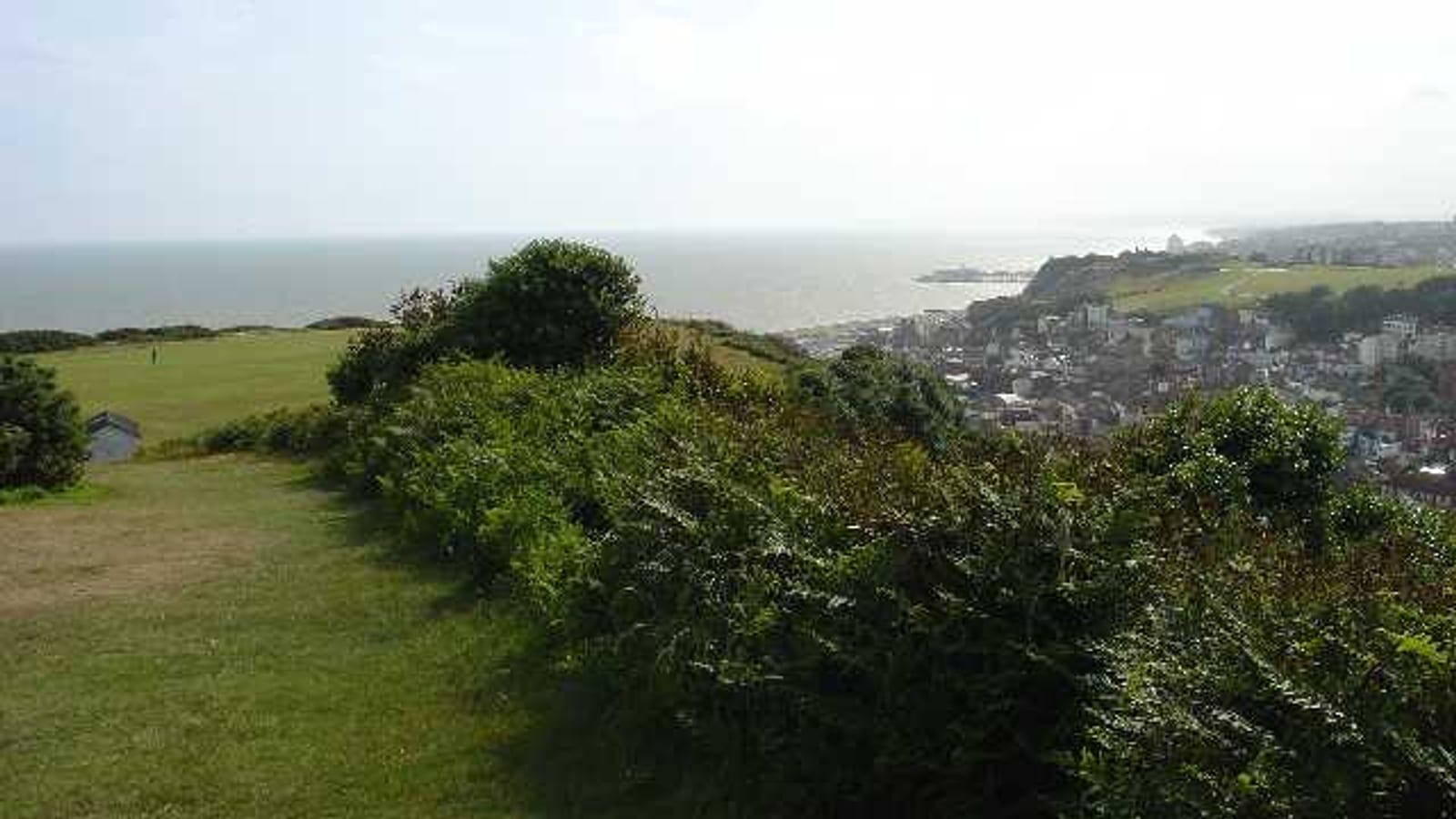 Hastings East Sussex Fossil Hunting GuideDinosaur bones and teeth, Dinosaur footprints
 Cooden Beach Bexhill Fossil Hunting GuideDinosaur bones and teeth, Crocodilian material
 Eastbourne Sussex Fossil Hunting GuideEchinoids, Chalk ammonites