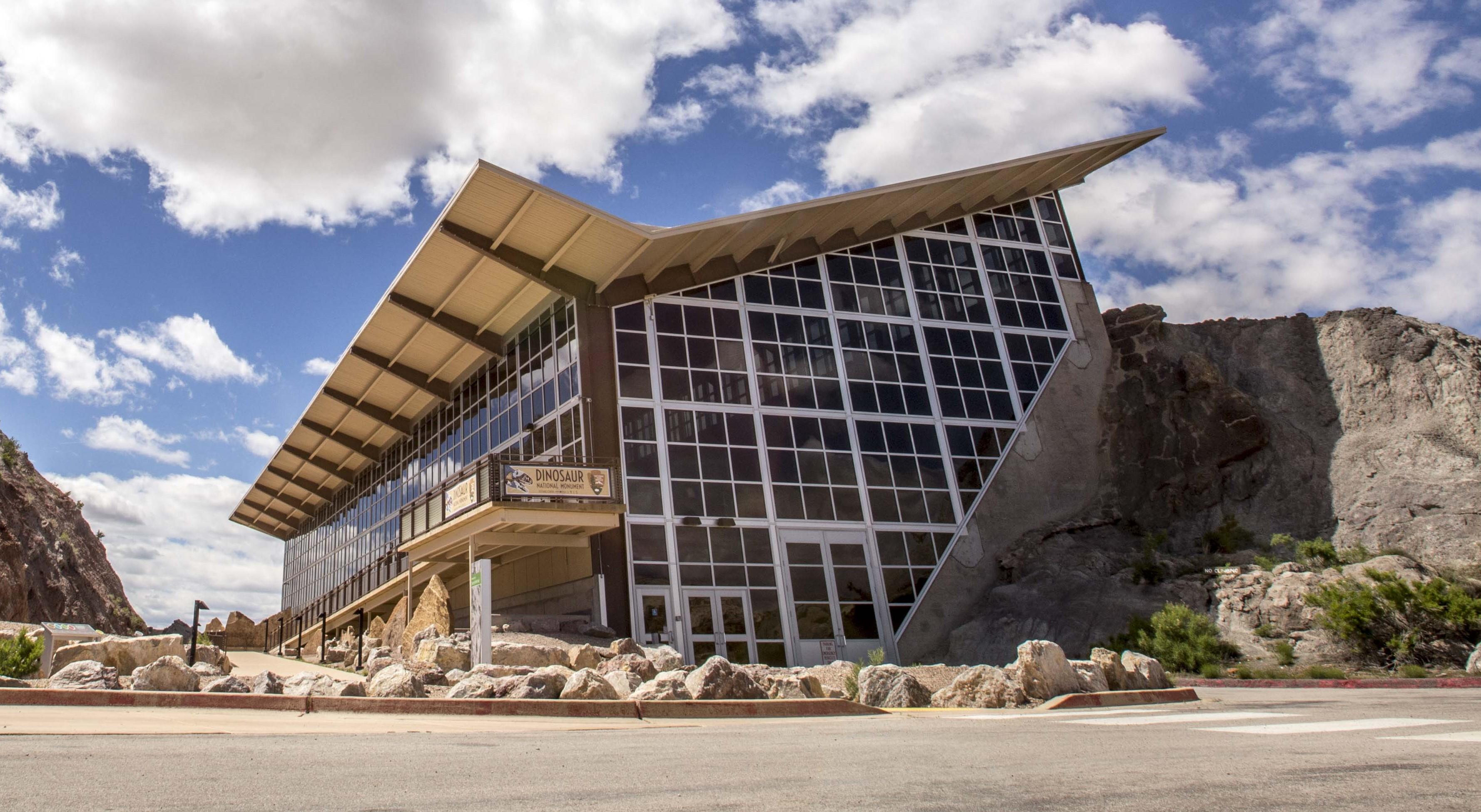
Dinosaur National Monument Quarry Exhibit Hall Fossil Hunting Guide
Image: NPS / Jake Holgerson (Public Domain)
Dinosaur National Monument's Quarry Exhibit Hall in northeastern Utah encloses the Carnegie Dinosaur Quarry, a 24-metre cliff face holding more than 1,500 in-place Morrison Formation bones from Allosaurus, Apatosaurus, Diplodocus, Stegosaurus, and Camarasaurus. Viewing-only NPS site.
By Edward Chen · Updated 31 July 2026
Introduction
Dinosaur National Monument straddles the Utah-Colorado state line along the Green and Yampa rivers, east of Vernal, Utah. The monument was first set aside in 1915 around a single hillside quarry where Earl Douglass of the Carnegie Museum of Natural History had identified a dense Jurassic bone bed in 1909. That hillside is now enclosed by the Quarry Exhibit Hall, a 1957 building rebuilt in 2011, that protects a 24-metre vertical cliff face containing more than 1,500 articulated and disarticulated dinosaur bones in their original burial position. The Wall of Bones is the largest in-place display of Jurassic dinosaur fossils in the world. Bones of Allosaurus, Apatosaurus, Diplodocus, Camarasaurus, Stegosaurus, and Dryosaurus are visible side by side. Many are within reach of visitors who can touch the Wall directly. Collecting is federally prohibited everywhere inside the monument, but the Quarry Exhibit Hall lets visitors get closer to in-place Jurassic dinosaur bone than almost anywhere else in the United States. The monument also contains more than 200,000 acres of canyon country, petroglyphs, river-running, and a much wider range of fossil-bearing rock from the Permian through the Cretaceous. This guide focuses on the Quarry Exhibit Hall, the Morrison Formation it preserves, and the rules that apply.
Photo: Smithsonian National Museum of Natural History, CC0, via Smithsonian Open Access
Location and Directions
The monument's Utah side and Quarry Exhibit Hall sit in Uintah County, about 7 miles north of the small town of Jensen and 20 miles east of Vernal. From Salt Lake City, the drive is about 3 hours east on US-40. From Grand Junction, Colorado, the drive is about 3 hours northwest.
The Quarry Visitor Center is at the corner of US-40 and Route 149 (Quarry Access Road), about 1 mile west of the Green River bridge in Jensen. The Quarry Exhibit Hall is at 11625 East 1500 South, Jensen, Utah 84035, on Cub Creek Road about 2 miles north of the visitor center. GPS for the exhibit hall is 40.4392 degrees north, 109.3036 degrees west.
From mid-May through mid-September, visitors park at the Quarry Visitor Center and take a free NPS shuttle to the Exhibit Hall. The shuttle runs every 15 minutes. From mid-September through mid-May, visitors drive directly to the Exhibit Hall.
Standard entry is 25 US dollars per private vehicle for a seven-day pass. America the Beautiful annual passes are accepted. The Quarry Exhibit Hall has the same opening hours as the Quarry Visitor Center: 8 a.m. to 6 p.m. from late spring through summer, 9 a.m. to 5 p.m. in spring and fall, and 10 a.m. to 4 p.m. in winter. The Exhibit Hall closes 30 minutes before the visitor center.
Vernal has the closest commercial airport and full lodging and dining. Inside the monument, the Green River Campground (Utah side) and the Echo Park Campground (Colorado side) provide front-country tent and small-RV camping by reservation in summer.
 Photo: National Park Service, Public domain via Wikimedia Commons
.jpg)
What Fossils You'll Find
You will not collect at Dinosaur National Monument. What you can do is stand in front of the Wall of Bones in the Quarry Exhibit Hall and see Jurassic dinosaurs side by side in their original sandstone matrix.
- Allosaurus fragilis. Large theropod represented by multiple individuals, including some of the most complete Allosaurus skulls in any collection. Carnegie Museum mount C.M. 11338 originally came from this quarry.
- Apatosaurus louisae. The type specimen of the species, named for Louise Carnegie, was excavated by Earl Douglass in 1909 to 1910 and is mounted at the Carnegie Museum. Additional referred material remains in the Wall.
- Diplodocus longus. Several caudal series, ribs, and limb bones are visible in the Wall, including articulated tail sections.
- Camarasaurus lentus. A nearly complete juvenile skeleton from the quarry is mounted in the lower exhibit gallery.
- Stegosaurus stenops. Plate, spike, and limb material from at least two individuals.
- Dryosaurus altus. A small ornithopod present in the bone bed and represented by partial skeletons.
- Crocodyliforms and turtles. Goniopholis-grade crocodyliform material and several turtle taxa are present in the same horizon.
The Wall of Bones contains roughly 1,500 catalogued bone elements visible to the public, plus thousands more documented before the rock was stabilised in the 1950s. Casts and full mounts of articulated skeletons are exhibited at the Carnegie Museum of Natural History in Pittsburgh, the Smithsonian, and the Utah Field House of Natural History State Park Museum in Vernal.
 Photo: James St. John, CC BY 2.0 via Wikimedia Commons

Geologic History
The Wall of Bones is a 24-metre exposure of the Brushy Basin Member of the Morrison Formation, a thick continental sequence deposited across the Western Interior during the Late Jurassic, between roughly 156 and 145 million years ago. The Carnegie Quarry sandstone is dated to about 149 million years ago, in the Kimmeridgian Stage, by stratigraphic correlation and indirect radiometric ages on bracketing ash beds elsewhere in the Morrison.
During the Late Jurassic, what is now northeastern Utah lay on a wide low-relief alluvial plain east of the rising western Cordillera. Streams flowed eastward across the plain, carrying clastic sediment from the highlands. The climate was strongly seasonal, with wet summers and long dry seasons. Dinosaur carcasses on the floodplain were occasionally swept by flood pulses into channel sandbars, where multiple animals accumulated together in dense bone-bed concentrations. The Carnegie Quarry sandbar trapped at least 30 individual dinosaurs of more than half a dozen species.
The bones lie roughly parallel to the original sandbar bedding, with limb bones aligned by the river current and small elements concentrated in scour pockets. Diagenetic cementation locked the bone-bed sandstone hard while surrounding mudstone weathered away, leaving the bone-bearing layer as a resistant ridge.
After the Jurassic, Cretaceous marine and continental rocks were deposited above the Morrison. Late Cretaceous to Cenozoic Laramide and Sevier tectonics tilted the Morrison Formation in this part of the Uinta Basin so that the original bedding now dips steeply north. The Wall of Bones is the upturned, exposed face of that tilted sandbar.
 Photo: James St. John, CC BY 2.0 via Wikimedia Commons
_3_(48878912622).jpg)
How the Quarry Became a Fossil Site
Earl Douglass, a vertebrate paleontologist working for the Carnegie Museum of Natural History, was prospecting for Jurassic dinosaurs along the Green River in August 1909 when he found a series of articulated Apatosaurus tail vertebrae on a hillside above Cub Creek. Excavation began the following month and continued through 1924. Carnegie Museum field parties recovered roughly 350 tons of bone and rock from the quarry and shipped it to Pittsburgh, where the mounted skeletons of Apatosaurus louisae and Diplodocus carnegii became the museum's centerpieces.
President Woodrow Wilson set aside the original 80-acre monument around the active quarry by proclamation on 4 October 1915. Excavation continued under successive institutions through 1924, then by the University of Utah in the early 1950s. In 1958, the National Park Service opened the first Quarry Visitor Center over the upturned bedding plane and exposed the in-place wall, ending bulk excavation in favour of stabilised display. The current Quarry Exhibit Hall, rebuilt to address foundation problems, reopened to the public on 4 October 2011, the 96th anniversary of the monument's establishment.
The monument was expanded in 1938 to 210,000 acres, taking in the Yampa River canyon, Steamboat Rock, and most of the present canyon country, in recognition of the wider geological and scenic value beyond the original quarry.
Photo: Smithsonian National Museum of Natural History, CC0, via Smithsonian Open Access
Collecting Rules and Regulations
Collecting is federally prohibited. Dinosaur National Monument is administered by the National Park Service, and removing, damaging, defacing, or disturbing any paleontological resource on NPS land is a federal offense under the Paleontological Resources Preservation Act of 2009 and 36 CFR 2.1. This includes bone fragments, petrified wood, and float pieces on the ground.
Practical rules:
- Stay on the elevated walkway inside the Quarry Exhibit Hall. The Wall of Bones is accessible from a single tactile zone where touching specific bones is allowed under ranger supervision.
- Photography for personal use is welcomed throughout the hall.
- Standard NPS entry fees apply. Annual America the Beautiful passes cover entry.
- Drones are not permitted in the monument.
- Pets are allowed in the campgrounds but not in the Exhibit Hall or on most fossil-bearing trails.
- Research collection at active dig sites elsewhere in the monument is permitted only to qualified scientists working with an institutional affiliation.
Safety
The Exhibit Hall is fully indoor and climate controlled. The interior walkway is level and accessible.
Outside, summer temperatures along the Green River regularly exceed 95 degrees Fahrenheit. Carry water on every outdoor walk. The Cub Creek Petroglyph Road and the Sound of Silence interpretive trail near the Exhibit Hall pass through open desert with no shade.
Rattlesnakes are present across the lower elevations of the monument. Watch foot placement near rocks and brush.
The Green and Yampa rivers, which run through the monument, carry class III and class IV rapids and require permits and skill for any boating. River permits are issued by lottery for multi-day trips through Lodore Canyon and the Yampa River canyon.
Sources
- National Park Service, "Dinosaur National Monument." https://www.nps.gov/dino/index.htm
- National Park Service, "Quarry Exhibit Hall." https://www.nps.gov/dino/planyourvisit/quarry-exhibit-hall.htm
- National Park Service, "Operating Hours and Seasons, Dinosaur." https://www.nps.gov/dino/planyourvisit/hours.htm
- Carpenter, K., 2013. "History, Sedimentology, and Taphonomy of the Carnegie Quarry, Dinosaur National Monument, Utah." Annals of Carnegie Museum, 81.
- Untermann, G.E. and B.R., 1969. "Geology of Dinosaur National Monument and Vicinity, Utah-Colorado." Utah Geological and Mineralogical Survey Bulletin, 72.
Nearby sites
 Fruita Paleontological Area Fossil Hunting GuideDinosaur bones, Mammal remains
 Cleveland-Lloyd Dinosaur Quarry Fossil Hunting GuideAllosaurus fragilis, Camarasaurus
 American Fossil Quarry Fossil Hunting GuideFish Fossils, Plant Fossils
 Cedar Mountain Formation Yellow Cat Member Fossil GuideDinosaurs, Utahraptor