Feather River Fossil Hunting Guide
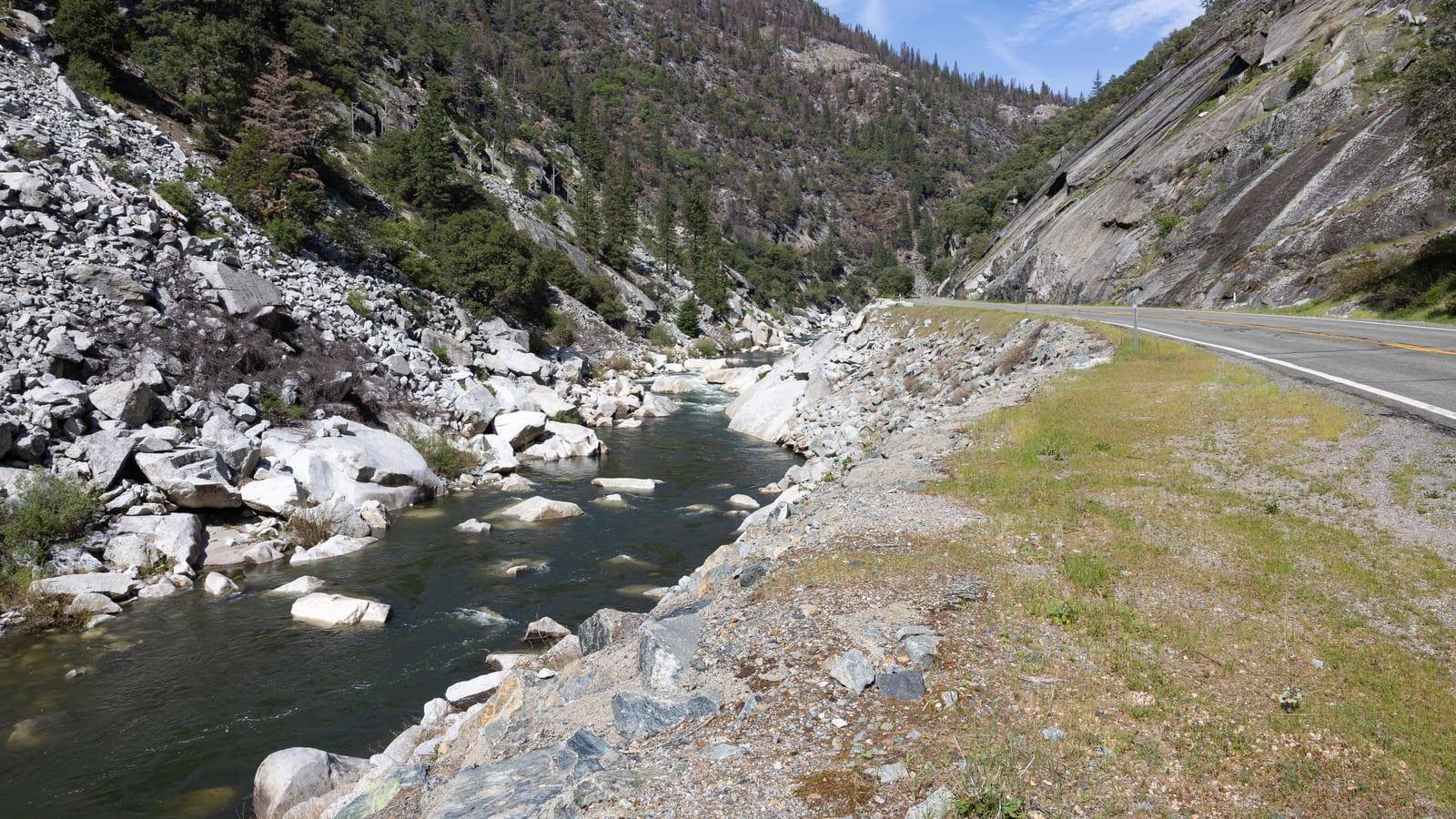
Image: Frank Schulenburg (CC BY-SA 4.0)
The Feather River drains the northern Sierra Nevada through some of the most tectonically scrambled rock in California.
By Edward Chen · Published 25 April 2016
Introduction
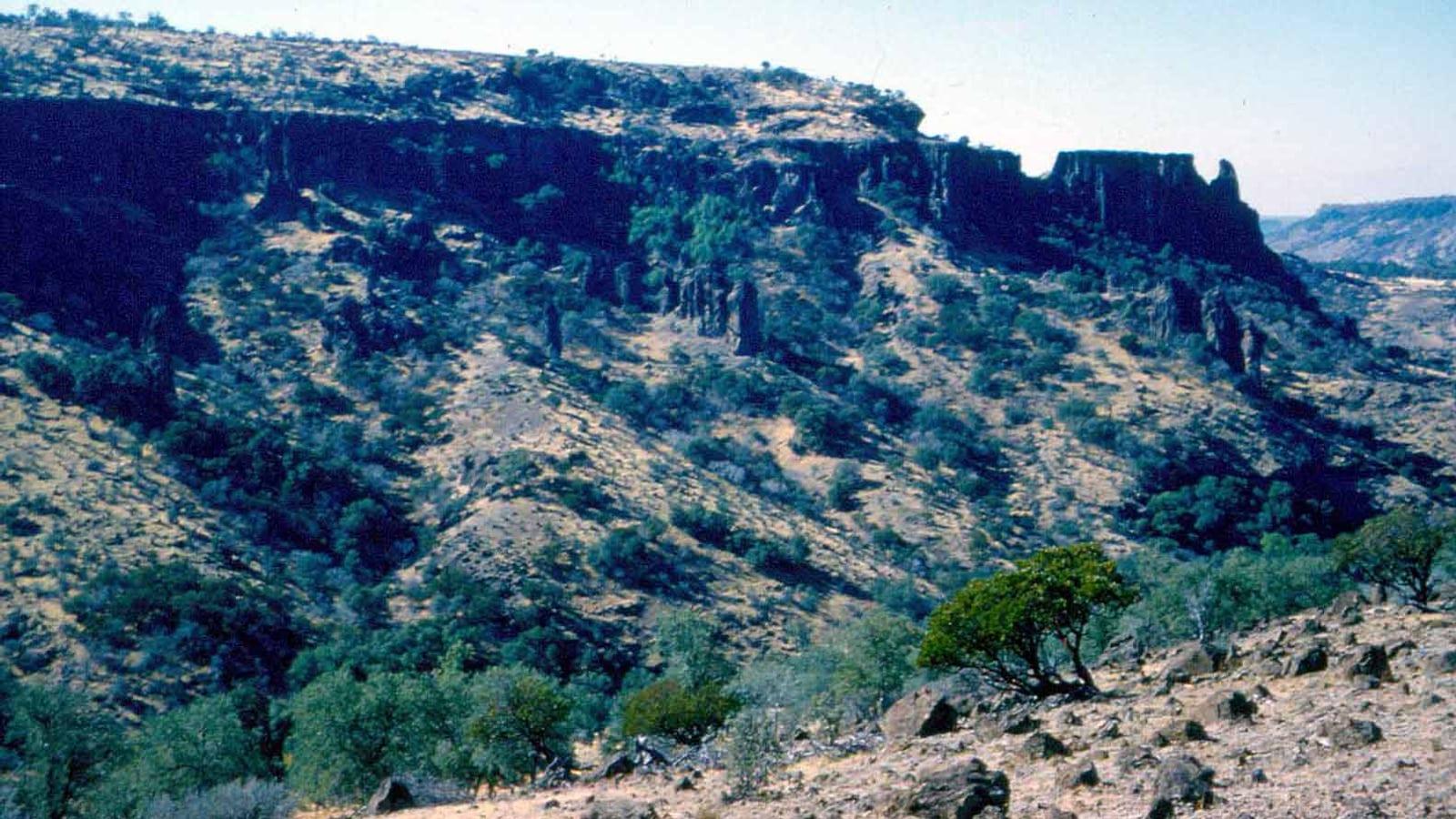
The Feather River drains the northern Sierra Nevada through some of the most tectonically scrambled rock in California. The canyon and its branches expose the Feather River metamorphic belt, a mélange of Paleozoic and early Mesozoic seafloor that was scraped, folded, and metamorphosed during long-lived subduction along the western edge of North America. Fossils here are sparse, mostly Jurassic plant impressions and a handful of invertebrate-bearing limestone lenses, but they survive at all only because pockets of less-deformed rock escaped the worst of the metamorphic overprint. This is not a single trailhead site like Charmouth or Mt. Diablo. The historically reported fossil localities are scattered along the river system between Oroville and Plumas County, mostly on or beside dirt access roads, and most lie on private mining claims or USFS land where collecting is restricted. This guide explains what the geology actually looks like in the field, what fossils have been documented and where, and what access realistically allows for a viewing-only visit.
Location and Directions
The fossil-bearing rocks lie in a roughly 50-mile corridor along the Feather River and its Middle Fork, between Oroville (Butte County) and the Plumas National Forest east of it. There is no single address. Two historical localities are cited in the literature:
- Banner Mine area, near South Table Mountain, Butte County. Reported as Jurassic plant fossils on the north bank of the Feather River, roughly 1 km south of the old Banner Mine workings, southeast of South Table Mountain. From Oroville, take Highway 162 (Oro Dam Boulevard East) and follow signs toward the Lake Oroville State Recreation Area. The Banner Mine is a historical gold-mining claim. The surrounding land is a patchwork of private inholdings and state recreation property. There is no marked trail to the cited locality.
- North of the Middle Fork, near Nelson Bar. Described as a fossil-bearing limestone outcrop on a hill about 2¾ miles west of the Nelson Bar bridge over the Middle Fork Feather River. From Oroville, the Middle Fork is reached via the Oroville, Quincy Highway (La Porte Road) and a network of forest roads. Most of this corridor is in the Plumas National Forest. Roads are unpaved beyond the highway and may be impassable in winter and early spring.
For a casual visitor, the more rewarding stop is the Lake Oroville Visitor Center on Kelly Ridge, where the metamorphic-belt geology is interpreted in displays and the surrounding state recreation area trails cross good outcrops of mélange.
What Fossils You'll Find
Fossils here are uncommon and require a sharp eye:
- Jurassic plant impressions in dark argillite and shale lenses are the most reliable find. Look for elongated carbon traces or compressions of fern fronds and primitive cycad-like leaves on cleaved bedding surfaces. Most specimens are fragmentary.
- Marine invertebrates in limestone lenses are reported from the Middle Fork locality, including poorly preserved bivalve and possibly ammonite traces. These limestone pods are small and weather to recessed lenses on hillsides.
- Trace fossils and burrow casts appear occasionally in the less-metamorphosed mudstone interbeds.
The dominant rock at the surface is metamorphosed and fossil-free: greenstone (metamorphosed basalt), serpentinite, and chert. The whitish-to-grey limestone pockets and dark-brown argillite lenses are the only horizons worth checking, and they account for far less than 5% of exposures along the corridor.
Geologic History
The Feather River metamorphic belt records about 250 million years of subduction-zone tectonics along the western North American margin.
Paleozoic to early Mesozoic seafloor (~300 to 200 million years). The protolith was an ocean basin: deep-water muds, cherty silica oozes, basaltic submarine lavas, and small carbonate buildups deposited on or near a Pacific spreading ridge. Some of these original sediments hosted plant and invertebrate fossils, but the original textures are mostly destroyed.
Subduction and accretion (Late Triassic to Late Jurassic, ~230 to 145 million years). As the Pacific plate descended beneath North America, slices of seafloor were scraped off and stacked onto the continental margin. The result is the Feather River ophiolite belt, a band of altered oceanic crust including serpentinite, greenstone, and gabbro, juxtaposed against the Calaveras Complex mélange to the east. Fossil-bearing horizons survive only where the deformation was incomplete, typically in lower-grade slate and argillite lenses where bedding is still legible.
Cretaceous to Tertiary uplift. The Sierra Nevada was raised, eroded, and faulted repeatedly over the past 100 million years. The modern Feather River canyon was carved through the metamorphic belt by river incision following the late Tertiary tilting of the Sierra block. Erosion exposes the otherwise-buried lenses where fossils still occur.
The post-Jurassic gold mineralization that drove 19th-century mining (Banner Mine and dozens of smaller claims) is unrelated to the fossils, but the historic gold workings opened many of the cuts that paleontologists later examined for fossil content.
How the Feather River Became a Fossil Collecting Site
The Feather River corridor became known to paleontologists secondarily, through gold-mining geological surveys rather than as a fossil destination. Clarence Logan's 1947 California Journal of Mines and Geology paper on California limestone catalogued small fossiliferous limestone lenses encountered by quarrymen. The 2005 FERC Project 2100 paleontological assessment, prepared as part of the Oroville Dam relicensing, compiled all known localities along the lower Feather River and Middle Fork and added a few previously unreported finds. No quarrying or excavation has ever been undertaken specifically to extract fossils here. Erosion from the river system continually exposes new fragments along cutbanks and roadcuts, but production is slow and the metamorphic overprint limits what survives.
Collecting Rules and Regulations
Collecting is generally not permitted. Most of the area falls under one of these jurisdictions:
- Plumas National Forest. Casual collection of common invertebrate and plant fossils for personal, non-commercial use is allowed under USFS rules in unwithdrawn areas, but only in small quantities and without mechanical tools. Vertebrate fossils may not be collected.
- Lake Oroville State Recreation Area. California State Parks prohibits removal of any natural materials including fossils, rocks, and minerals. Viewing only.
- Private mining claims (including the Banner Mine area). Active claims are private property. Access for collecting requires the claim owner's permission. Many old claims are unmaintained but still legally registered.
Practical rules:
- Treat all roadside outcrops as off-limits for collecting unless you have confirmed the land status with USFS or the claim holder.
- Photograph in place rather than collect.
- Forest roads off the main highway are seasonally impassable. Check Plumas National Forest road conditions before heading up the Middle Fork.
- The river canyon has steep, unstable slopes and active rockfall. Stay on roads and established viewpoints.
- Cell coverage drops out almost immediately past Oroville. Carry paper maps.
For visitors more interested in seeing the rocks than collecting, the interpretive trails around Lake Oroville and the Feather River Scenic Byway (Highway 70 through the canyon east of Oroville) offer the best in-place views of the mélange.
Safety
This is steep, remote canyon country in the northern Sierra Nevada, and the hazards here are more serious than at most sites on this site.
The river is controlled, and the flow can change without any warning from the sky. Releases from upstream dams and powerhouses can raise the level and the current quickly, on a clear day, with no rain anywhere near you. Do not work a gravel bar or a channel you cannot leave immediately, do not wade in fast water, and treat any rise in level as a signal to get out and stay out. Cold water and strong current together are what drown people in Sierra rivers.
The terrain is steep and loose. Canyon slopes are unstable, and the metamorphic rock breaks into sharp, shifting talus. Wear boots with ankle support and a firm sole, and do not scramble on slopes above the river where a slip ends in the water.
Rattlesnakes are common through the warmer months on sunny canyon slopes and in rock piles. Look before placing hands and feet, and do not reach into gaps you cannot see into. Poison oak is abundant along the canyon and grows as shrub, ground cover, and climbing vine.
Summer heat in the canyon is severe and there is little shade on the rock, so carry substantial water and start early. Wildfire risk is high through the dry season, so check current conditions and closures before setting out, and be aware that a fire can close your exit road. Mobile coverage is poor to absent in the canyon. Tell someone your route and expected return, and do not work this country alone.
Sources
- Logan, C.A, 1947. "Limestone in California." California Journal of Mines and Geology, Vol. 43, No. 3. http://quarriesandbeyond.org/states/ca/quarry_photo/ca-plumas_photos.html
- California Department of Water Resources, 2005. "Paleontologic Resources in the Vicinity of FERC Project 2100 (Oroville Reservoir and Lower Feather River)." http://www.water.ca.gov/orovillerelicensing/docs/wg_study_reports_and_docs/EWG/Paleontology%20jun03%20fr%20rev_public.pdf
- Kenney, D. "US and Canadian Fossil Sites, California." http://donaldkenney.x10.mx/STATES/CA.HTM
- US Forest Service, "Plumas National Forest." https://www.fs.usda.gov/plumas
- California State Parks, "Lake Oroville State Recreation Area." https://www.parks.ca.gov/?page_id=462