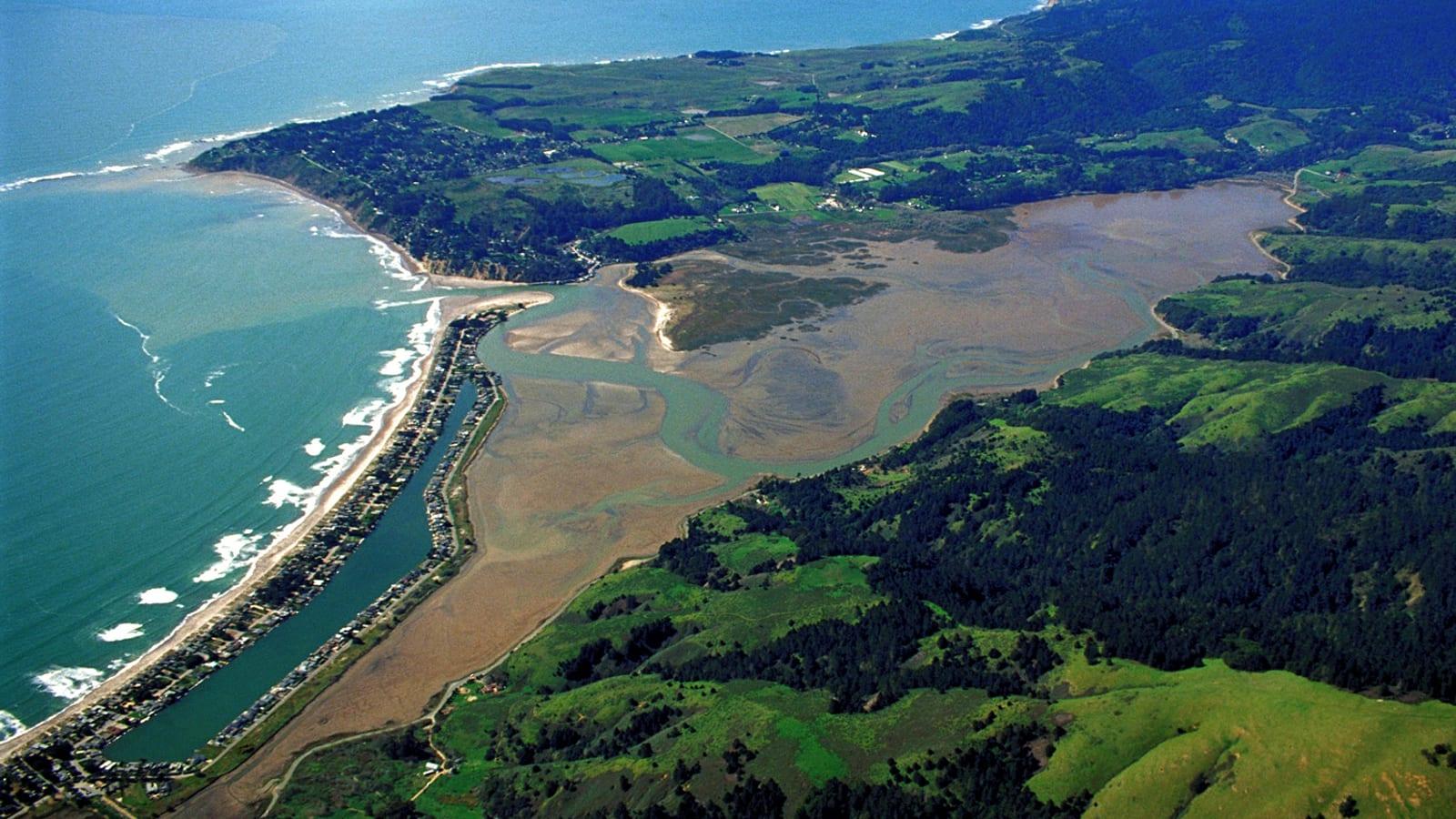
Find Fossils at Bolinas Lagoon Fossil Hunting Guide
Image: U.S. Army Corps of Engineers (Public domain)
Geology: The Bolinas shelf is less than 0.3 degrees tilted, meaning that it is quite flat.
By Edward Chen · Updated 1 August 2026
Introduction
Bolinas Lagoon is a shallow tidal estuary on the Marin County coast, approximately 25 miles (40 km) north of San Francisco via Highway 1. The lagoon itself is a federally designated National Estuary and is protected from any collecting or disturbance. The palaeontological interest at Bolinas lies not in the lagoon but in the road-cut exposures of the Monterey Formation that line the east side of Highway 1 between Stinson Beach and the Bolinas turnoff. These outcrops of late Miocene siliceous shale and chert, grey, thinly bedded, and conspicuously fractured, are visible from the roadside and accessible informally on foot. Collecting from road-cut exposures on state highway right-of-way is low-key and informal at this location, but the lagoon itself and the adjacent National Seashore land are strictly off-limits. This is a site for geologically curious visitors rather than prolific collectors: the Monterey Formation here produces microfossils and occasional fish material, not the large, photogenic specimens found at sites like Shark Tooth Hill.
Location and Directions
The palaeontologically relevant road cuts are located along Highway 1 between Stinson Beach and the unsigned Bolinas Road junction, in Marin County, CA.
From San Francisco, take the Golden Gate Bridge north on US-101, exit at Mill Valley/Highway 1, and follow Highway 1 (Shoreline Highway) west and north through Muir Woods Road junction, then continue north through Stinson Beach. The Monterey Formation outcrops begin to appear on the east (right-hand) side of the road approximately 1 mile (1.6 km) north of Stinson Beach. Pull-outs are limited and narrow. The road is winding and carries significant weekend tourist traffic. Park fully off the road surface in any available gravel pull-out and walk back to the exposures. Do not park on the road shoulder.
There is no public transport directly to the road cuts. The West Marin Stagecoach (Marin Transit Route 61) runs from San Rafael to Bolinas on weekdays and connects to limited Saturday service. The journey takes approximately 90 minutes from San Rafael Transit Center. The route passes the relevant section of Highway 1.
Bolinas itself has no fossil-related facilities, visitor centre, or services specifically for geology visitors. The town has a small general store and a handful of restaurants.
What You'll Find
Collecting from these road-cut exposures is informal and the material is not abundant. The Monterey Formation at this location is primarily of scientific rather than recreational collecting interest, but several types of material are present.
- Fish vertebrae and scales. Isolated vertebral centra and ganoid scales from marine bony fish are the most likely collectible find in the shale units. They are small, typically 3 to 10 millimetres, and require a hand lens to examine properly. Eroded surfaces of the shale occasionally expose concentrations of fish material.
- Fish otoliths. Ear stones from Miocene fish, usually 5 to 15 millimetres across, appear on weathered bedding surfaces. They have a characteristic oval outline and a layered internal structure.
- Marine mammal fragments. Occasional rib or limb bone fragments occur in the coarser beds. These are typically poorly preserved and require experience to identify. If you find what appears to be a large vertebrate bone, leave it in place and note the location.
- Diatoms. The Monterey Formation is partly composed of diatomite, rock formed from the silica shells of microscopic algae, and these are the most scientifically significant fossils in the unit. They are not visible to the naked eye and not collectible as display specimens.
The lagoon itself and its shores hold no collectible fossil material and are protected as a National Estuary.
Geologic History
The Monterey Formation is one of the most extensively studied rock units in California. It was deposited during the late Miocene epoch, approximately 16 to 5 million years ago, in a series of deep basins along the California continental margin. The Bolinas area section represents the northern end of the Coast Range Monterey exposures and records deposition in a cold, oxygen-depleted, highly productive upwelling zone, conditions broadly similar to the modern California Current system.
The formation's distinctive character comes from two sources: biological productivity and basin restriction. Surface waters teemed with diatoms, radiolarians, and other silica-secreting organisms. When they died, their silica shells accumulated on the anoxic basin floor faster than they dissolved, creating the siliceous mudstone, chert, and diatomite beds visible in the road cuts today. The low-oxygen bottom conditions also preserved organic carbon, which is why the Monterey Formation is a major petroleum source rock in California and why road cuts can smell faintly of hydrocarbons on warm days.
The Bolinas section was subsequently uplifted and deformed by movement along the San Andreas Fault system, which runs through the Point Reyes Peninsula immediately to the northwest. The tectonic setting explains the intense fracturing and jointing visible in the outcrops, and also why the Monterey Formation here is tilted steeply compared to its original horizontal depositional attitude.
 Photo: ACRComms, CC BY-SA 4.0, via Wikimedia Commons
Visiting Rules and Regulations
The situation at Bolinas Lagoon is defined by one clear boundary: the lagoon and its shores are protected as a National Estuary administered by the National Park Service as part of the Golden Gate National Recreation Area. No collecting, disturbing, or removing of any material, fossil or otherwise, is permitted inside the National Estuary boundary.
Road-cut exposures on the Highway 1 right-of-way are state property managed by Caltrans. Collecting small amounts of loose rock and fossil material from road cuts is informally tolerated in California in the absence of specific posted prohibitions, but this is not a formally designated collecting site. Do not collect from cut faces in a way that destabilises the slope. Do not collect in quantities that suggest commercial intent. If there are posted signs at the specific pull-outs you visit, follow them.
Do not enter the lagoon shore or tidal flats at any point. Do not collect from beaches or shore areas adjacent to the lagoon. The boundary between the highway right-of-way and NPS land is not always marked. If in doubt, stay on the uphill side of the road. The area north of the Bolinas junction along the lagoon edge is NPS land and has no collecting access.
No facilities are available at the road-cut exposures. Stinson Beach, approximately 2 miles (3 km) south, has public restrooms, a seasonal food stand, and a large public parking area.
Safety
Bolinas Lagoon is a protected tidal estuary, and the roadside exposures that matter geologically sit along Highway 1, so the risks divide between traffic and tide.
Highway 1 here is narrow, winding, and busy. The road cuts of interest are on a coastal highway with blind bends, cyclists, and no shoulder in many places. Park only in a genuine pull-off well clear of the carriageway, never on a bend, and do not walk the road edge. If there is nowhere safe to stop, drive on.
The lagoon is tidal mud, not a beach. The flats look walkable and are not. Mud is deep and soft, channels fill quickly on the flooding tide, and people become stuck. Stay off the flats, watch the tide if you are anywhere near the water's edge, and be aware the currents at the lagoon mouth are strong.
This is a National Estuarine Research Reserve and a major bird site. Harbour seals haul out here and pup in spring, and disturbing them is both harmful and an offence. Keep well back, stay off the flats, keep dogs leashed and away from the water, and use binoculars rather than approaching.
Nothing may be collected or removed here, fossil or otherwise. Treat the lagoon as a place to look at geology in the roadcuts and wildlife across the water.
The San Andreas fault runs directly beneath the lagoon, and the surrounding slopes are prone to landslides after winter rain, so avoid the cut faces when the ground is saturated.
Sources
- Isaacs, C.M. "Geology of the Monterey Formation in California." USGS Open-File Report 83-284, 1983.
- USGS. "Geology and geomorphology, Offshore of Bolinas Map Area, California." Data Series 781, 2015. http://pubs.usgs.gov/ds/781/OffshoreBolinas/
- National Park Service. "Golden Gate National Recreation Area, Bolinas Lagoon." https://www.nps.gov/goga/index.htm
- UC Berkeley. "Recent Marine Sediments of Bolinas Bay, California." UC Escholarship, 1968. http://escholarship.org/uc/item/2kf907bg](http://escholarship.org/uc/item/2kf907bg)