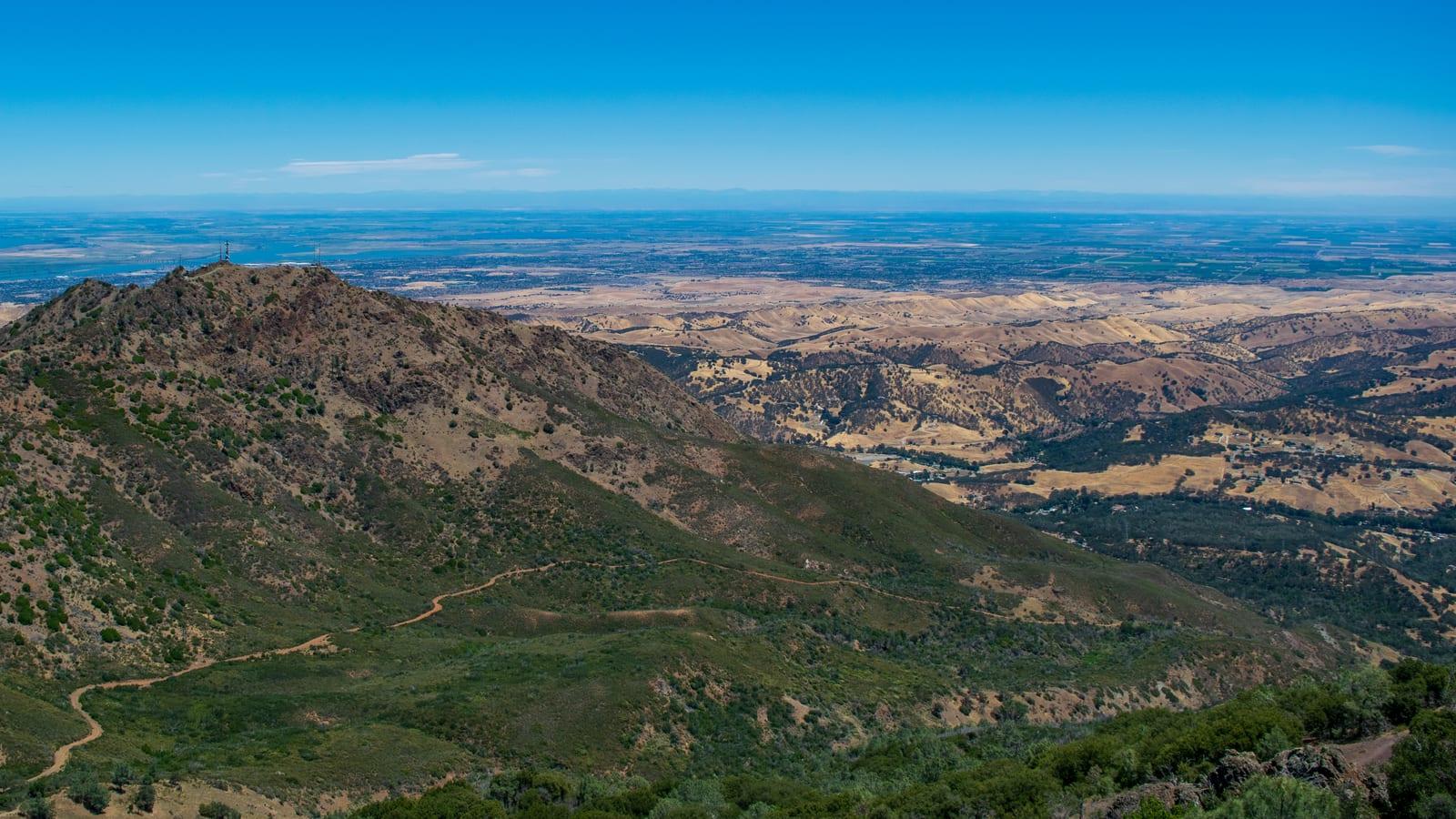
Mt. Diablo Fossil Hunting Guide
Image: 9yz (CC BY-SA 4.0)
Rising 3,849 feet above the eastern edge of the San Francisco Bay Area, Mt.
By Edward Chen · Updated 4 August 2026
Introduction
Rising 3,849 feet above the eastern edge of the San Francisco Bay Area, Mt. Diablo is one of California's most distinctive solitary peaks and a stacked record of three different geological worlds. The mountain itself is geologically young, lifted into its current shape over the past few million years by faulting along the Calaveras and Concord fault systems, but the rocks it exposes range from 165-million-year-old oceanic crust at its base to Miocene marine shell beds near its flanks. For fossil hunters, the most accessible and productive exposures are the Briones Formation shell hashes along Stage Road, where sedimentary cliffs erode each winter and shed fragments of clams, scallops, and other bivalves down into Pine Creek. This guide covers how to access the fossiliferous trail, what you can expect to find, the layered geological history that produced it, and the rules that govern collecting on the mountain.
Location and Directions
The fossil-bearing exposures lie along Stage Road in Castle Rock Park, on the western flank of Mt. Diablo near Walnut Creek.
From Interstate 680 in Walnut Creek, take Ygnacio Valley Road east. Turn right (south) onto Oak Grove Road, which becomes Castle Rock Road. Follow Castle Rock Road to its end, where it is blocked by a gate. Parking is free in the lot on the left.
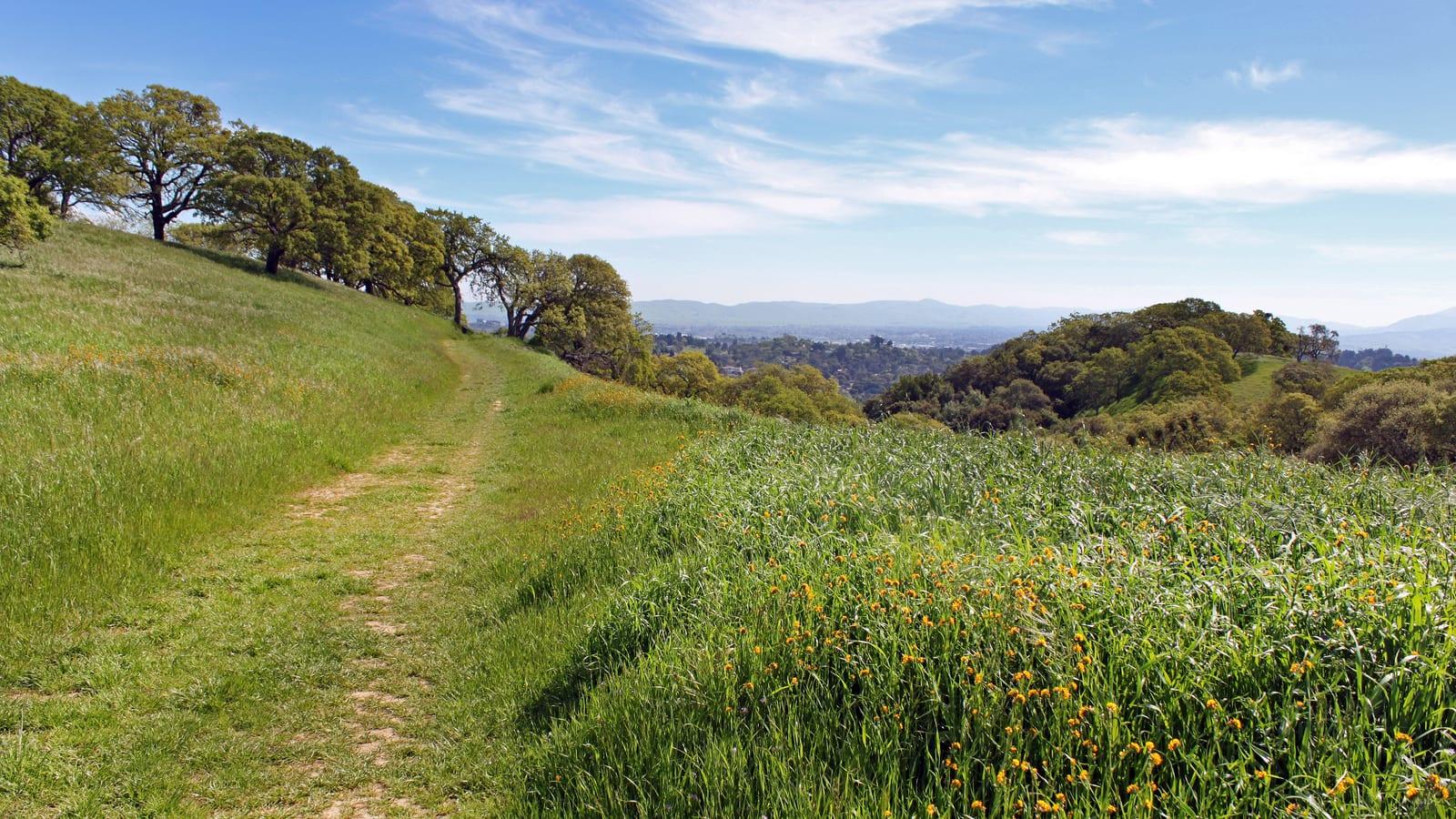
Walk past the gate into Castle Rock Park, an East Bay Regional Parks property. The paved road passes a picnic area, swimming pool, and park buildings before turning to gravel. Past the gravel transition, the route continues as Stage Road through Pine Canyon, an old wagon road following Pine Creek with moderate shade.
After leaving the developed park area, you'll pass another gate and reach a fork. Bear right to stay on Stage Road. The trail crosses Pine Creek seven times between the parking area and the fossil exposure, so be prepared for wet boots, especially from December through March when winter rains run high. After the first creek crossing, watch for a narrow footpath leading right through the grass. If you reach the second crossing, you've gone too far. The footpath leads past a rough grape arbor to a slide on a tall cliff above the creek bed. The fossil-bearing layer is in that cliff face. Total walk from parking to fossil exposure is roughly 1.5 miles one way.
 Photo: Effeietsanders, CC BY-SA 4.0, via Wikimedia Commons
What Fossils You'll Find
The dominant fossils are bivalve mollusks preserved in dense shell hashes, sedimentary rock composed almost entirely of broken shells cemented in sandstone matrix. Most fragments are too small or weathered to identify to species, but with attention you can pick out:
- Clams of multiple genera, the most common find. Look for the symmetrical curved valves and growth-line patterns on whitish chips.
- Pectens (true scallops), recognizable by their fan-shaped fluted valves. Less common than clams but the most distinctive fossil at the site.
- Other shallow-marine invertebrates including occasional gastropods.
Vertebrate fossils are far less common but have been recovered from Miocene strata elsewhere on the mountain, including jaws of cattle relatives and the extinct dog-bear Aelurodon. These are not in the Stage Road exposure and would only be encountered during professional excavations.
The whitish, weathered chips visible in the creek bed are the easiest way to spot fossil material, that color contrasts against the surrounding mudstone gravel and indicates Briones Formation shell hash that has tumbled down from the cliff above.
 Photo: Peter J. Caprio, CC BY-SA 4.0, via Wikimedia Commons
Geologic History
Mt. Diablo exposes one of the most complete vertical sections of California Coast Range geology, with three older units stacked beneath younger sedimentary cover:
Mt. Diablo Ophiolite (Jurassic, ~165 million years). The mountain's basement is a slice of oceanic crust that was thrust upward during plate convergence. Visible at the surface as black-to-greenish-brown basalt with a glassy, crystalline texture, plus coarser diabase intrusions and exposures of serpentinite. These rocks formed at a Jurassic mid-ocean ridge before being scraped onto the continent.
Franciscan Complex (Late Jurassic to Cretaceous, ~140 to 80 million years). A thick chaotic mélange of subduction-zone debris, including shales, greywackes, cherts, and exotic blocks. About 10% of the Franciscan in this area is shale, but most has been metamorphosed to argillite, destroying any fossil content.
Great Valley Group (Late Jurassic to Cretaceous). Marine sedimentary rocks deposited in the deep-water forearc basin that lay between the subduction zone and the rising Sierran arc. Mostly deep-water shale with sandstone interbeds. Limited fossil content.
Cenozoic cover. Younger marine and terrestrial sediments cap the section, including the Briones Formation of late Miocene age (~13 to 10 million years), deposited when this part of California was a shallow embayment of the Pacific. The Briones is the source of the shell hashes along Stage Road. As Central California's interior basins dried during the late Miocene and Pliocene, marine deposition ended at this site.
The mountain's modern shape is geologically recent. Compression and lateral motion along nearby strike-slip faults have squeezed the older rocks upward, exposing the layered section in cross-section.
 Photo: Centpacrr (Digital image), CC BY-SA 3.0, via Wikimedia Commons
How Mt. Diablo Became a Fossil Collecting Site
The Stage Road exposure is the product of ongoing natural erosion. The Briones Formation cliff above Pine Creek is constantly weathered by winter rains, gravity, and creek undercutting. Each year, fresh shell-hash material slides down to the creek bed where it can be examined. The fossil ledge has been known to local hikers and naturalists for decades, but its accessibility through Castle Rock Park (an East Bay Regional Park) keeps it a casual day-hike destination rather than a managed paleontological site. No mining or quarrying has ever exposed these specific beds. Everything visible is the result of slope erosion.
Collecting Rules and Regulations
Collecting is not permitted. The fossil cliff lies within the boundaries of Castle Rock Park (East Bay Regional Park District), and the surrounding Mt. Diablo State Park prohibits removal of any natural materials including fossils, rocks, plants, and minerals. This is a viewing-only site.
Practical rules:
- Examine fossils in place. Photograph rather than collect.
- Stay on the trail and do not climb the cliff face, the slope is unstable and active erosion makes the rock fragile.
- The seven creek crossings between December and March may be impassable after heavy rain. Check the East Bay Regional Park District website for trail conditions before visiting.
- Castle Rock Park is private at its developed core but allows trail access for hikers. Respect any posted closures.
- Dogs are allowed on leash. No bicycles or horses on Stage Road past the developed area.
- No fees for parking or trail access.
The collect-nothing ethic at Mt. Diablo also reflects a broader concern in the Bay Area: increased visitor traffic to fossil sites accelerates erosion and removes specimens that would otherwise help future visitors and researchers identify the rock units. Leaving fossils in place is the strongest contribution any individual visitor can make to the site.
Safety
Mt. Diablo is a state park with roads, trails, and rangers, but it rises nearly 3,850 feet straight out of the Bay Area lowlands and the mountain makes its own conditions.
Heat is the main hazard, and it kills people on this mountain. Summer temperatures on the exposed slopes regularly exceed 100 degrees Fahrenheit, and much of the trail network has no shade at all. Water sources on the mountain are unreliable. Carry substantially more than you expect to drink, start early, and turn back rather than pushing on in the afternoon heat. Every summer people are rescued here after underestimating exactly this.
Rattlesnakes are common on the sunny slopes and among rocks through the warmer months. Look before placing hands and feet, stay on trails, and give any snake you see a wide berth rather than trying to move it.
Ticks are abundant in the grassland and chaparral, particularly in spring, and Lyme disease is present in the Bay Area. Wear long trousers, use repellent, and check yourself afterwards. Poison oak grows throughout the park as shrub, ground cover, and climbing vine, and is easy to walk into without recognising it.
The terrain is steep and the trails are loose in places, so wear boots with grip and ankle support. Weather at the summit can differ sharply from the valley, and wind is often strong. Note that fossils, rocks, and plants are all protected here, so this is a place to look rather than collect, and that the park closes its gates at set times.
Sources
- Mt. Diablo Interpretative Association, "The Rocks of Mt. Diablo, Their Type and History." https://www.mdia.org
- Geohiking, "Castle Rock, Mt. Diablo Fossil Trail." http://geohiking.com/castlerock.html
- East Bay Regional Park District, "Castle Rock Recreation Area." https://www.ebparks.org/parks/castle-rock
- California Geological Survey, "Geology of the San Francisco Bay Region." https://www.conservation.ca.gov/cgs