Southerndown Glamorgan Heritage Coast Fossil Hunting Guide
Image: andy dolman (CC BY-SA 2.0)
Dunraven Bay at Southerndown in South Wales exposes Blue Lias with Jurassic ammonites, belemnites, and brachiopods on the Glamorgan Heritage Coast. Free foreshore access.
By Edward Chen · Published 27 April 2026
Introduction
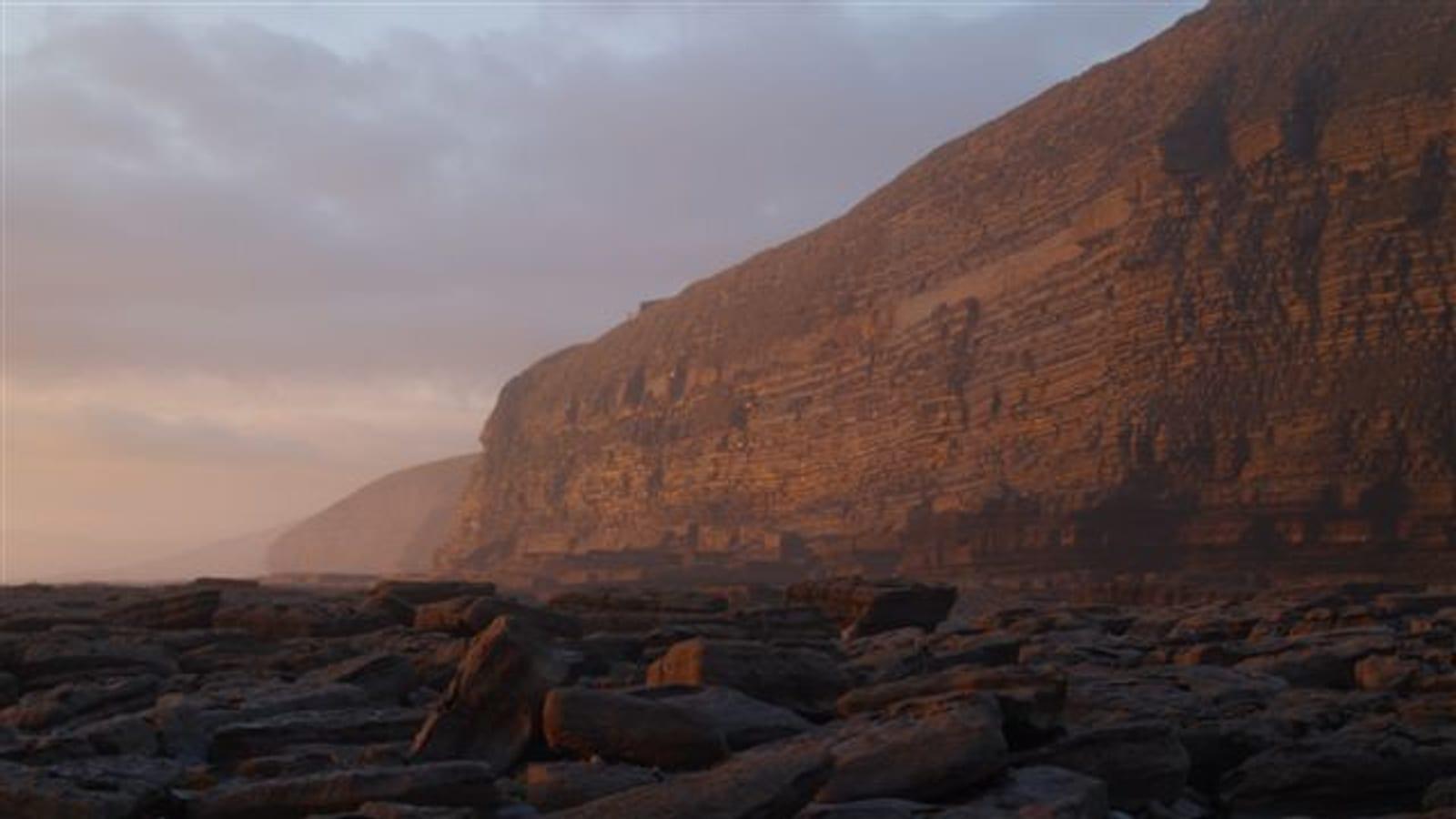
Dunraven Bay at Southerndown on the Glamorgan Heritage Coast in South Wales exposes the Blue Lias Formation along a beach that closely resembles the famous Lias coast of Somerset and Dorset, but with considerably less collecting pressure. The alternating beds of argillaceous limestone and dark shale here belong to the Hettangian Stage of the Early Jurassic, approximately 201 to 199 million years ago, and they yield ammonites, belemnites, and brachiopods to collectors who work the foreshore systematically. The Bay sits at the foot of dramatic folded and faulted cliffs that record the compressive forces of the Variscan Orogeny, and the contrast between the ancient Carboniferous structures in the cliff and the Jurassic fossils on the beach makes Southerndown one of the more geologically layered sites on the Welsh coast.
The site is part of the Glamorgan Heritage Coast, one of the longest stretches of undeveloped coastline in Wales. A car park with admission charge sits at the cliff top, and access to the beach is straightforward. The bay is large and offers good collecting ground across much of its extent, with the most productive fossil areas typically toward the southeastern end. This guide covers the route, the fossils and their horizons, the geological history of the Blue Lias at this location, and the rules for collecting along a Heritage Coast.
 Photo: Jaggery, CC BY-SA 2.0, via Wikimedia Commons
Location and Directions
Address
Dunraven Bay, Southerndown, Vale of Glamorgan, South Wales CF32 0RP.
Directions and Parking
From Bridgend, take the B4524 southward through Ewenny and continue toward Southerndown village. Follow the road through the village and down toward Dunraven Bay. The car park is private and operated by Glamorgan Heritage Coast. A full day charge applies (current fees should be checked with the Vale of Glamorgan Council before visiting). Parking is on a surfaced cliff-top area with good capacity. From the car park, follow the path down to the beach, which involves a moderate descent. The beach is sandy toward the centre of the bay, with limestone slabs and cobbles toward both ends. The most productive fossil ground is generally toward the southeastern end of the bay, where the bedded Blue Lias is most extensively exposed at low tide, though fossils are also found toward the northwest. Check tide times for Barry or Porthcawl (both are reasonable reference points for this stretch of the Glamorgan coast). The limestone exposures at the southeast are most accessible for the two hours either side of low water.
What Fossils You'll Find
Ammonites are the principal attraction at Southerndown and occur in the limestone beds of the Blue Lias, typically as internal moulds with some degree of calcite replacement. Species from the Hettangian Stage include Psiloceras and related genera, the earliest ammonites of the Jurassic Period. They are found most frequently in the harder limestone bands where weathering has exposed the outline of the shell. Newly detached blocks from the cliff base and recently exposed sections of the limestone platform offer the best chance of finding ammonites with good surface detail.
Belemnites are extremely common throughout the Blue Lias and are among the easiest fossils to find at the site. They occur as cylindrical calcite guards (the internal skeleton of the animal), typically 2 to 8 cm long and tapered to a point at one end. Fresh surfaces of broken belemnite guards show a characteristic radial crystalline structure. They are found both in the limestone beds and in the shale partings, and loose guards are abundant on the foreshore after storms.
Brachiopods occur in specific horizons within the limestone sequence, sometimes in shell-rich concentrations. Rhynchonellid and terebratulid forms are the most common. They are smaller than the ammonites and can be overlooked, but a careful examination of limestone surfaces reveals them on many blocks.
Geologic History
The Ancient Environment
The Blue Lias at Southerndown was deposited during the Hettangian Stage of the Early Jurassic, approximately 201 to 199 million years ago, very shortly after the end-Triassic mass extinction that eliminated a substantial proportion of marine species globally. South Wales at this time lay at a latitude of approximately 30 to 35 degrees north, in a warm, shallow tropical sea that had flooded across the Triassic desert landscape of the Bristol Channel area as sea levels rose during the early Jurassic transgression. The Blue Lias records alternating carbonate and clay deposition driven by orbital (Milankovitch) cycles: limestone beds represent intervals of clear, warm, carbonate-producing conditions, while the shale beds record periods of increased clay input, likely associated with wetter or stormier climatic phases. The organisms living in this sea included ammonites swimming in the water column, belemnites hunting fish and small invertebrates, brachiopods and bivalves on the seafloor, and occasional marine reptiles. The distinctive folding and faulting visible in the cliff faces above the Blue Lias foreshore is not a Jurassic feature but a much older one: these structures were formed during the Variscan Orogeny, approximately 300 million years ago, in the Carboniferous rocks that form the cliffs. The Jurassic Blue Lias was deposited unconformably on top of the older deformed rocks after a long period of erosion had planed the Variscan structures flat.
How Southerndown Became a Fossil Collecting Site
The Blue Lias at Dunraven Bay has been exposed by the retreat of the Glamorgan coastline over millennia, driven by wave action from the Bristol Channel, which has some of the highest tidal ranges in the world. These extreme tidal ranges produce powerful currents that erode the coast efficiently, cutting back the limestone platform and exposing fresh surfaces with each tidal cycle. The alternate limestone and shale beds of the Blue Lias erode at different rates: the shale weathers and disintegrates more quickly, leaving the harder limestone beds standing proud as wave-cut platforms and ridges. This differential erosion exposes the ammonite-bearing limestone surfaces for collectors and simultaneously undermines the cliff base, producing fresh falls of Blue Lias from the cliff above. The Heritage Coast designation has protected the site from development since the 1970s, preserving the natural erosion process and maintaining the foreshore as accessible collecting ground.
Collecting Rules and Regulations
Is Fossil Collecting Allowed?
Dunraven Bay and the surrounding Glamorgan Heritage Coast are managed for conservation and public access by Vale of Glamorgan Council. Fossil collecting is a traditional activity on this foreshore and is not prohibited. You may collect loose material from the beach and from naturally fallen cliff debris. You must not hammer the in-situ cliff face, undercut the cliff base, or remove slabs from the wave-cut platform in a way that constitutes excavation. Parts of the Glamorgan Heritage Coast are SSSIs under Welsh legislation administered by Natural Resources Wales. If the specific area you are visiting is an SSSI, the prohibitions on damaging geological features under the Environment (Wales) Act 2016 apply. Surface and loose material collecting at a personal scale is widely considered acceptable practice by Natural Resources Wales and the British Geological Survey in these circumstances. If you find an ammonite or other specimen of unusual size or completeness, consider reporting it to Amgueddfa Cymru (National Museum Wales).
Recommended Tools
A geological hammer and cold chisel are useful for splitting loose shale and opening small limestone blocks to reveal ammonites inside. Use them only on material that has already fallen from the cliff, not on the in-situ face. A stiff brush cleans shale from the surface of limestone to reveal fossil outlines more clearly. Bring padded wrapping for ammonites, which can be fragile, particularly those in shale matrix. A tide table is essential. The car park charges mean that bringing everything you need for a full session from the start is worthwhile, rather than making additional trips to the car.
Safety
The cliffs at Southerndown are high and actively eroding, and rock falls from the cliff face are a genuine hazard, particularly after wet weather or frost. Do not work directly beneath the cliff face. The Bristol Channel has the second highest tidal range in the world, and the tide moves fast across the flat limestone platform at the base of the bay. You must be aware of the returning tide and move to higher ground well before it reaches you. Check the tidal range for the day of your visit, not just the time, as a high spring tide will cover ground that a neap tide leaves dry. The limestone platforms can be extremely slippery when wet or covered in algae.