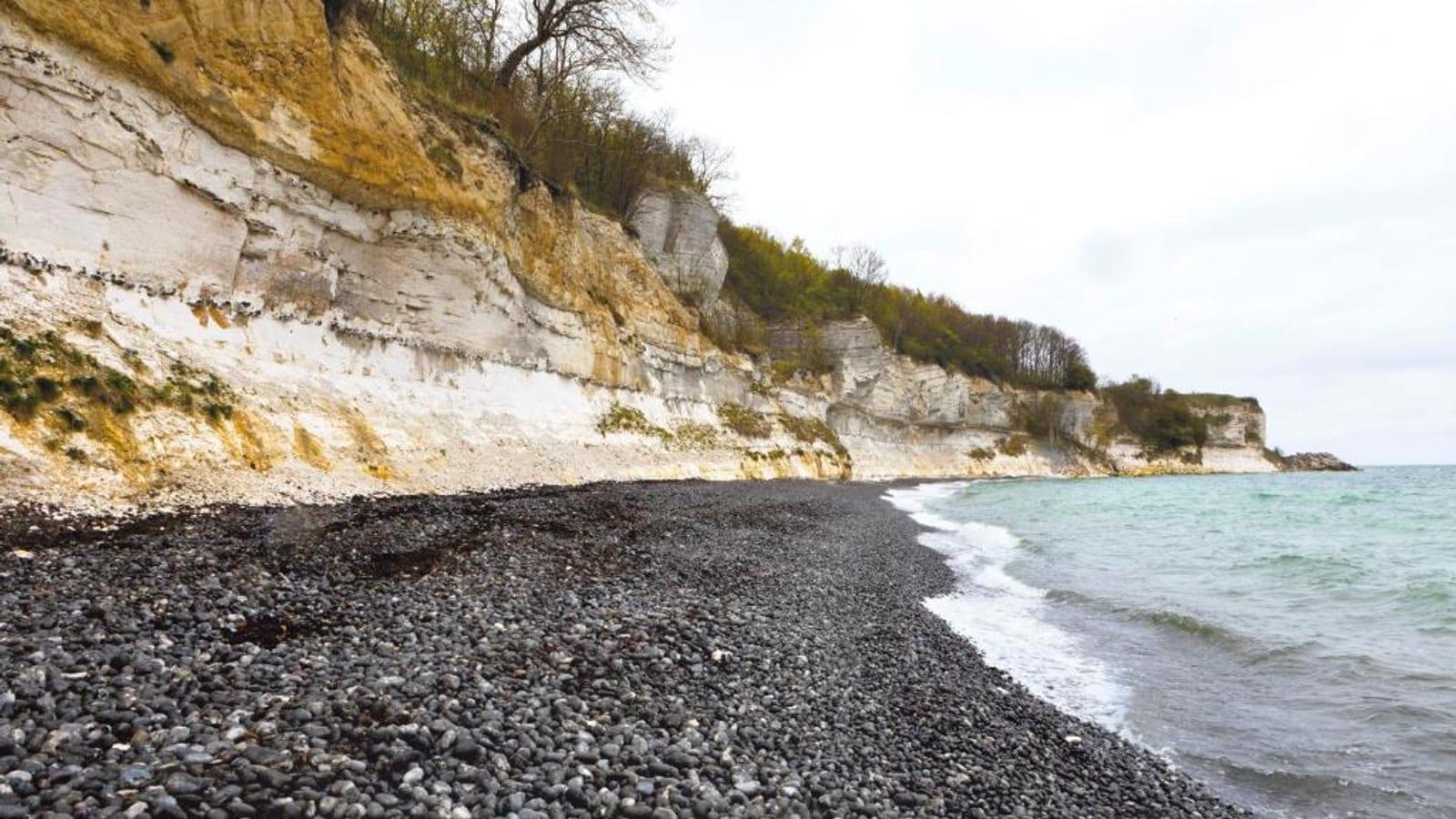
Baggy Point Fossil Hunting Guide
Image: Lewis Clarke (CC BY-SA 2.0)
Baggy Point is the blunt headland that closes the northern end of Croyde Bay in North Devon, and it carries one of the most accessible Upper Devonian.
By Edward Chen · Updated 1 August 2026
Introduction
Baggy Point is the blunt headland that closes the northern end of Croyde Bay in North Devon, and it carries one of the most accessible Upper Devonian sequences in southwest England. The cliffs and foreshore around the headland expose the Baggy Sandstone Formation, a sequence of yellowish sandstones, siltstones, and mudstones laid down in shallow marine and deltaic settings about 372 to 359 million years ago, near the end of the Frasnian and into the Famennian. Fossils here are not abundant in the way the Jurassic Coast is, and many are weathered or fragmentary, but gritty shelly pockets within the sandstone yield brachiopods, bivalves, crinoid stem fragments, corals, bryozoans, and the occasional plant impression. The headland itself is owned and managed by the National Trust, and the wider coast is part of the North Devon SSSI for its Devonian geology. This guide covers how to walk in, where to look on the foreshore, what the Baggy Sandstone records about Late Devonian seas, and the strict viewing-only collecting rules that apply on this protected coast.
Location and Directions
The site is the headland and foreshore at Baggy Point, immediately west of Croyde village, North Devon, postcode EX33 1PA. The grid reference for the National Trust car park is roughly SS 432 397.
From the M5 motorway, leave at junction 27 and follow the A361 northwest through Tiverton and South Molton toward Barnstaple, then continue on the A361 to Braunton. From Braunton, take the B3231 west to Croyde village. In Croyde, follow brown National Trust signs for Baggy Point along Moor Lane. The lane is single track in places, so allow time. The Sandleigh Tea Room car park sits at the road end. Charges apply year-round, with current pay and display rates posted at the entrance. National Trust members park free.
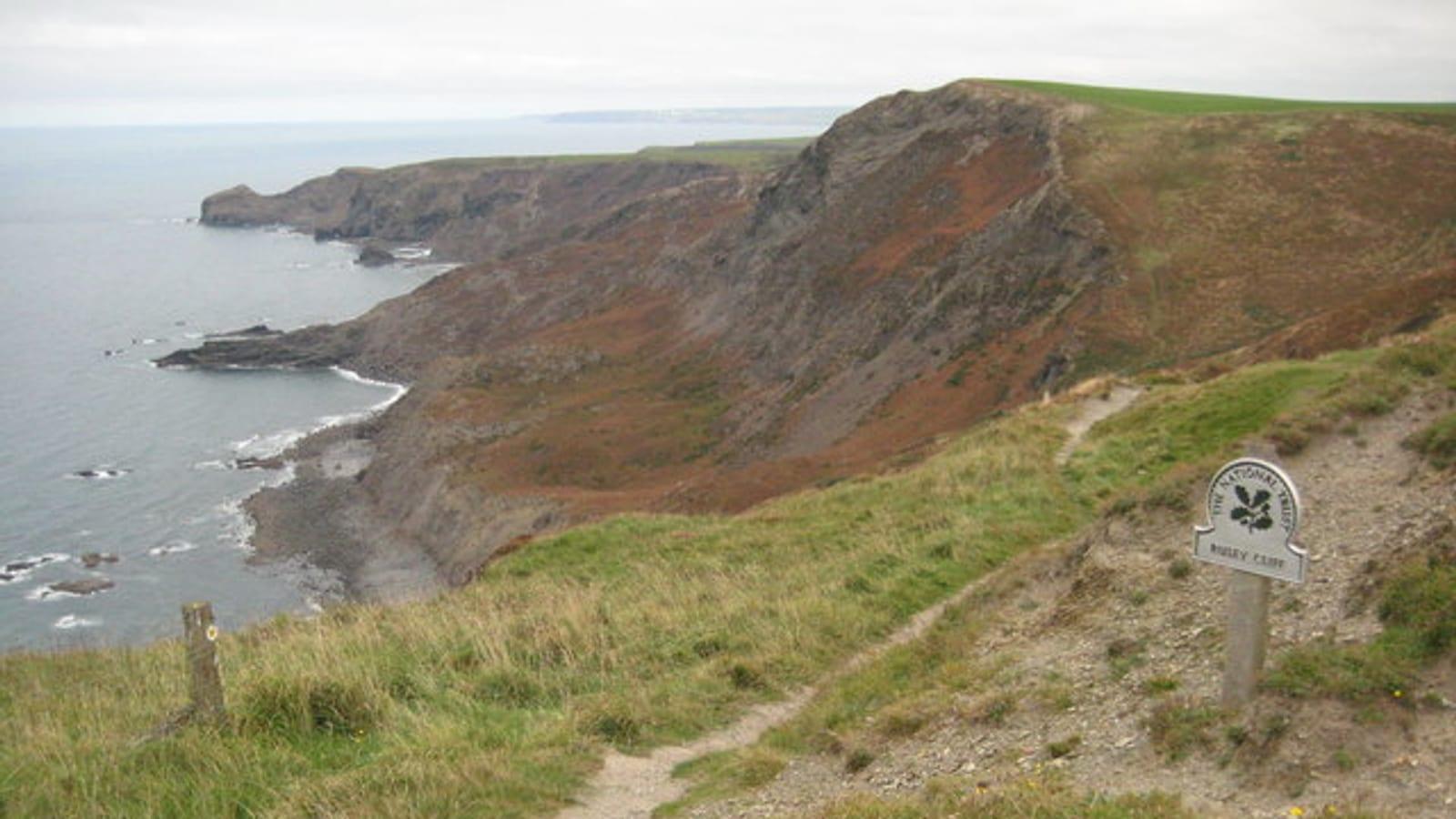
From the car park, take the broad coast path that climbs gently across the south side of the headland. The walk to the tip of Baggy Point is roughly 1.6 kilometres each way. Cliff-edge fences and the South West Coast Path waymarkers keep you on safe ground. Foreshore access is best on the south side at low water, where you can scramble down at recognised access points near the start of the walk. Do not attempt to descend the cliffs along the headland itself. The rock is fractured and rotten, and rescue helicopters work this stretch regularly.
Tide planning is essential. You need a tide of at least mid-falling to give you working time on the platforms. A spring low tide is best. Aim to be on the foreshore from two hours before low water until one hour after. Check Ilfracombe or Croyde tide tables before setting out. The site faces west-northwest, so onshore swells from the Atlantic can wash the platforms even at low water. Do not turn your back on the sea.
What Fossils You'll Find
The Baggy Sandstone is not a chalk or a clay where fossils part cleanly from the matrix. Most material is locked in hard sandstone, often weathered, and the better finds come from loose float at the cliff base or from gritty shelly pockets within bedding planes exposed on the foreshore platforms.
Brachiopods are the most common identifiable fossil. Look for symmetrical biconvex shells in pale, sandy infill, sometimes preserved as internal moulds where the original shell has dissolved. Spiriferids with their wing-like profiles are typical of Frasnian-Famennian shelf faunas.
Bivalves appear as flattened impressions and moulds in finer-grained interbeds. They are usually small and require a sharp eye against the sandy matrix.
Crinoid stem segments show as small disc shapes, often weathered into pale rings on bedding surfaces. Complete calyces are extremely rare here.
Corals, mostly tabulate and rugose colonial forms, occur as broken fragments in shelly pockets. Look for honeycomb textures or long horn-shaped sections in the loose blocks.
Bryozoans survive as lacy reticulate fragments, easier to spot when the rock has been wet and the texture darkens slightly against the matrix.
Plant remains, including stem and root impressions from Late Devonian vegetation, occur in some siltstone partings. They are uncommon but do show up in fallen blocks after winter storms.
The Baggy Sandstone is a recognised reference section for Late Devonian shallow marine deposition in southwest England, but the fossils themselves are not the showpiece. You visit for the geology and the headland, and you take any decent brachiopod as a bonus.
Geologic History
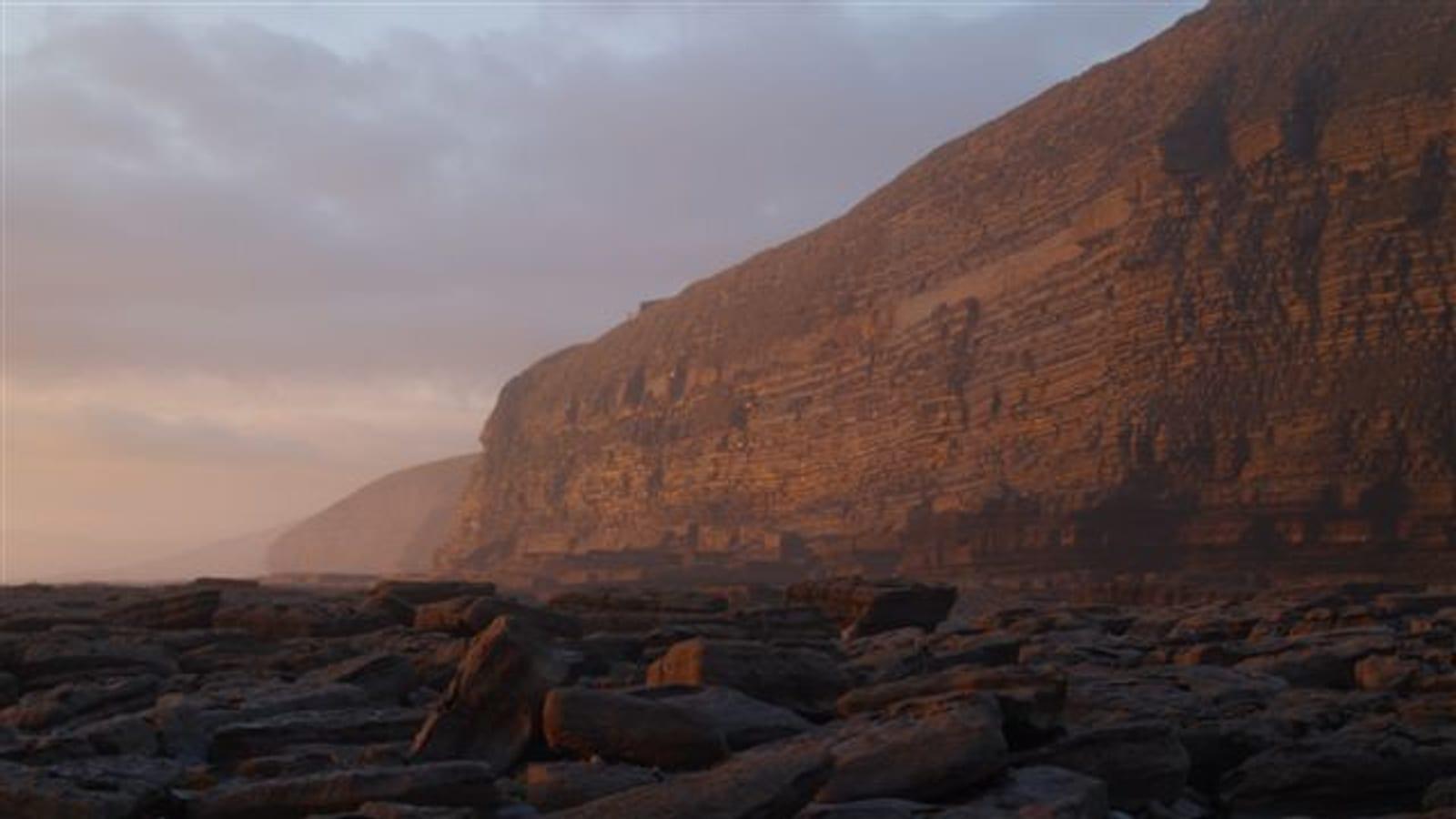
The Baggy Sandstone Formation sits in the upper part of the Upper Devonian succession of North Devon, at the boundary of the Frasnian and Famennian stages, roughly 372 to 359 million years ago. The formation is dominantly fine to medium-grained quartz sandstone with subordinate siltstone and mudstone interbeds, laid down on a shallow marine to nearshore deltaic shelf along the southern margin of Old Red Sandstone Britain.
During the Late Devonian, what is now North Devon lay at low southerly latitudes on the southern edge of the Laurussian continent. Rivers draining the rising mountains of southern Britain delivered sand and silt onto a broad, gently subsiding shelf. Storms and currents reworked the sediment into the cross-bedded sandstones now visible at the headland, and shell debris accumulated in lag deposits at the base of higher-energy beds. The gritty fossil pockets are these reworked storm beds. They concentrate durable shells and shell fragments while finer sediment was winnowed away.
The underlying Upcott Slates Formation and the overlying Pilton Mudstone Formation are exposed elsewhere along the North Devon coast, but at Baggy Point itself the sandstone dominates. The Pilton Mudstone, exposed at Saunton and around Croyde Bay, marks the return to deeper-water muddy deposition above the Baggy.
The whole sequence was caught up in the Variscan Orogeny during the late Carboniferous, which folded and tilted the beds, creating the steep dips you can see along the headland. Subsequent erosion through the Mesozoic and Cenozoic stripped the cover off, and modern Atlantic wave action keeps the cliffs and platforms freshly exposed.
How Baggy Point Became a Fossil Collecting Site
Baggy Point has been a reference exposure for North Devon geologists since the nineteenth century, when surveyors mapping the Old Red Sandstone and overlying marine sequences worked out the stratigraphic order of the Baggy Sandstone, Pilton Mudstone, and related units. The site was never quarried for stone in any major way. What is visible today is the product of natural cliff retreat and storm action. Atlantic swells, winter storms, and freeze-thaw weathering continually break new fossil-bearing blocks from the cliffs onto the foreshore. The headland was given to the National Trust in 1939 and has been managed for landscape, biodiversity, and geological conservation since. The wider coast is designated as part of the North Devon Coast SSSI and the North Devon UNESCO Biosphere Reserve.
Collecting Rules and Regulations
This is a viewing-only and limited-collecting site. Hammering the bedrock is not permitted. Baggy Point sits within the North Devon Coast SSSI, and it is also National Trust property. Both designations restrict what you can do with hammers and chisels.
Surface collecting of small, loose fossils that have already weathered free from the cliff or foreshore is generally tolerated for personal study under the standard SSSI fossil collecting code, but you must not hammer the bedrock, prise material out of in-situ outcrops, or remove anything large or scientifically significant. If you find a vertebrate fossil or anything that looks unusual, leave it in place and report it to the British Geological Survey or the National Trust ranger team.
Practical rules and safety notes:
- Do not climb the cliffs or work directly beneath them. The Baggy Sandstone is fractured and rockfall is common, especially after rain.
- Stay clear of the cliff base on a rising tide. The headland gets cut off quickly on the south side.
- Wear sturdy boots with grip. The wave-cut platforms are slippery with weed.
- Park only in the National Trust car park. Verge parking on the lanes blocks emergency access.
- Dogs are allowed on the coast path on a lead during the bird-nesting season.
- No fees for foreshore access. National Trust car park charges apply.
If you want a richer haul, visit the nearby Saunton Sands and Croyde foreshore exposures of the Pilton Mudstone on the same trip. The rules are the same but the brachiopod density is higher.
Safety
Baggy Point is an exposed Atlantic headland, and the sea rather than the rock is the first thing to plan around.
Time the tide and know your exit. The foreshore exposures are accessible around low water, and the incoming tide can cut off sections of shore against steep rock. Check a tide table before you go down, work the ebb rather than the flood, and identify your way back up before you start collecting. This coast takes a heavy Atlantic swell, and waves here are considerably more powerful than the sheltered south-coast sites. Never turn your back on the water on the rock ledges, and stay off them entirely in rough conditions or a big swell.
The rock is slippery and the ledges are uneven. The Pilton and Baggy formations weather into ribbed, weed-covered surfaces with pools and gaps between them. Wear boots with a firm sole and good grip, move deliberately, and accept that a fall on a barnacled ledge cuts badly.
Stay off the cliffs. They are steep, undercut in places, and shed rock. Work loose material on the foreshore instead, which is where the collecting is anyway. Do not attempt to reach an exposure by scrambling.
The approach is along the National Trust coast path from the car park at Croyde, which is a proper walk on an exposed clifftop, so keep well back from the edge, particularly in wind. Dogs must be on a lead during the bird-nesting season. Bring water, sun protection, and a windproof layer, since the headland is exposed and the weather can turn while you are out. Tell someone your plans, and note that mobile coverage is unreliable below the cliffs.
Sources
- National Trust, "Baggy Point." https://www.nationaltrust.org.uk/visit/devon/baggy-point
- British Geological Survey, "Geology of Britain Viewer, Baggy Sandstone Formation." https://www.bgs.ac.uk/discovering-geology/
- UK Fossils Network, "Baggy Point." https://ukfossils.co.uk/
- Natural England, "North Devon Coast SSSI citation." https://designatedsites.naturalengland.org.uk/
- Discovering Fossils, "Devonian Fossils of North Devon." https://www.discoveringfossils.co.uk/