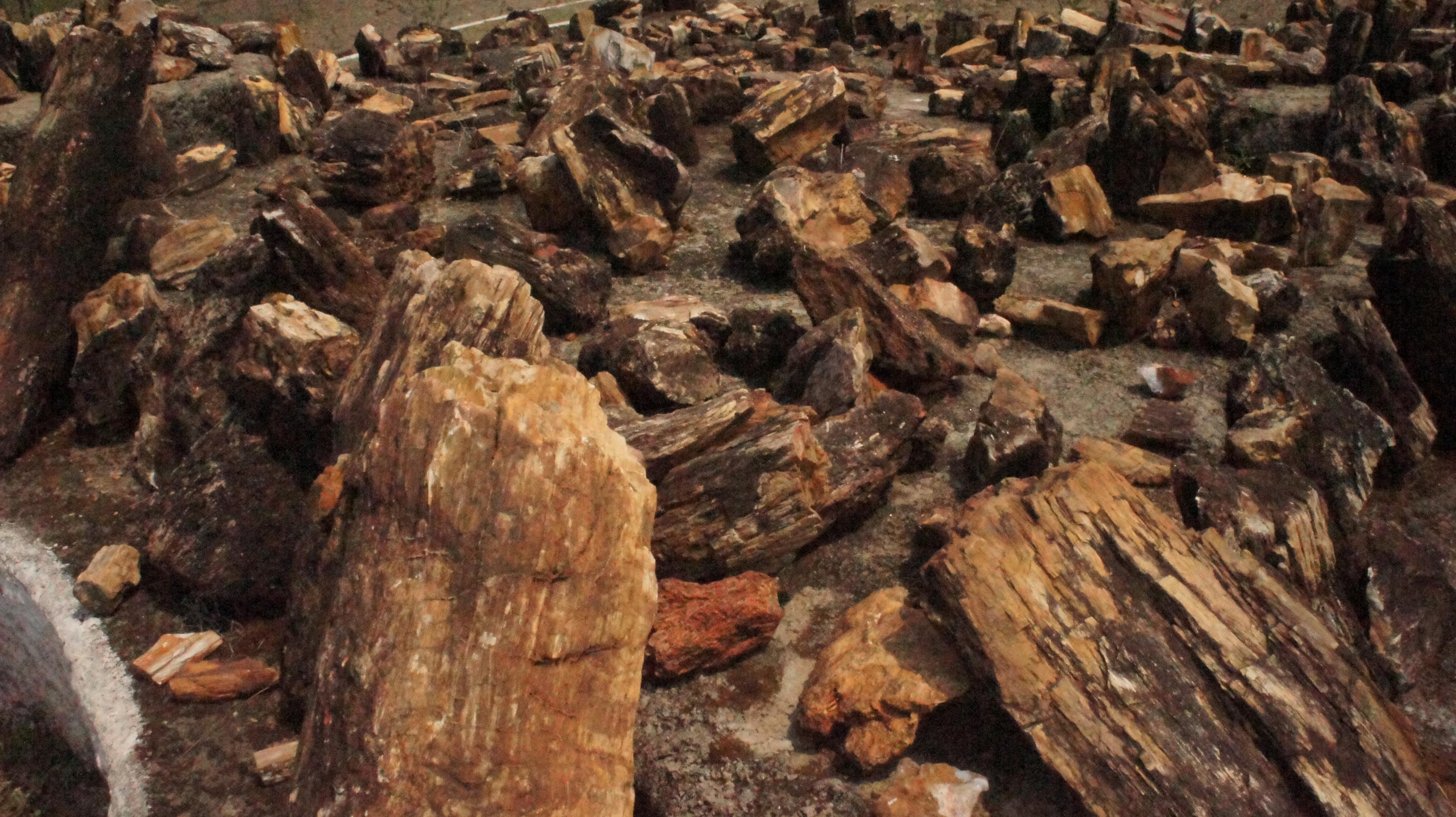
Ghughua National Fossil Park Fossil Hunting Guide
Image: NJneeraj (CC BY-SA 4.0)
A 75-hectare protected park in central India preserving Late Cretaceous to early Paleocene petrified wood, fossil fruits, seeds, and dinosaur egg fragments in situ.
By Edward Chen · Updated 27 July 2026
Introduction
Ghughua National Fossil Park covers about 75 hectares of low scrub and forest in the Dindori district of Madhya Pradesh, on the northern flank of the Maikal Range. The site preserves one of the best in-situ assemblages of plant fossils in peninsular India: petrified trunks, fossil fruits, seeds, and leaf impressions in volcanic sediments deposited between the lava flows of the Deccan Traps, the massive eruptive event that coincided with the end-Cretaceous mass extinction. Dinosaur egg fragments have also been recovered from comparable horizons elsewhere in central India and are reported from the park boundary. Ghughua was designated a National Park in 1983 to halt removal of the petrified wood by local villagers, who had been using the logs as building material and as fuel for centuries. This guide covers how to reach the park from Jabalpur, what fossils visitors can examine in place, the geology of the intertrappean beds that produce them, and the strict no-collection rules that protect the site.
Location and Directions
Ghughua National Fossil Park sits about 76 kilometres south of Jabalpur and 30 kilometres east of Shahpura town. The closest major railhead and airport are both at Jabalpur.
From Jabalpur, take National Highway 30 (formerly NH-12A) east toward Mandla. After about 50 kilometres, turn south at Shahpura toward Dindori. The park is on the right side of the road approximately 30 kilometres past Shahpura. Brown forest-department signs mark the entrance. The drive takes roughly 2 hours from Jabalpur in dry weather. Roads inside the park are unpaved tracks suitable for two-wheel-drive vehicles in dry conditions only.
The park entrance has a small interpretive centre and a forest department booking office. Entry is via a designated walking trail. Off-trail movement is not permitted. The trail loop covers about 1.5 kilometres and takes 90 minutes at a casual pace with stops at the major outcrops.
Best time to visit is November through February, when daytime temperatures are around 25°C and humidity is low. The monsoon (June to September) makes interior tracks impassable and brings dense vegetation that obscures many of the smaller specimens. April and May are extremely hot, with daytime temperatures regularly above 40°C.
There is no accommodation inside the park. The nearest reliable lodging is in Jabalpur for higher-end travellers, or in Dindori town (40 kilometres) for budget options. Dindori has a small forest rest house that requires advance booking through the District Forest Office.
What Fossils You'll Find
Ghughua's exposed fossils are entirely in situ. Nothing is moved or arranged for display. The trail passes a series of points where the petrified material weathers out of the soil and is visible on the surface.
Petrified tree trunks are the headline feature. The park preserves more than 30 trunk fragments, some over six metres long, mineralized into hard silica-rich rock that retains the original wood grain and growth-ring patterns. The trees are mostly gymnosperms (conifer and cycad relatives) and a smaller number of palms (angiosperms), reflecting a mixed Late Cretaceous flora.
Fossil fruits and seeds are scattered through the same horizons. Particularly notable are fossil specimens of palm fruits, identified by the radial structure on the cut surface. Smaller seeds, some less than a centimetre across, are visible in the matrix around the larger trunks.
Leaf impressions appear in fine-grained mudstones at several points along the trail, though most are fragmentary.
Dinosaur egg fragments have been recovered from Deccan Intertrappean horizons across central India, particularly in the Lameta and Pisdura areas. Ghughua's intertrappean beds are reported to contain similar material, though no complete clutches have been described from within the park boundary. Specimens recovered during park development are held in the interpretive centre rather than displayed in situ.
Geologic History
The fossils at Ghughua are preserved in the Deccan Intertrappean Beds, sedimentary horizons deposited between lava flows of the Deccan Traps. The traps are one of the largest volcanic provinces in geological history, with an estimated original volume of over 1.5 million cubic kilometres of basalt erupted in a series of pulses between roughly 66.5 and 65 million years ago, spanning the Cretaceous-Paleogene boundary.
Between pulses of eruption, lakes and small drainage basins formed on the cooling lava surfaces. Vegetation grew on the volcanic soils. Rain washed leaves, fruits, and seeds into the lake bottoms. Trees that fell during eruptions were buried in volcanic ash. The next eruption sealed the deposits under a new lava flow. The Ghughua section preserves several such intertrappean layers, each representing a brief window of biological activity between catastrophic eruptions.
Mineralization replaced the original organic carbon with silica (chalcedony and opaline silica) derived from the surrounding basalt. The replacement is so faithful that cellular wood structure is visible under a hand lens in some specimens.
The Deccan Traps eruption is one of the leading hypotheses, alongside the Chicxulub asteroid impact, for the dramatic environmental change at the end of the Cretaceous. The plant assemblages from intertrappean beds like Ghughua's are direct evidence of the kind of biota that lived around the eruptions, a mix of relict Mesozoic gymnosperm forms alongside the emerging angiosperms and early palms that would dominate Cenozoic floras.
Local uplift along the Maikal Range during the late Cenozoic has exposed the intertrappean beds at the modern surface, where erosion now reveals the fossil horizons.
How Ghughua Became a Fossil Collecting Site
Ghughua's petrified logs were widely known to local villagers, who had been removing them for use as boundary stones, building material, and ceremonial objects for generations. Systematic geological investigation began in the 1970s when the Geological Survey of India documented the site and recommended protection. The Madhya Pradesh state government declared Ghughua a National Park in 1983, halting all extraction.
The park is managed by the Madhya Pradesh Forest Department in cooperation with the GSI. A dedicated interpretive centre opened in the 1990s, and the site is now treated as a paleontological resource of national importance.
No mining, quarrying, or excavation for fossils has ever been undertaken inside the park boundary. Everything visible on the trail is exposed by natural erosion of the soil cover. The forest department periodically clears vegetation around the larger trunks to maintain visibility for visitors.
Collecting Rules and Regulations
Collecting is strictly prohibited. Ghughua is a National Park, and the removal of any natural material, including fossils, soil, stones, vegetation, or animal remains, is a criminal offence under the Wild Life (Protection) Act, 1972 and the Forest Conservation Act, 1980. Fossils are additionally protected under the Antiquities and Art Treasures Act, 1972.
Practical rules:
- Photograph and examine in place. Do not touch the petrified logs, since hand oils can accelerate weathering.
- Stay on the marked trail. Off-trail movement is prohibited and may disturb unexposed specimens that have not yet been catalogued.
- Entry fees are nominal (around 50 to 150 rupees for adults, free for children under 12). Foreign visitors typically pay a higher entrance fee.
- Park hours are 7:00 to 17:00, daily. The last entry is at 16:00.
- A forest guide is included with the entrance fee for groups. Individuals can usually arrange a guide at the entrance gate.
Safety
The park sits in dry deciduous forest, and the risks are heat, snakes, and distance from help.
April and May are dangerous rather than merely uncomfortable. Daytime temperatures pass 40°C and the trail has almost no shade. Visit between November and February if you can. If you go in the hot season, walk early, carry more water than you think you need, and turn back rather than pushing through the middle of the day.
Snakes are active from June through October, and the trail edges where leaf litter meets rock are where they rest. Wear closed boots and long trousers, watch where you put your feet, and do not reach into gaps between the fallen trunks.
The petrified logs are hard and their broken edges are sharp. The ground between them is uneven, with silicified fragments sitting proud of the soil. Sandals are a poor choice.
The monsoon, June to September, makes the interior tracks impassable and the approach road unreliable. Dindori, 40 kilometres away, is the nearest town with any medical facility, and Jabalpur, two hours off, is the nearest hospital of size. Carry a basic first aid kit, tell someone where you are going, and expect patchy mobile coverage at the park.
Sources
- District Administration, Dindori, Madhya Pradesh. "Places of Interest." https://dindori.nic.in/en/places-of-interest/
- Geological Survey of India. "Geological Heritage Sites of India." https://www.gsi.gov.in/
- Government of India, Ministry of Culture. "The Antiquities and Art Treasures Act, 1972." https://www.indiaculture.gov.in/sites/default/files/acts_rules/TheAntiquitiesandArtTreasuresAct1972_12.03.2018.pdf (link no longer available)
- Madhya Pradesh Tourism Board. "Fossil Park Ghughua." https://www.mptourism.com/
- GSI Special Publication No. 11, "Plant Fossils of the Deccan Intertrappean Beds."
Nearby sites
 Lameta Geological Park Fossil Hunting GuideIsisaurus colberti, Jainosaurus septentrionalis
 Salkhan Fossils Park: 1.4-Billion-Year-Old StromatolitesStromatolites, Microbialites
 Wadadham Fossil Park Fossil Hunting GuideDinosaur Bones, Dinosaurs
 Raiyoli (Balasinor) Dinosaur Fossil ParkDinosaur Eggs, Dinosaur Bones