Spiti Valley: Shaligram Ammonites of the Tethys Sea
Image: Sumita Roy Dutta (CC BY-SA 4.0)
The high-altitude cold desert of Spiti exposes Late Jurassic to Early Cretaceous marine fossils on the Tibetan plateau's southern edge, including the ammonites known locally as Shaligrams.
By Edward Chen · Updated 31 July 2026
Introduction
The Spiti Valley sits at 3,800 to 4,600 metres on the southern edge of the Tibetan plateau, a high-altitude cold desert hemmed in by the Pir Panjal and Zanskar ranges. The shale slopes that surround the villages of Langza and Hikkim expose what was, until 60 million years ago, the floor of the Tethys Sea, the warm ocean that lay between India and Asia before the two continents collided. Ammonites and belemnites weather out of the slopes by the thousands, and locals have known about them for centuries: the spiral ammonite shells are venerated in Hindu tradition as Shaligrams, considered sacred representations of Vishnu. A December 2024 Himachal Pradesh High Court ruling banned all extraction, trade, and collection of fossils in the region, so this is now strictly a viewing-and-photography destination. This guide covers how to reach Langza, what fossils are exposed in the slopes around the village, the geological story of the Tethyan sediments, and the rules that now govern visits to the most famous fossil locality in the Indian Himalaya.
Location and Directions
Langza and Hikkim sit on a high plateau roughly 16 kilometres east of Kaza, the administrative centre of Spiti subdivision in Lahaul and Spiti district, Himachal Pradesh.
To reach Kaza, you have two seasonal road options. The Manali to Kaza route via Rohtang Pass and the Kunzum La (4,590 metres) is shorter at about 200 kilometres but only open from late May or June through October, depending on snow. The longer Shimla to Kaza route via Kinnaur and the Sutlej valley and the Hindustan-Tibet Highway is open most of the year except during heavy winter snowfall. Both drives require permits for foreign nationals through Reckong Peo (Kinnaur side).
From Kaza, a paved road climbs steeply northeast to Langza (4,420 metres) and continues to Hikkim (4,400 metres), which holds the world's highest post office. The drive from Kaza to Langza takes about 45 minutes. Most visitors hire a local taxi from Kaza or arrive as part of a multi-day Spiti circuit tour. There is no public bus service to the villages.
Accommodation in Langza is limited to a handful of homestays. Most visitors base in Kaza and visit Langza as a day trip. Acclimatization in Kaza for two or three days before climbing to Langza is essential to avoid acute mountain sickness. The elevation gain from Manali (2,050 m) or Shimla (2,200 m) to Langza is significant.
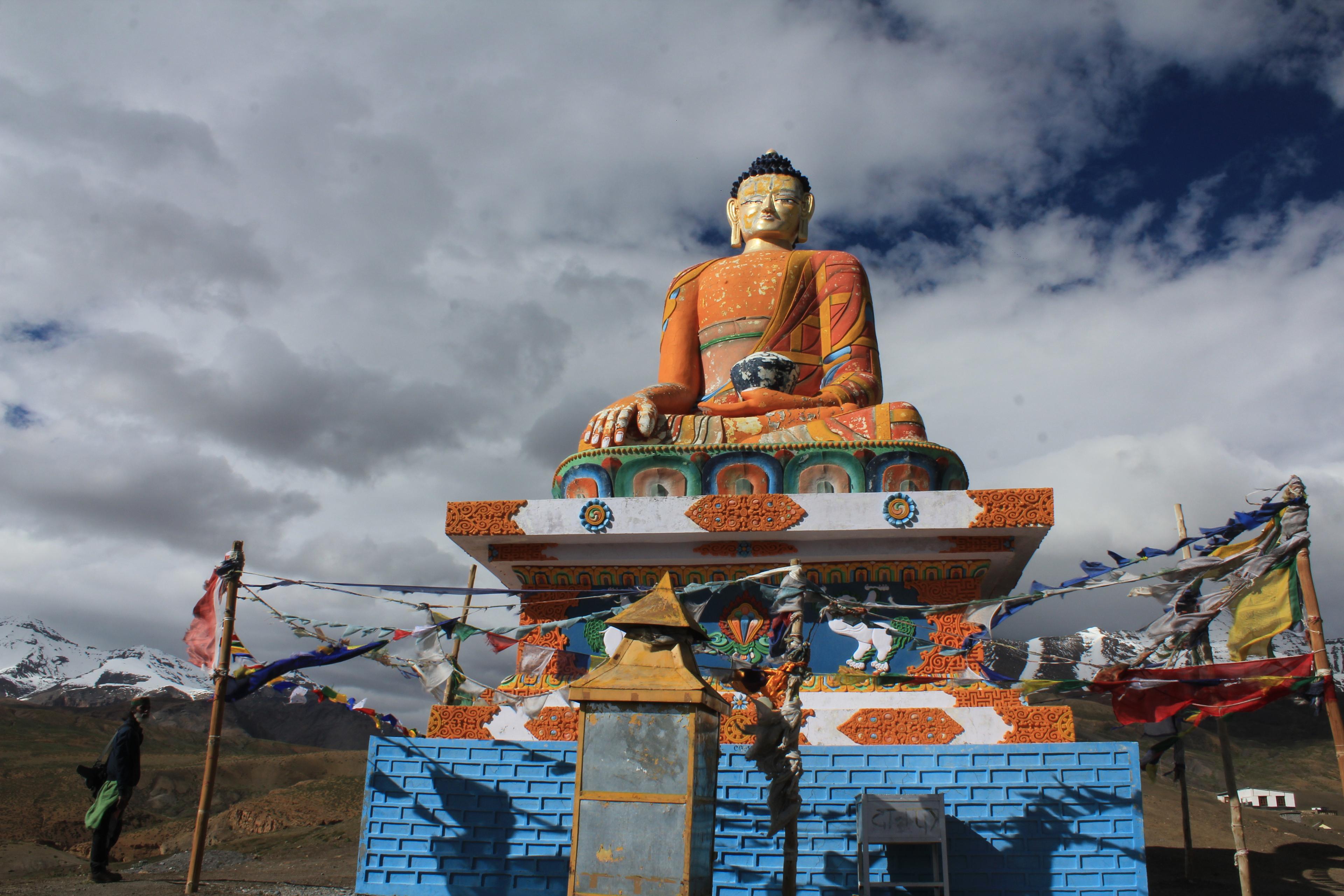
The fossil-bearing slopes are reached on foot from the village. From the giant Buddha statue on the eastern edge of Langza, walk north and east into the rolling shale terrain. The slopes are unmarked. A local guide is strongly recommended both for finding the productive horizons and for explaining what may and may not be touched under the current legal regime.
 Photo: Madhumita Das, CC BY-SA 4.0 via Wikimedia Commons

What Fossils You'll Find
The Spiti shale slopes around Langza weather to release loose fossil material onto the surface, where it can be examined without any tools.
The dominant find is ammonites, the coiled-shell cephalopods that swam the Tethys Sea through the Mesozoic. Specimens range from a few centimetres to over 30 centimetres across, with most well-preserved examples showing intricate suture patterns visible on the outer whorls. Local tradition calls the well-preserved internal moulds Shaligrams and treats them as religious artefacts. This distinction matters for the access rules described below.
Belemnites, the bullet-shaped fossils of extinct squid-like cephalopods, are common in the same horizons. They appear as smooth, dark, cigar-shaped objects in the loose shale, typically two to five centimetres long.
Less common are marine invertebrate fragments, including bivalve shells, brachiopods, and rare crinoid stem ossicles. Trilobite fragments have been reported from older Cambrian and Ordovician horizons exposed elsewhere in Spiti, particularly along the road between Kibber and Tashigang, but these are not the focus of the Langza-Hikkim slopes.
The Shaligrams that show up in roadside trade with religious vendors in Spiti and along the pilgrimage routes from the valley are mostly genuine specimens collected from these slopes over decades. Since the 2024 court ruling, this informal trade is no longer permitted, and law enforcement has been instructed to seize specimens leaving the valley.
Geologic History
The Spiti Shale is a thick package of dark grey to black marine mudstones deposited on the southern margin of the Tethys Ocean during the Late Jurassic and Early Cretaceous, roughly 150 to 100 million years ago. At that time, the Indian subcontinent had separated from Antarctica and Africa and was drifting north as an isolated island continent across the Tethys.
Sediments on the Indian continental shelf accumulated slowly in deep, oxygen-poor bottom water. The dark colour of the shale reflects high organic content. The lack of disturbing burrows in many beds indicates anoxic seafloor conditions that favoured the preservation of ammonite and belemnite shells. Periodic minor sea-level changes produced thin limestone interbeds within the shale.
When India collided with Asia between 50 and 40 million years ago, the Tethys was closed, and the marine sediments of the Indian continental shelf were thrust upward to form the Himalayas. The Spiti Shale was carried up to its present elevation along major fault systems including the Indus-Tsangpo Suture Zone. Subsequent erosion has stripped the overlying rocks and exposed the marine package on the southern flank of the Zanskar range.
The Spiti Shale is part of a broader Tethyan Sedimentary Sequence that extends across much of the Tibetan Plateau and into Ladakh. Comparable Jurassic-Cretaceous ammonite faunas occur in the Domeling-Tashigang area of Ladakh, in northern Nepal, and across the border into the Tibet Autonomous Region.
 Photo: Mike Shaw, CC BY-SA 4.0 via Wikimedia Commons

How Spiti Valley Became a Fossil Collecting Site
The Spiti Shale exposure is the product of natural slope erosion in a high-altitude cold desert. Freeze-thaw weathering, occasional summer rain, and steady wind continuously break down the shale and expose fresh fossil material on the slopes. There has been no formal quarrying for fossils.
The Langza-Hikkim area became internationally known to paleontologists through the late-19th and early-20th-century surveys of the Geological Survey of India and the British Indian Geological Survey. The first systematic monographs on Spiti ammonites were published by Carl Diener in the 1890s as part of the Palaeontologia Indica series, and they remain reference works for Tethyan Mesozoic stratigraphy.
The Shaligram tradition in Hindu practice is far older than any scientific survey: the spiral fossils have been collected as sacred objects from Spiti and Mustang (in Nepal) for at least a thousand years. The same tradition is the historical reason these slopes are well-known to local people, and it is what made commercial fossil trade out of Spiti possible during the late 20th century.
Collecting Rules and Regulations
All extraction, trade, and removal of fossils from Spiti Valley is banned by order of the Himachal Pradesh High Court (December 2024). The fossils are protected as national heritage under the Antiquities and Art Treasures Act, 1972. Violations carry criminal penalties, and enforcement at road checkpoints leaving the valley has tightened since the ruling.
Practical rules:
- Examine fossils where you find them. Photograph rather than collect.
- Do not purchase any fossil material from local vendors. The trade in Shaligrams that operated before the 2024 ruling is no longer legal even for religious use sourced from outside the valley network.
- A local guide from Langza or Hikkim is strongly recommended both for safety and for staying clear of areas under monitoring.
- Acclimatize in Kaza for at least two days before visiting. The elevation at Langza (4,420 m) and Hikkim (4,400 m) is sufficient to cause acute mountain sickness in unacclimatized visitors. Symptoms include severe headache, nausea, and shortness of breath. Descend immediately if they appear.
- No fees for visiting the slopes, but homestays and guides charge for their services. Expect to pay 500 to 1,500 rupees per day for a local guide.
- Weather is severe. Bring layers, sun protection (the UV at this altitude is intense even in summer), and water. The valley is effectively closed by snow from November through April.
- Cell coverage is intermittent. Most homestays have basic Wi-Fi.
Safety
The dominant hazard in Spiti is not the terrain or the wildlife. It is the altitude, and it is a serious one.
Langza sits above 4,000 metres, and the valley ranges from roughly 3,800 to 4,600 metres. Acute mountain sickness is a real risk at these elevations and can affect anyone regardless of fitness or previous experience. Ascend slowly, build in acclimatisation days rather than driving straight up from Manali or Shimla, and sleep lower than the height you reach during the day where you can. Headache, nausea, breathlessness at rest, and disturbed sleep are warning signs. If they worsen, the only reliable treatment is to descend, immediately and without debating it. High-altitude pulmonary and cerebral oedema are both possible here and both are life-threatening.
Medical help is far away. Facilities in the valley are minimal, Kaza has limited services, and evacuation to a hospital at lower elevation takes many hours over rough roads. Travel with someone, carry a basic kit, and consider travel insurance that explicitly covers high altitude.
This is a cold desert with extreme conditions. Daytime sun at this elevation burns quickly through thin air even when the air is cold, so use strong sun protection and cover up. Nights are cold year-round and bitter outside summer. The valley is snowbound and effectively closed for much of the winter, and roads in and out are subject to landslides and closures.
The shale slopes themselves are loose and steep. Wear boots with grip, walk rather than scramble, and take the thin air into account when judging how far you can comfortably go.
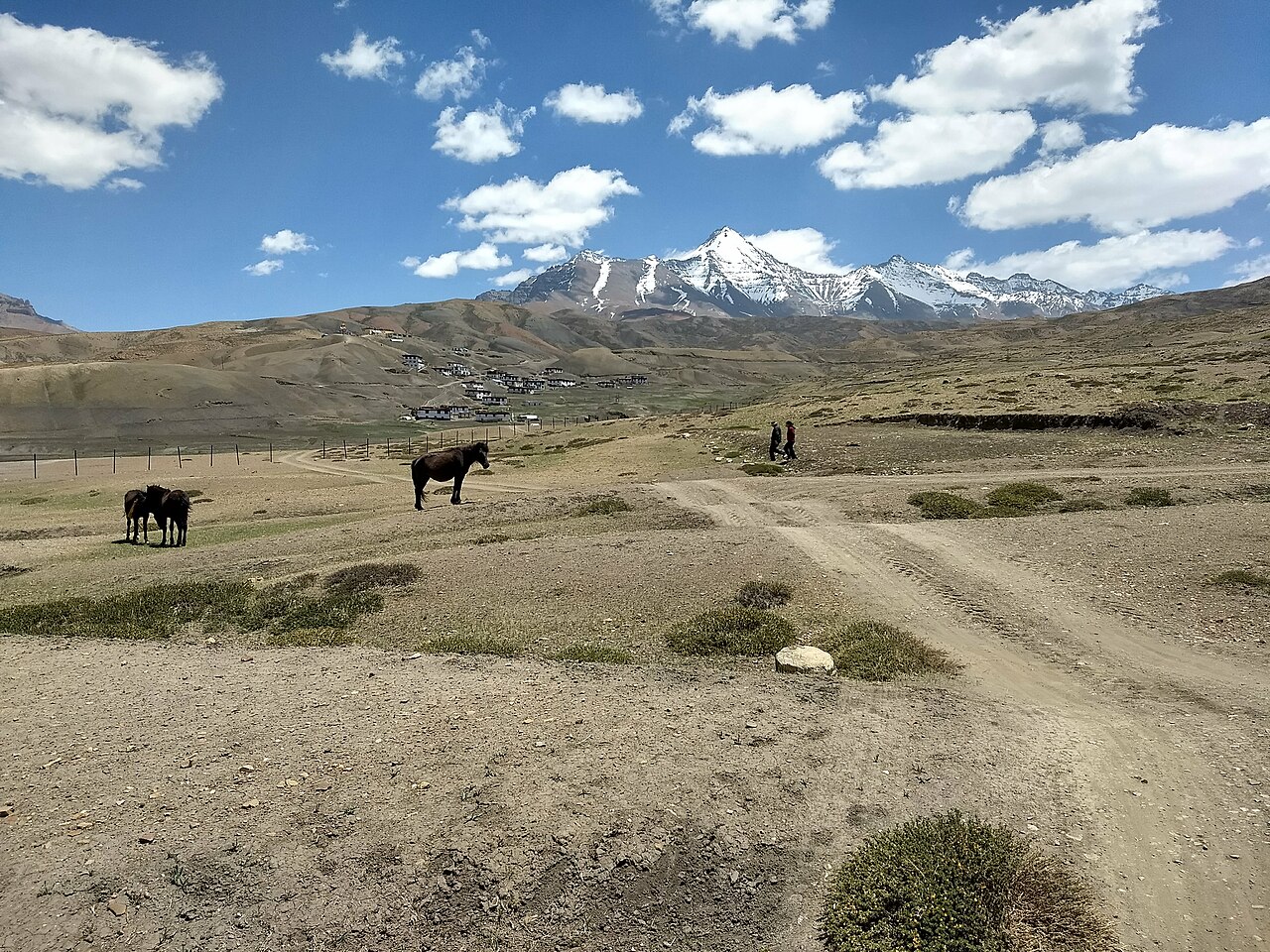 Photo: Drawtheline, CC BY-SA 4.0 via Wikimedia Commons

Sources
- Government of India, Ministry of Culture. "The Antiquities and Art Treasures Act, 1972." https://www.indiaculture.gov.in/sites/default/files/acts_rules/TheAntiquitiesandArtTreasuresAct1972_12.03.2018.pdf (link no longer available)
- Geological Survey of India. "Palaeontology of the Himalayan region." https://www.gsi.gov.in/
- Diener, C. 1895–1908. "Himalayan fossils: Spiti Shales." Palaeontologia Indica, Series 15, Volumes 1–4.
- Government of Himachal Pradesh, District Lahaul and Spiti. https://hplahaulspiti.nic.in/
Nearby sites
 Akal Wood Fossil Park Fossil Hunting GuidePetrified Wood, Plants
 Salkhan Fossils Park: 1.4-Billion-Year-Old StromatolitesStromatolites, Microbialites
 Lameta Geological Park Fossil Hunting GuideIsisaurus colberti, Jainosaurus septentrionalis
 Ghughua National Fossil Park Fossil Hunting GuidePetrified Wood, Seeds and Fruits