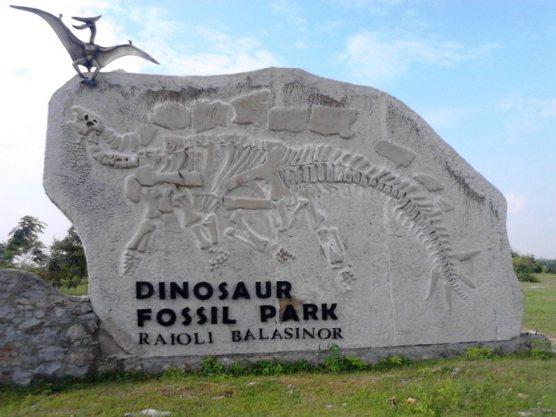
Raiyoli (Balasinor) Dinosaur Fossil Park
Image: Shyam parasiya (CC BY-SA 4.0)
One of the world's largest dinosaur nesting sites, with hundreds of titanosaur eggs and the holotype Rajasaurus narmadensis bones preserved in the Late Cretaceous Lameta Formation of Gujarat.
By Edward Chen · Updated 31 July 2026
Introduction
Raiyoli is a low ridge of rust-coloured limestone and mudstone in eastern Gujarat that holds one of the densest concentrations of dinosaur eggs and bones anywhere in the world. The site was discovered in 1981 by Geological Survey of India geologists prospecting a limestone quarry, and over the following four decades it has yielded hundreds of nests containing titanosaur sauropod eggs, the holotype of the abelisaurid theropod Rajasaurus narmadensis, and an associated bone assemblage that documents the last few hundred thousand years of the Cretaceous on the Indian subcontinent. The deposit sits in the Lameta Formation, the same unit that has produced the bulk of India's Late Cretaceous vertebrate fauna. Locally called the "Jurassic Park of India," the site is managed by the Gujarat Tourism Department and the Forest Department as a viewing-only paleontological monument with an on-site museum and guided tours. This guide covers how to reach Raiyoli from Ahmedabad, what is visible to visitors on the excavation surface and in the museum, the geology of the Lameta beds, and the rules that govern a protected dinosaur site.
Location and Directions
Raiyoli village lies in Balasinor taluka of Mahisagar district, about 100 kilometres east-northeast of Ahmedabad. The drive is straightforward on the Ahmedabad, Indore highway (NH-48 then NH-148N).
From Ahmedabad, take the Sardar Patel Ring Road to the Vadodara Expressway, then exit toward Kheda and continue east through Kapadvanj and Balasinor. The park entrance is signed on the right side of the road approximately 12 kilometres past Balasinor town. Total driving time is around 2 hours in light traffic.
From Vadodara, the distance is about 90 kilometres via Halol and Lunawada, taking roughly 2 hours.
There is a paved parking area at the entrance and a small admission booth. The site is operated jointly by the Gujarat Tourism Department and the Gujarat Forest Department. A modern interpretive complex, the Dinosaur Fossil Park Museum, opened in 2019 and houses casts of major specimens, life-sized reconstructions, and the original interpretation of the excavated surfaces.
From the museum, a paved path leads down to the excavation site itself, where the productive bed is exposed in a roofed open-air enclosure. Multiple egg clutches and isolated bones remain in their original matrix. The path follows the perimeter so visitors can examine the surface from above and from the sides without stepping on the fossils.
Best time to visit is November through February when temperatures are mild. The site is hot and exposed in summer (April to June), and the monsoon (July to September) limits visitor access on heavier-rain days.
What Fossils You'll Find
Raiyoli's preserved fossils are entirely in place. The excavation enclosure exposes the original death assemblage, and the museum holds prepared specimens that complement the in-situ display.
Sauropod skeletal remains are present in the same beds, including vertebrae, limb bones, and rare partial skulls. Two named genera have been described from the Lameta of central India: Isisaurus colberti and Jainosaurus septentrionalis, both titanosaurs of medium size (12 to 18 metres long).
Rajasaurus narmadensis is the headline carnivore. The holotype skeleton was assembled from material recovered at Raiyoli and from associated sites in the Narmada valley by the GSI and the University of Michigan in the early 2000s. Rajasaurus was an abelisaurid theropod, roughly 7.5 metres long, with a short snout, a horn-like ornament on the skull, and stocky limbs. A full cast skeleton is displayed in the museum.
Eggshell fragments are abundant on the surface around the main clutches. Visitors can see them clearly from the viewing path but cannot pick them up.
Other vertebrate material includes crocodyliform teeth, lungfish toothplates, freshwater fish remains, and rare turtle fragments, reflecting a riverine ecosystem associated with the nesting ground.
Geologic History
Raiyoli sits in the Lameta Formation, a thin (typically less than 30 metres thick) sedimentary package deposited across central and western India during the latest Cretaceous, immediately before and during the onset of the Deccan Traps eruptions. Radiometric dates from interbedded volcanic ash put the egg-bearing beds at roughly 66 to 67 million years old, within the final million years of the Maastrichtian stage.
The Lameta was deposited in a low-energy fluvial and lacustrine environment. Carbonate-rich freshwater ponds and slow river channels covered a low-relief landscape, with seasonal drying producing the calcrete (caliche) horizons that now host most of the eggs. The titanosaurs returned year after year to the same nesting grounds, scraping shallow depressions into the soft calcareous mud and laying clutches of eggs in arrays of nests that can extend over hundreds of square metres.
The arrival of the Deccan Traps eruptions ended this depositional setting. Massive basaltic lava flows covered the Lameta sediments, sealing the nesting horizons under hundreds of metres of basalt. The eggs and bones at Raiyoli are preserved at the contact between the latest Lameta carbonate and the basal Deccan Trap lava flow. You can see the contact in the excavation enclosure.
Cenozoic erosion has stripped the upper Deccan Trap basalts off the Raiyoli area, exposing the Lameta beds at the surface. The original discovery in 1981 was made when limestone quarrying for the cement industry cut into one of the nesting horizons and brought egg clutches to the surface.
The Lameta and its overlying Deccan basalts are the same age as the Chicxulub impact in Mexico. Raiyoli is one of the world's most important localities for understanding the terrestrial ecology of the last few hundred thousand years of the Cretaceous.
 Photo: Joseph H. Hartman, CC0, via Wikimedia Commons
.jpg)
How Raiyoli Became a Fossil Collecting Site
The site was discovered in 1981 when limestone quarrying by the Associated Cement Companies (ACC) for a cement plant exposed dinosaur egg clutches. Initial reports were filed by GSI geologists working on the regional survey of the Cambay Basin.
Systematic excavation began in the 1980s under the GSI in collaboration with Punjab University and later the University of Michigan. The 2003 description of Rajasaurus narmadensis by Wilson, Sereno, and others, based on Raiyoli and Narmada-valley material, brought international attention to the site. Quarrying was halted, the surrounding area was acquired by the state government, and the property was developed as a paleontological monument.
The Dinosaur Fossil Park Museum was constructed by the Gujarat Tourism Department and opened in 2019, replacing an earlier wooden interpretive shed. The site is now monitored continuously by the Gujarat Forest Department, with active research permits granted to GSI and partner universities for further excavation.
Collecting Rules and Regulations
Collecting is strictly prohibited. Raiyoli is a protected paleontological site under the Antiquities and Art Treasures Act, 1972. The surrounding land is administered by the Gujarat Forest Department, and removal of any natural material, including soil and stone, is a criminal offence.
Practical rules:
- Stay on the marked viewing path through the excavation enclosure. Do not step onto the exposed fossil surface.
- Photography is allowed throughout the site and museum for personal use. Commercial photography requires advance permission from the Tourism Department.
- Entry fees are charged at the museum: typically 30 to 100 rupees for Indian adults, 200 to 500 rupees for foreign visitors, with discounts for children and students. Fees are subject to change. Check the Gujarat Tourism website before visiting.
- Site hours are typically 9:00 to 17:30, daily except Monday. Confirm with the Tourism Department before driving out from Ahmedabad.
- Guided tours run hourly from the museum during open hours and are included with the entrance fee.
Safety
Raiyoli is a managed site with a paved path and a roofed excavation enclosure, so the risks are modest and mostly about heat and footing.
Heat is the main one. Daytime temperatures from March through June often exceed 40°C, and the approach from the museum is exposed. Visit between November and February if you can, go in the morning otherwise, and carry water. The museum is air-conditioned and is the place to cool down.
The viewing path passes uneven excavation terrain, with steps, loose stone, and open edges above the fossil surface. Wear closed shoes with a firm sole, since the site discourages sandals for good reason. Hold onto children near the enclosure edge, where the drop onto the exposed bed is short but the bed itself is fragile and unforgiving.
The monsoon, July to September, brings heavy rain that limits access on the worst days and makes the paths slick. Check before driving out from Ahmedabad, which is two hours away.
Snakes and scorpions are present in the scrub around the enclosure during warmer months. Stay on the path, which you are required to do in any case.
Balasinor town, about 12 kilometres west, has the nearest basic medical services. Anything serious means Ahmedabad. Mobile coverage at the site is generally adequate.
Sources
- Gujarat Tourism. "Balasinor Dinosaur Fossil Park." https://gujarattourism.com/central-zone/mahisagar/balasinor-dinosaur-fossil-park.html
- Wilson, J.A. et al. 2003. "A new abelisaurid (Dinosauria, Theropoda) from the Lameta Formation (Cretaceous, Maastrichtian) of India." Contributions from the Museum of Paleontology, University of Michigan 31(1).
- Geological Survey of India. "Dinosaur Fossils of India." https://www.gsi.gov.in/
- Government of India, Ministry of Culture. "The Antiquities and Art Treasures Act, 1972." https://www.indiaculture.gov.in/sites/default/files/acts_rules/TheAntiquitiesandArtTreasuresAct1972_12.03.2018.pdf (link no longer available)
Nearby sites
 Akal Wood Fossil Park Fossil Hunting GuidePetrified Wood, Plants
 Lameta Geological Park Fossil Hunting GuideIsisaurus colberti, Jainosaurus septentrionalis
 Ghughua National Fossil Park Fossil Hunting GuidePetrified Wood, Seeds and Fruits
 Wadadham Fossil Park Fossil Hunting GuideDinosaur Bones, Dinosaurs