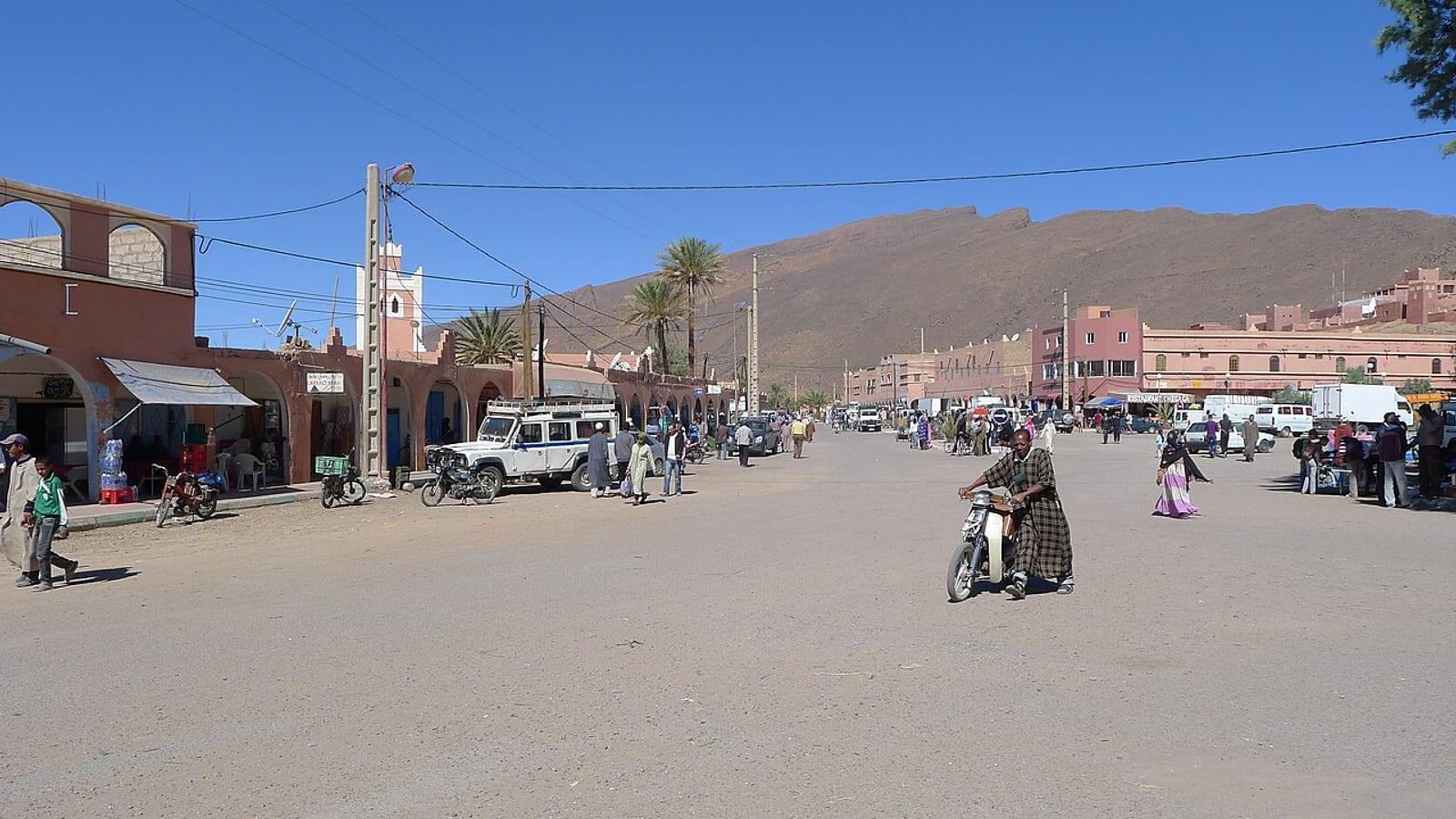
Jbel Gara el Zguilma Trilobite Site Foum Zguid Fossil Hunting Guide
Image: Dromedar61 (CC BY-SA 3.0)
Jbel Gara el Zguilma near Foum Zguid, Morocco, yields three-dimensionally preserved Devonian trilobites including Walliserops and Psychopyge from Middle Devonian limestone.
By Edward Chen · Updated 30 July 2026
Introduction
Jbel Gara el Zguilma is a limestone hill rising from the pre-Saharan plains south of Foum Zguid in Morocco's Draa Valley, and for collectors focused on spiny Devonian trilobites it is one of the most productive localities on the planet. The site yields three-dimensionally preserved trilobites extracted from Devonian limestone, with genera such as Walliserops trifurcatus, known for its trident-shaped rostral spine, and Psychopyge elegans, whose elongated nose appendage has no parallel among trilobites from any other period or locality. These are not surface finds. The specimens are worked out of dense grey limestone by experienced local preparators using pneumatic tools and dental picks. Visiting the area gives you direct access to both the quarry operations and a range of prepared specimens available for purchase.
This guide explains how to get to Jbel Gara el Zguilma from Foum Zguid, what trilobite genera are found there and why, the Devonian geology that produced them, and what to expect during a visit in practical terms.
 Photo: Dromedar61, CC BY-SA 3.0, via Wikimedia Commons

Location and Getting There
Location
Jbel Gara el Zguilma lies approximately 22 km north of Foum Zguid in the Draa-Tafilalet region of southern Morocco. Foum Zguid itself sits around 150 km southwest of Ouarzazate and roughly 200 km west of Zagora. The hill is visible from the main road as an isolated limestone ridge standing above the surrounding flat hammada. Approximate GPS coordinates for the site are 30.10°N, 6.85°W, though guide contact is recommended for precise quarry locations.
Getting There
From Ouarzazate, take the N9 south to Agdz, then the R108 road southwest through Tansikht toward Foum Zguid. The journey from Ouarzazate takes approximately 2.5 to 3 hours by car. From Foum Zguid, the fossil site is reached via a short piste track suitable for standard vehicles in dry conditions, though 4WD is advisable in any recent wet weather. Guide and transport services are available through guesthouses and fossil dealers in Foum Zguid. There is no formal parking or visitor infrastructure at the quarry. Vehicles park on flat ground near the working areas.
What Fossils You'll Find
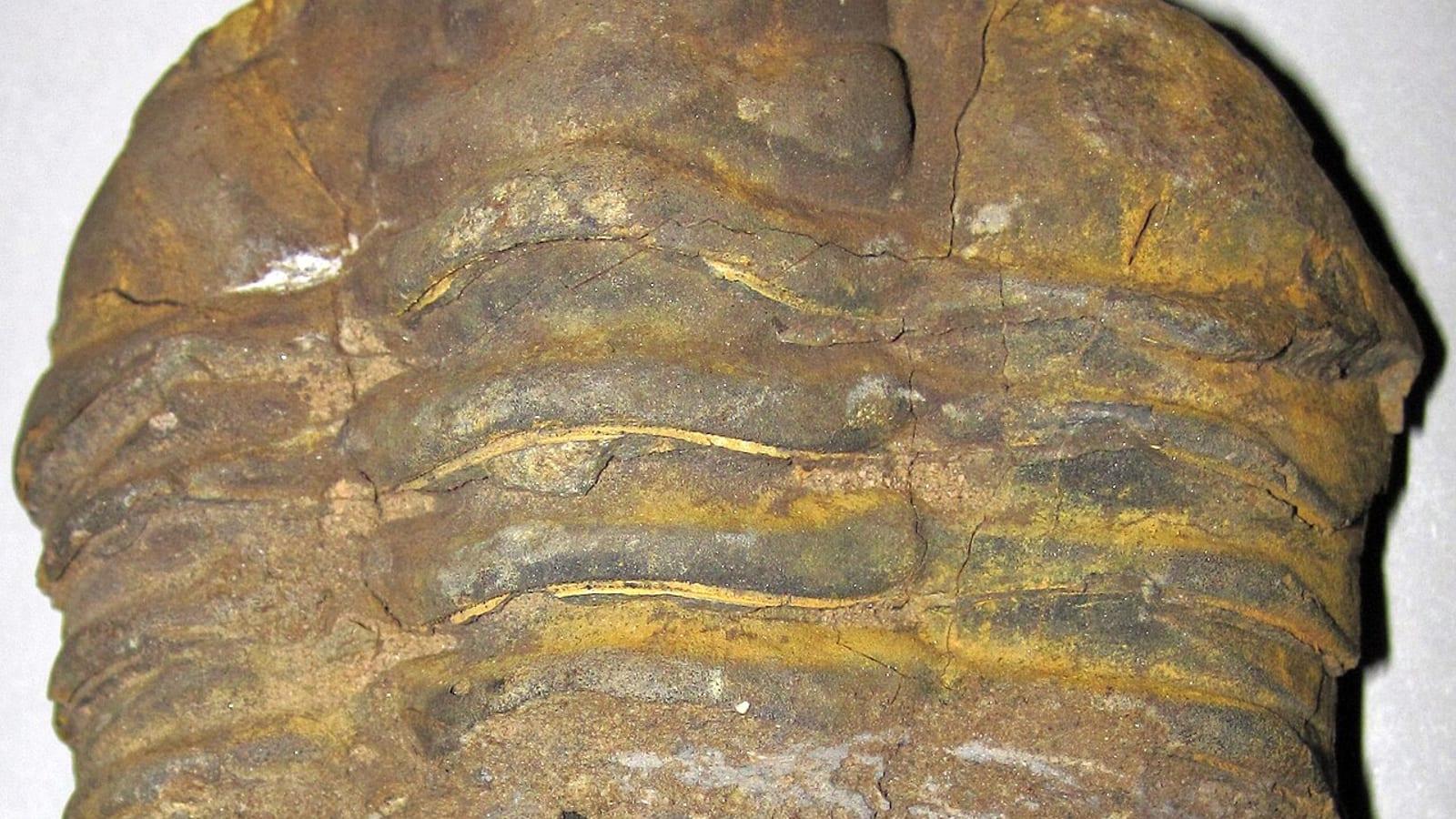
Walliserops trifurcatus is the signature species of this locality. This trilobite, from the Middle Devonian Eifelian stage, carries a long frontal spine that forks into three prongs, a structure whose function remains debated among researchers, with possibilities including sexual selection, prey manipulation, or species recognition. Complete specimens with the trident intact are rare and command premium prices. Isolated tridented spines and partial specimens appear more frequently in the quarry material.
 Photo: James St. John, CC BY 2.0, via Wikimedia Commons
.jpg)
Psychopyge elegans produces perhaps the most visually arresting of any trilobite preserved at this locality, carrying a long curved rostral appendage that projects forward from the front of the glabella. Specimens showing the full length of this structure are extracted intact only by skilled preparators working under magnification.
Cyphaspis and Comura species also occur in the Jbel Gara el Zguilma limestones, along with various enrolled and partially articulated Phacops-grade trilobites. Crinoid stem sections and occasional brachiopod valves appear in the matrix alongside the trilobites. Surface-weathered specimens are rare at this site because the host limestone is dense and does not shed fossils easily. Nearly all collectible material comes from active quarrying rather than surface searching.
When purchasing specimens at the site, look for natural matrix around all appendages and check that legs, spines, and hypostome have not been replaced with fill. Run your fingernail along spines to detect plaster. Under UV light, authentic calcite matrix fluoresces differently from calcium-carbonate filler, which is useful when evaluating complex specimens.
Geologic History
The Ancient Environment
The limestones at Jbel Gara el Zguilma belong to formations of Middle Devonian age, broadly within the Eifelian to Givetian stages, approximately 393 to 382 million years ago. During this period the area formed part of the southern margin of the Rheic Ocean, a shallow tropical sea that covered much of what is now North Africa. Morocco occupied a paleolatitude of roughly 20 to 30 degrees south, within the warm, carbonate-producing belt. The seafloor was a low-energy muddy shelf supporting a diverse invertebrate community, including abundant trilobite populations that lived among crinoid gardens and brachiopod beds.
Preservation of three-dimensional specimens results from burial in fine carbonate mud with limited bioturbation. When trilobites molted or died in relatively undisturbed bottom conditions, the exoskeleton retained its shape as the surrounding sediment lithified around it. The resulting fossil lies encased in a limestone nodule or bed, requiring mechanical preparation to expose.
How Jbel Gara el Zguilma Became a Fossil Site
The hill survives as an erosional remnant of Devonian carbonate rocks that once covered a much wider area. Differential erosion stripped away softer overlying and surrounding formations, leaving the harder Devonian limestone exposed as a prominent ridge. Local collectors began systematic quarrying operations here in the late twentieth century as international demand for Moroccan trilobites grew. The site now supports a network of quarry workers and preparators, many of whom have developed significant expertise in extracting and presenting the spiny trilobites found nowhere else in comparable quantity and preservation quality.
Visiting and Collecting Information
Access and What to Expect
The site operates as an informal commercial quarry. You pay for access and guide services through local operators, with half-day visits typically costing 300 to 600 MAD (30 to 60 USD) per person including transport from Foum Zguid. Visitors can observe quarrying in progress, collect loose matrix chips from the spoil heaps, and purchase prepared specimens directly from the workers. The best prepared specimens are typically held back by experienced quarrymen for sale to dealers. The selection available on any given day depends on recent finds and current stock.
There is no fixed tourist allowance for taking fossils out of Morocco. Article 116 of the 2015 Mining Code (Law 33-13) requires a permit for collecting and trading fossils, minerals, and meteorites, with the procedures set out in a 2019 implementing decree and the framework revised again in 2025. Enforcement is uneven, and small purchases from licensed dealers are commonly carried out without incident, but that is practice rather than an entitlement. Keep a receipt and a written description of each specimen and its origin, and check the current rules with the Moroccan ministry responsible for mines before you travel. Commercial export requires authorization from the Moroccan Ministry of Energy, Mines and Environment.
What to Bring
Bring a minimum of 2 liters of water per person per half-day visit. Sun protection is essential year-round in southern Morocco. Temperatures in the Draa Valley exceed 40°C from June through August. Closed-toe boots and long trousers protect against sharp limestone edges and occasional scorpions near rock piles. Bring cash in Moroccan dirhams. A small loupe (10x) and UV flashlight are useful for evaluating specimens. Matrix inspection tools such as a dental pick and small brush are helpful if you intend to do any self-directed matrix work.
Safety and Practical Tips
The quarry area involves actively worked ground with loose limestone blocks and uneven footing. Watch your step around active extraction areas. Agree on prices before committing to a purchase, and take your time when evaluating specimens. Bargaining is expected and accepted. The workers at Jbel Gara el Zguilma are professional and accustomed to foreign visitors. Treating them with straightforward courtesy goes a long way. Keep visits to the cooler morning hours from October through April for the most comfortable experience.
Sources
Nearby sites
 Draa Valley Ordovician Trilobite Site Agdz Fossil Hunting GuideGiant trilobites, Brachiopods
 Fezouata Biota Locality Zagora Fossil Hunting Guideanomalocaridids, Trilobites
 Ait Benhaddou Echinoid Site Ouarzazate Fossil Hunting GuideCretaceous echinoids, Brachiopods
 Bou Dib Fossil Site North Jbel Isoumour Alnif Fossil Hunting GuideBou Dib, Phacops