National Fossil Wood Park at Tiruvakkarai Fossil Hunting Guide
Image: Ranjith Kumar Inbasekaran (CC BY-SA 3.0)
A National Geological Monument in northern Tamil Nadu preserving more than 200 silicified Mio-Pliocene tree trunks scattered across nine fenced enclaves of the Cuddalore Sandstone.
By Edward Chen · Updated 3 August 2026
Introduction
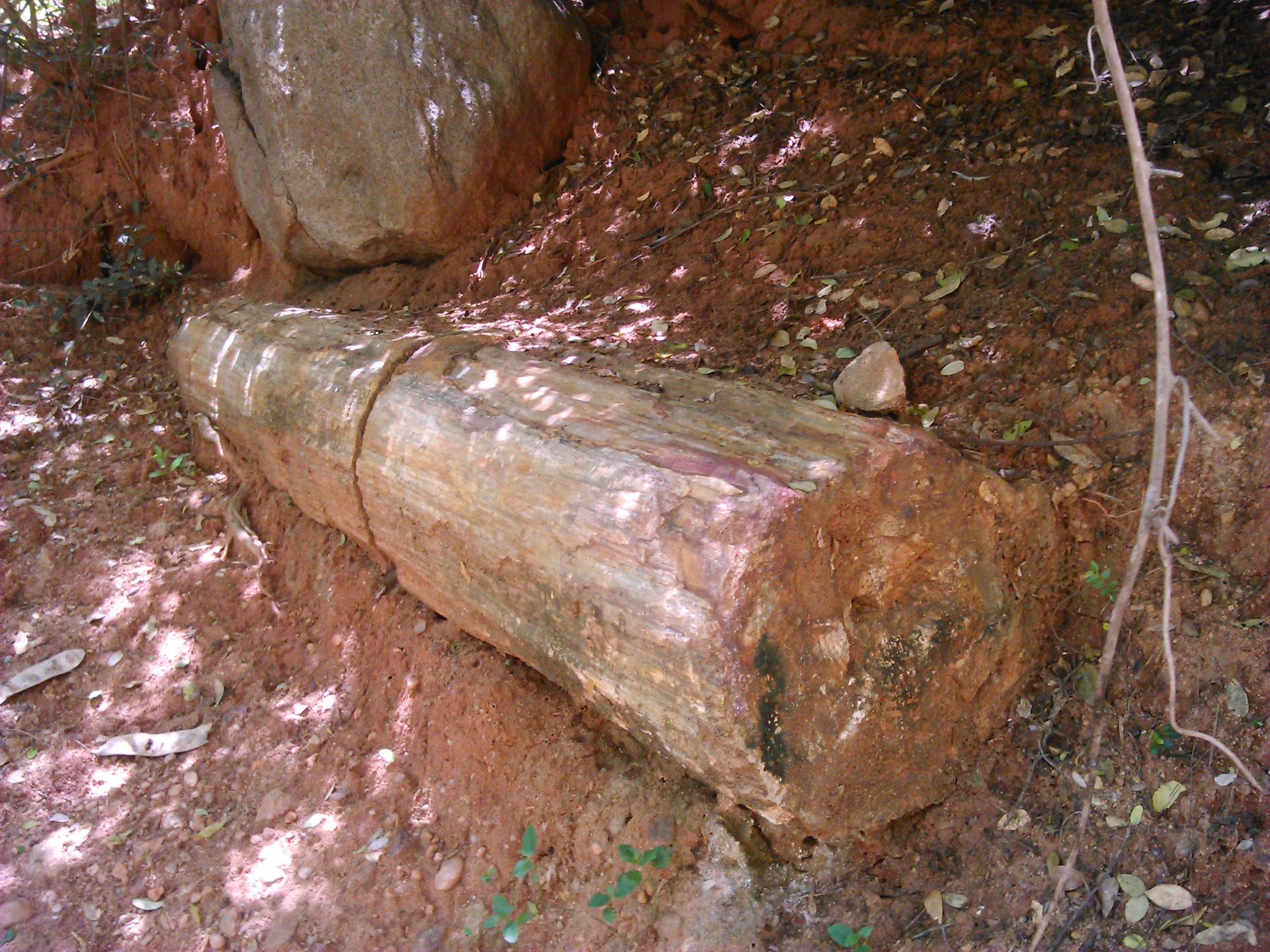
The National Fossil Wood Park at Tiruvakkarai is one of two protected petrified-forest sites in Tamil Nadu and the more accessible of the pair for visitors approaching from Chennai or Puducherry. Spread across nine separate fenced enclaves that together cover about 247 hectares, the park preserves more than 200 silicified tree trunks, some over 10 metres long, lying where they were buried during the Mio-Pliocene roughly 20 million years ago. The trunks have been replaced by silica so completely that the original annular growth rings, bark texture, and even branching scars are preserved on the weathered surfaces. The site was declared a National Geological Monument by the Geological Survey of India in 1940, making it one of the earliest such designations in India, and is now maintained by the GSI in cooperation with the Tamil Nadu Forest Department. This guide covers how to reach Tiruvakkarai from Puducherry or Chennai, what visitors can examine in the open-air enclaves, the depositional setting of the Cuddalore Sandstone, and the rules that govern collecting at a protected geological monument.
Location and Directions
Tiruvakkarai village lies in the Villupuram district of northern Tamil Nadu, about 35 kilometres west of Puducherry and 155 kilometres south-southwest of Chennai.
From Puducherry, take the East Coast Road or NH-32 north for about 12 kilometres, then turn west onto the Tindivanam Road. Tiruvakkarai is about 23 kilometres west of the turnoff. The drive takes around 45 minutes in light traffic.
From Chennai, take NH-32 (the East Coast Road) south through Mahabalipuram to Tindivanam (about 120 kilometres), then turn east-southeast and follow signs to Tiruvakkarai (35 kilometres). Total drive is around 3 hours.
The closest major railhead is Villupuram Junction (40 kilometres west), with rail connections to Chennai, Tiruchirappalli, and Madurai. The closest airport is Chennai International Airport (155 kilometres north).
The park has a small entrance office and a perimeter fence around the largest enclave. The other eight enclaves are spread around Tiruvakkarai village. Some are reached on foot from the main site (a 10- to 20-minute walk between enclaves), while others require a short drive on rural roads. Most visitors focus on the main enclave near the village, which contains the largest and best-preserved specimens.
Best time to visit is November through February when daytime temperatures are 25 to 30°C with low humidity. From March through May the heat is intense (up to 40°C) and there is little shade in the enclaves. The monsoon (October to December for the northeast monsoon affecting Tamil Nadu) brings significant rainfall but otherwise does not close the site.
 Photo: Ranjith Kumar Inbasekaran, CC BY-SA 3.0, via Wikimedia Commons

What Fossils You'll Find
The park's specimens are all in situ, displayed in their original orientation in the soil and sandstone matrix. Visitors walk through the enclaves on informal paths between the trunks.
Silicified tree trunks are the headline feature. Most specimens are large gymnosperm and dicotyledonous angiosperm trunks, identified by ring spacing and vessel structure visible in cross-section. The largest single trunk in the park is over 14 metres long. The wood is completely replaced by silica (chalcedony and opaline silica), often with attractive brown, red, and grey colour banding from trace iron oxides.
Annular growth rings are visible on many specimens where natural weathering has exposed cross-sections. Ring counts on individual trunks span 100 to 250 years, indicating mature trees at the time of burial. Bark texture and knot patterns are preserved on outer surfaces.
Smaller branches and root fragments are scattered around the larger trunks. A few logs show forked or branching geometry, allowing the form of the tree to be reconstructed from the broken pieces.
The site has not yielded body fossils of animals, leaves, or fruits, only the wood. The depositional environment was not favourable for the preservation of softer plant tissues or animal remains.
 Photo: Ranjith Kumar Inbasekaran, CC BY-SA 3.0, via Wikimedia Commons

Geologic History
The petrified trunks at Tiruvakkarai are preserved in the Cuddalore Sandstone (also called the Cuddalore Formation), a fluvial-deltaic sandstone unit deposited along the eastern margin of peninsular India during the Miocene to early Pliocene, roughly 20 to 5 million years ago. The Cuddalore Sandstone extends along the Coromandel Coast for over 200 kilometres, from north of Cuddalore town through Pondicherry and into Tamil Nadu's Villupuram district.
At the time of deposition, the area was a broad coastal plain on the eastern edge of the Indian craton, with major rivers draining the Western Ghats and Eastern Ghats hinterlands and depositing sand and silt onto a low-relief surface that sloped gently east toward the Bay of Bengal. The climate was warm and humid, supporting dense tropical and subtropical forests on the floodplains. The trees represented in the park are gymnosperms and dicotyledonous angiosperms reflecting the regional flora of the Mio-Pliocene.
The exact mechanism of burial varies between localities. At Tiruvakkarai, the trunks appear to have been buried by flood-deposited sands rather than volcanic ash. Many specimens are oriented in similar directions, consistent with transport by river current before final deposition. Silica-rich groundwater, derived from weathering of the surrounding granitic basement, percolated through the buried wood and replaced the organic carbon over hundreds of thousands to millions of years, preserving the cellular structure cell by cell.
The Cuddalore Sandstone unconformably overlies older Cretaceous rocks of the Ariyalur and related formations and is itself overlain by laterite, Pleistocene alluvium, and modern soils. Erosion of the soft sandstone matrix continues to expose new specimens at the surface. The park's holdings have grown over the decades since its 1940 designation as natural weathering reveals additional trunks.
 Photo: Ranjith Kumar Inbasekaran, CC BY-SA 3.0, via Wikimedia Commons

How Tiruvakkarai Became a Fossil Collecting Site
The petrified trunks of Tiruvakkarai have been known to local villagers for centuries, the durable silica logs are visible on the surface across the area, and many were used as boundary stones or as construction material before the site's protection. The Geological Survey of India documented the site systematically in the 1930s and, in 1940, declared it a National Geological Monument, halting all extraction.
The 1940 designation was one of the GSI's earliest National Geological Monument declarations and predates the formal monument framework now used for similar sites. Subsequent administrative orders by the Tamil Nadu state government formalized fenced enclaves around the major specimen clusters, and the GSI continues to provide scientific oversight.
The site has never been excavated specifically for fossils, all visible specimens are in their original position in the soil and sandstone matrix. Ongoing erosion of the soft Cuddalore Sandstone matrix continues to expose new trunks, but the park's official inventory of 200+ specimens has grown only slowly over the past half-century.
Collecting Rules and Regulations
Collecting is strictly prohibited. Tiruvakkarai is a National Geological Monument under the Geological Survey of India, and the surrounding land is administered by the Tamil Nadu Forest Department. Removal of any natural material, including fossil wood fragments, soil, or stones, is a criminal offence under the Antiquities and Art Treasures Act, 1972.
Practical rules:
- Examine the trunks in place. Do not touch, hammer, or attempt to chip any specimen.
- Stay on informal paths between the larger logs. The soft sandstone matrix is easily disturbed, and unmarked trunks can lie just below the surface.
- Entry to the main enclave is typically free or carries a nominal fee. Hours are 9:00 to 17:00, daily.
- Some of the outer enclaves are unattended. Respect the perimeter fences and do not climb over.
- A local guide can usually be arranged at the entrance for a small fee and is helpful for finding the more distant enclaves.
Safety
The park is a set of open, fenced enclaves on the Tamil Nadu coastal plain, and the hazards are heat, ground conditions, and remoteness.
Heat and humidity are the main problem. March through May regularly reaches 40°C, the enclaves have almost no shade, and the coastal humidity makes it harder going than the figure suggests. Visit between November and February, walk in the morning, and carry water from Tindivanam or Puducherry, since there is none at the site.
The ground is uneven. Silicified wood fragments sit proud of soft sandstone soil, and their broken edges are sharp enough to cut through thin soles, so wear closed shoes. Unmarked trunks lie just below the surface in places, which means an apparently clear stretch of ground is not necessarily level.
Snakes are active from June through October, particularly along the fence lines and where vegetation meets exposed rock. Watch where you step and do not reach into gaps between logs.
The outer enclaves are unattended and scattered around the village. Some are a 10 to 20 minute walk apart, others need a short drive on rural roads. Take a local guide from the entrance if you intend to visit them, tell someone where you are going, and travel in daylight. Mobile coverage is patchy, and the nearest hospital of any size is at Villupuram, around 40 kilometres west.
Sources
- Trip Untold. "National Fossil Wood Park, Tiruvakkarai." https://www.tripuntold.com/india/tamil-nadu/viluppuram/national-fossil-wood-park/
- Geological Survey of India. "National Geological Monuments." https://www.gsi.gov.in/
- Government of Tamil Nadu, District Villupuram. https://villupuram.nic.in/
- Government of India, Ministry of Culture. "The Antiquities and Art Treasures Act, 1972." https://www.indiaculture.gov.in/sites/default/files/acts_rules/TheAntiquitiesandArtTreasuresAct1972_12.03.2018.pdf (link no longer available)
Nearby sites
 Wadadham Fossil Park Fossil Hunting GuideDinosaur Bones, Dinosaurs
 Ghughua National Fossil Park Fossil Hunting GuidePetrified Wood, Seeds and Fruits
 Lameta Geological Park Fossil Hunting GuideIsisaurus colberti, Jainosaurus septentrionalis
 Raiyoli (Balasinor) Dinosaur Fossil ParkDinosaur Eggs, Dinosaur Bones