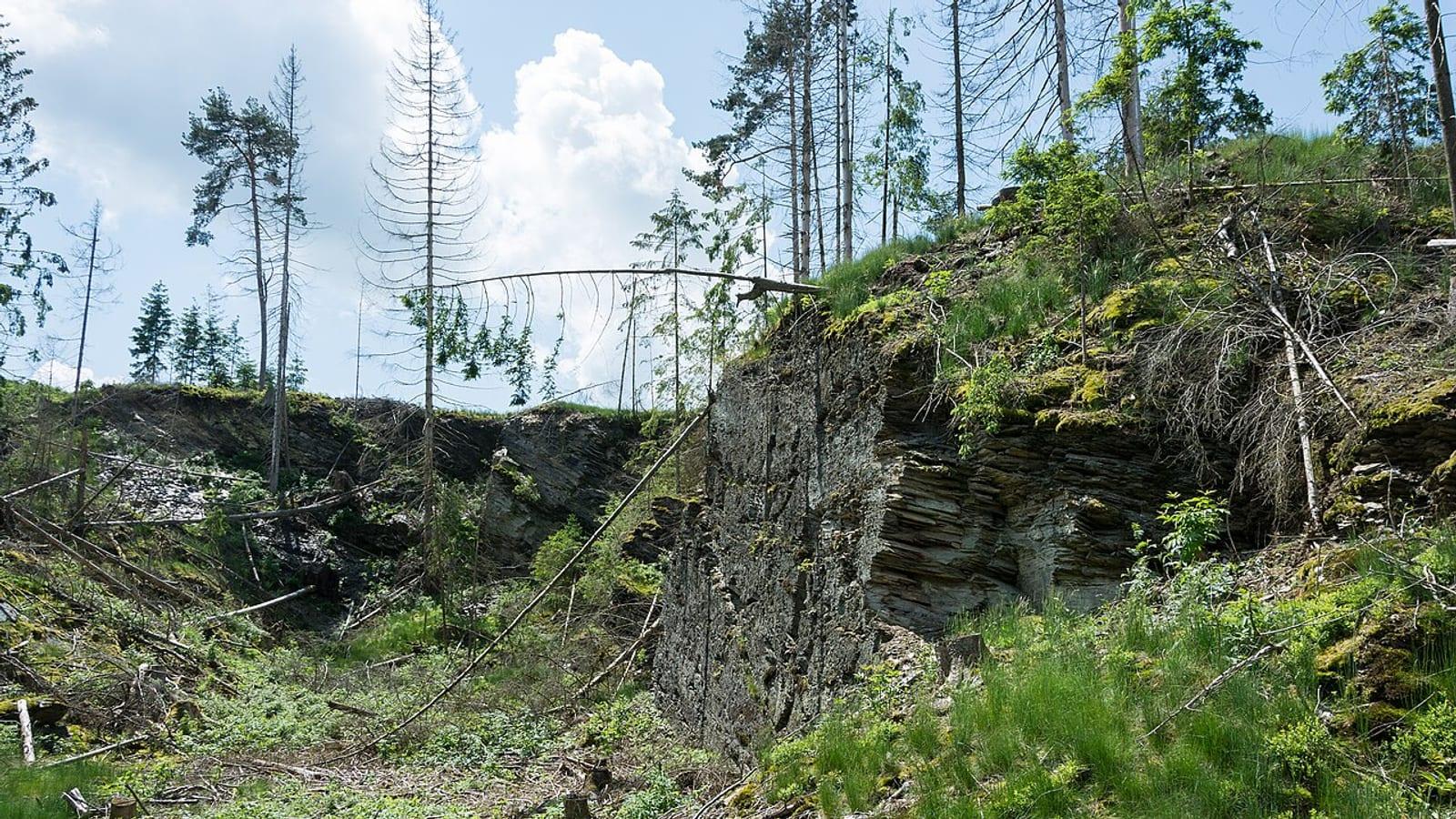
Schieferbruch Kromer Ohmden Posidonia Shale Fossil Hunting Guide
Image: Namenloser Hobbyhistoriker (CC BY-SA 4.0)
Fee-based Posidonia Shale fossil collecting at Schieferbruch Kromer, Ohmden, Baden-Württemberg. Ammonites, belemnites, ichthyosaur bones from a Toarcian Lagerstätte.
By Edward Chen · Updated 4 August 2026
Introduction
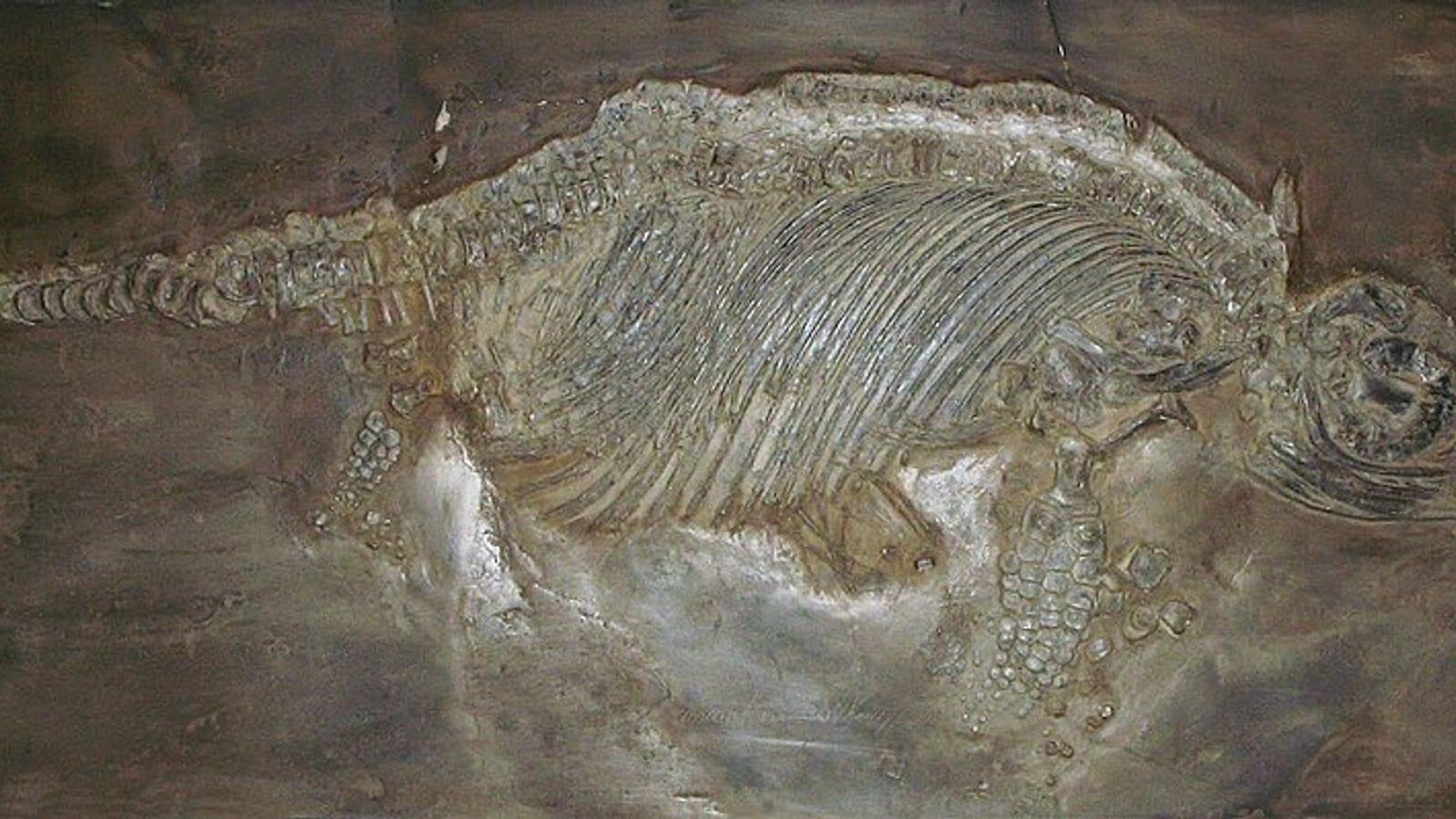
The black shale exposed at Schieferbruch Kromer in Ohmden preserves 182 million years of deep-sea history from the Early Jurassic. This is the Posidonia Shale, a Lagerstätte whose most celebrated residents, complete ichthyosaurs, plesiosaurs, and marine crocodiles preserved with skin outlines intact, are displayed in museums from Stuttgart to London to Tokyo. The Kromer quarry gives amateur collectors access to fresh exposures of this same formation, where ammonites and belemnites are regular finds, bivalves and crinoid fragments occur throughout the shale, and occasional ichthyosaur vertebrae or rib fragments turn up for the attentive and persistent collector.
The site lies in the Holzmaden-Ohmden area of Kirchheim unter Teck district, Baden-Württemberg, close to the Urwelt-Museum Hauff, the specialist museum that holds the finest single collection of Holzmaden fossils anywhere in the world. Access to the Schieferbruch Kromer is fee-based and seasonally dependent on quarry conditions. Visitors should contact the Urwelt-Museum Hauff before travelling to confirm current availability. This guide covers the site location and directions, the fossils you can expect to find, the geology of the Posidonia Shale, the history of the Holzmaden quarrying tradition, and the current rules and safety requirements.
Location and Directions
Address
Schieferbruch Kromer, Schieferbruchweg, 73099 Ohmden, Kirchheim unter Teck district, Baden-Württemberg, Germany. The quarry is located near the Urwelt-Museum Hauff on the edge of Ohmden village.
Directions
From Stuttgart, take the A8 south-east toward Ulm for approximately 30 km and leave at the Kirchheim unter Teck Ost or Aichelberg exit, then follow local roads to Ohmden. In Ohmden, follow local signs to Schieferbruchweg and the quarry near the Urwelt-Museum Hauff. The museum is clearly signposted within the village. Total driving time from Stuttgart is approximately 50 minutes.
From Munich, take the A8 motorway west past Ulm and leave at the Aichelberg or Kirchheim unter Teck Ost exit, then follow local roads to Ohmden. Total distance is approximately 170 km, taking around 1 hour 45 minutes.
From Tübingen, take the B27 and B28 east for approximately 30 km to the Ohmden area. Parking is available near the quarry entrance. Kirchheim unter Teck railway station is 6 km from Ohmden. Local bus connections cover this route on most days, but check current timetables before relying on public transport.
Contact the Urwelt-Museum Hauff before travelling to confirm the collecting area is open: +49 7023 2873, website: www.urweltmuseum.de.
What Fossils You'll Find
Belemnites are abundant throughout the shale. The cigar-shaped guards preserve well in the black matrix, where they often appear as dense accumulations suggesting mass mortality events. Belemnites are among the easiest finds at the site and a good starting point for less experienced collectors.
Bivalves of the genus Posidonia (now usually placed in Bositra), the genus that gives the formation its name, occur throughout the shale as thin-shelled, concentrically ribbed forms. They are common in specific beds and easily identified once you know what to look for: small, dark, smooth-edged shells crowded together on shale surfaces.
Crinoid fragments occur regularly, including occasional sections of the long stems that form the dramatic crinoid-mat specimens displayed in museums. Complete articulated specimens are rare and scientifically protected, but detached stem sections and columnals appear regularly in working shale.
Ichthyosaur material is genuine but uncommon. Vertebrae, ribs, and isolated bones occur in the collecting area and represent the most prized ordinary find at the site. Any vertebrate material should be documented carefully and, if it appears to be part of an articulated skeleton, must be reported to site staff or the quarry operators. Complete ichthyosaurs are exceptionally rare and would be treated as a significant scientific find.
Fish scales and isolated fish bones appear in the shale and reward careful examination of large split surfaces. Compared to the Solnhofen limestone quarries of the Altmühltal, Posidonia Shale collecting is more physically demanding: the rock is harder, splits in larger sheets, and requires more effort per specimen found.
Geologic History
The Ancient Environment
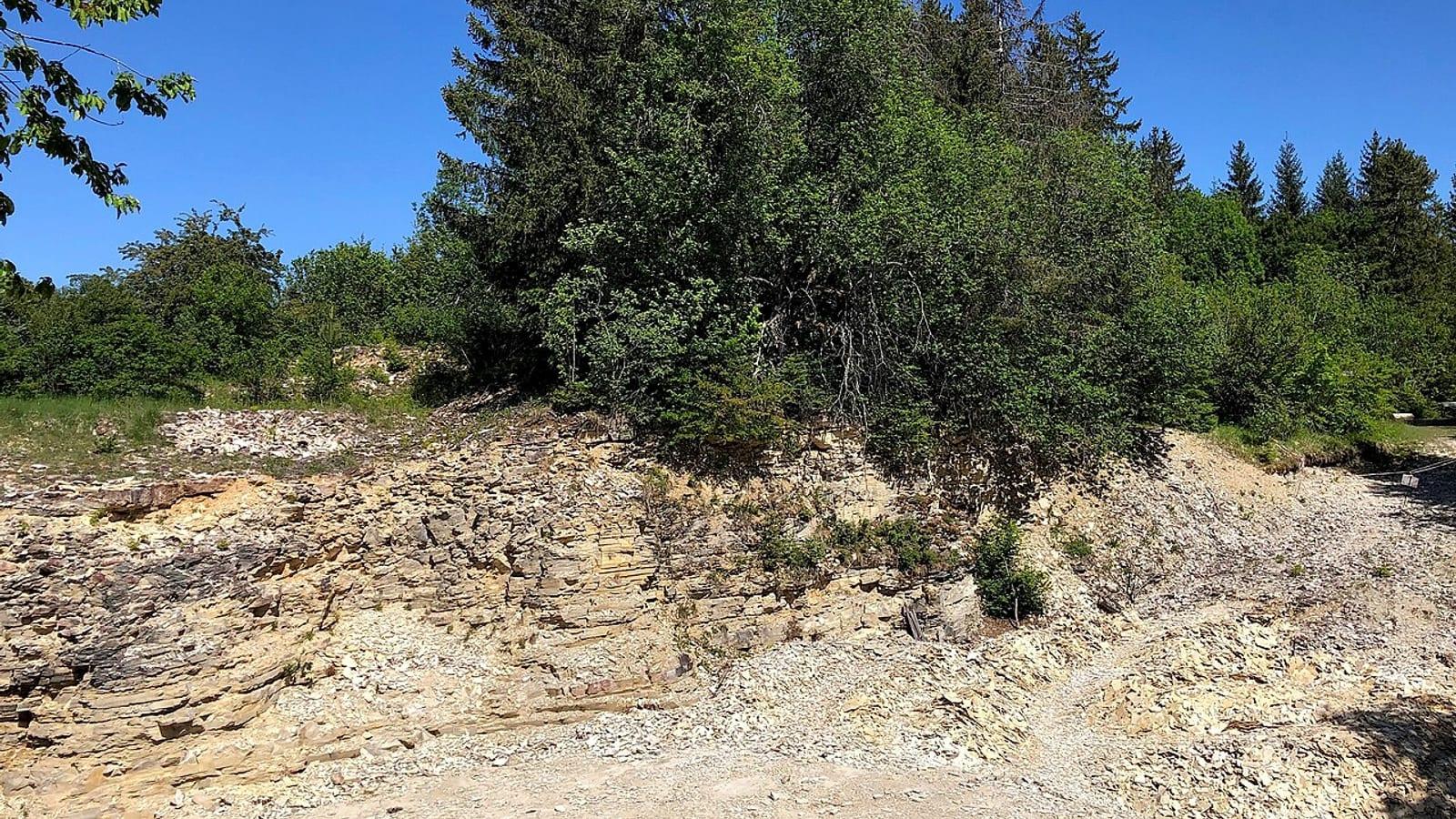
The Posidonia Shale at Schieferbruch Kromer was deposited during the Toarcian Stage of the Early Jurassic, approximately 182 million years ago. The formation is formally known in German as the Posidonienschiefer and in older literature as the Lias epsilon. The rock is a black bituminous oil shale: dark, finely laminated, and rich in organic carbon.
During the Toarcian, the region now occupied by Baden-Württemberg lay beneath a shallow epicontinental sea connected to the Tethys Ocean. The climate was warm temperate. A global warming event in the early Toarcian, the Toarcian Oceanic Anoxic Event, reduced oxygen levels in seawater across much of the world ocean. In the Holzmaden basin, bottom waters became persistently anoxic. No burrowers or bottom-feeding scavengers could survive in these conditions. Organisms that sank to the floor were not disturbed after death: they settled into fine organic mud and were sealed by continuing sedimentation. Ichthyosaurs, plesiosaurs, and marine crocodiles that died in the water column sank slowly into this preserving environment. The result was exceptional: complete skeletons with soft tissue outlines, embryos visible inside adult ichthyosaurs, and stomach contents preserved in place.
The organic richness of the shale later made it commercially attractive as an oil shale, and it was this industrial history that drove the quarrying which now gives collectors access to the fossil beds.
How Schieferbruch Kromer Became a Fossil Collecting Site
Commercial oil shale extraction in the Holzmaden-Ohmden area began in the early 19th century. The bituminous shale yielded petroleum by destructive distillation and was quarried on a significant industrial scale through the 19th and into the early 20th century. Workers encountered well-preserved fossils regularly during operations, and the Hauff family, based in nearby Holzmaden from 1892, developed specialized techniques for preparing and selling fossil material from the formation.
The Hauff Museum, opened in 1936, assembled what remains the world's most important single collection of Holzmaden fossils, including multiple complete ichthyosaur skeletons and the famous crinoid-mat specimens. As petroleum production from oil shale became uneconomical in the mid-20th century, the quarries transitioned to other uses. The Schieferbruch Kromer continued operating as a collecting locality for visitors, providing access to fresh shale exposures in the Ohmden section of the formation. The site is run in coordination with the Urwelt-Museum Hauff, which provides the primary contact point for visitor access information.
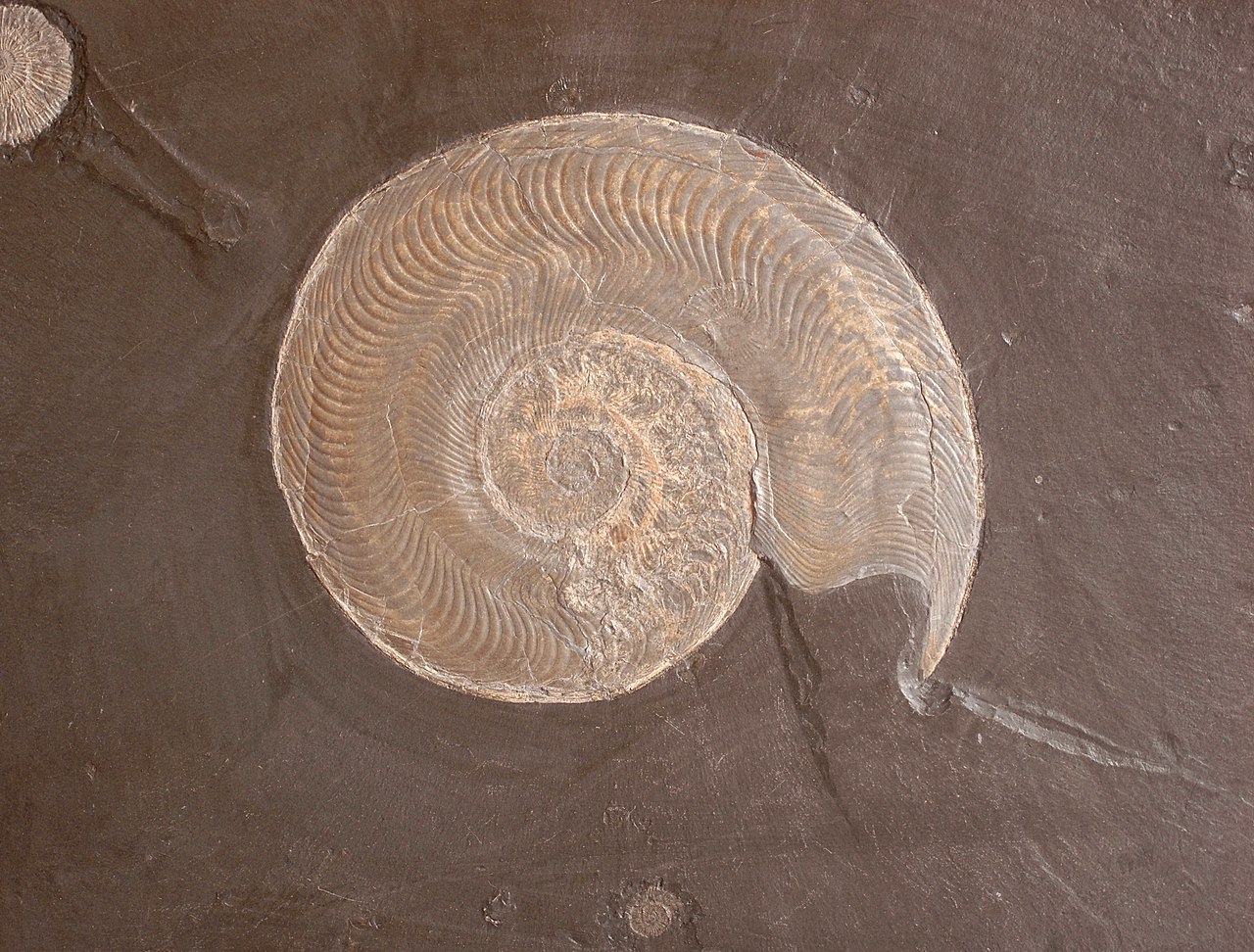 Photo: Lysippos, CC BY-SA 3.0, via Wikimedia Commons

Collecting Rules and Regulations
Is Fossil Collecting Allowed?
Yes, Schieferbruch Kromer allows fee-based fossil collecting for visitors during the operating season, which runs approximately April to October and is subject to quarry conditions and weather. Advance contact is strongly recommended before visiting, as hours and availability vary and the site does not maintain fixed public opening hours in the way that the Altmühltal Besuchersteinbrüche do.
- Open approximately April to October. Hours variable, contact before visiting
- Admission: adults typically €5–8, children reduced rates, exact current fees confirmed by phone
- Contact Urwelt-Museum Hauff: +49 7023 2873, website: www.urweltmuseum.de
- Visitors must bring their own tools. No rental available at the quarry
- Safety glasses are required. Gloves strongly recommended (shale is sharp and contains oil residue)
- Fresh Posidonia Shale provided in the collecting area
- Ammonites and belemnites common. Vertebrate material occasional
- Significant vertebrate finds (articulated bones or partial skeletons) must be reported to site operators
- Better suited to experienced collectors than absolute beginners due to the physical nature of shale splitting
Under Baden-Württemberg state heritage law, scientifically significant fossils are subject to reporting and potentially to state ownership claims. The site operators will advise on any specific find if asked.
Recommended Tools
You must bring all tools from home. No rental is available at the quarry. Posidonia Shale splits in larger, heavier sheets than Solnhofen limestone, and a heavier hammer (1.5–2 kg) with robust flat chisels is more effective than the lighter kit used at plattenkalk sites. Safety glasses are non-negotiable. Shale chips are extremely sharp and fly at unpredictable angles. Gloves are strongly recommended: fresh shale has sharp edges and the oil content stains hands and clothing. Bring a spray bottle, a stiff brush, and newspaper or cardboard for wrapping specimens. The black shale makes fossil outlines easier to see when wetted. Old clothing is sensible, as the oily shale leaves marks that do not wash out easily.
Safety
Wear safety glasses throughout your time in the working area without exception. Shale chips are sharp and travel fast. Gloves protect against lacerations from fresh-split edges and reduce exposure to the oil residue in the rock. The quarry surface can be uneven and slippery, particularly when wet. Boots with ankle support and good grip are essential. Shale becomes slippery when it rains: exercise caution on any incline or step. Keep children actively supervised. Do not work near or under overhanging shale faces. Follow all posted signs and any instructions from site staff or the quarry operators.
Sources
Nearby sites
 Urweltsteinbruch Holzmaden Posidonia Shale Fossil Hunting GuideAmmonites, Ichthyosaur
 Werkforum Dotternhausen Fossil Hunting GuideAmmonites, Belemnites
 Schiefererlebnis Dormettingen Fossil Klopfplatz Fossil Hunting GuideAmmonites
 Nusplingen Plattenkalk Museum Fossil Klopfplatz Fossil Hunting Guideangel sharks, pterosaurs