France Fossil Sites Guide
6 Best Fossil Sites in France
France is a looking country more than a collecting one, and one of these six sites changed category in September 2026. A new national nature reserve closed the Vaches Noires cliffs in Normandy to collectors, which leaves Cap Blanc-Nez on the Opal Coast as the only site here where a visitor may pick anything up, and only by hand from loose beach material. The other four are a ticketed trackway at Plagne, a research excavation at Angeac-Charente that admits observers in July, and two free roadside and hillside sites inside the Réserve Naturelle Géologique de Haute-Provence. What they share is rock in place: 1,550 ammonites on one tilted slab, an ichthyosaur still in its marl, and 155 m of sauropod footprints.
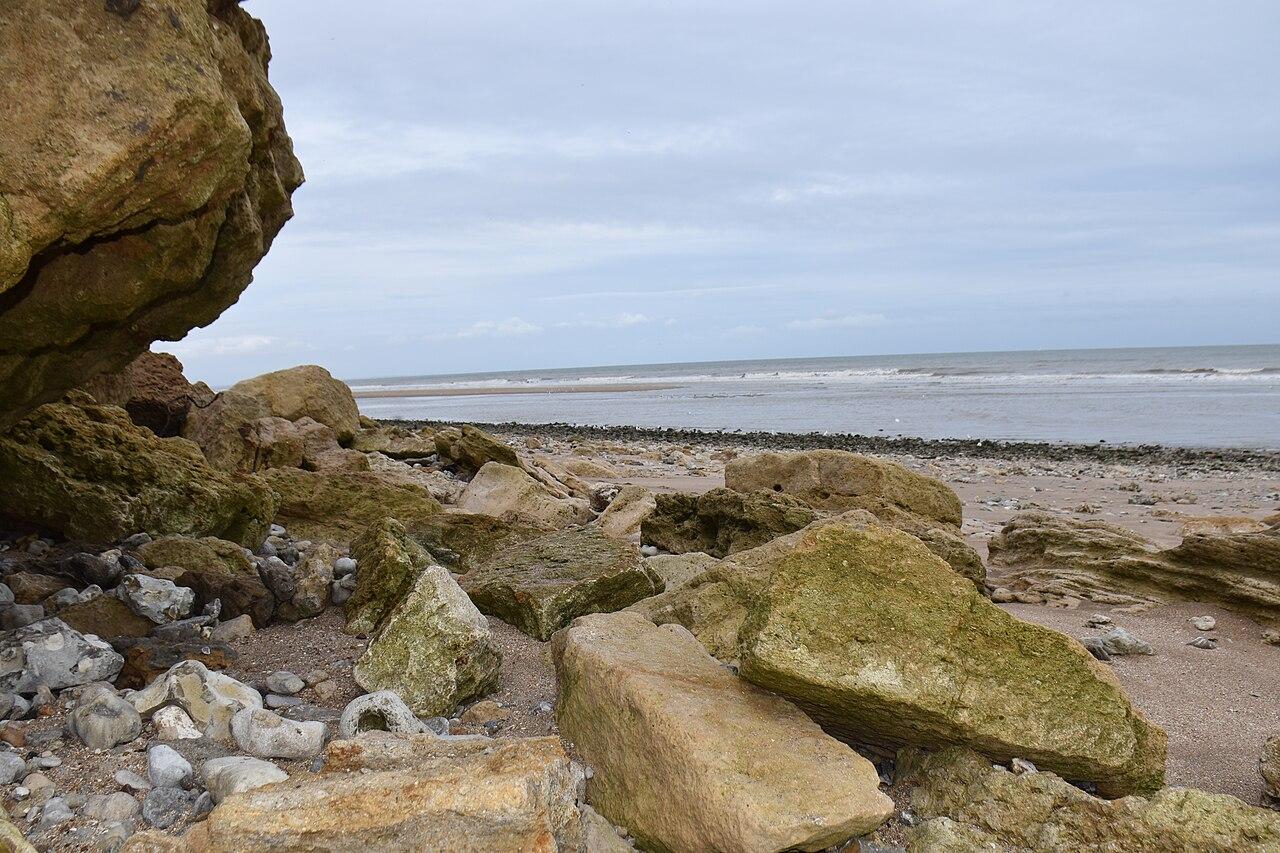
6 fossil sites
Updated 1 October 2026
Northern shelf seas and an Alpine tilt
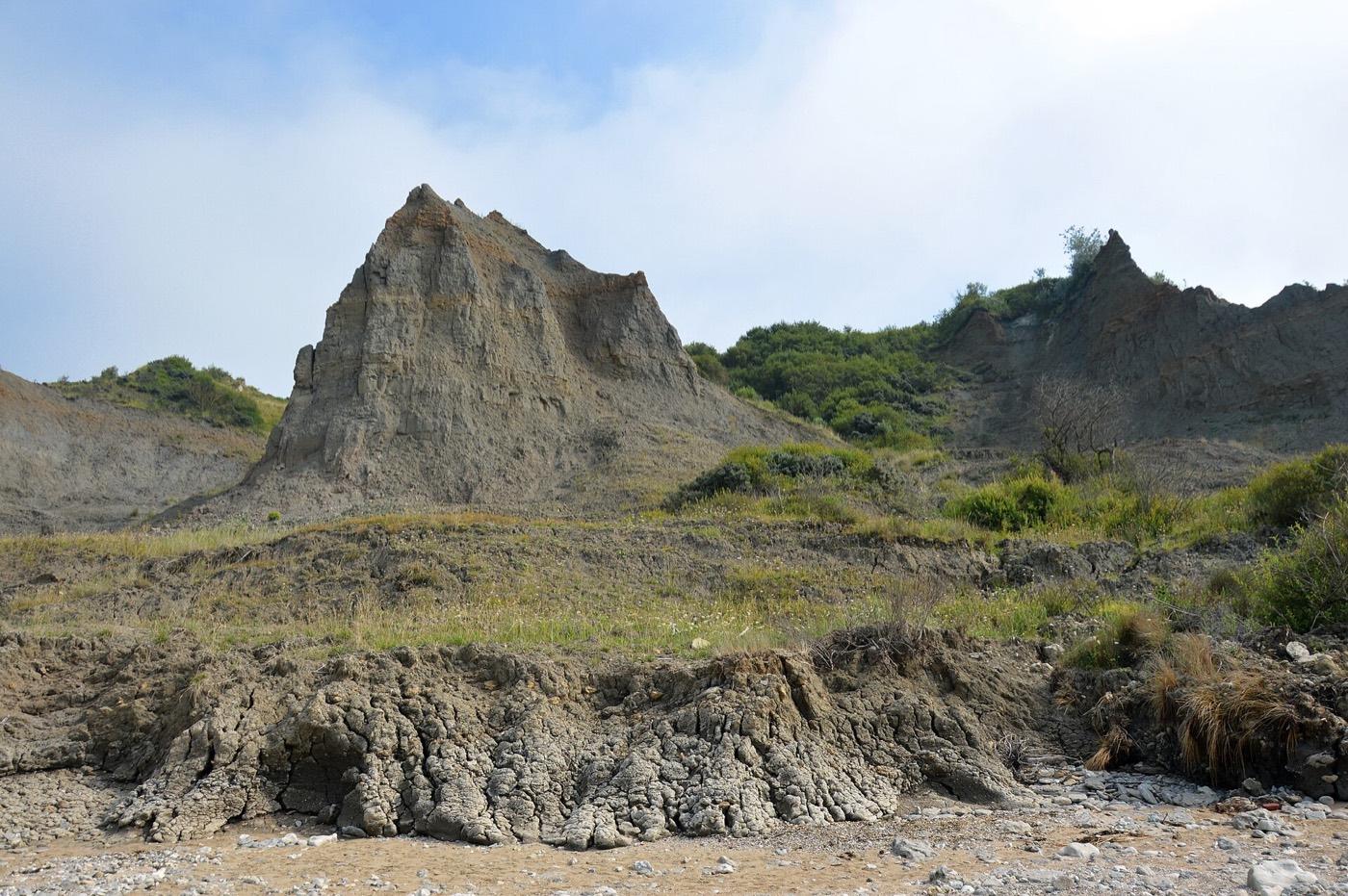
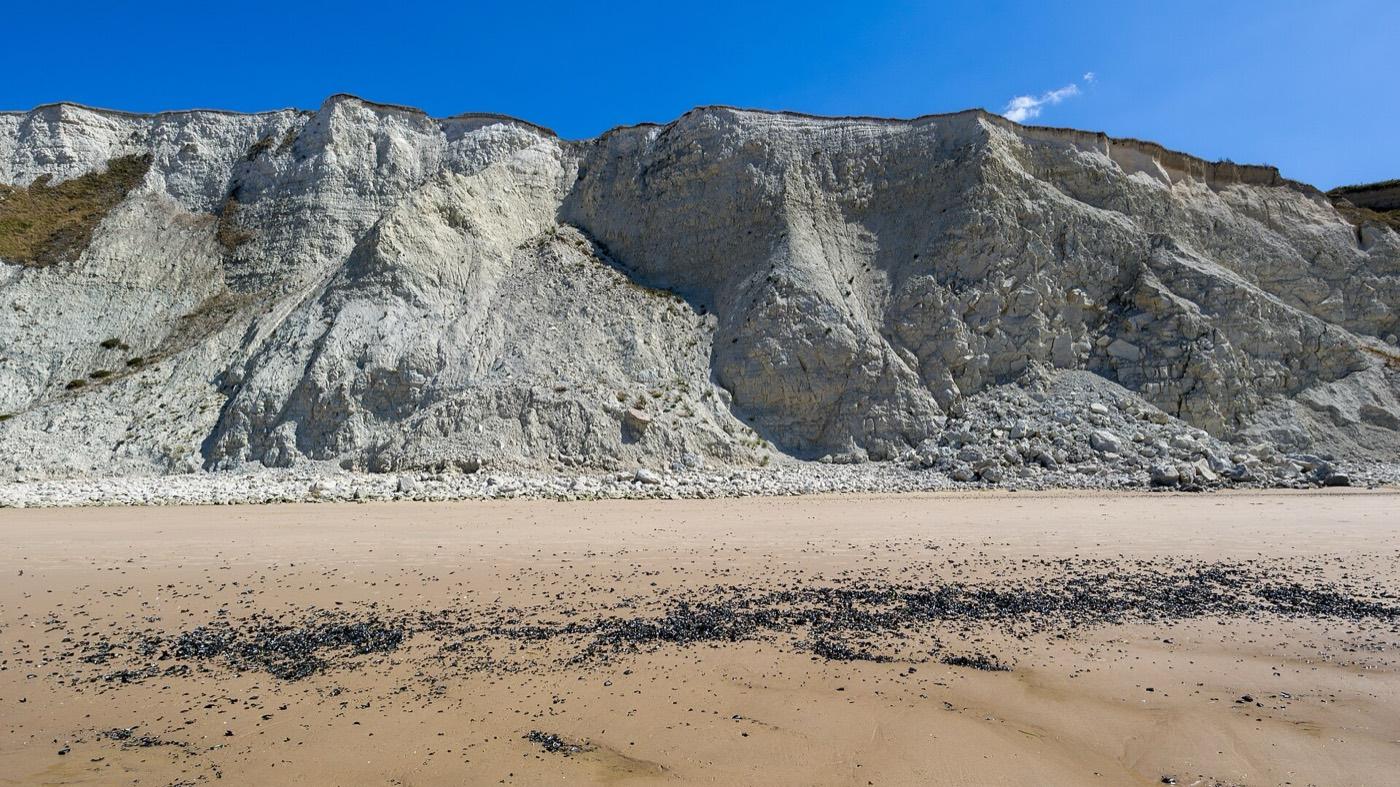
The two northern sites were both shallow shelf seas, separated by about 65 million years and by the rock each left behind. At the Vaches Noires the sequence runs from the upper Callovian, around 163 million years ago, into the middle Oxfordian, around 160 million. The lower part is the Marnes de Dives, the unit known for its vertebrate content, overlain by the lowermost Oxfordian Marnes de Villers. Those clays are soft, they hold water, and they sit on a coast under active marine attack, which produces the continuous slumping that keeps the foreshore supplied. Cap Blanc-Nez is the French side of the chalk that forms the white cliffs at Dover, described bed by bed as a reference section for the Cenomanian in northern France, from the glauconitic Formation de Strouanne at the base to nodular chalk at the top. Two meters of that section, the Formation des Crupes or Plenus Marls, record the global crash in ocean oxygen at the Cenomanian and Turonian boundary, which is why the cliffs appear so often in the international literature.
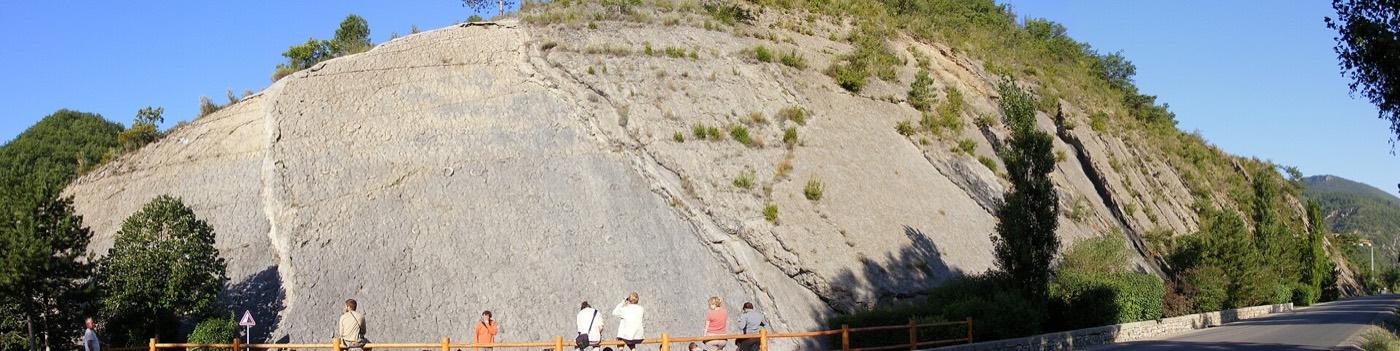
The southern sites record the same sediments lifted into mountains. The limestone of the Dalle aux Ammonites formed in the Sinemurian, roughly 200 to 196 million years ago, as a flat seafloor, and the collision between the African and European plates crushed, tilted and raised it into the slab that now stands at 60 degrees above the Barles road. The marls that hold the La Robine ichthyosaur are Toarcian, about 185 million years old, and their fine grain is why the animal survives articulated rather than as scattered bone. Quiet water and rapid burial keep a carcass together. Further north at Plagne, early Tithonian limestone of the Jura carbonate platform preserves a protected littoral mudflat, where prints dried, the sea returned to fill them with sediment, and the fill hardened. The Angeac bonebed is younger again, Berriasian at roughly 140 million years, and it formed on a river floodplain where waterlogged, oxygen-poor lignite stopped the bacteria that normally destroy bone and wood. The conditions that preserved the site are the conditions that flood it for eleven months a year.
- 1
Falaises des Vaches Noires Fossil Hunting Guide
Calvados, Normandy, France
Viewing onlyAmmonitesEchinoidsNautiloidsThe Vaches Noires are 4.5 km of slumped Jurassic clay and marl between Villers-sur-Mer and Houlgate in Calvados, and the instability is the point. Material slides toward the sea continuously, so what lies on the foreshore has usually been released by the last few tides rather than dug out by anyone. Ammonites are the staple, weathering out pyritized or calcitic, with echinoids, nautiloids, belemnites and bivalves alongside them, and the vertebrate-bearing Marnes de Dives have produced plesiosaur and ichthyosaur bone plus a mid-Jurassic bony fish assemblage described in PLOS ONE in 2026. A decree of 2 September 2026 created the réserve naturelle nationale des falaises jurassiques du Calvados, in force from 10 September 2026, and it forbids extracting or removing fossils, rock, sand and concretions across roughly 1,900 hectares, foreshore included. Go to look, work a falling tide from Villers-sur-Mer, and take anything puzzling to the Paléospace museum in the town for identification.
Read the full guide → - 2
Cap Blanc-Nez Fossil Hunting Guide
Pas-de-Calais, Hauts-de-France, France
Free collectingAmmonitesBelemnitesEchinoidsCap Blanc-Nez is the only site in this guide where a visitor may take a fossil home, which is why it ranks second despite a shorter species list than the Normandy clays. The cliffs carry 70 to 75 m of Cenomanian and Turonian chalk, and at low water the foreshore exposes older Albian clay with a different assemblage, so one visit covers two environments. Echinoids and belemnites are the most consistent finds, the echinoids often preserved as flint internal molds rather than shell. A prefectoral order made under the decree of 23 December 1987 prohibits mechanical extraction and heavy tools, named as pickaxe, spade and hammer, on the beach as well as the cliff, and a geologist's hammer needs prefectoral authorization. Hand collection of material that erosion has already exposed on the beach is tolerated, so leave the tools in the car, work the loose debris, and never dig the cliff.
Read the full guide → - 3
Dalle aux Ammonites, Digne-les-Bains Fossil Hunting Guide
Alpes-de-Haute-Provence, France
Viewing onlyAmmonitesNautiloidsThe Dalle aux Ammonites is one bedding plane, and everything worth the trip is on that single surface: more than 1,550 cephalopods across about 320 square meters of grey limestone, the largest shells about 70 cm in diameter. One ribbed, loosely coiled ammonite species accounts for the great majority, which points to a mass death or a current that gathered floating shells rather than slow background accumulation. Alpine collision has tilted the slab to about 60 degrees from horizontal, so the site demonstrates seafloor and mountain building at once. Access is free all year from a roadside pull-in with an interpretation panel on the D900A, 3 km north of Digne-les-Bains, with no gate, ticket or booking. It sits inside the Réserve Naturelle Géologique de Haute-Provence, where fossils stay where they lie, so this is a half-hour stop for a traveler rather than a collecting site.
Read the full guide → - 4
Dinoplagne Fossil Hunting Guide
Ain, Auvergne-Rhône-Alpes, France
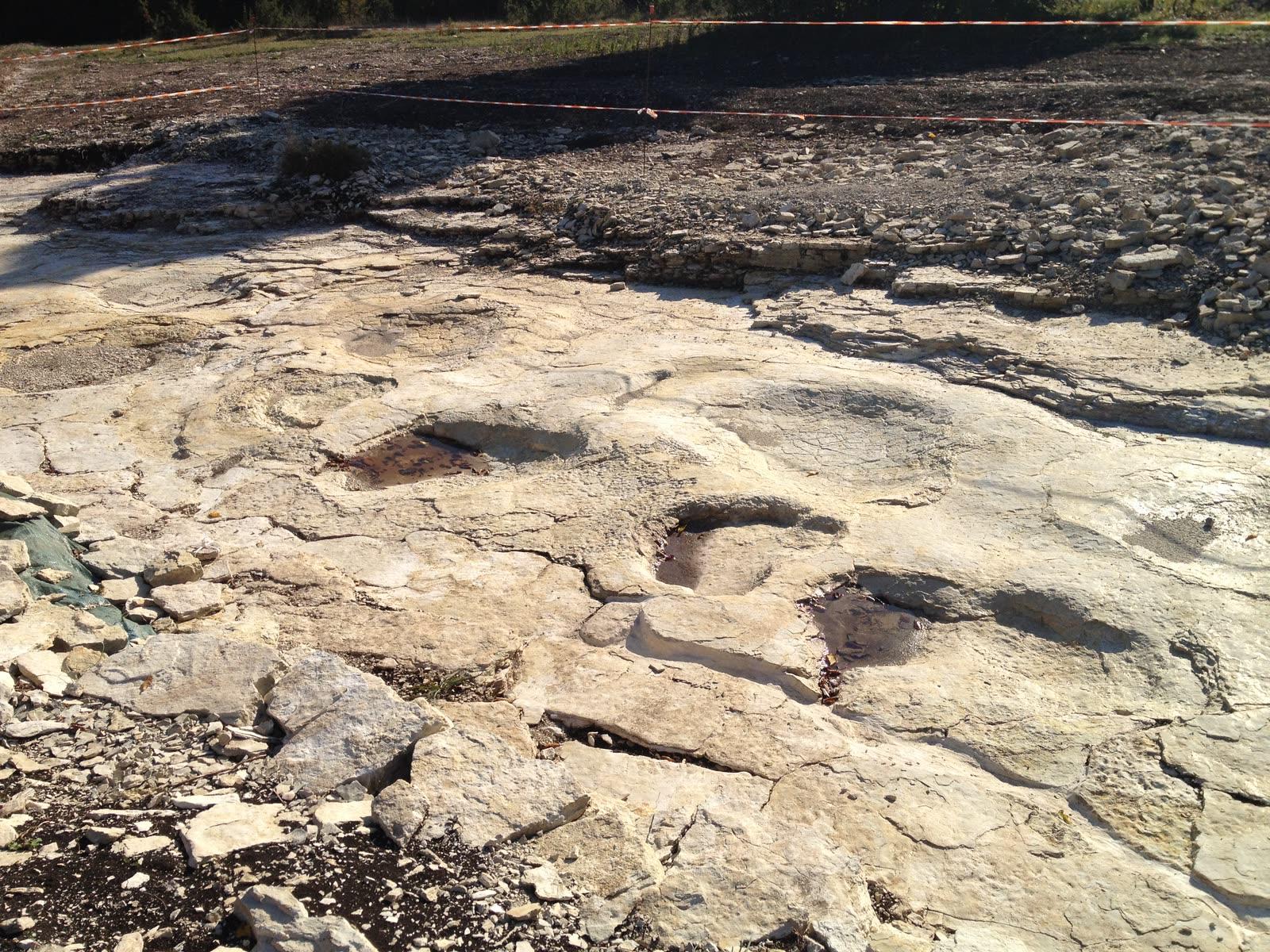
Pay to digSauropod trackwayBrontopodus plagnensisTheropod trackwayDinoplagne protects the longest sauropod trackway known anywhere, 155 m of it excavated across 110 successive paces in the southern Jura. The pes prints measure 94 to 103 cm long and reach 3 m across once the rim of displaced mud is counted, and the 2017 biometric analysis in Geobios puts the trackmaker at no less than 35 m long, 35 to 40 metric tons, walking at about 4 km per hour. A second trackway, 38 m and 18 paces, belongs to a theropod the CNRS describes as roughly 9 m long. This is the one fee site in the guide: 12 euros for an adult booked online and 14 at the gate in 2026, children 5 to 12 at 8 or 9 euros, under fives free, with the season running from early April to the end of October. You walk a path to a wooden canopy over the prints, so book online, allow about two hours, and note that the site is not wheelchair accessible.
Read the full guide → - 5
Angeac-Charente Dinosaur Dig Fossil Hunting Guide
Charente, Nouvelle-Aquitaine, France
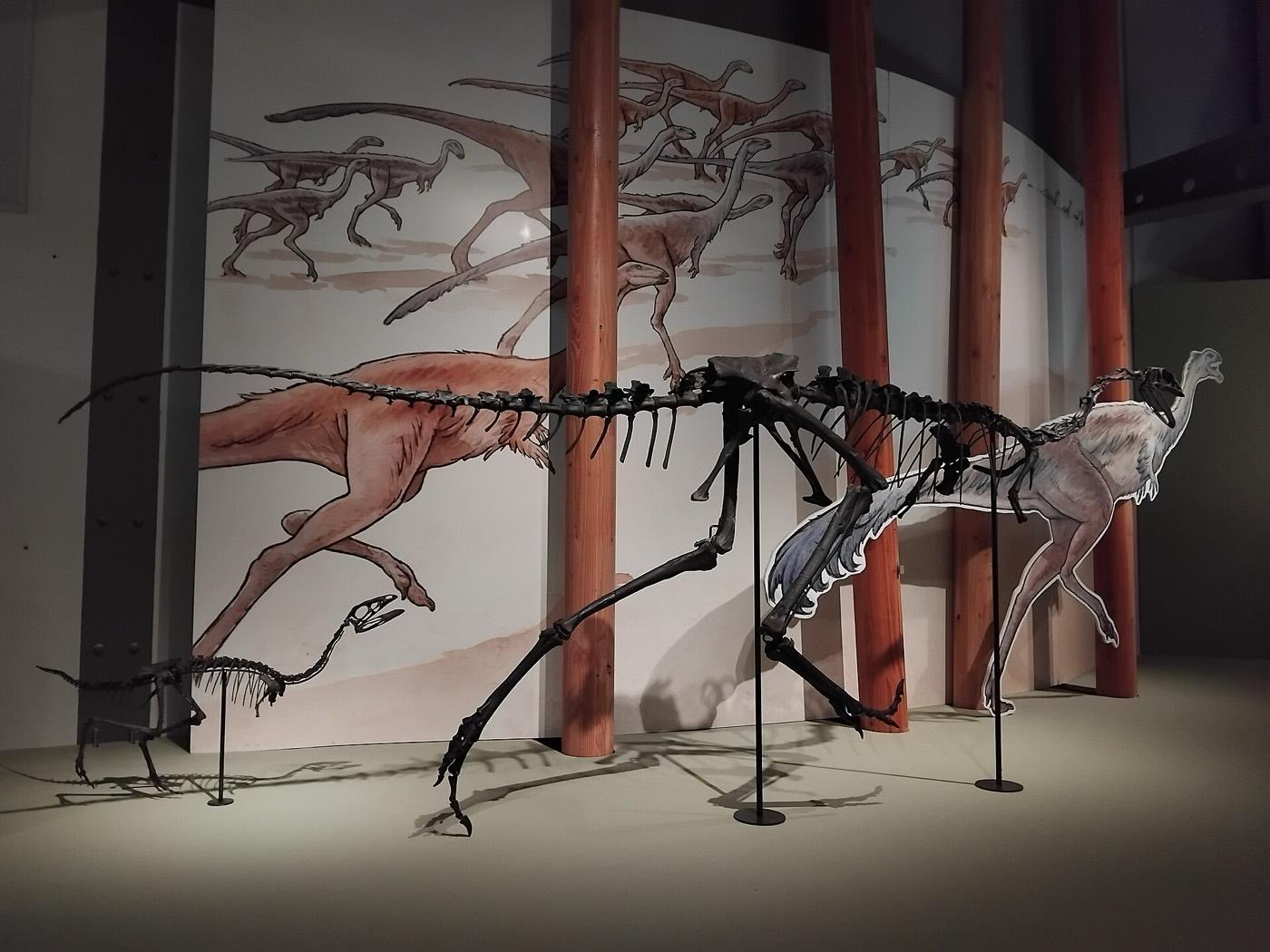
Guided toursDinosaursSauropodsTheropodsAngeac-Charente is an active research excavation that opens its gates for a few weeks each summer, and the timing is forced by water rather than convenience. The bonebed lies in gravel quarries on the bank of the Charente below the water table, and July is when it can be pumped dry and dug. Found in 2008 and worked every summer since 2010, it has produced thousands of fossils and published counts of 38 or 39 vertebrate taxa, including a herd of ornithomimosaurs recovered together and sauropod material among the largest recorded from Europe. Visits in 2026 run during the 8 to 22 July campaign at 10:30 and 14:30, reservations are mandatory, and numbers are limited because this is a scientific work site first. You attend as an observer and collect nothing, with the open-air discovery area nearby as the fallback if the slots have gone.
Read the full guide → - 6
Ichthyosaur of La Robine Fossil Hunting Guide
Alpes-de-Haute-Provence, France
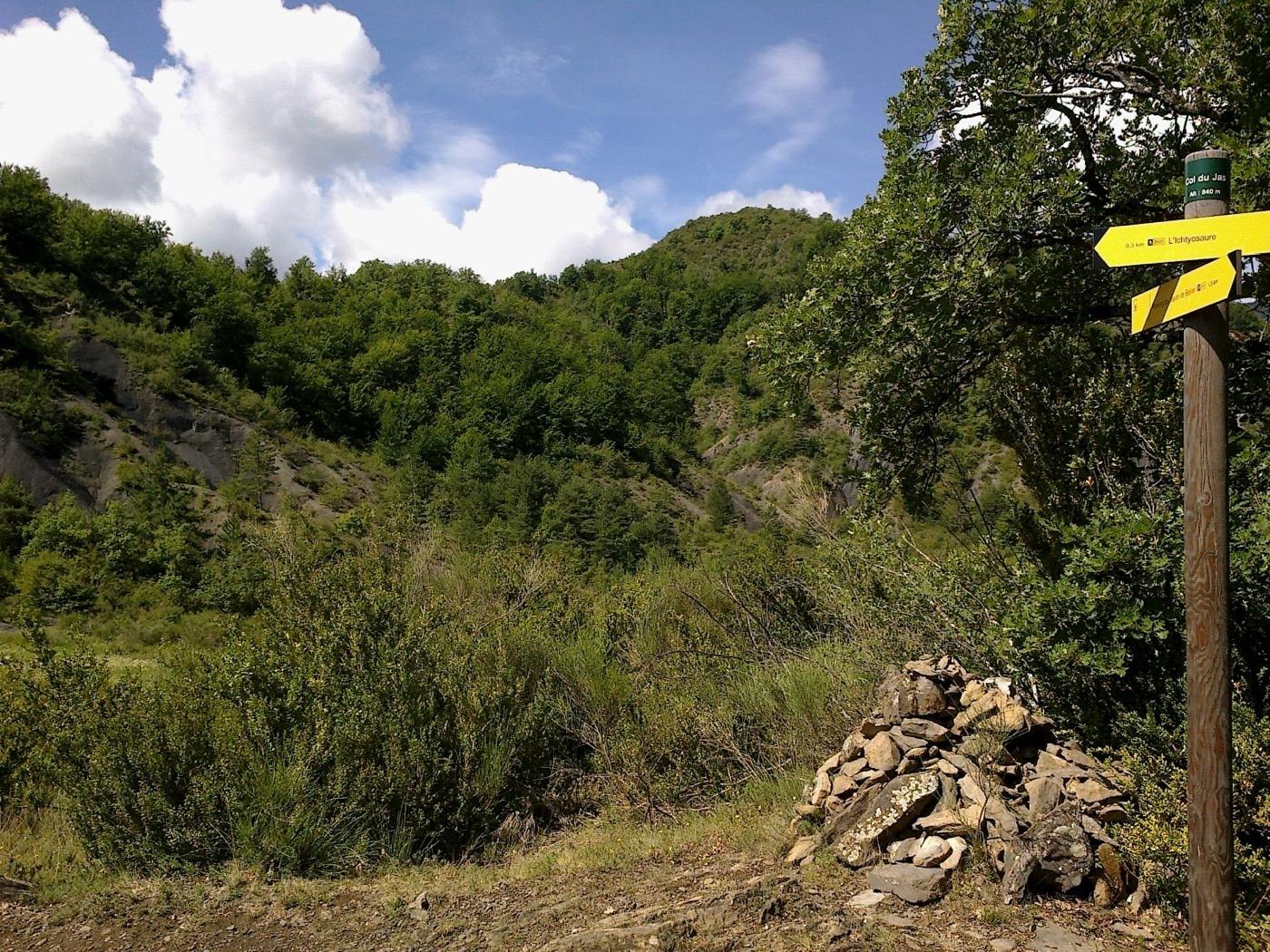
Viewing onlyMarine reptilesAmmonitesMost ichthyosaurs a visitor can look at sit cleaned and mounted in a gallery. This one, close to complete and about 4 m long, is still in the Toarcian marl it died in on a hillside above La Robine-sur-Galabre, laid out as it came to rest about 185 million years ago. Reaching it means a marked round trip of 4.3 km with roughly 190 m of ascent, about an hour and a half at a steady pace, graded easy and open all year with no ticket and no attendant. The reserve chose protection through display over excavation, and built shelter over the specimen in 2018, so do not touch it and do not wet or brush the surface for a photograph. Pair it with the Dalle aux Ammonites and the Vélodrome fold on the same drive north from Digne.
Read the full guide →
Planning your visit
When to visit
Three different calendars apply. The coastal pair answers to the tide: check a tide table for Villers-sur-Mer or Escalles, start on a falling tide, and keep a clear route back, because the Vaches Noires foreshore floods against the cliff and there is no way up through the slumps. Angeac-Charente runs in July alone, with the 2026 campaign from 8 to 22 July, and the dates move each year with the water level and the research program. Dinoplagne opens from early April to the end of October and closes for the winter, with hours that differ between the Ain and Pays de Gex tourist listings, so telephone or download the current flyer before you travel. The Dalle aux Ammonites and the La Robine walk stay open all year, but the Barles road can carry ice and the Col du Jas holds snow, so check conditions before driving up from Digne.
What to bring
Boots with grip, at all six. The Vaches Noires foreshore is soft clay that turns greasy when wet, the descent to Cap Blanc-Nez through the Cran d'Escalles dry valley is steep and slick in rain, the Digne slab is smooth limestone, the La Robine marls are slippery and the Angeac pit floor is pumped mud. Leave the hammer behind: Cap Blanc-Nez prohibits it without prefectoral authorization and the other five prohibit collecting outright. Take a tide table and a phone for the two coastal sites, and tell someone your route, because mobile coverage is unreliable along the Calvados cliff base and patchy in the Bélier ravine. Carry water, a hat and sun cover for Angeac in July and for the unshaded sections of the La Robine path. Bring your Dinoplagne booking confirmation, and expect wind off the Channel at Blanc-Nez to be rougher on the cliff top than it looks from the car park.
Rules and access
France regulates its fossil sites locally, so the rule changes with the designation rather than following one national code. Two of these sites lie inside the Réserve Naturelle Géologique de Haute-Provence, created in 1984, which protects 18 sites totaling about 270 hectares within a perimeter of roughly 230,000 hectares across 59 communes, and in that designation fossils stay where they lie. The Vaches Noires joined a national nature reserve in September 2026 under a decree that forbids removing fossils, rock, sand and concretions, foreshore included. Dinoplagne is a ticketed site on an Espace Naturel Sensible, managed by Terre Valserhône, where the tracks sit under a canopy and visitors keep to the path. Angeac-Charente is a research excavation owned by the Département de la Charente. Only Cap Blanc-Nez allows any collecting, under a prefectoral order that bans mechanical extraction and heavy tools and tolerates hand collection of already eroded beach material. A separate inter-prefectoral biotope order of 26 March 2021 protects the seabird colony there and bans cliff climbing, free flight and drones from 1 January to 31 August, with no fossil provision at all.
Getting there
The six split into three clusters, and none of them pairs easily with another. For the Vaches Noires, park in Villers-sur-Mer in Calvados, walk down to the beach and head east toward Houlgate, where the productive ground starts beyond the sea wall and the groynes. Cap Blanc-Nez sits near Calais: take Rue de la Mer in Escalles, follow the track along the field edge to the car park, then descend through the Cran d'Escalles, which is also the way back up. Arrive early on fine weekends, because both Blanc-Nez and Gris-Nez fill and drivers end up on the main road. For the two Haute-Provence sites, base yourself in Digne-les-Bains: the ammonite slab is 3 km north on the D900A with a roadside pull-in, and the signed La Robine trailhead lies further up the same valley. Plagne is in the southern Jura at 1 lieu-dit Sur la Croix on the RD 49, with free parking for cars, motorbikes and coaches. Angeac-Charente is about 20 km east-south-east of Cognac, and visits meet either at the former village school on the Route des Bergeries or at the dig 1.7 km away, so confirm the meeting point when you book.
These six are every French site documented here so far. Browse the full index of French fossil sites for the current list, which grows as new localities are researched and published.
Frequently asked questions
- Can you collect fossils in France at these sites?
- At one of the six, within limits. Cap Blanc-Nez tolerates hand collection of material that erosion has already exposed on the beach, while prohibiting mechanical extraction and heavy tools including a hammer. Everywhere else in this guide, collecting is prohibited. The Vaches Noires foreshore came inside a national nature reserve on 10 September 2026. The Dalle aux Ammonites and the La Robine ichthyosaur sit inside the Réserve Naturelle Géologique de Haute-Provence, where fossils stay where they lie. Dinoplagne shows its trackway under a canopy from a viewing path, and Angeac-Charente is a working excavation where all material is recovered under the direction of the Musée d'Angoulême.
- Is it still legal to collect at the Vaches Noires cliffs?
- No. A decree of 2 September 2026 created the réserve naturelle nationale des falaises jurassiques du Calvados, which came into force on 10 September 2026 and covers about 1,900 hectares across some 37 km of coast and two dozen communes. The decree forbids extracting or removing fossils, rocks, sand, minerals and concretions from the ground or subsoil of the reserve, and it covers the foreshore out to the low-water line. Exceptions exist only for authorized scientific and educational work, with no general exception for a visitor picking up a loose ammonite. Most guidance online predates the decree and describes the old position, so treat anything written before September 2026 with care.
- Which French fossil sites are free to visit?
- Four of the six. Cap Blanc-Nez, the Dalle aux Ammonites and the La Robine ichthyosaur all have free open access with no booking, and the Vaches Noires foreshore is a public beach walk from Villers-sur-Mer. Dinoplagne charges admission, 12 euros for an adult booked online in 2026 and 14 at the gate, and it is the only ticketed site here. Angeac-Charente cannot be visited independently at all, and its July guided visits must be reserved through the Cognac tourist office or the Grand Cognac agglomération. Parking is free at Dinoplagne and at the Escalles car park for Cap Blanc-Nez, although the latter fills on fine weekends.
- Can you dig at Angeac-Charente?
- No. Angeac-Charente is a scientific excavation on land owned by the Département de la Charente, and visitors attend as observers on a guided visit in July. Follow the instructions of the excavation staff, keep to the marked routes and stay out of the working faces, which are wet, muddy and uneven because the pit is dug below the water table and pumped. French law treats paleontological material of scientific interest as heritage, so removal from a research excavation is not a grey area. Finds are curated by the Musée d'Angoulême, and material from Angeac has also been displayed at the Muséum national d'Histoire naturelle in Paris, which is a way to see the fossils outside July.
- When is the best time to visit?
- It depends which part of France you want. The two coastal sites answer to the tide, not the season: check a tide table for Villers-sur-Mer or for Escalles, start on a falling tide, and know your route back, because the Vaches Noires foreshore floods against the cliff and the Albian clay at Cap Blanc-Nez is reachable only at low water. Angeac-Charente is July only, and the 2026 campaign ran from 8 to 22 July. Dinoplagne opens from early April to the end of October and closes in winter. The Dalle aux Ammonites and the La Robine ichthyosaur are open all year, but the Barles road can carry ice and snow and the Col du Jas holds snow in winter, so check conditions before driving up from Digne.
Recommended resources
- Paléospace, Villers-sur-Mer · The museum at the western end of the Vaches Noires, which holds material from the cliffs and is the best place to have a find identified.
- Géoparc de Haute-Provence · The UNESCO Global Geopark covering the Dalle aux Ammonites, the La Robine ichthyosaur and the other 16 protected sites of the geological reserve.
- Dinoplagne · Official site for the Plagne trackway, with the current season, prices and the online booking that guided tours require.
- Destination Cognac: the Angeac-Charente site · Visitor information and reservations for the July excavation visits, run with the Grand Cognac agglomération.