Dinoplagne Fossil Hunting Guide
Image: Mfrays (CC BY-SA 3.0)
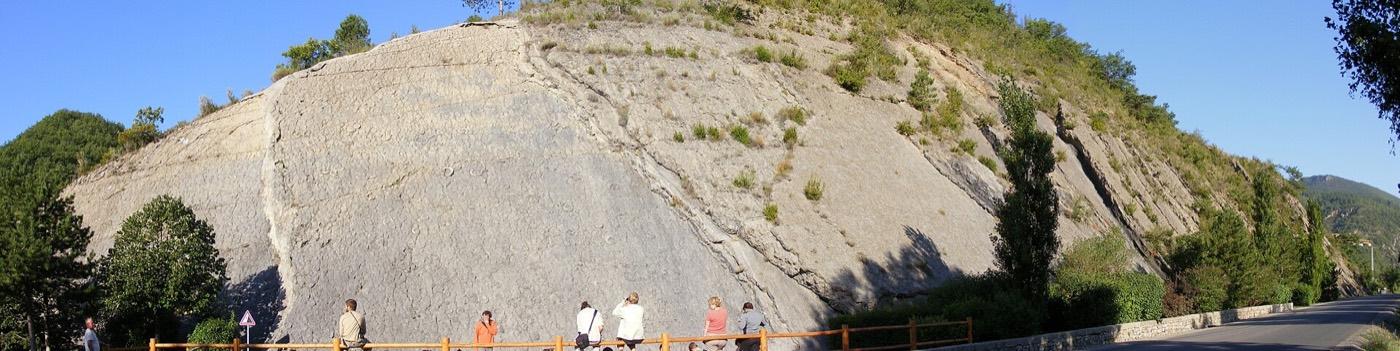
Dinoplagne in Plagne, Ain, protects the longest known sauropod trackway, 155 m of Late Jurassic prints from the early Tithonian. Entry is paid, the site opens from April to October, and online booking is advised.
By Edward Chen · Published 1 October 2026
Introduction
Dinoplagne is a paid visitor site at Plagne, in the Ain department of southeastern France. It protects the longest sauropod trackway known anywhere. Researchers excavated 155 m of it. The trackway has 110 successive paces.
Members of the Société des naturalistes d'Oyonnax found the first prints in 2009. Researchers from the Laboratoire de Géologie de Lyon excavated the site from 2010 to 2012. More campaigns ran until 2015. The meadow that holds the tracks covers about three hectares.
Mazin, Hantzpergue and Olivier described the site in 2017 in the journal Geobios. They named the sauropod ichnospecies Brontopodus plagnensis. The site also holds a theropod trackway.
This is a viewing site. You walk a path to a wooden canopy over the tracks. You do not collect. The pages below cover the 2026 season, prices and booking.
Location and Directions
The address is 1 lieu-dit Sur la Croix, on the RD 49, 01130 Plagne. The listed coordinates are 46.1892°N, 5.7151°E. Plagne lies in the southern Jura massif. A free car park serves cars, motorbikes and coaches.
The Ain tourism office gives the season as 6 April to 30 October in 2026. The Pays de Gex office gives 1 April to 31 October. Plan for early April to the end of October. The site closes in winter.
Opening days and hours differ between sources. The Ain tourism office gives 10:00 to 16:30 or 10:00 to 18:00, depending on the date. It also lists Wednesday to Sunday, 10:00 to 18:00, for July and August. The Pays de Gex office lists Monday to Friday, 10:00 to 16:30. Download the 2026 flyer from dinoplagne.fr or telephone +33 4 50 48 48 68 before you travel.
The 2026 tickets are 12 euros for an adult when you book online and 14 euros at the gate. A child from 5 to 12 pays 8 euros online and 9 euros at the gate. Children under 5 enter free. A family pass costs 34 euros online and 36 euros at the gate. Students from 13 to 25, jobseekers and disabled visitors pay 10 euros online and 11 euros at the gate. The virtual reality add-on costs 2 euros.
Online booking is mandatory for guided tours. It is strongly advised for self-guided visits, because entry and the virtual reality session are not guaranteed without it. Book at reservation.dinoplagne.fr. The listing gives about 2 hours for a visit.
The site is not wheelchair accessible. The virtual reality headset is not for children under 9.
What Fossils You'll Find
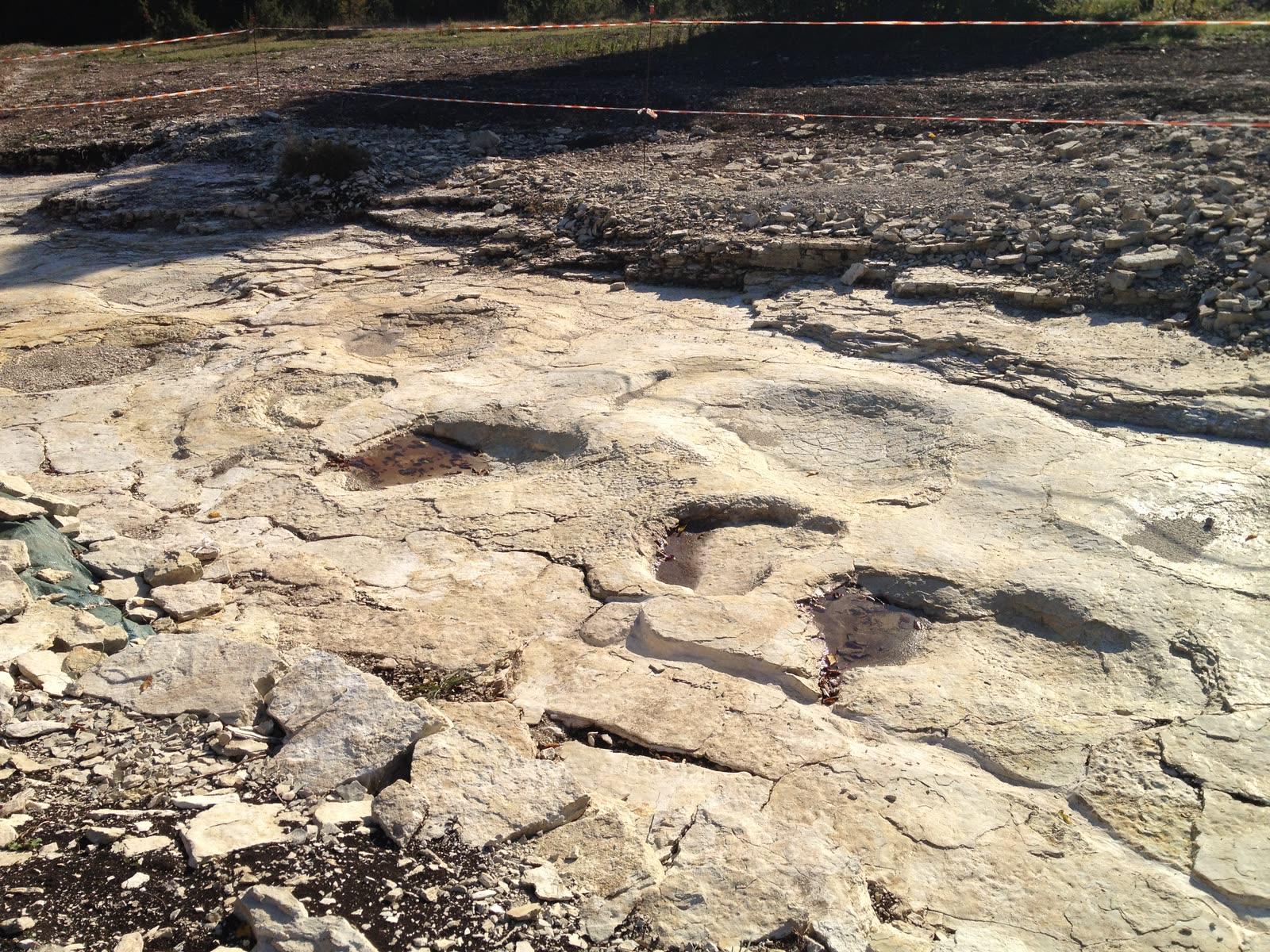
 Photo: Mfrays, CC BY-SA 3.0, via Wikimedia Commons
The main trackway belongs to a sauropod. The pes prints measure 94 to 103 cm long. With the ring of mud that the foot pushed out, a print reaches up to 3 m. Each pes print shows five oval toe marks. Each manus print shows five round digit marks in an arc.
The Geobios analysis, as reported by the CNRS, puts the trackmaker at no less than 35 m long. It weighed 35 to 40 tonnes. The mean stride was 2.80 m, and the animal walked at about 4 km/h. These values come from the published biometric analysis of the trackway, not from a news estimate.
The paper assigns the best-preserved section to Brontopodus plagnensis. The name means "thunder foot of Plagne". It marks the similarity to the existing ichnogenus Brontopodus.
A second trackway belongs to a carnivorous theropod. It has 18 paces and runs for 38 m. The CNRS describes the maker as about 9 m long and 3 m high.
The prints are the fossils here. Dinoplagne does not show bones or shells. Researchers state that many more prints remain to be found and studied on the meadow. The Ain tourism listing says the program includes fossil excavation activities and a virtual reality film for visitors aged 9 and over. The film follows a sauropod the site calls Odysseus.
Geologic History
The prints date to the early Tithonian, in the Late Jurassic. That is about 150 million years ago. The International Commission on Stratigraphy puts the Tithonian stage between 149 and 143 million years. This guide found no formal formation name in the sources it could read. The frontmatter describes the rock instead.
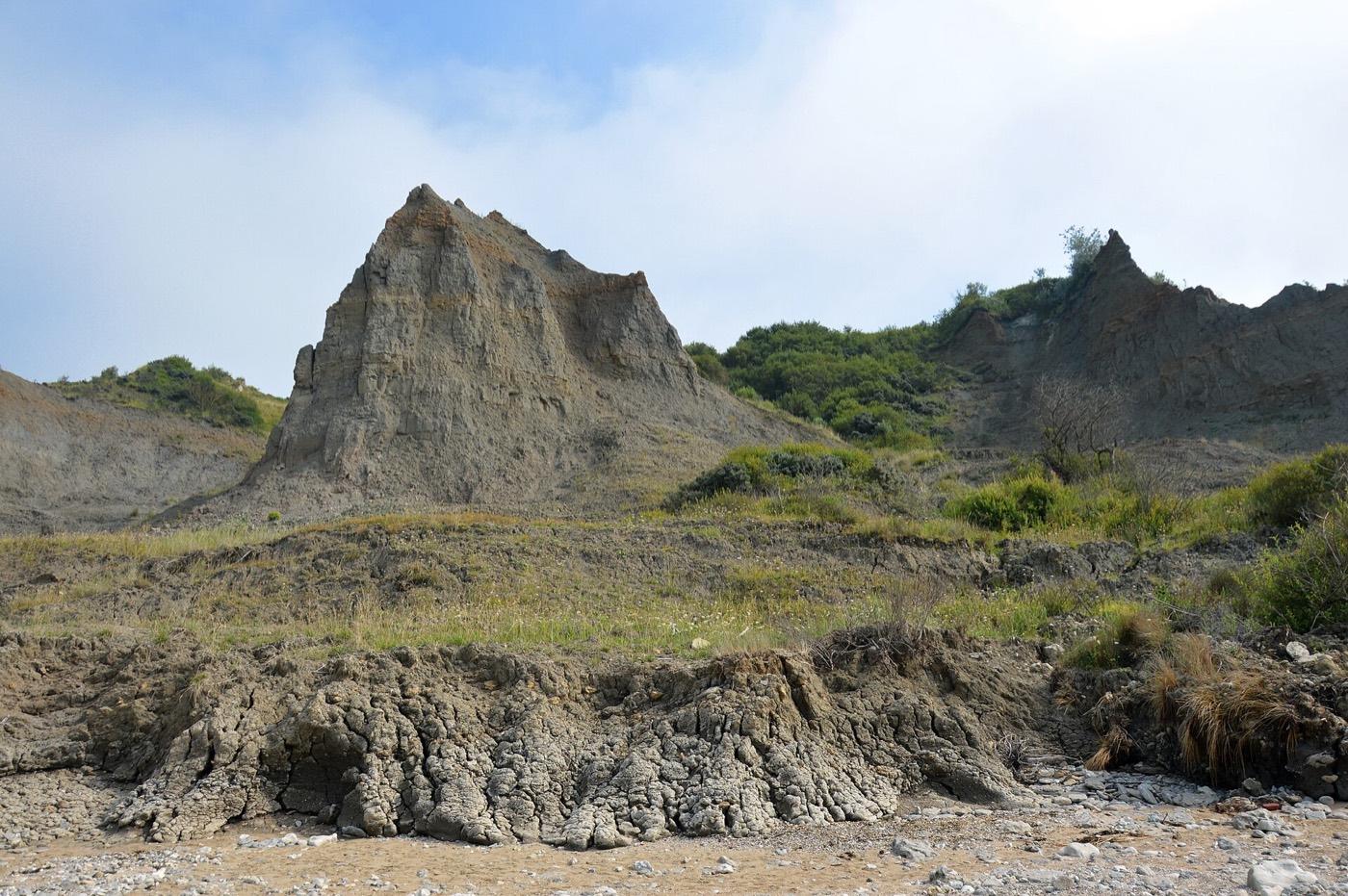
The Plagne site lay on the southeastern margin of the carbonate-dominated Jura platform. The setting was a protected littoral mudflat. A warm, shallow sea covered the platform, and the Geobios abstract puts the tracks in that mudflat environment.
The CNRS reads the region as a chain of islands with enough plant cover to feed very large animals. Sea level changed over time. The islands could join, so the animals could move from the land of the Rhenish Massif.
The animal crossed the mudflat, and the prints dried. The sea then returned and filled each print with sediment. That sediment hardened into limestone, and the prints survived. The Geobios abstract adds that, with other Early Jurassic Swiss and French sites, the area forms the largest dinosaur megatracksite in Europe.
Collecting Rules and Regulations
No collecting is possible at Dinoplagne. The tracks lie under a wooden canopy designed by Mégard Architectes, and you see them from a path. Researchers covered the excavated prints to protect them from weather.
Key Points:
- Do not collect, dig or remove anything.
- Pay at the gate or book online.
- Follow the staff on guided visits.
- The site pages do not say whether a visitor may touch the prints. Ask staff first.
- The Ain department lists the site as an Espace Naturel Sensible, a sensitive natural area.
The dinoplagne.fr site names Terre Valserhône, an intercommunal authority, as the manager. The Pays de Gex tourist office page describes the site differently. Both pages agree that the visit is by ticket.
Safety
The official pages list no hazards. These notes follow from the access information.
The site is outdoors. A path leads to the canopy. Wear shoes that suit a gravel or dirt path, and carry rain cover. Check the weather and the booking confirmation before you leave.
The site is not wheelchair accessible. If you need step-free access, telephone before you go.
The virtual reality headset is for visitors aged 9 and over. Adults must stay with younger children on the meadow.
Sources
https://www.ain-tourisme.com/en/visit/theme-parks/dinoplagne/ https://www.ain-tourisme.com/en/offers/dinoplagne-plagne-en-5376655/ https://news.cnrs.fr/articles/a-jurassic-trail-like-no-other https://www.ens-lyon.fr/sites/default/files/2017-11/CP%20Empreintes%20Dino%20Plagne.pdf https://www.em-consulte.com/es/article/1136597/the-dinosaur-tracksite-of-plagne-early-tithonian-l https://www.dinoplagne.fr/horaires-et-tarifs/ https://www.dinoplagne.fr/en/ https://www.paysdegex-montsjura.com/en/cultural-heritage/dinoplagne/ https://www.ain-tourisme.com/en/offers/dinoplagne-ens-de-lain-plagne-en-5380839