Ichthyosaur of La Robine Fossil Hunting Guide
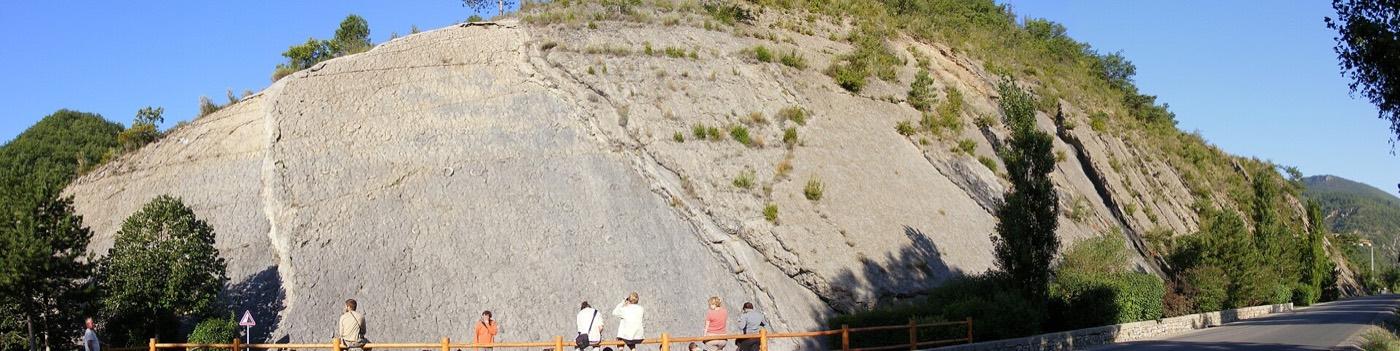
Image: rene boulay (CC BY-SA 3.0)
A near-complete ichthyosaur about 4 metres long, roughly 185 million years old, left in the rock where it was found above La Robine-sur-Galabre and sheltered since 2018. Reached by a marked 4.3 kilometre walk in the Réserve Naturelle Géologique de Haute-Provence. Free, and viewing only.
By Edward Chen · Published 11 September 2026
Introduction
Most ichthyosaurs you can look at are in museums, cleaned, mounted and lit. This one is still in the rock it died in, on a hillside in the Alpes-de-Haute-Provence, and you walk to it.
The skeleton is close to complete and measures about 4 metres. It is roughly 185 million years old, which places it in the Early Jurassic. The animal was a marine reptile, not a fish and not a mammal, although the body plan converged on both.
The decision to leave it in place is the interesting part. Excavation gives a museum a specimen and leaves an empty hillside. Instead the reserve built protection over it, and since 2018 the site has had equipment that shelters the fossil and still lets visitors see it.
It is one of 18 protected sites in the Réserve Naturelle Géologique de Haute-Provence, and access is free all year.
Location and Directions
The site lies above the commune of La Robine-sur-Galabre, north of Digne-les-Bains.
The walk is a marked round trip of 4.3 kilometres with about 190 metres of ascent. It takes roughly an hour and a half at a steady pace. It is graded easy and is suitable for most walkers with reasonable footwear.
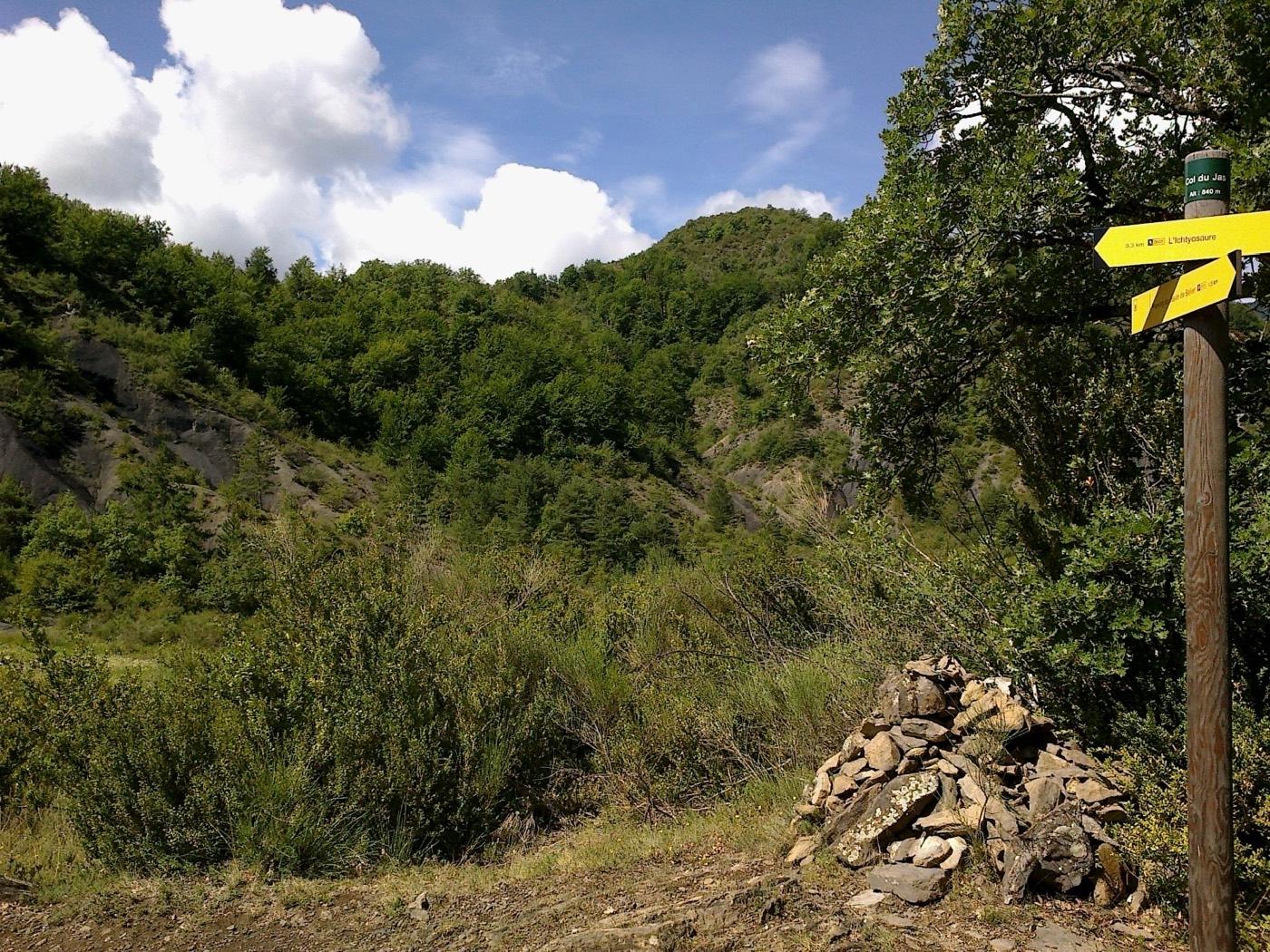
The path follows the Bélier ravine. It then climbs through a wooded slope of oak and beech to the Col du Jas, at a maximum altitude of about 863 metres. The fossil is about 200 metres below the col.
Village GPS: 44.1713°N, 6.2504°E. Use the signed trailhead rather than the village centre.
Access is free and open all year. There is no booking, no ticket and no attendant on site.
What Fossils You'll Find
Nothing is collectable here. What you see is the ichthyosaur itself, preserved in the Toarcian marls, laid out as it came to rest.
Ichthyosaurs were reptiles that breathed air and returned to the sea. They evolved a body shaped like a tuna, with a long toothed snout, large eyes, paddle-like limbs and a vertical tail fin. On a specimen preserved in the rock the vertebral column and the paddles are usually the clearest features.
The wider reserve preserves ammonite beds, sirenian sites and other marine material of similar age. So the ichthyosaur is one element of a regional Jurassic marine record rather than an isolated curiosity.
Ichthyosaurs gave birth to live young rather than laying eggs, which is known from specimens preserved mid-birth. They were among the first animals to evolve the deep-bodied, fast-swimming shape later arrived at independently by tuna and dolphins. A specimen left in its rock shows the arrangement the animal actually died in, which a mounted skeleton in a gallery cannot.
Geologic History
The Toarcian is the last stage of the Early Jurassic, and about 185 million years ago this part of what is now Provence lay beneath a sea. The marls that hold the skeleton were soft seafloor mud.
That fine-grained mud is why the animal survives as an articulated skeleton rather than scattered bone. Quiet water and rapid burial keep a carcass together. Coarser, more energetic conditions break a carcass up.
The same Alpine collision that tilted the Dalle aux Ammonites near Digne raised these beds into the hillside you walk up. The fossil now sits several hundred metres above sea level in a mountain landscape, which is worth remembering while you look at a marine reptile.
The reserve was created in 1984. Its purpose is protection through display rather than removal, and La Robine is the clearest demonstration of that policy on the ground.
Collecting Rules and Regulations
Collecting is prohibited. This is a protected site within a réserve naturelle géologique, and fossils stay where they are.
Do not touch the specimen. Do not attempt to clean, brush or wet the surface to improve the contrast for a photograph. The protective structure installed in 2018 exists because the marls weather, and handling accelerates that.
Collecting elsewhere in the reserve is also prohibited without research authorisation.
The network of 18 protected sites also takes in the Vélodrome fold at La Robine-sur-Galabre, a set of steeply tilted strata visible from the road. If you drive up from Digne, the two are worth combining.
Safety
The walk is graded easy, but it is a mountain path with 190 metres of ascent and it is exposed in places. Wear proper footwear.
The marls are slippery when wet, and the ravine section can be greasy after rain.
There is no water and no shade on parts of the route. In summer the Provençal sun is strong, so carry water and start early.
Mobile coverage in the ravine is patchy. Tell someone your route before you set out.
In winter the col can hold snow and ice. Check conditions locally before you commit to the climb.
Sources
https://www.geoparchauteprovence.com/en/poi/the-ichthyosaurus-of-la-robine/ https://en.tourisme-alpes-haute-provence.com/grands-espaces-naturels/4619314_curiosite-naturelle-la-robine-sur-galabre-lichthyosaure-de-la-robine/ https://www.rando-alpes-haute-provence.fr/trek/227404-Site-de-l-ichtyosaure-(reptile-marin-fossile) https://www.dignelesbains-tourisme.com/