Fossils of Aust Cliff Fossil Hunting Guide
Image: Dr Duncan Pepper (CC BY-SA 2.0)
Collect shark teeth and fish remains from the Rhaetic Bone Bed at Aust Cliff in Gloucestershire. The UK's most productive Triassic fossil site, accessible only around low tide on the Severn.
By Edward Chen · Updated 1 August 2026
 Photo: Arpingstone at English Wikipedia, Public domain via Wikimedia Commons
Introduction
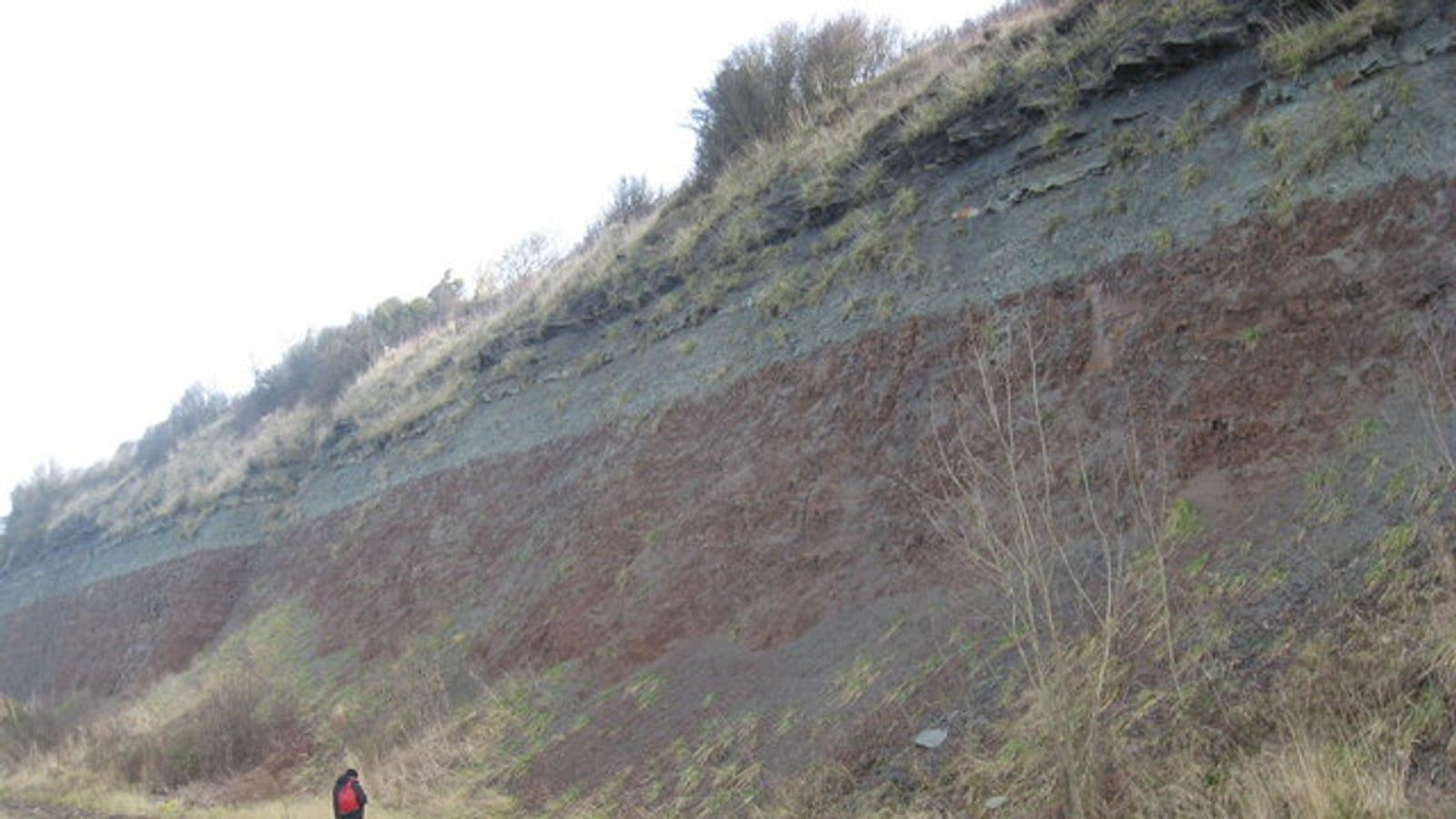
Aust Cliff stands on the western bank of the River Severn, visible to millions of motorists crossing the old Severn Bridge, and it holds one of the most scientifically significant geological sections in Britain. The red and white cliff face exposes a complete transition from the Triassic desert mudstones through the Rhaetic marine transgression into the Early Jurassic Blue Lias, a sequence spanning the end-Triassic mass extinction and one of the most dramatic biological crises in Earth's history. At the very top of the Triassic sequence, a thin, dark layer known as the Rhaetic Bone Bed concentrates an astonishing density of shark teeth, fish scales, and reptile bone fragments. This is the most productive Triassic fossil locality in the United Kingdom, and it has been studied continuously since William Buckland and William Conybeare rowed into the Severn in 1824 to sketch the cliff face. Extreme caution is essential here: the tides on the Severn are among the most powerful in the world, and the site demands careful planning. This guide explains how to reach the cliff, what the bone bed yields, the geological story behind this extinction boundary, and the serious safety precautions the site demands.
 Photo: Dr Duncan Pepper, CC BY-SA 2.0, via Wikimedia Commons
Location and Directions
Address
Aust Cliff, near Aust village, South Gloucestershire, by the old Severn Bridge.
Directions
From the M4 motorway, take Junction 21 and follow the M48 toward the old Severn Bridge. Exit at the junction for Aust village before reaching the bridge. Follow the minor road through Aust toward the river. There is limited parking near the bridge approach road. Use verges carefully and do not block gateways. From the parking area, walk toward the river bank and follow the shoreline south to reach the cliff exposures. The Rhaetic Bone Bed is visible at the top of the red mudstone sequence, below the overlying limestone beds. The cliff is only accessible during a narrow window around low water on the Severn's tidal cycle. The Severn has a tidal range of up to 14 metres at spring tides. Check tide times for Avonmouth or Sharpness before visiting and allow generous safety margins. The foreshore is covered for most of each tidal cycle.
What Fossils You'll Find
Shark teeth are the most abundant and accessible fossils in the Rhaetic Bone Bed. The teeth are small, typically a few millimetres to around one centimetre, dark brown or black, and belong to a range of Triassic and Early Jurassic shark species. A 2018 University of Bristol study identified six shark species from the basal Rhaetic at Aust. Look for them concentrated in the thin, dark bone bed layer at the top of the Triassic sequence.
Fish scales and teeth are similarly abundant. The bone bed preserves a concentration of fish remains representing species from both the marine transgression and material reworked from older Carboniferous limestone, including teeth of Psephodus, Psammodus, and Helodus that were eroded from nearby Carboniferous outcrops and incorporated into the Rhaetic sediment. Louis Agassiz described seventeen fish taxa from this cliff in the 1830s, of which eight remain valid species today.
Reptile remains occur in the bone bed as fragments of bone, scales, and teeth representing marine reptiles that entered the sea during the Rhaetic transgression. These are rarer than the fish material but the site has produced ichthyosaur and other reptile fragments.
The Blue Lias overlying the Rhaetic section yields ammonites and bivalves of Early Jurassic age. Ammonite-bearing limestone and shale beds are visible in the upper part of the cliff and as foreshore exposures.
Geologic History
The Ancient Environment
Aust Cliff exposes a sequence spanning the Triassic-Jurassic boundary, from approximately 221 million years ago down through the Rhaetic transition at around 205 million years ago and into the Early Jurassic Blue Lias at 195 to 201 million years ago. The lower red mudstones of the Branscombe Mudstone Formation (Mercia Mudstone Group) represent a hot, arid Triassic desert environment, with red and green siltstones and abundant alabaster nodules formed by evaporation of saline groundwater. Above these lie the green mudstones of the Blue Anchor Formation, marking the transition to moister conditions, and then the black shales and limestones of the Penarth Group (Westbury Formation and Cotham Member), which record the beginning of the Rhaetic marine transgression. The thin Rhaetic Bone Bed formed approximately 205 million years ago as sea levels rose at the close of the Triassic, sweeping terrestrial and nearshore marine life remains together into a concentrated lag deposit. This storm-reworked sediment mixed primary material with reworked fossils from older formations. Above the bone bed, the cream-coloured limestones and dark shales of the Blue Lias record the establishment of a shallow Early Jurassic sea.
How Aust Cliff Became a Fossil Collecting Site
The Severn is one of Britain's most powerful rivers, and combined with one of the largest tidal ranges in the world, it has cut back the soft Triassic and Rhaetic mudstones to expose the geological sequence in cross-section. The river and tidal action continues to erode the cliff base, releasing new material from the bone bed. The site was first documented scientifically in 1824 and has been the subject of continuous geological investigation for two centuries. The 5.3-hectare site was notified as a Site of Special Scientific Interest in 1954, and it has been described by the University of Bristol as one of the top ten geological sites in Britain. The Bristol City Museum maintains a substantial reference collection of material from Aust Cliff for year-round research access.
Collecting Rules and Regulations
Is Fossil Collecting Allowed?
Surface collecting of loose fossils from the foreshore at Aust Cliff is permitted for personal, non-commercial purposes. The site is an SSSI. Hammering the cliff face is prohibited. The bone bed is an in-situ feature of the cliff and cannot be excavated. Material that has fallen from the cliff and is loose on the foreshore may be collected. Given the tidal constraints, the window for collecting is short and the site is not accessible on every tide. Report scientifically significant finds to the Bristol City Museum or the British Geological Survey.
Recommended Tools
A hand lens is the most useful tool for examining the tiny shark teeth and fish scales in the bone bed material. A small container or specimen bag is useful for carrying small teeth without losing them. Sturdy waterproof boots with grip are essential for the muddy foreshore. Do not bring large hammers or excavation equipment.
Safety
The tides at Aust Cliff present an extreme hazard. The Severn Estuary has one of the largest tidal ranges in the world, and the tide comes in very rapidly across a wide, flat foreshore, with no warning and very little time to retreat. You must know the exact low water time for the Severn at this location before setting foot on the foreshore, and you must be back at the top of the bank well before the tide turns. Do not attempt this site without checking a reliable tide table for Avonmouth or Sharpness. The cliff is also actively eroding and unstable. Never stand under the cliff face or near any overhang. The foreshore is accessed only at low water. Arriving at the wrong state of the tide makes the site completely inaccessible and dangerous to approach.