Big Brook Preserve Fossil Hunting Guide
Big Brook Preserve in Monmouth County, New Jersey, is the East Coast's best public Cretaceous fossil-hunting site. A small spring-fed stream cuts through 75-million-year-old marine sediments and washes out shark teeth, belemnites, ammonites, and Exogyra oyster shells onto the gravel bars. Free collecting from the stream bed with small hand tools.
By Edward Chen · Updated 31 July 2026
Introduction
Big Brook Preserve is a 143-acre Monmouth County park straddling the line between Colts Neck and Marlboro Townships in central New Jersey. A small spring-fed stream, Big Brook, cuts through the bottom of the preserve and exposes Late Cretaceous marine sediments of the Navesink and Mount Laurel formations. Erosion of the stream banks continuously delivers fresh fossils, shark teeth, belemnite guards, crinoid stems, Exogyra oyster shells, ammonite fragments, onto the gravel bars where collectors can simply pluck them up.
It is the most accessible Cretaceous fossil-collecting site in the eastern United States and one of the few public locations within day-trip range of New York and Philadelphia where amateur collectors can take home what they find. The county permits stream-bed collecting during posted park hours with small hand tools no larger than 14 inches, scooping material no more than 6 inches deep, and explicitly forbids digging into the stream banks.
This guide covers what to look for, how to access the brook, and the rules that keep the site open.
Location and Directions
Big Brook Preserve has two main county access points: the Colts Neck entrance at 95 Hillsdale Road (the official preserve entrance, with parking lot and trail) and an informal Marlboro access at the Boundary Road bridge over Big Brook.
Directions to Big Brook Preserve
From the Garden State Parkway, take Exit 109 (Red Bank) onto Route 520 (Newman Springs Road) west, then various local roads (Hillsdale Road, Conover Road, Boundary Road) into the Colts Neck / Marlboro line. The Hillsdale Road lot is the main entrance and includes interpretive signage about the rules and what visitors can find. A trail leads about 5–10 minutes from the lot to the brook.
Best collecting is on the gravel bars exposed at low summer water levels and especially after heavy rains or spring snowmelt that scours fresh material from the banks. Bring rubber boots or sandals (you'll be wading), a small kitchen sieve, and a film canister or zip-top bag for finds. The brook is typically only ankle-to-knee deep but cold. Avoid the site immediately after major storms when banks are unstable and water is high.
What Fossils You'll Find
The Navesink Formation (Maastrichtian, about 70 to 66 million years old) and the underlying Mount Laurel Formation (Campanian, about 75 to 70 million years old) record the last few million years of the Cretaceous in a shallow, near-shore marine setting along the eastern margin of the Western Interior Seaway's North Atlantic embayment. The Navesink in particular is one of the youngest Cretaceous marine units exposed at the surface anywhere in eastern North America.
By far the most common finds are shark teeth. The slender, striated teeth of the goblin shark Scapanorhynchus texanus are the most abundant and easily recognised, most visitors fill a small vial within an hour of careful screening. The straight-cusped teeth of the sand tiger sharks Carcharias amonensis and the larger Cretodus crassidens are also common. The dramatically serrated, hook-shaped teeth of the scavenger Squalicorax kaupi, sometimes called the "Cretaceous crow shark", are highly coveted and a regular Big Brook find. The lemon-sized triangular teeth of Cretolamna appendiculata round out the principal shark fauna.
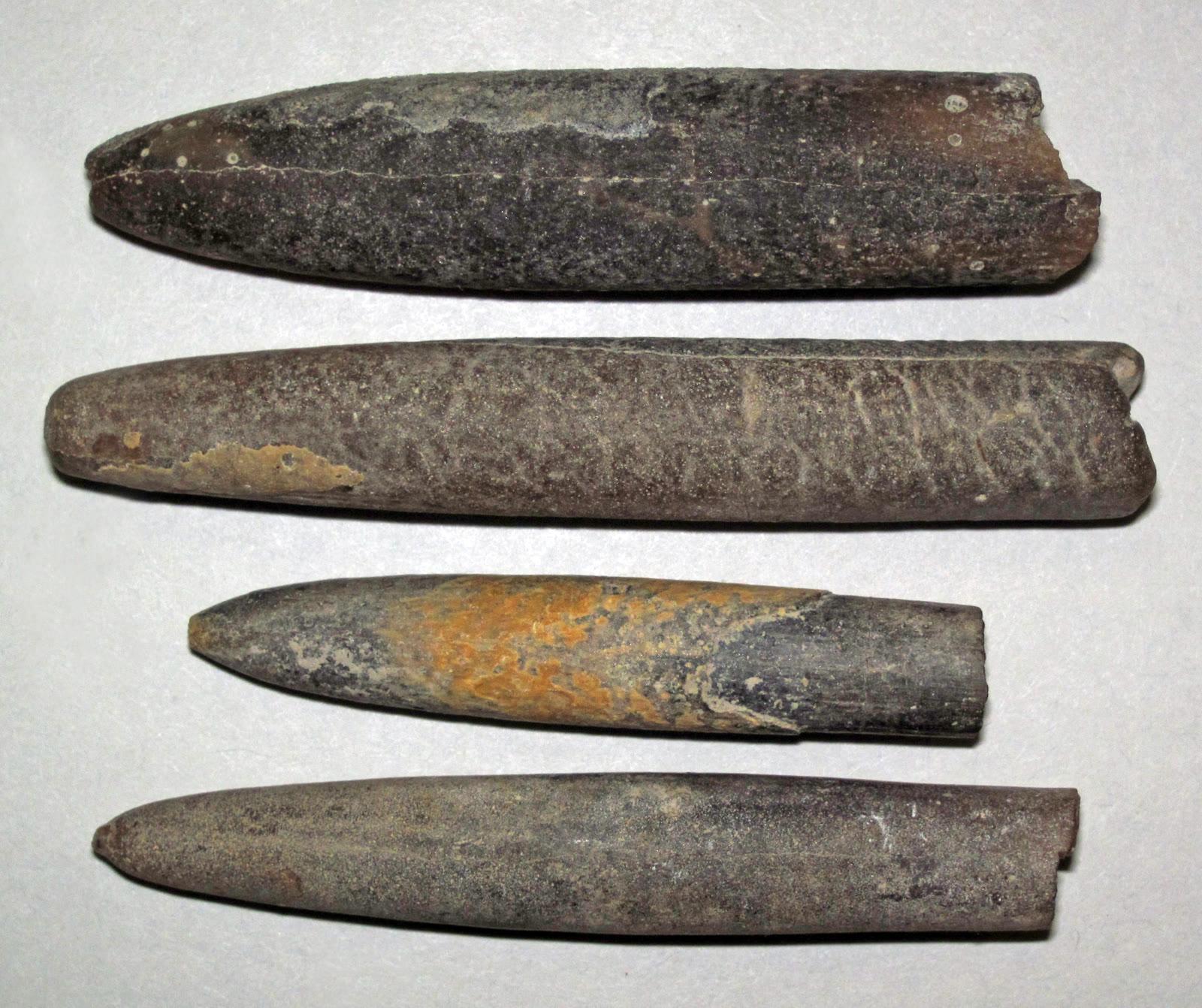
Bullet-shaped belemnite guards (Belemnitella americana), internal skeletons of a Cretaceous squid relative, wash out of the gravel by the dozen and are perhaps the most distinctive Big Brook fossil. They are typically 5 to 10 centimetres long, polished and dark. The Cretaceous oyster Exogyra costata, with its strongly ribbed coiled valve, is abundant and decorative. The smaller Pycnodonte mutabilis is similarly common. Brachiopods (Choristothyris plicata, Cyclothyris), sponge spicules and fragments, and the high-spired gastropod Turritella are common smaller invertebrates. Echinoid spines and isolated plates appear in the screened fraction.
Less common but regular finds include crocodile teeth (Hyposaurus rogersii and similar marine crocodyliforms), small mosasaur teeth and vertebrae from Halisaurus, Mosasaurus, Plioplatecarpus, and the giant Tylosaurus, fish vertebrae (the long fangs of the saber-toothed herring Enchodus petrosus are particularly prized), turtle shell fragments from chelonioids and the giant Archelon, and the occasional dinosaur bone fragment from terrestrial taxa washed in from the Atlantic margin. Rare highlights over the years have included partial ammonite specimens (most often the heteromorph Discoscaphites iris), pterosaur bone fragments (likely from Pteranodon), and a famous Cretaceous bird humerus that helped place the early avian Ichthyornis in the Atlantic embayment.
"Sites along the stream bed are the most popular fossil hunting location in New Jersey, with countless numbers of sharks teeth found in the stream for decades." New Jersey Monthly
Photo: Smithsonian National Museum of Natural History, CC0, via Smithsonian Open Access
Geologic History
During the latest Cretaceous, central New Jersey lay on the western margin of a shallow continental sea that connected the North Atlantic with the Western Interior Seaway through the central Appalachian foreland. Sea level was high, the highest of the Phanerozoic, and the entire Atlantic Coastal Plain from modern Maine to Florida was inundated by warm tropical to subtropical marine waters. Fine glauconitic sands and silts accumulated in nearshore to inner-shelf conditions, periodically winnowed by storms that concentrated bones, teeth, and shells into bonebed lags.
The Navesink Formation is the type unit for the New Jersey Maastrichtian and is divided into a lower fossil-poor glauconitic clay and an upper "shell bed" packed with Exogyra, belemnites, and vertebrate fossils. The Mount Laurel Formation below is more uniformly sandy and represents slightly older Campanian deposition. The contact between the two units is exposed across central Monmouth County and is the principal source of Big Brook's fossils. In some Monmouth County sections, most famously at the famed Inversand pit in Sewell, Gloucester County, the K-Pg boundary itself is preserved just above the Navesink fossil zone, and the New Jersey K-Pg boundary has produced some of the most detailed marine records of the extinction event anywhere in the eastern United States.
Pleistocene glaciation reached as far south as central New Jersey during the Wisconsinan, but the Late Cretaceous outcrop belt at Big Brook lies just south of the terminal moraine and was not glacially scoured. Pleistocene to Holocene incision of the Hudson, Raritan, and Delaware drainage systems exhumed the Navesink and Mount Laurel formations along small stream valleys across Monmouth County. Big Brook itself is a small Holocene-age spring-fed stream cutting through the soft glauconitic Cretaceous units. Its slow, steady erosion continuously delivers fresh fossil material to the gravel bars where collectors can pick them up.
The Big Brook site has been collected since at least the 1920s, and is the type locality for several Late Cretaceous species. The New Jersey State Museum, Rutgers University, Princeton University, and Drexel University maintain active research collections from the brook and the adjacent Inversand pit, and the New Jersey Paleontological Society runs regular field trips. The discovery of Hadrosaurus foulkii in 1858 at nearby Haddonfield, the first articulated dinosaur skeleton ever recovered in North America and the official state dinosaur of New Jersey, set the stage for the modern paleontological tradition that Big Brook continues.
How Big Brook Came to Be Protected
The 143-acre Big Brook Preserve was assembled by Monmouth County over multiple acquisitions beginning in the late 1990s, partly with assistance from the New Jersey Conservation Foundation, specifically to safeguard one of the state's best-known amateur paleontology sites while allowing continued public collecting under controlled rules. Monmouth County's Supplemental Rules for Fossiling at Big Brook Park, formalised in the early 2000s and updated since, allow stream-bed collecting with small hand tools while prohibiting bank-digging that would accelerate erosion of the fragile streambank palaeontological exposures. The rules are intended to keep the site open and productive indefinitely.
Collecting Rules and Regulations
Is Fossil Collecting Allowed?
Yes, but only from the stream bed itself, with small hand tools.
Key Points:
- Fossil collecting permitted during posted park hours
- No permit or fee for individuals or groups of 10 or fewer
- Larger groups require a county permit
- Hand tools only, maximum 14 inches in length
- No digging into stream banks. Disturbance limited to 6 inches deep
- No power tools, no metal detectors, no removing rooted vegetation
- Pack out everything you bring in
Safety
Big Brook is one of the gentlest sites in this guide, a shallow stream in a county park, and the hazards are correspondingly modest.
The brook is shallow but the footing is poor. The bed is gravel, clay, and loose cobbles, slippery underfoot and uneven, and the banks are undercut in places and collapse when stood on. Wear boots or wading shoes you do not mind soaking, enter from a shallow bank rather than the lip of a cut, and expect to get wet to the knee.
Water levels rise fast after rain. A brook that is ankle deep can be knee deep and pushing after a storm, and the water is cold outside summer. Do not work the stream during or immediately after heavy rain, both because it is unsafe and because the visibility drops to nothing.
Ticks are the hazard people underestimate here. Monmouth County has a high tick density and Lyme disease is common in this part of New Jersey. Wear long trousers tucked into socks, use repellent, and check yourself thoroughly afterwards. Poison ivy grows along the banks and the approach paths.
Note the park's own rules, which limit collecting to hand sifting in the stream and prohibit digging into the banks. That rule protects the banks from the erosion that would otherwise undercut the trees and, incidentally, keeps you away from the ground most likely to collapse. Supervise children in the water, and carry insect repellent and water for the walk in.