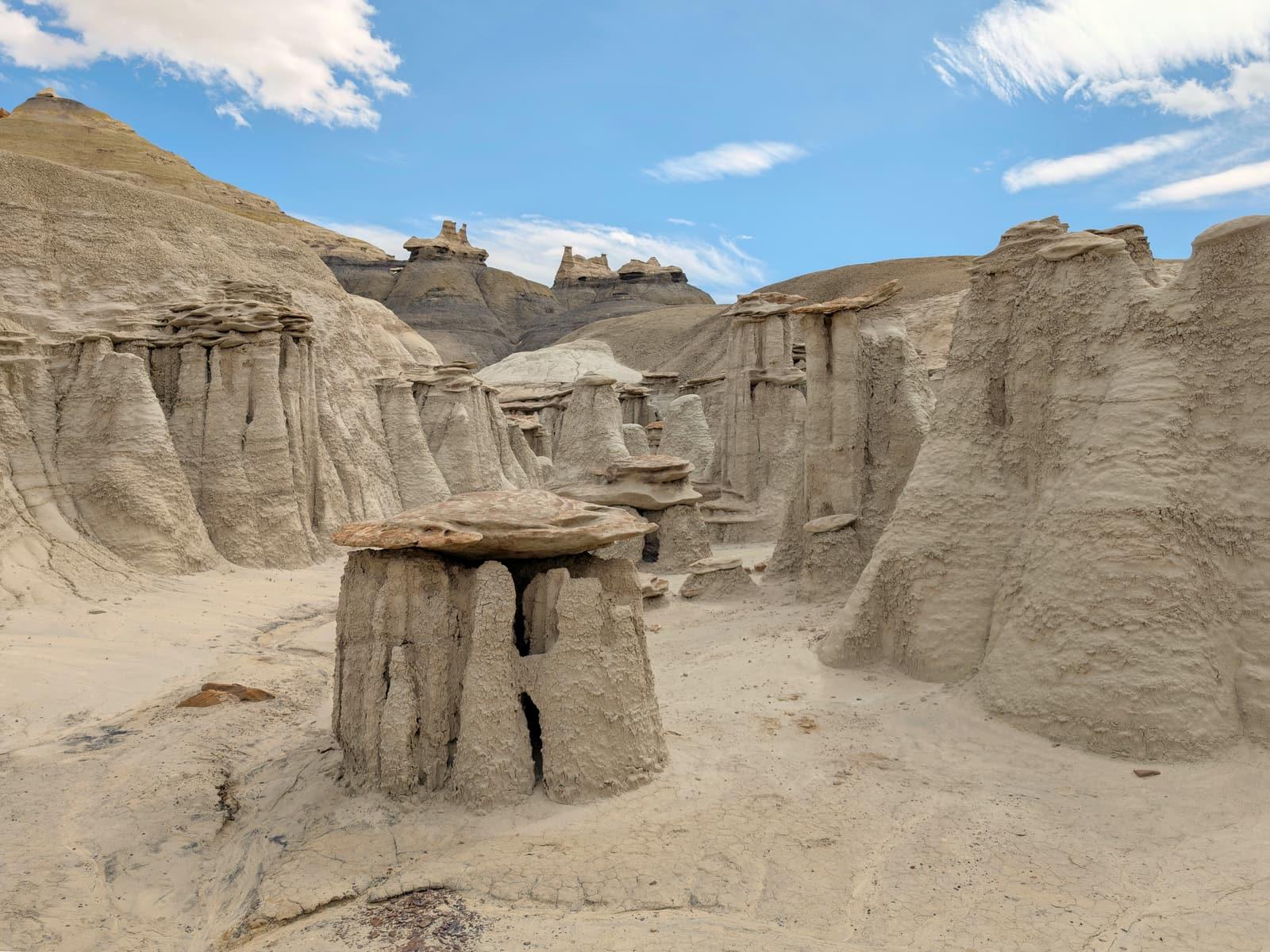
Bisti / De-Na-Zin Wilderness Fossil Guide
Image: Krzysztof Ziarnek, Kenraiz (CC BY-SA 4.0)
The Bisti/De-Na-Zin Wilderness south of Farmington, New Mexico, is 45,000 acres of eroded badlands cut into the Late Cretaceous Fruitland and Kirtland Formations. The beds hold petrified wood, fossil leaves, and dinosaur bone from around 74 million years ago. As a BLM wilderness, collecting petrified wood and fossils is prohibited, so it is a place to view, photograph, and leave in place.
By Edward Chen · Updated 31 July 2026
Introduction
The Bisti/De-Na-Zin Wilderness is 45,000 acres of badlands in northwestern New Mexico, where wind and water have carved the soft Late Cretaceous rock into hoodoos, fins, and mounds. The exposed beds belong mainly to the Fruitland Formation, which records swamps and rivers near the Cretaceous shoreline about 74 million years ago. Black coals and gray shales mark the old swamp deposits, and the badlands are scattered with petrified wood, leaf impressions, whole branches and trunks of fossil trees, and the bones of the animals that lived on this coastal plain.
This is a designated wilderness managed by the Bureau of Land Management, set aside in 1984. The fossils and petrified wood are part of what makes it worth the trip, but they are protected. The experience here is hiking, viewing, and photography rather than collecting.
Location and Directions
The wilderness lies in San Juan County, roughly 35 to 40 miles south of Farmington and north of the community of Crownpoint. The most-used access is the Bisti parking area reached from NM Highway 371 by way of unpaved County Road 7297, near 36.26°N, 108.00°W. The De-Na-Zin unit has a separate access farther east.
There are no marked trails, no facilities, no water, and no entrance station. From the parking area you walk into the badlands across open desert and dry washes, navigating by landmarks and GPS. The dirt access road can be rough, and it becomes slick and risky when wet. Plan your route, carry a map and GPS, and note where you parked, because the eroded terrain looks similar in every direction.
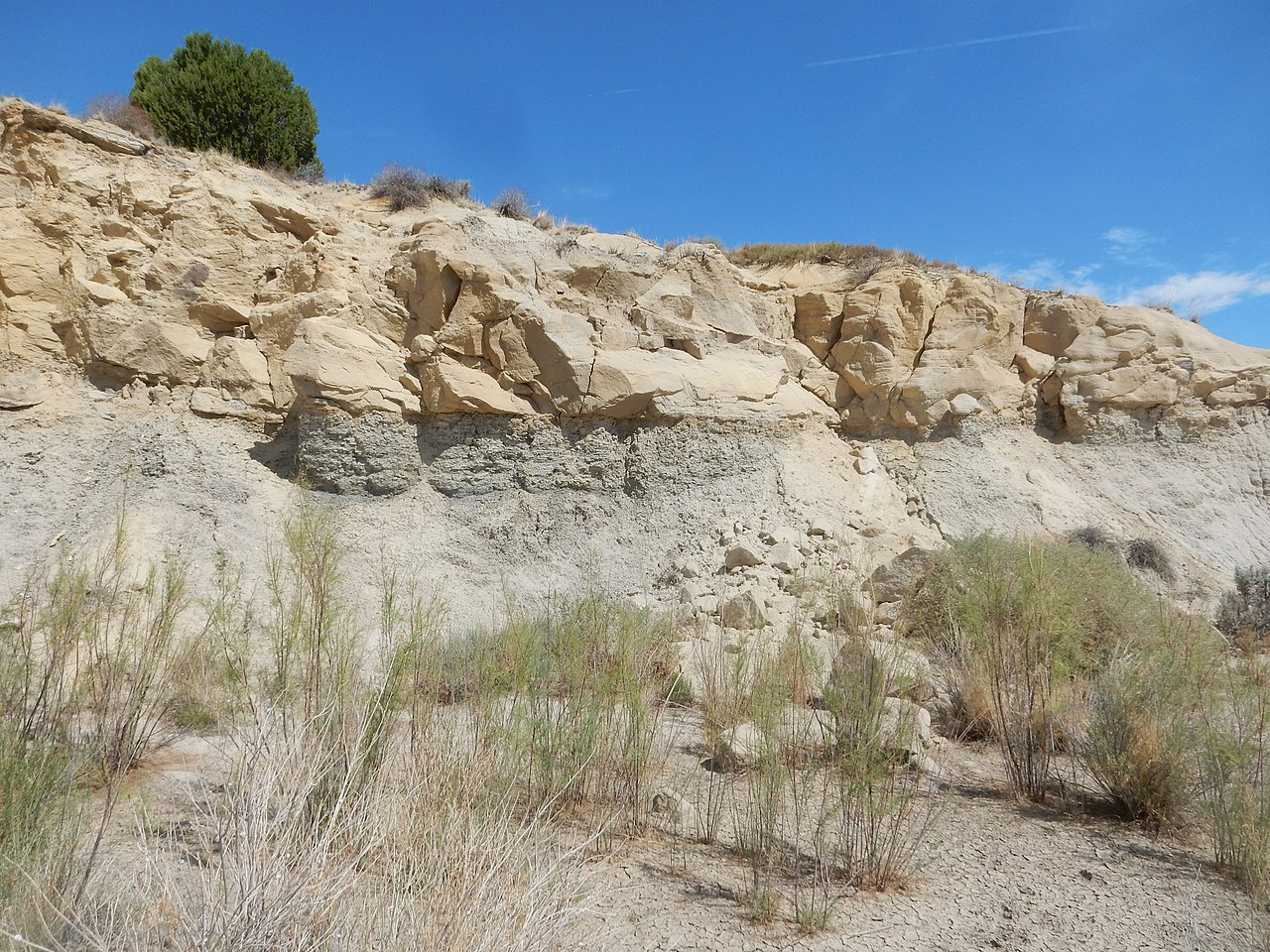 Photo: Kent G. Budge, CC0, via Wikimedia Commons
What Fossils You'll Find
Petrified wood is the most visible fossil, including chunks, branches, and the occasional large trunk weathering out of the Fruitland beds. Fossil leaf impressions and other plant material occur in the shales. The formation also produces dinosaur bone, including the horned dinosaur Pentaceratops and hadrosaurs (duckbilled dinosaurs), along with turtles, crocodilians, and other Cretaceous animals, though good vertebrate material is far less obvious to a casual visitor than the petrified wood.
None of this may be collected. The reason to find these fossils is to see and photograph them in place. Removing petrified wood or any fossil from the wilderness is prohibited, and vertebrate fossils are protected throughout.
 Photo: NickLongrich, CC BY-SA 4.0, via Wikimedia Commons
Geologic History
The Fruitland Formation was deposited in the Late Cretaceous, around 75 to 73 million years ago, along the western edge of the Western Interior Seaway. Rivers, swamps, and coastal lowlands laid down sand, mud, peat, and plant debris. The peat became the coal seams seen as black bands today, and buried logs and branches were mineralised into petrified wood. The overlying Kirtland Formation records the continuing coastal plain. After the seaway withdrew and the Colorado Plateau was uplifted, erosion stripped away softer material and sculpted the resistant layers into the hoodoos and badlands now exposed across the wilderness.
 Photo: Patrick Alexander, CC0, via Wikimedia Commons
Collecting Rules and Regulations
Collecting is prohibited in the Bisti/De-Na-Zin Wilderness. Under the site's Wilderness Management Plan, collecting petrified wood is specifically banned, which is stricter than the general BLM rule that allows limited petrified wood collection on ordinary public land. Vertebrate fossils may not be disturbed or collected anywhere without a research permit, and cultural objects are also protected. As a designated wilderness, the area also bans campfires, mechanized and motorized travel off road, and climbing on the geologic features. Leave all petrified wood, fossils, rocks, and artifacts exactly where you find them, and pack out everything you bring in.
Safety
The badlands are remote, exposed, and easy to get lost in, with no trails, water, shade, or services. Carry far more water than you expect to need, plus sun protection, food, and a map and GPS. Tell someone your route and return time. Summer heat is extreme, and afternoon thunderstorms can trigger flash floods in the washes, so avoid low ground when storms threaten and stay out after rain when the access road and clay surfaces turn to impassable, slick mud. Watch your footing on crumbly slopes and undercut hoodoos, and be alert for rattlesnakes. A high-clearance vehicle is advisable for the access road.
Sources
https://www.blm.gov/visit/bisti-de-na-zin-wilderness https://geoinfo.nmt.edu/tour/home.cfml?id=34 https://geoinfo.nmt.edu/faq/fossils/ https://www.desertusa.com/desert-new-mexico/bisti-badlands.html
Nearby sites
 Ghost Ranch Coelophysis Quarry Fossil GuideCoelophysis bauri, Phytosaurs
 Petrified Forest National Park Fossil Hunting GuidePetrified Araucarioxylon logs, Phytosaurs
 Cedar Mountain Formation Yellow Cat Member Fossil GuideDinosaurs, Utahraptor
 Fruita Paleontological Area Fossil Hunting GuideDinosaur bones, Mammal remains