Garden Park Fossil Area Fossil Hunting Guide
Garden Park Fossil Area, 6 miles north of Cañon City, Colorado, exposes the Morrison Formation along Four Mile Creek. The Marsh-Felch and Cope-Lucas quarries here produced type specimens of Allosaurus, Stegosaurus, Diplodocus, and Ceratosaurus. BLM ACEC, free visit, no collecting.
By Edward Chen · Updated 13 July 2026
Introduction
Garden Park Fossil Area is a 4,800-acre Area of Critical Environmental Concern on Bureau of Land Management ground, 6 miles north of Cañon City in southern Colorado. The badland gullies of Four Mile Creek expose the Late Jurassic Morrison Formation in cross section, and the slopes above the creek hold a string of historic dinosaur quarries that played a central role in the Great Dinosaur Rush of the 1870s and 1880s. The Marsh-Felch Quarry on the west side of the creek produced the type specimen of Stegosaurus stenops and the first complete Allosaurus skeleton. The Cope-Lucas quarries on the east side produced the type specimens of Camarasaurus supremus and several other Morrison sauropods. Later work by the Denver Museum of Nature and Science at the Small Quarry has produced more recent finds, including a juvenile Stegosaurus skeleton recovered in the late 1990s. Garden Park was added to the National Natural Landmark register in 1972, upgraded to a Research Natural Area in 1991, and protected as an Area of Critical Environmental Concern in 1996. Collecting is prohibited. Two interpretive sites and a series of marked overlook trails let visitors walk the historic quarry hillsides and read the story of the dinosaur rush from in-place panels. This guide covers access, what is visible, the Morrison geology, and the rules that apply.
Location and Directions
Garden Park lies in Fremont County, Colorado, about 6 miles north of Cañon City and 45 miles southwest of Colorado Springs. From US-50 in Cañon City, turn north on Fremont County Road 9 (Garden Park Road) and drive about 6 miles to the marked Marsh-Felch Quarry overlook. GPS for the overlook is 38.5556 degrees north, 105.2336 degrees west.
There are two main interpretive stops:
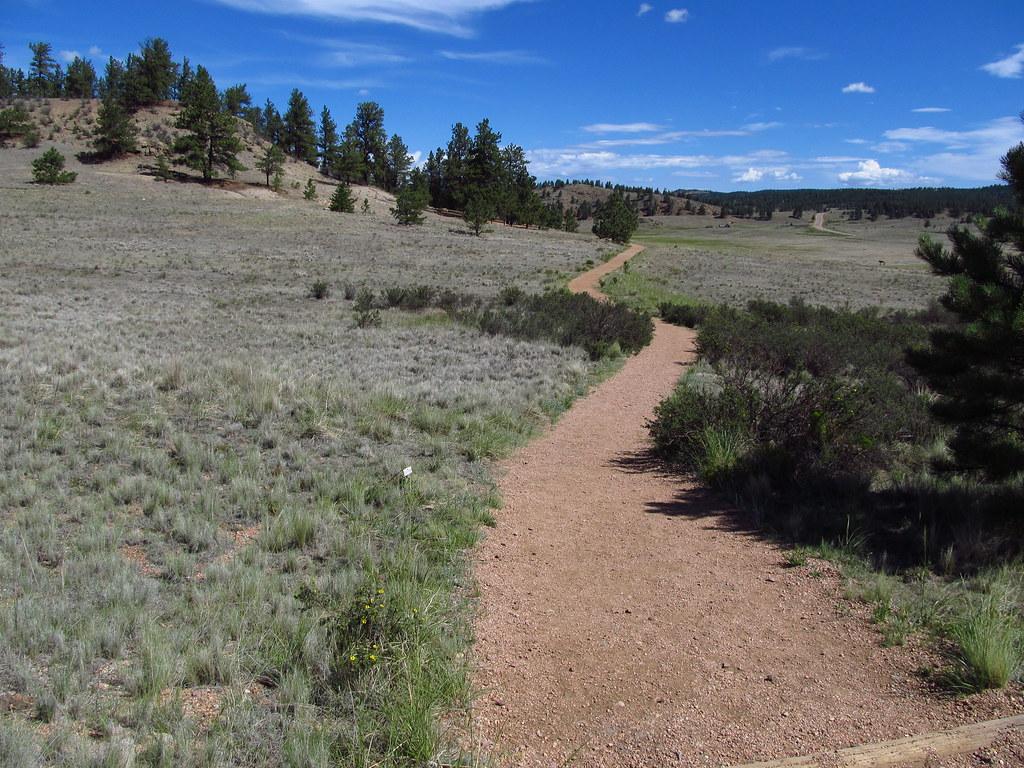
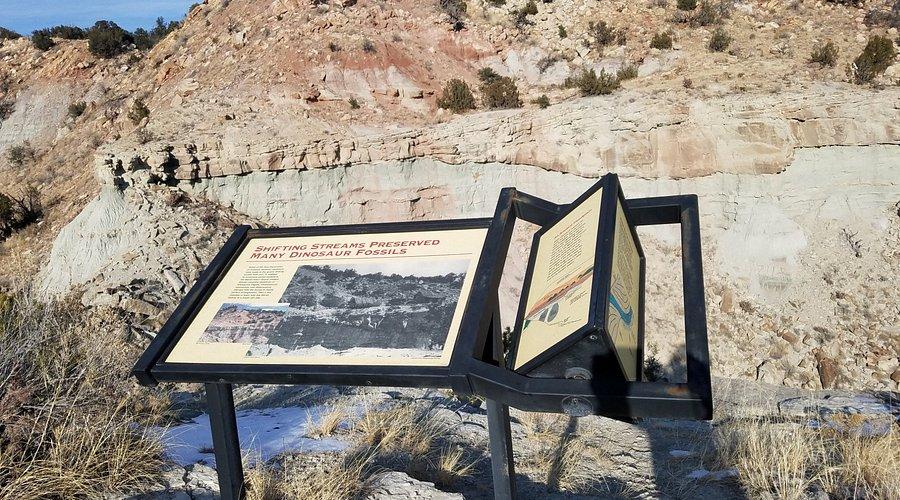
The Marsh-Felch Quarry overlook on the west side of the creek includes a small gravel pullout, a wheelchair-accessible kiosk with weather-proof panels, and a short walking path to the quarry scarp. Bones once excavated from this hillside are now on display at the Smithsonian, the Carnegie Museum, the Yale Peabody Museum, and the Royal Ontario Museum.
The Cope-Lucas Quarry overlook on the east side of the creek is reached by a half-mile gravel path from the road. The panels at this stop tell the story of the Cope-Marsh feud and the local Cañon City teams who excavated for both rival paleontologists.
The Garden Park area is open year round during daylight hours. There is no entrance fee. There are no restrooms or water at the overlooks. Cell coverage is intermittent.
Cañon City, 6 miles south, has full lodging, dining, and fuel. The Royal Gorge Regional Museum and History Center in downtown Cañon City, at 612 Royal Gorge Blvd, holds prepared specimens and quarry-history exhibits drawn from local collections. Since 2014 it has served as the federal repository for fossils collected on public land in Fremont County, including material from the Garden Park area.
What Fossils You'll Find
You will not collect at Garden Park. What you can do is walk to the historic Marsh-Felch and Cope-Lucas quarry scarps, see in-place exposures of the Morrison Formation bone-bearing horizon, and read the geological story on weather-proof panels. The Royal Gorge Regional Museum and History Center in Cañon City complements the on-site interpretation with prepared specimens.
- Allosaurus fragilis. The first complete Allosaurus skeleton, recovered from the Marsh-Felch Quarry by Marshall Felch in 1883 to 1884, is held at the Smithsonian and is the basis for many modern reconstructions.
- Stegosaurus stenops. Othniel Charles Marsh described the type specimen from Garden Park in 1887 from material excavated at the Marsh-Felch Quarry. The species is the most familiar Stegosaurus form.
- Camarasaurus supremus. The type species of the genus, described by Edward Drinker Cope in 1877 from the Cope-Lucas Quarry. The Cope-Lucas material remains at the American Museum of Natural History.
- Diplodocus longus. Vertebral and limb material referred to Diplodocus longus comes from Cope-Lucas and Felch material.
- Ceratosaurus nasicornis. The type specimen of the genus was recovered from Marsh-Felch material in 1884 and remains a key reference for ceratosaurid theropods.
- Late Jurassic mammals. Multituberculate teeth and small triconodont remains have been recovered from the same quarry levels.
- Juvenile Stegosaurus. A near-complete juvenile recovered by the Denver Museum of Nature and Science from the Small Quarry in 1995 to 1997 is on display in Denver.
The Royal Gorge Regional Museum and History Center in Cañon City displays a local fossil exhibit, including a full Stegosaurus replica, and is the most accessible single stop for visitors who want to follow the Garden Park story to its scientific outputs.
Geologic History
Garden Park exposes the Morrison Formation, a thick continental sequence deposited across the Western Interior during the Late Jurassic, between roughly 156 and 145 million years ago. The Garden Park section is dated to roughly 155 to 148 million years ago, in the Kimmeridgian Stage.
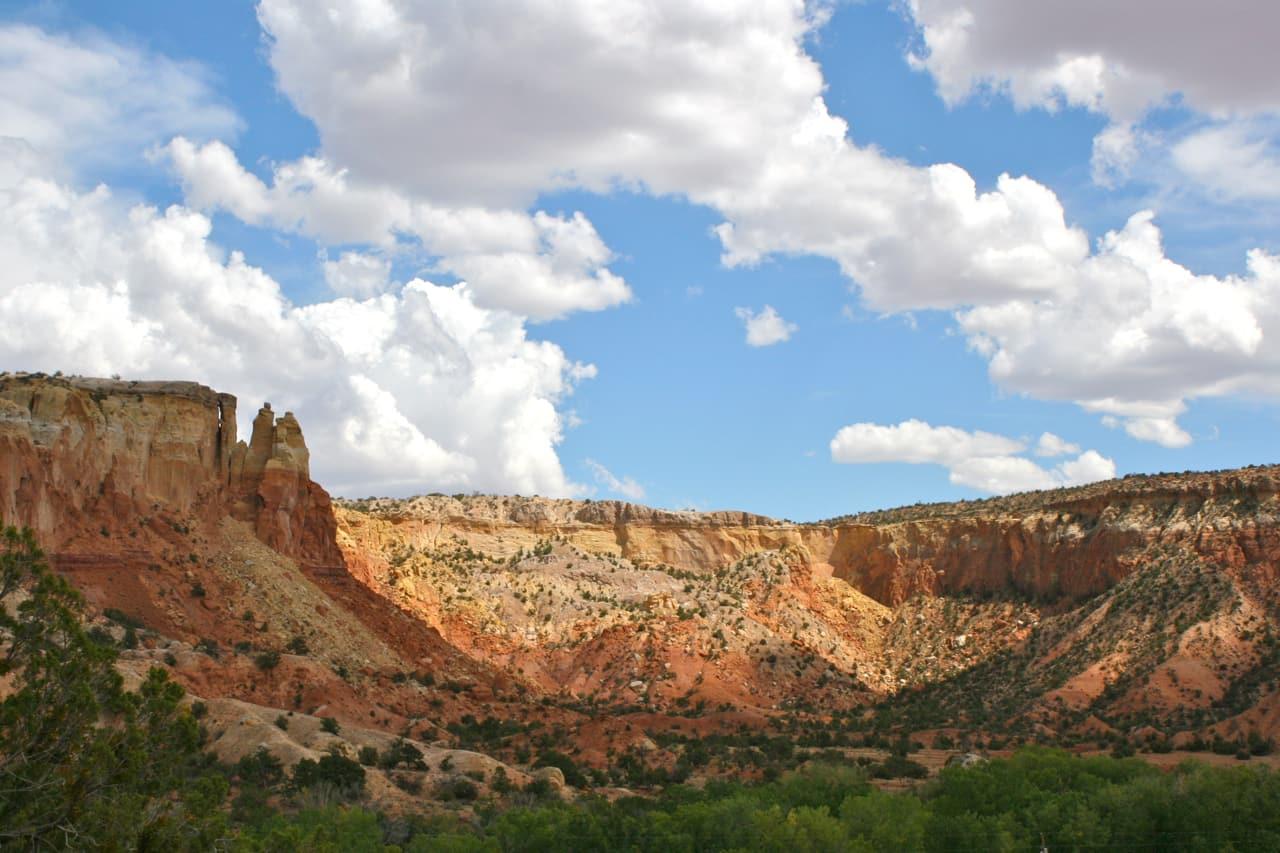
The Morrison at Garden Park is divided into three main members, with the productive bone beds concentrated in the middle Salt Wash and lower Brushy Basin members. The sediments record alluvial floodplain, meandering river, and ephemeral lake settings on a low-relief plain east of the rising western Cordillera. The climate was strongly seasonal, with wet summers and dry winters, and the vegetation was open conifer woodland with cycadeoid undergrowth.
Dinosaur carcasses on the floodplain were swept into channel sandbars during flood pulses and buried under fresh sand. Multi-individual bone beds in the Marsh-Felch and Cope-Lucas quarries record such accumulations. The bone-bearing sandstone is hard and resistant compared to the surrounding mudstone, which is why the quarry scarps still stand prominently above the modern badlands.
After Cretaceous burial, the Morrison was uplifted along with the rest of the central Rockies during Laramide tectonics. The Garden Park section is now tilted moderately to the southeast, with the productive horizons accessible on hillside outcrops along Four Mile Creek.
How Garden Park Became a Fossil Site
The first Morrison Formation bones at Garden Park were identified by Oramel W. Lucas, a schoolteacher in Cañon City, in early 1877. Lucas wrote to Edward Drinker Cope at the Academy of Natural Sciences of Philadelphia and began shipping material east later that year. Cope's rival, Othniel Charles Marsh of Yale, hired Cañon City stonemason Benjamin Mudge and farmer Marshall Felch to dig a competing quarry on the west side of the creek. The Cope-Lucas and Marsh-Felch quarries operated side by side from 1877 through the late 1880s and produced the type material of more than a dozen Morrison species, including Camarasaurus, Allosaurus, Stegosaurus, Ceratosaurus, and Diplodocus.
Field work resumed at Garden Park in the 1930s, and the area later came under Bureau of Land Management administration. Periodic Smithsonian, Cleveland Museum, and Denver Museum of Nature and Science excavations through the late twentieth century produced additional material, including the juvenile Stegosaurus "Sophie." The site was placed on the National Natural Landmark register in 1972, designated a BLM Research Natural Area in 1991, and protected as an Area of Critical Environmental Concern in 1996. Active research collection continues under BLM permit.
Collecting Rules and Regulations
Collecting is prohibited. Garden Park Fossil Area is administered by the Bureau of Land Management as a Research Natural Area and Area of Critical Environmental Concern. Removing or disturbing any paleontological resource on BLM-managed ACEC land is an offense under the Paleontological Resources Preservation Act of 2009 and the BLM Paleontological Resource Management regulations.
Practical rules:
- Stay on marked overlook paths. Climbing on or moving rock or fossil material on the quarry scarps is not permitted.
- Photography for personal use is welcomed at all overlook stops.
- There is no entrance fee.
- Drones are not permitted in the ACEC.
- Pets must be leashed on the overlook paths.
- Research collection is restricted to permitted teams working under BLM authorisation.
Casual rock and mineral collecting on adjacent BLM land outside the ACEC may be permitted under standard BLM rules. The ACEC boundary is signed. Confirm boundaries with the Royal Gorge BLM Field Office in Cañon City before any collecting trip.
Safety
Summer temperatures at Garden Park regularly exceed 90 degrees Fahrenheit. The overlooks have little shade. Carry water on every visit. Afternoon thunderstorms can produce hail and high wind from June through August. Watch for lightning on exposed ridges.
Winter brings occasional snow and ice on the overlook paths. The gravel County Road 9 is plowed but may be slick.
The badlands themselves are unstable. Soft Morrison mudstone fails in slumps after rain. Do not climb on the quarry scarps or stand near the cliff edges.
Rattlesnakes are present in the badlands and along the creek. Watch foot placement near rocks and brush.
Cell coverage is intermittent. The Royal Gorge BLM Field Office in Cañon City, phone +1 719 269 8500, can advise on current site conditions.
Sources
- Bureau of Land Management, "Garden Park Fossil Area, Colorado." https://www.blm.gov/visit/garden-park-fossil-area
- City of Cañon City, "Garden Park Fossil Area." https://canoncity.org/594/Garden-Park-Fossil-Area
- Carpenter, K., 1998. "Vertebrate Biostratigraphy of the Morrison Formation Near Cañon City, Colorado." Modern Geology, 23.
- Carpenter, K. and Galton, P.M., 2001. "Othniel Charles Marsh and the Eight-Spiked Stegosaurus." In: K. Carpenter (ed.), The Armored Dinosaurs. Indiana University Press.
- Royal Gorge Regional Museum and History Center, Cañon City. https://royalgorgeregion.com/royal-gorge-regional-museum-and-history-center/
Corrections
Updated July 2026: this guide previously referenced the Dinosaur Depot Museum in downtown Cañon City, which closed in 2013. The Royal Gorge Regional Museum and History Center now houses the local fossil exhibit and has been the federal repository for Fremont County public-land fossils since 2014. Correction contributed by Linda Skinner, using information from the Royal Gorge Regional Museum and History Center and the Bureau of Land Management.