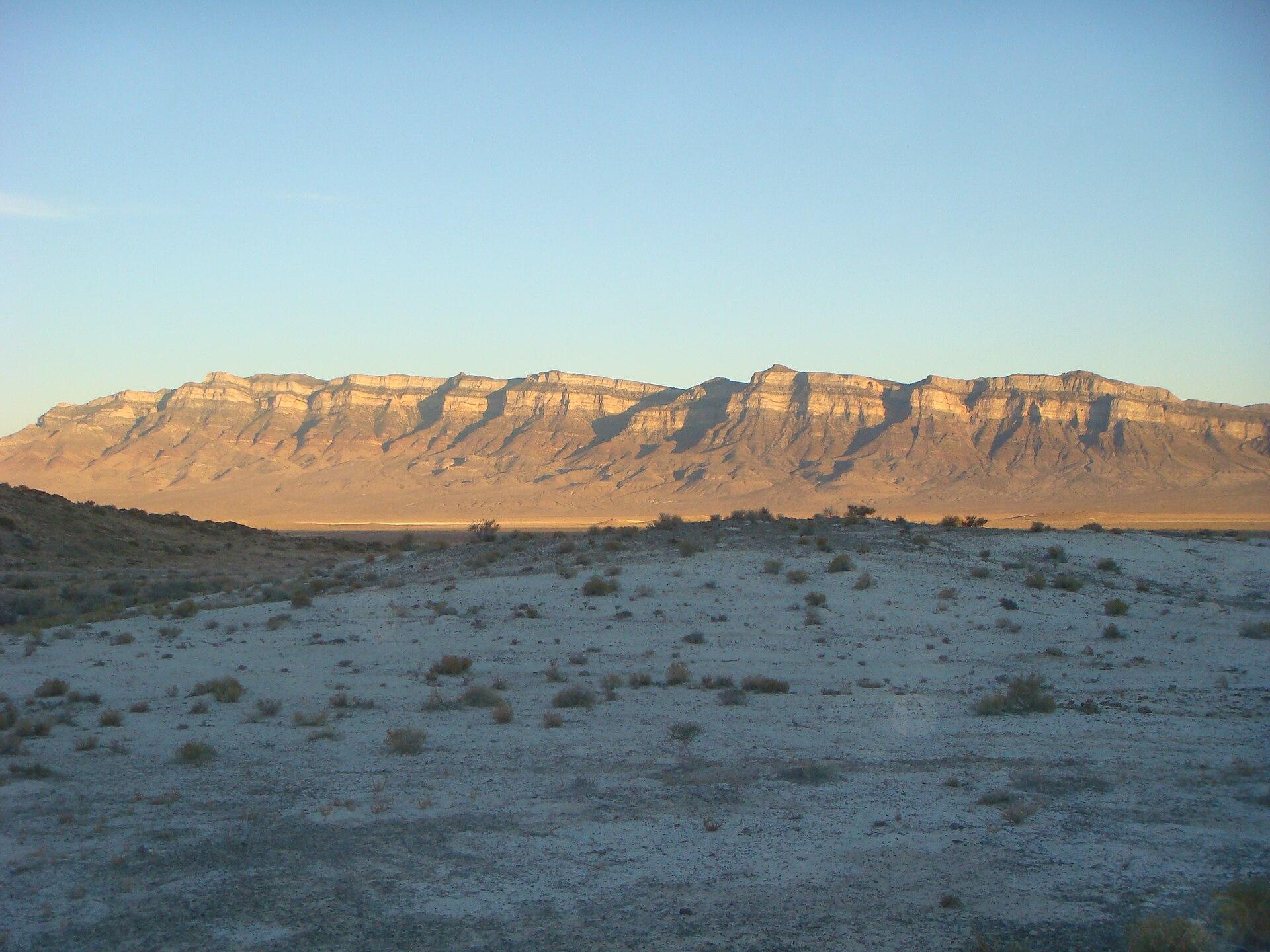
BLM Trilobite Quarry (Antelope Springs) Fossil Guide
Image: Qfl247 (CC BY-SA 3.0)
The BLM Trilobite Quarry in the House Range of Millard County, Utah, is a free public Cambrian fossil locality just down the road from the better-known fee-based U-Dig Fossils quarry. The Wheeler Shale exposes abundant Elrathia kingii and other Middle Cambrian trilobites weathering out of soft greenish shale. BLM rules allow casual personal collection of common invertebrate fossils.
By Edward Chen · Updated 31 July 2026
Introduction
The BLM Trilobite Quarry sits in the rugged House Range of west-central Utah, about 50 miles west of Delta in remote Millard County. The site exposes the Middle Cambrian (Wuliuan) Wheeler Formation, a thinly bedded greenish marine shale famous worldwide for its abundance of the small trilobite Elrathia kingii. The quarry is on federally administered Bureau of Land Management land and is free to visit. BLM rules allow casual personal collection of common invertebrate fossils in reasonable quantities.
It's the free counterpart to the well-known fee-based U-Dig Fossils Quarry on adjacent private land. The free BLM site requires more hiking, screening of scrap piles, and persistence, but the fossils are the same Wheeler Shale Elrathia, Asaphiscus, and other trilobites that have made the House Range a global Cambrian reference for nearly 150 years.
Location and Directions
The site is in the House Range of the western Great Basin, about 50 miles west of Delta, Utah, in Millard County. The drive is one of the more remote in the Lower 48.
Directions to the BLM Trilobite Quarry
From Delta, take US-50/US-6 west about 32 miles to the small junction at the Long Ridge Reservoir turnoff, then follow signed gravel roads (Antelope Spring Road and BLM access tracks) roughly 20 more miles southwest into the mountains. A high-clearance vehicle is essential. The road is rough, washboarded, and impassable in wet weather. There is no fuel, water, or cell service for the last 50+ miles, fuel up in Delta and bring more water than you think you need.
The quarry sits a few miles past the U-Dig Fossils private quarry. A small BLM sign marks the turnoff. Park on the existing flat area and walk in. The quarry itself is roughly an acre of worked slopes with scrap piles on several levels, bring a small hammer and chisel, work gloves, eye protection, sturdy boots, water, and sun protection. The summer heat is severe, and shade is non-existent.
Combine the trip with a stop at the U-Dig commercial quarry (closer to Delta, fee-based, with provided tools and freshly excavated rock), they're a 20-minute drive apart and serve different audiences.
 Photo: Famartin, CC BY-SA 4.0, via Wikimedia Commons
What Fossils You'll Find
The Wheeler Formation records a thinly layered Middle Cambrian (Drumian Stage, about 507 million years ago) marine basin known as the House Range Embayment, which formed on the western margin of the Laurentian (proto-North American) carbonate platform between the broader Drum and Marjum platforms. The thinly fissile black-to-greenish marine shales preserve trilobite exoskeletons in great numbers as undisturbed bed assemblages, and the formation is one of the global type sections for Drumian biostratigraphy.
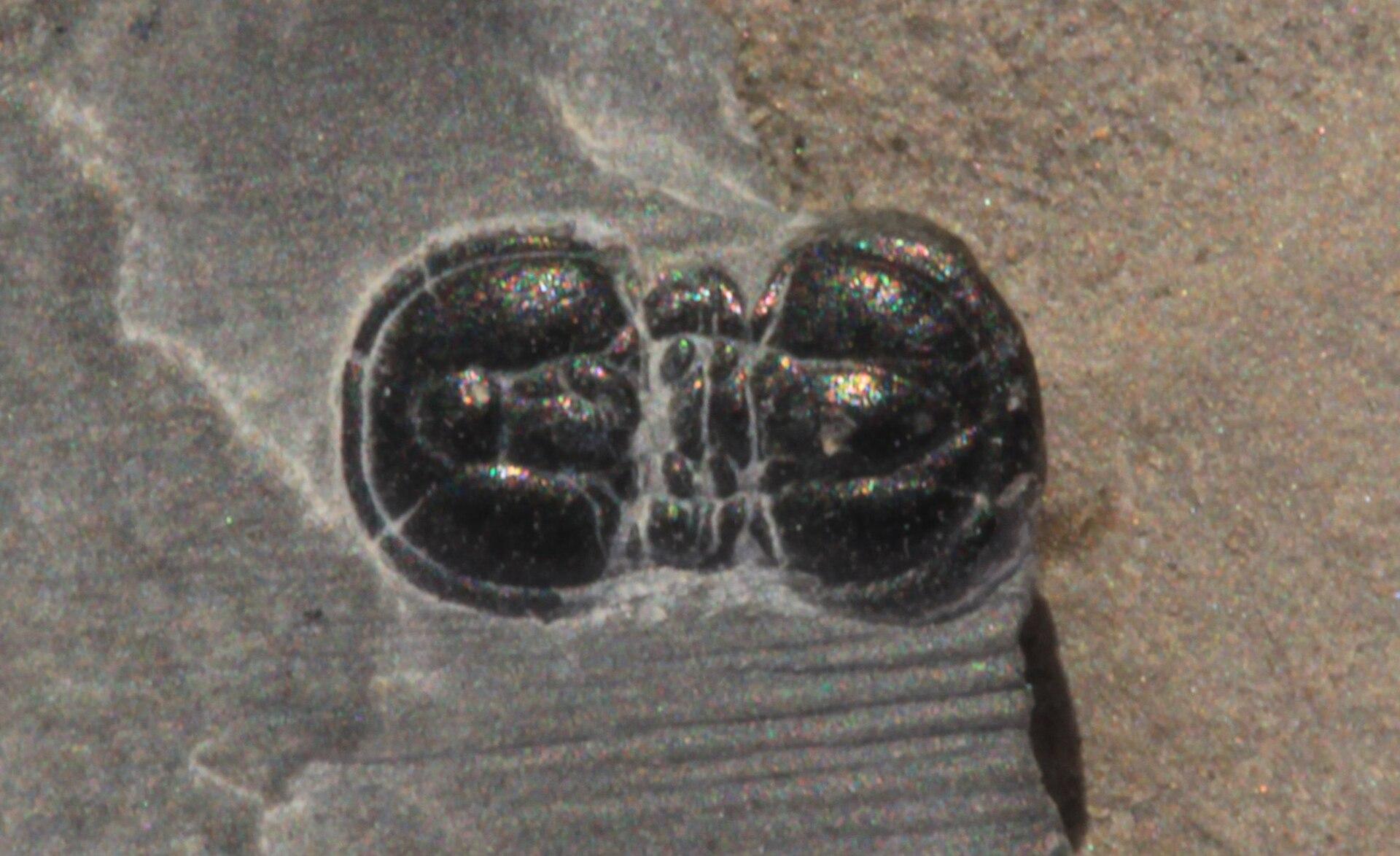
The classic find at the BLM Trilobite Quarry is the small ptychopariid trilobite Elrathia kingii. Typically 1 to 3 centimetres long, with a distinctive ovoid outline and a clear three-lobed division, Elrathia is so abundant in the Wheeler Shale that it has become the most commercially traded trilobite species in the world, virtually every American rock shop and natural-history gift store carries Elrathia specimens, almost all of them from the adjacent U-Dig commercial quarry just down the road. At the BLM site, you can readily find a dozen complete Elrathia in an afternoon of careful splitting, mostly as pyritised dark grey carapaces against pale grey to greenish shale.
Other trilobite species recovered include the larger Asaphiscus wheeleri, a 4- to 8-centimetre ptychopariid that is the second-most-common Wheeler trilobite, and the rarer, larger predator Olenoides nevadensis. Smaller and less common trilobites include Bolaspidella housensis, Modocia species, Ehmaniella waptaensis, Alokistocare, and the tiny agnostid Ptychagnostus atavus, a key Drumian biostratigraphic index fossil used worldwide. Whole enrolled specimens of any species are particularly prized and can fetch high prices in commercial markets (a reminder that BLM collection is for personal use only).
Beyond trilobites, the Wheeler fauna includes the small conical hyolith Haplophrentis carinatus (an extinct mollusc-like organism), small inarticulate brachiopods (Acrothele subsidua, Lingulella desiderata), the dish-shaped sponge Choia, rare echinoderm "buds" of Gogia and Gogiacystis, and small arthropod fragments. The famous Burgess Shale–type soft-bodied Lagerstätte horizons known from the Wheeler section elsewhere, preserving the worm Ottoia, the predator Anomalocaris, the bivalved arthropod Tuzoia, and assorted Cambrian oddities, are best developed in the Marjum Pass and Spence Shale localities further north and have produced striking finds for decades. The BLM Trilobite Quarry's productive bed at Antelope Springs is mostly trilobite-bearing shale rather than a soft-bodied Lagerstätte, but the same diagenetic setting that preserves soft tissue is present throughout the formation, and serendipitous soft-bodied finds are always possible.
The fauna provides one of the most complete pictures of post-Cambrian Explosion marine community structure in North America, and the Wheeler trilobites are used as global reference faunas for the Drumian Stage.
"BLM Trilobite Quarry is a completely free public site. As an undeveloped site, it may take a bit more hiking and effort to make desired finds." Nautiloid.net
 Photo: James St. John, CC BY 2.0, via Wikimedia Commons
Geologic History
During the Middle Cambrian (Wuliuan and Drumian stages, about 510 to 504 million years ago), what is now western Utah lay on the trailing-margin continental shelf of Laurentia (proto-North America), with the equator roughly running through modern southern Utah. The continent at the time was rotated about 90 degrees from its modern orientation, and the Laurentian western coastline faced an open ocean across what is now Asia. A series of carbonate platforms, ramps, and intervening deeper basins accumulated thick stacks of limestone, shale, and rare Lagerstätten horizons recording the early post-Cambrian Explosion diversification of complex marine life.
The Wheeler Formation specifically was deposited in the House Range Embayment, a deeper-water shaly basin between the Drum platform to the west and the Marjum platform to the east. Water depths were probably 100 to 200 metres, deep enough to be below normal storm-wave base, shallow enough to be within the photic zone for surface productivity. Periodic oxygen-poor bottom conditions preserved trilobite exoskeletons in great numbers as undisturbed bed assemblages, and the rare Konservat-Lagerstätte horizons within the formation preserve soft-bodied animals as carbon-film compressions analogous to the Burgess Shale of British Columbia.
The Wheeler is biostratigraphically divided into multiple zones based on agnostoid trilobite assemblages, and the Ptychagnostus atavus zone within the formation defines the global type boundary for the Drumian Stage of the Cambrian System, the only Stage GSSP (Global boundary Stratotype Section and Point) currently located in the United States. This makes the Wheeler Formation one of the world's most heavily cited Cambrian reference sections.
After deposition, the Wheeler Formation was deeply buried beneath younger Paleozoic, Mesozoic, and Tertiary cover. Tertiary Basin-and-Range extension beginning about 30 million years ago broke the western Cordilleran crust into a series of north-south-trending normal-fault-bounded blocks. The House Range is one of these uplifted blocks, with the Wheeler Formation now exposed on its steep eastern and southern slopes. Modern weathering of the soft shales onto the talus aprons provides the working scrap piles at the BLM Trilobite Quarry and at U-Dig.
The Wheeler Shale has been collected by scientific and commercial interests since the 1860s, when the first Elrathia kingii specimens were described by F. B. Meek for the United States Geological Survey. Charles Doolittle Walcott, the same paleontologist who later discovered the Burgess Shale, visited the House Range in the 1880s and produced foundational work on Wheeler trilobites. The Antelope Springs area was developed by Robert and Carol Hayes in the early 1970s as the U-Dig Fossils commercial quarry. The adjacent BLM Trilobite Quarry was set aside as a free public site at roughly the same time.
How the BLM Trilobite Quarry Came to Be a Collecting Site
The site is part of the Bureau of Land Management's House Range Cooperative Management Area, a public-land area open to recreational rockhounding. Public rockhounding and recreational fossil collecting on BLM lands are governed by 43 CFR 8365 and the Paleontological Resources Preservation Act (PRPA) of 2009. Common invertebrate fossils are explicitly permitted for casual personal collection in reasonable quantities, while vertebrate fossils and specimens of scientific interest require permits. The site has been managed informally with visitor goodwill for several decades. The BLM Fillmore Field Office is the responsible administrative unit.
 Photo: James St. John, CC BY 2.0, via Wikimedia Commons
Collecting Rules and Regulations
Is Fossil Collecting Allowed?
Yes, for common invertebrate fossils (trilobites included) in "reasonable amounts" for personal recreational use.
Key Points:
- Free public access. No permit or fee required
- Personal-use collection only, commercial sale is prohibited under BLM rules
- Reasonable quantities only (a small bucket per visitor per day is typical)
- No mechanised equipment (power tools, ATVs through closed areas)
- No collection of vertebrate fossils anywhere on BLM land without a permit
- No road use during or after wet weather. The access road becomes impassable
Safety
This is public land in the remote House Range with no staff, no facilities, and no help nearby. Unlike the commercial quarries in the same district, everything here is on you.
The remoteness is the primary hazard. The site is roughly 50 miles west of Delta, the last town with fuel, water, or a phone signal, and the final approach is unpaved desert road. Fill the tank, carry water for everyone plus a reserve, bring a full-size spare and the means to change it, and tell someone your route and expected return. Do not attempt the road in a low-clearance vehicle after rain, when it can wash out. A breakdown here is a serious situation rather than an inconvenience.
Desert heat and sun. Summer temperatures are severe and there is no shade at the quarry. The site sits at elevation, which increases ultraviolet exposure and speeds dehydration. Plan for the cooler months, start early, drink steadily rather than waiting for thirst, and wear a hat and long sleeves.
Splitting shale sends chips flying, so wear eye protection, and the plates have sharp edges, so take gloves. The spoil slopes are loose and uneven, and wearing boots with a firm sole matters more when the nearest medical help is over an hour away.
Rattlesnakes shelter under ledges and in rock piles through the warmer months, so look before reaching. Flash floods can run through washes during storms. Check current BLM conditions and access before setting out.

_(Wheeler_Formation,_Middle_Cambrian;_House_Range,_western_Utah,_USA)_1.jpg)
.jpg)