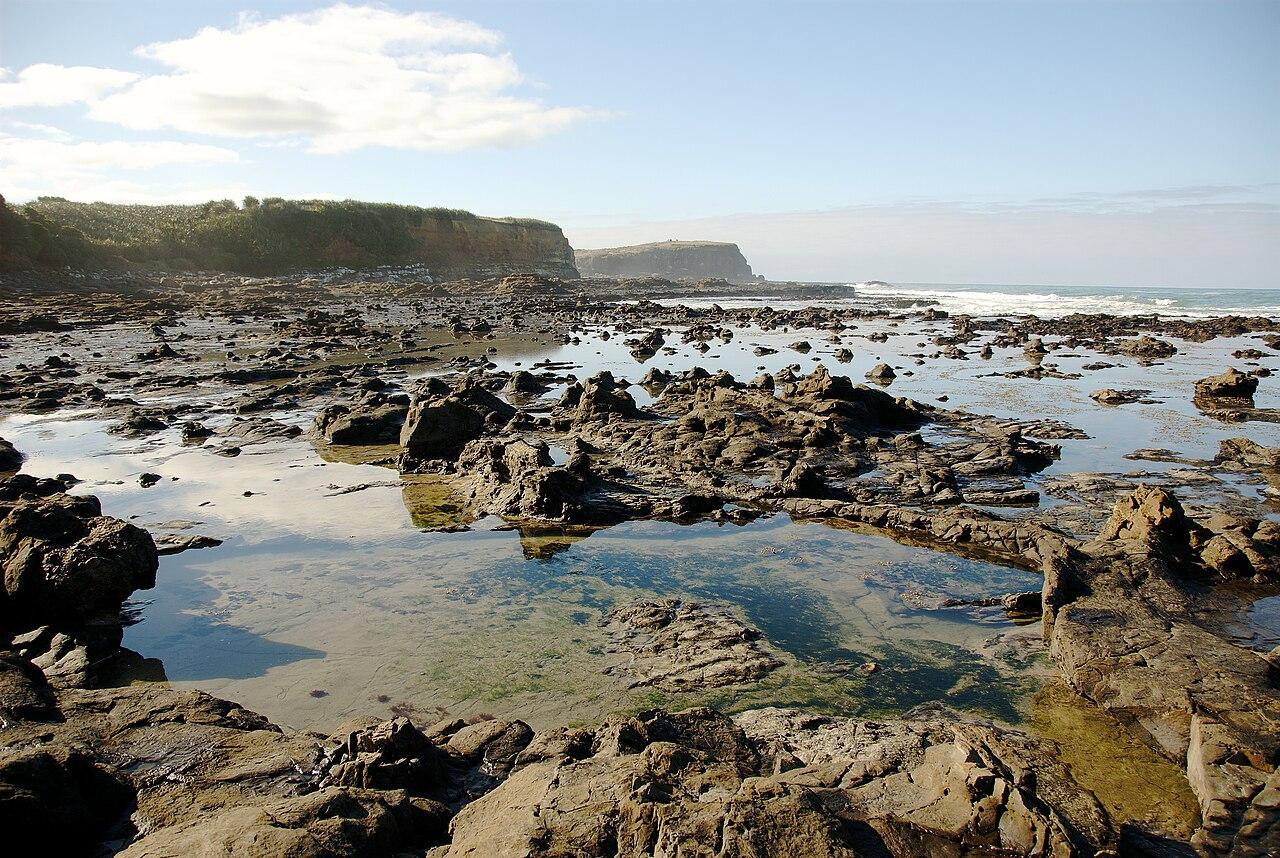
Curio Bay Petrified Forest Fossil Guide
Image: Karora (Public domain)
Curio Bay on the southern Catlins coast of New Zealand exposes a 170 million year old Middle Jurassic petrified forest. Fossilized conifer trunks and stumps lie in growth position across the wave-cut platform and are best seen at low tide. It is one of only three accessible in-situ Jurassic fossil forests in the world.
By Edward Chen · Updated 31 July 2026
Introduction
Curio Bay sits on the wild southern coast of the Catlins in Southland, near the village of Waikawa, and is one of the most accessible in-situ Jurassic petrified forests on Earth. At low tide, a broad wave-cut platform exposes the silicified trunks, stumps, and root systems of a coniferous forest that grew across this coastline roughly 170 million years ago, when New Zealand still lay on the eastern margin of Gondwana.
The Department of Conservation (DOC) manages the site as part of the Catlins coastal area. A sealed, wheelchair-accessible path leads to a viewing platform on the cliff edge. Steps lead down onto the rock platform itself, where the fossil wood is best examined two to three hours either side of low tide. Collecting and damage are prohibited.
This guide covers what you'll see, how to time tides for the best viewing, and the rules that protect this internationally studied fossil forest.
Location and Directions
Curio Bay is at the south end of the Catlins coast, roughly 90 km southwest of Invercargill and 175 km south of Dunedin.
Directions to Curio Bay
From Invercargill, follow the Southern Scenic Route (SH92) east, then signed local roads through Tokanui and Waikawa to Curio Bay. From Dunedin, follow SH1 south to Balclutha, then the Southern Scenic Route through Owaka and Papatowai to Curio Bay. A short sealed road from the Curio Bay holiday park leads to the cliff-top car park. The Tumu Toka CurioScape interpretive centre at the holiday park has displays on the petrified forest and the resident yellow-eyed penguins.
From the car park, a sealed track winds through native flax to a viewing platform overlooking the rock platform. The steps down to the platform itself are slippery when wet. Check Bluff or Tautuku tide times, low tide exposes the most fossil wood, and an incoming tide quickly cuts off the platform.
The neighbouring Porpoise Bay, just over the headland, hosts a resident pod of Hector's dolphins. The area is also home to yellow-eyed penguins and fur seals. Maintain at least 20 m from all wildlife.
 Photo: Anagoria, CC BY 3.0, via Wikimedia Commons

What Fossils You'll See
The fossil forest is preserved in the Curio Bay Formation of the Murihiku Supergroup, deposited during the Middle Jurassic about 170 to 180 million years ago. At least four superposed forest horizons are recognised along the foreshore, each buried by a separate volcanic mudflow event.
At low tide, visitors can walk among hundreds of large silicified tree stumps standing 30 to 60 centimetres tall in growth position, with flared root buttresses and concentric growth rings still clearly visible. The largest stumps are nearly a metre across at the base, and many have intact bark patterns and knotholes preserved in the silicified wood. Long horizontal trunks lie alongside the stumps, some over 30 metres long, fallen in the direction of the incoming mudflow that buried them. Polished sections of fallen wood reveal finely preserved cellular detail, tracheids, growth rings, and even occasional resin canals, in a pale brown to honey-coloured chalcedony.
The trees are mostly araucarian conifers closely related to modern kauri (Agathis australis) and Norfolk pine (Araucaria heterophylla). Anatomical work on the silicified wood places most of the Curio Bay stumps within the form-genus Agathoxylon and the closely related Mataia. Some smaller trunks have been assigned to the podocarp-relative Protophyllocladoxylon, suggesting a mixed araucarian-podocarp coastal canopy similar in floristic structure to the modern New Zealand kauri forest. Fine carbonaceous shales between the silcrete-rich horizons contain occasional impressions of bennettitalean and cycad-like cycadophyte leaves (Ptilophyllum, Otozamites), fern fronds (Cladophlebis, Coniopteris, Sphenopteris), and the gingko-related Sphenobaiera. Pollen and spore palynomorph assemblages have been used to refine the age of the deposit to the Aalenian–Bajocian (early Middle Jurassic). Insect, fish, or vertebrate fossils have not yet been recovered from the Curio Bay forest beds despite intensive prospecting.
The growth-position preservation is what makes Curio Bay internationally noted. Most fossil forests preserve wood after transport, logs in fluvial gravels, or driftwood concentrated on beaches, but Curio Bay preserves the trees standing exactly where they grew, killed in place, with their roots still attached to their original substrate. The closest comparable site is the Cerro Cuadrado Petrified Forest in Patagonia, Argentina (also Jurassic, also fed by volcanic mudflows from contemporaneous Andean arc volcanism).
"Curio Bay is of international significance for its Petrified Forest dating back to the Jurassic period. It is one of only three such accessible fossil forests in the world." Catlins Coast information
 Photo: Avenue, CC BY-SA 3.0, via Wikimedia Commons

Geologic History
About 180 million years ago, in the late Early to Middle Jurassic, the Curio Bay area was a broad forested coastal floodplain on the eastern margin of Gondwana, on the seaward flank of the rising Median Tectonic Zone arc that runs the length of the New Zealand basement. Andesitic and dacitic volcanism was active along the arc, with stratovolcanoes that we know from the surviving Hokonui and Murihiku volcanic-arc sequences. The Curio Bay floodplain lay just east of these volcanoes, separated from the open sea by a narrow back-arc basin.
A series of catastrophic lahars, water-saturated volcanic mud flows triggered most likely by heavy seasonal rain on barren ash-mantled volcanic slopes, surged eastward off the volcanic highland and buried the coastal forest at least four times over a period of about 20,000 years. Each lahar killed and buried the standing forest in place, then was capped by overbank ash and silt before the forest could re-establish. The buried wood was rapidly entombed in anoxic, hot, volcanically-influenced silica-laden groundwater. Over millennia, the silica replaced the wood cell by cell, producing today's finely detailed silicified fossils with cellular and even sub-cellular detail intact.
The Curio Bay Formation was subsequently buried by hundreds of metres of further Murihiku Supergroup sediment during the late Mesozoic, then uplifted, tilted, and exposed along the modern Southland coast during the Cenozoic Kaikōura Orogeny that built the Southern Alps. Marine erosion of the southern coast cuts gradually back into the formation and continuously exhumes new fossil trees on the wave-cut platform. New stumps appear after big southerly storms strip overlying sand.
The fossil forest was scientifically described in the late 19th century by the New Zealand Geological Survey, with key work by James Hector and later by James Park. Modern palynological and palaeobotanical work led by Mike Pole and colleagues from the 2000s onward has refined the age, palaeoclimate, and floristic interpretation of the deposit.
How Curio Bay Came to Be Protected
The petrified forest and the surrounding coast are managed as a Scientific Reserve and conservation area by New Zealand's Department of Conservation under the Reserves Act 1977 and the Wildlife Act 1953. The site is also a designated International Union of Geological Sciences (IUGS) Geoheritage Site under the IUGS First 100 list (2022).
 Photo: Mike Dickison, CC BY-SA 4.0, via Wikimedia Commons

Collecting Rules and Regulations
Is Fossil Collecting Allowed?
No. Damaging, hammering, or removing any fossil wood is prohibited.
Key Points:
- Free access at all daylight hours. Best viewing is around low tide
- No collection, hammering, or chiselling of any fossil
- No dogs in the reserve. Keep distance from penguins and seals
- Drones are not permitted at the Fossil Forest
- Watch the incoming tide carefully. The platform is cut off rapidly
Safety
The fossil forest at Curio Bay lies on a wave-cut platform below the high-tide line, and the tide here is genuinely dangerous rather than merely inconvenient.
The platform is cut off rapidly. The petrified stumps are exposed only around low water, and the incoming tide floods the platform quickly and from more than one direction. Check the tide before you go down, aim for the couple of hours either side of low water, keep your exit in view, and leave with a margin rather than at the last moment. Southern Ocean swell breaks across the platform without warning even on calm days, so never turn your back on the sea.
The rock is treacherous. The platform is slick with algae and cut by channels and pools, and the fossil stumps themselves are smooth and slippery. Wear boots with a firm sole and good grip, walk rather than stride, and expect wet feet.
This is protected wildlife habitat. Yellow-eyed penguins come ashore here, and fur seals and sea lions haul out on the rocks. Keep a substantial distance, never get between an animal and the sea, and be aware that sea lions can move fast and will defend space. Dogs are not permitted in the reserve.
The Catlins coast is exposed and the weather changes fast, so bring windproof and waterproof layers whatever the morning looks like. Nothing may be collected, hammered, or chiselled, and drones are not permitted at the fossil forest.
Sources
Nearby sites
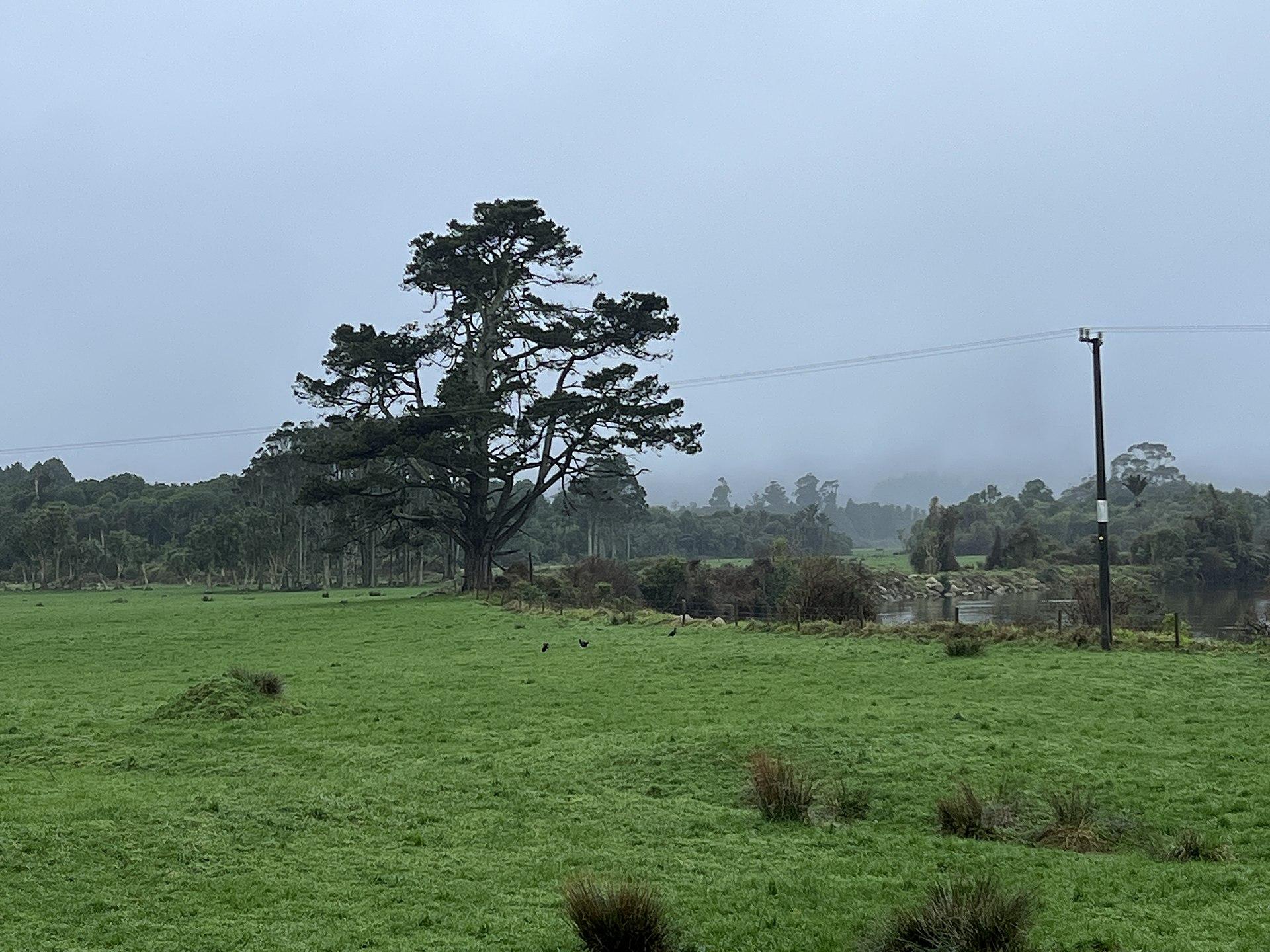 Honeycomb Hill Caves Fossil Hunting GuideMoa (Pachyornis, Dinornis, Megalapteryx), Haast's eagle (Hieraaetus moorei)
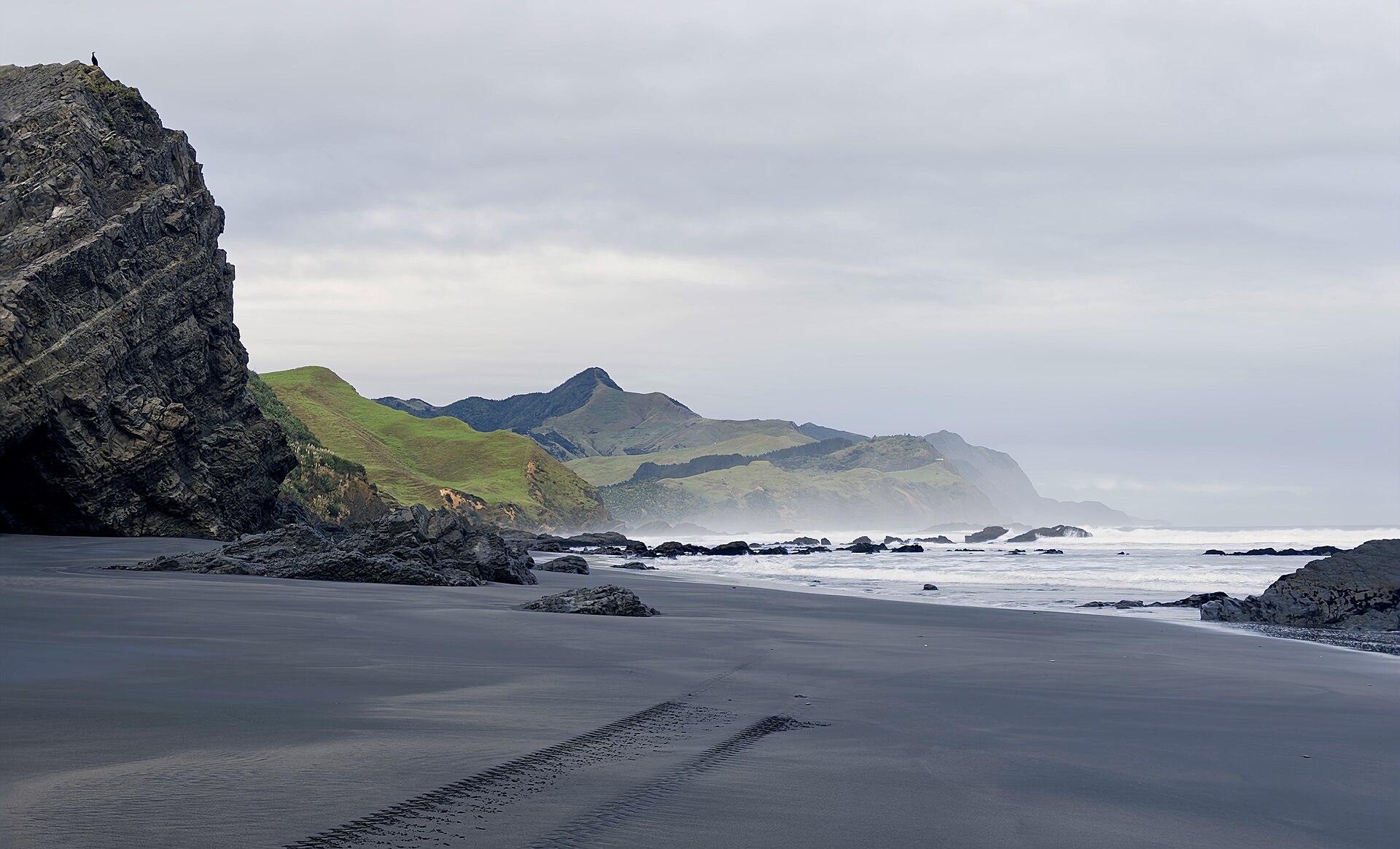 Kiritehere Beach, Marokopa Fossil Hunting GuideBivalves, Monotis
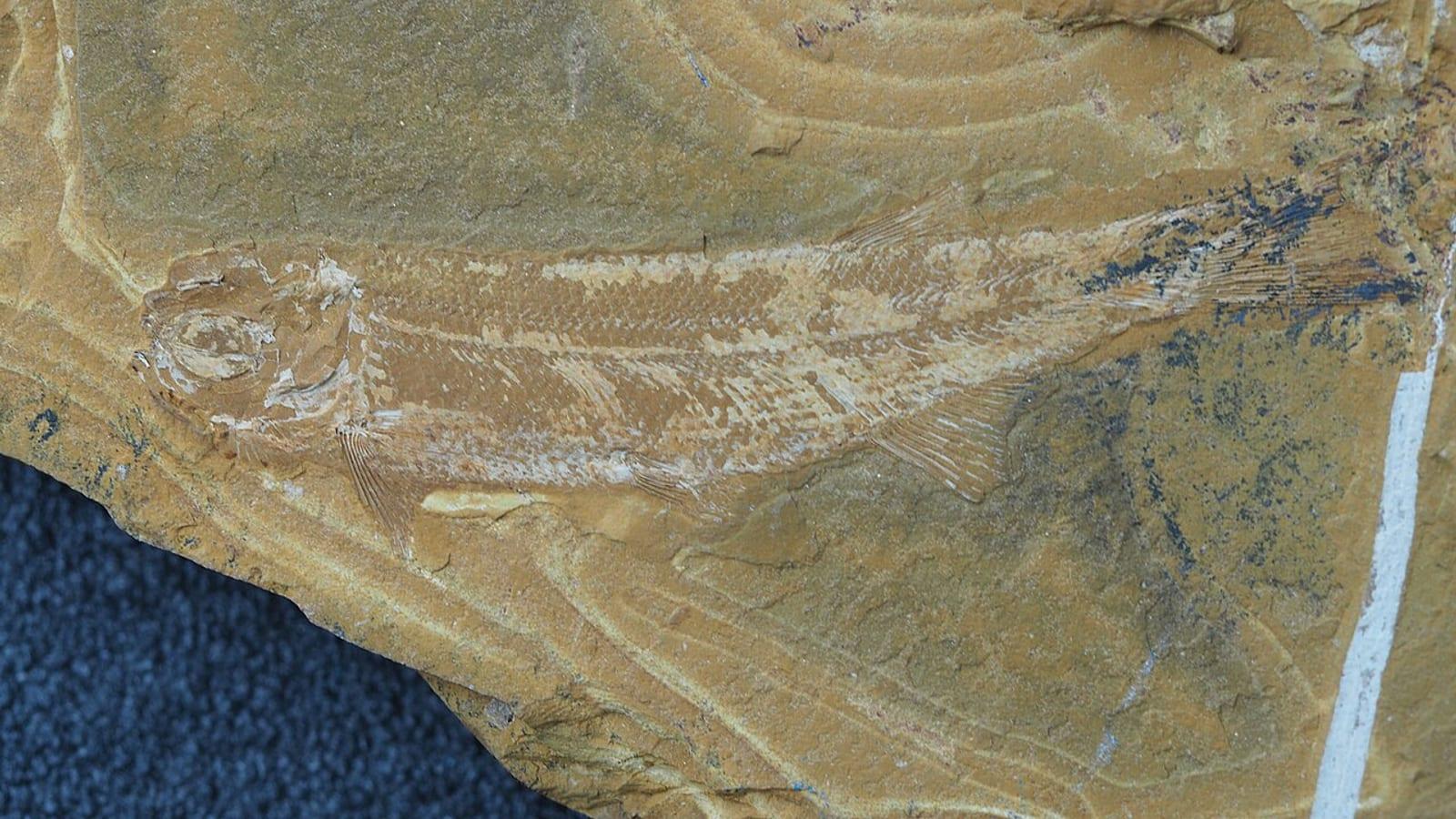 Talbragar Fossil Site Jurassic Fish Gulgong Fossil Hunting GuideFish, Plants
 Lufeng World Dinosaur Valley Fossil Hunting GuideLufengosaurus huenei, Yunnanosaurus huangi