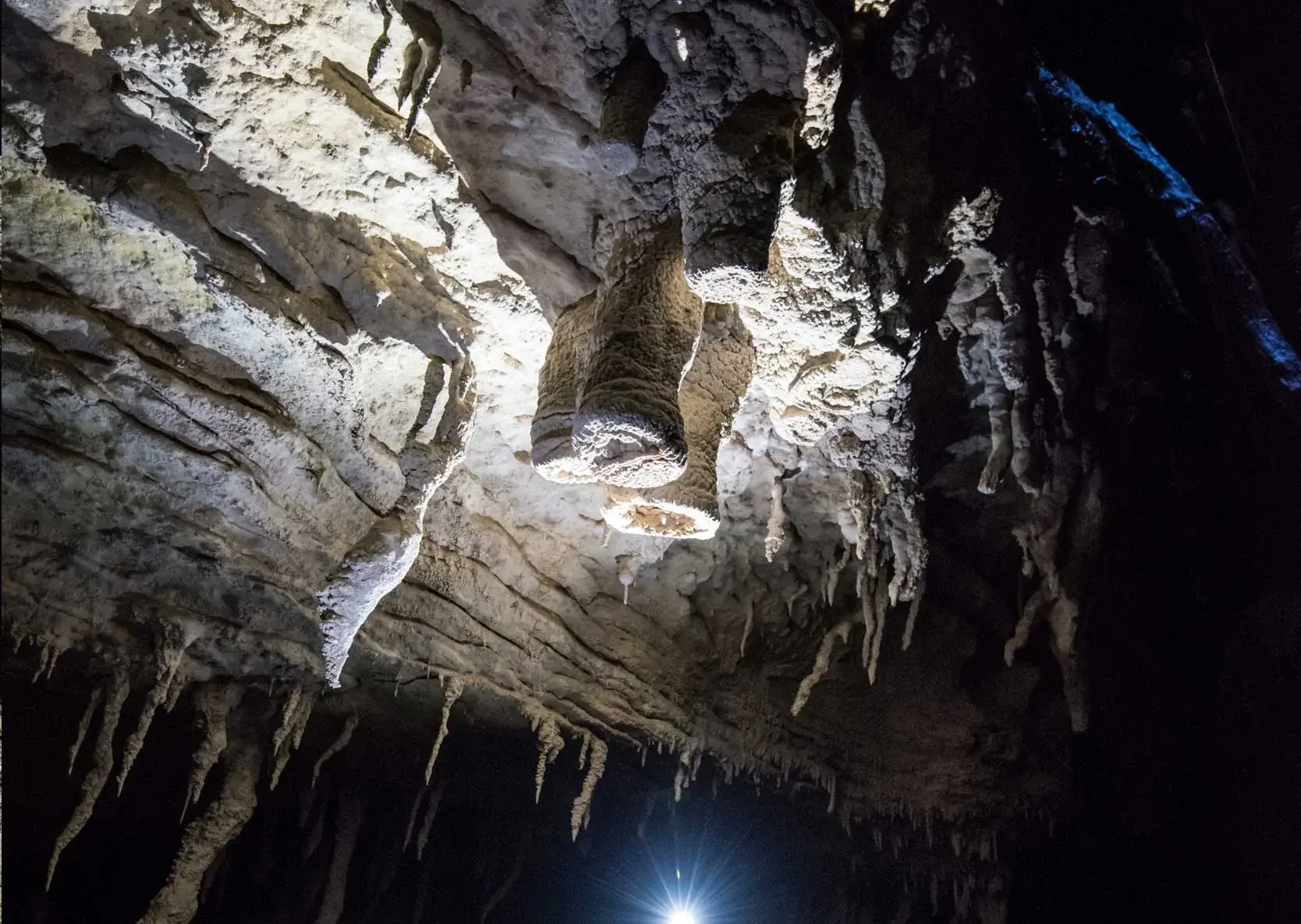
Honeycomb Hill Caves Fossil Hunting Guide
Honeycomb Hill Caves in the Oparara Basin of Kahurangi National Park, northern South Island of New Zealand, hold the largest and most varied collection of sub-fossil bird bones found in the country, including nine moa species and the giant Haast's eagle. Access is by guided tour only, with a Department of Conservation concessionaire.
By Edward Chen · Published 4 June 2026
Introduction
Honeycomb Hill Caves sit on the northern flank of the Oparara Valley in Kahurangi National Park, on the West Coast of the South Island of New Zealand. The cave network developed in the Oparara Limestone, a karstified Eocene to Oligocene marble that crops out across the Oparara Basin north of the small town of Karamea. The caves contain the largest and most varied collection of sub-fossil bird bones found anywhere in New Zealand, with more than 50 vertebrate species documented from cave floor accumulations. Most of the material is late Pleistocene to Holocene in age, between roughly 20,000 and 700 years before present. The fauna includes nine species of moa, the giant Haast's eagle (Hieraaetus moorei), Finsch's duck (Chenonetta finschi), the New Zealand owlet-nightjar (Aegotheles novaezealandiae), and a range of other extinct and surviving native birds. The caves were declared a Specially Protected Area under the National Parks Act in 1981, and public access is restricted to Department of Conservation (DOC) approved guided tours. The principal concessionaire is Oparara Guided Tours, based in Karamea. Collecting is prohibited. This guide covers how to book a tour, what each route shows, the Quaternary geology, and the rules that apply.
Location and Directions
Karamea sits at the northern end of State Highway 67 on the West Coast of the South Island, about 100 kilometres north of Westport and 480 kilometres west of Christchurch. The road in from Westport climbs the Karamea Bluff and is paved throughout. From Nelson on the north coast, an unsealed alternative route runs over Karamea Pass through the Wangapeka Track area, but it is closed to vehicles.
The Oparara Basin car park is at the end of McCallum's Mill Road, about 25 kilometres north of Karamea. GPS for the car park is 41.1761 degrees south, 172.1239 degrees east. The road is unsealed for the last 17 kilometres and is suitable for standard passenger cars in dry weather. Logging-truck traffic uses the road on weekdays.
The Honeycomb Hill Caves themselves lie about 4 kilometres north of the car park and are reached by a DOC-controlled access track that is not open to independent visitors.
The principal concessionaire is Oparara Guided Tours, based at the Karamea Information & Resource Centre. Tours run year round, weather permitting, on a schedule of one to two departures per day. The standard Honeycomb Hill Caves tour lasts about 2.5 to 3 hours, with a minimum group size of two and a maximum of eight. The standard adult fare at the time of writing is NZD 155 per person. Booking is required and can be made through the Karamea Information Centre or directly with Oparara Guided Tours.
Several shorter unguided walks in the Oparara Basin, including to the Oparara Arches and to the Mirror Tarn, do not require a permit and are open year round. The Honeycomb Hill Specially Protected Area is the only part of the basin restricted to guided access.
What Fossils You'll Find
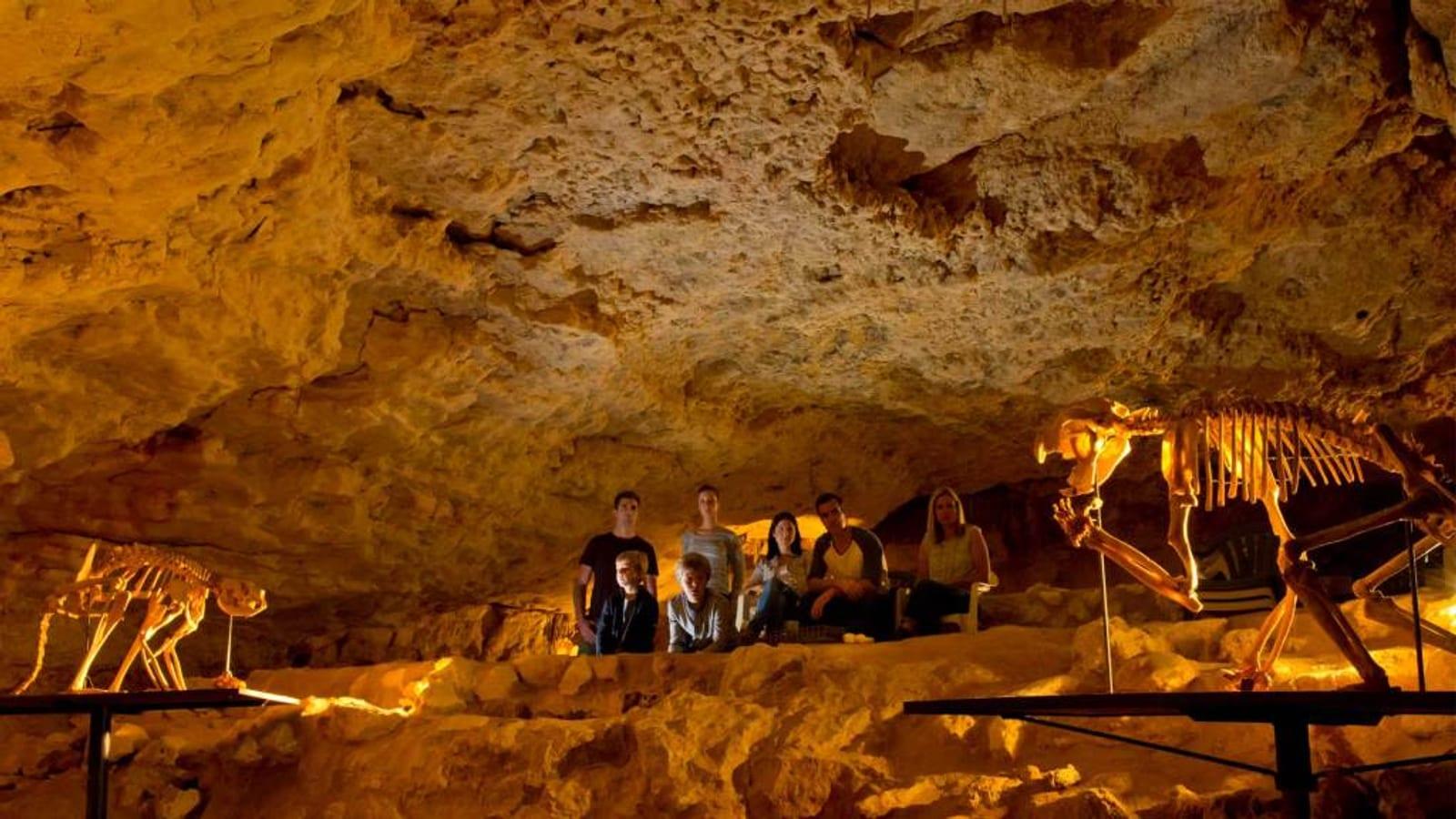
You will not collect at Honeycomb Hill. What you can do is walk into the cave system with your guide and see in-place sub-fossil bird bones lying on the cave floor exactly where they were deposited. Identifications follow the published vertebrate species list maintained by Te Papa Tongarewa, the Museum of New Zealand, and by DOC's natural-history records.
- Moa. Nine moa species have been recorded from Honeycomb Hill, including the small bush moa (Pachyornis), the large Dinornis, and the upland Megalapteryx didinus. Articulated moa skeletons, including some with skin and feather impressions, are present on several cave floor surfaces.
- Hieraaetus moorei (Haast's eagle). The largest known eagle, with an estimated wingspan of 2.6 to 3 metres. Skull and limb material has been recovered from the caves and is held at Te Papa and the Canterbury Museum.
- Chenonetta finschi (Finsch's duck). A flightless duck known only from sub-fossil material in New Zealand caves.
- Aegotheles novaezealandiae (New Zealand owlet-nightjar). A small flightless nocturnal bird, extinct since European settlement.
- Surviving species. Kakapo (Strigops habroptilus), kokako, takahe, and yellowhead bones occur with the extinct species, recording the pre-human community structure.
- Other vertebrates. Tuatara (Sphenodon) bones and a small skink fauna are present in some cave floor accumulations.
Several of the cave passages have moa footprints preserved in soft cave-floor sediment. Te Papa Tongarewa in Wellington and the Canterbury Museum in Christchurch hold the principal prepared collections.
Geologic History
The Oparara Basin is underlain by the Oparara Limestone, a thick (about 600 metres) sequence of carbonate rocks deposited on the New Zealand continental shelf during the late Eocene to early Oligocene, roughly 38 to 28 million years ago. The unit was uplifted to the surface during the late Cenozoic by movement along the Alpine Fault and rotation of the western South Island. Modern karst dissolution of the limestone has produced an extensive cave network with passages running up to 13 kilometres in total mapped length.
The Honeycomb Hill cave system formed by gradual solution of the limestone by groundwater flowing through joints and bedding planes over the last 1 to 2 million years. Surface streams cut down into the limestone, and as the cave roofs collapsed, large entrance shafts called tomos opened to the surface. Flightless birds, tuatara, and frogs that approached the tomos sometimes fell in and could not climb out, accumulating skeletons on the cave floor over thousands of years.
Radiocarbon ages on moa bones and surrounding plant material from Honeycomb Hill cluster between about 20,000 and 700 years before present. The youngest dates fall in the last few centuries before Polynesian arrival in New Zealand around 1280 CE. The cave floor accumulation captures a continuous record of the New Zealand land bird community from the last glacial maximum through the start of human settlement.
After Polynesian arrival, hunting reduced the moa to extinction by roughly 1450 CE. Haast's eagle followed shortly after, with the loss of its main prey base.
How Honeycomb Hill Became a Fossil Site
European caving and exploration of the Oparara Basin began in the early twentieth century, but Honeycomb Hill was first mapped systematically by the New Zealand Speleological Society in the late 1970s. Survey work by Roger Hyde, Bruce Hodson, and Graham Reade documented the entrance tomos and the in-place sub-fossil bone deposits between 1978 and 1981. The Royal Forest and Bird Protection Society of New Zealand campaigned successfully for protection of the area, and the Specially Protected Area designation was applied in 1981, the year that Kahurangi National Park's predecessor reserve was expanded to include the Oparara Basin.
Trevor Worthy of the Museum of New Zealand led the principal paleontological excavations in the 1980s and 1990s, producing a series of monographs on the cave bird fauna that remain the standard reference. Worthy and Richard Holdaway published "The Lost World of the Moa" in 2002, drawing heavily on Honeycomb Hill material. Research collection continues each year under DOC permit, and many of the more delicate specimens have been moved to Te Papa and the Canterbury Museum for long-term curation.
Collecting Rules and Regulations
Collecting is prohibited. Honeycomb Hill Caves is a Specially Protected Area under the National Parks Act 1980, within Kahurangi National Park. Removing fossils, rocks, plants, or any material from the area is an offence under the National Parks Act and the Wildlife Act 1953. Sub-fossil moa material is also covered by the Protected Objects Act 1975.
Practical rules:
- Public access is by DOC-approved guided tour only. Independent travel into the Specially Protected Area is not allowed.
- Stay with the guide and on the designated track inside the caves. The cave floor sub-fossil deposits are extremely delicate.
- Photography for personal use is permitted with the guide's approval. Flash use is restricted near sensitive deposits to minimise impact on cave invertebrate fauna.
- Drones are not permitted inside Kahurangi National Park.
- Pets are not allowed in the national park.
- Research collection is restricted to permitted teams working under DOC concession and under permit from the Ministry for Culture and Heritage.
Safety
The West Coast of the South Island receives some of the highest rainfall in New Zealand. Rain gear and warm layers are essential year round. Carry waterproof outer layers and a warm fleece even in summer (December through February).
The cave system is wet, cold, and uneven underfoot. Sturdy waterproof tramping boots with good ankle support are required. The standard guided tour involves about 2 hours of walking inside the caves, with several short scrambles over rock ledges.
Carry a packed lunch and water for the trip. The Karamea Information Centre and Oparara Guided Tours can advise on current conditions.
Sandflies are persistent on the West Coast from October through May. Carry strong insect repellent.
Cell coverage on the access road to the Oparara Basin is intermittent. Coverage in Karamea town is reliable.
Sources
- Karamea Information Centre, "Oparara Basin." https://www.karameainfo.co.nz/oparara-basin
- Oparara Guided Tours. https://www.oparara.co.nz/
- West Coast NZ, "Oparara Experience." https://westcoast.co.nz/visit/plan-your-trip/oparara-experience/
- Worthy, T.H. and Holdaway, R.N., 2002. "The Lost World of the Moa: Prehistoric Life of New Zealand." Indiana University Press.
- Worthy, T.H., 1993. "Fossils of Honeycomb Hill." Museum of New Zealand Te Papa Tongarewa.