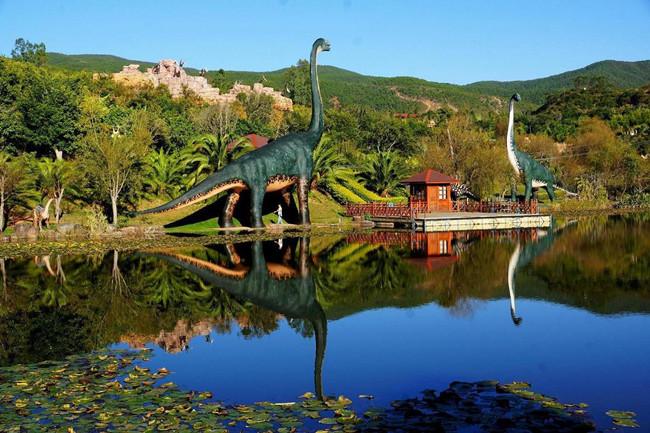
Lufeng World Dinosaur Valley Fossil Hunting Guide
Lufeng World Dinosaur Valley in Yunnan Province, China, is a fossil park and museum built around the type locality of Lufengosaurus huenei, an Early Jurassic sauropodomorph first described in 1941. Roughly 150 articulated skeletons have been recovered from the Lower Lufeng Formation. Viewing-only.
By Edward Chen · Published 4 June 2026
Introduction
Lufeng World Dinosaur Valley is a fossil-themed park and museum complex in Jinshan Town, Lufeng County, in the Chuxiong Yi Autonomous Prefecture of Yunnan Province, southwest China. The park sits roughly 80 kilometres west of Kunming on the Kunming-Chuxiong expressway. The surrounding hills expose the Lower Lufeng Formation, a continental Early Jurassic sequence that is the type unit of the Lufeng Saurischian Fauna. Since farmers first found large bones near the modern park in 1938, roughly 150 articulated skeletons of dinosaurs and other archosaurs have been excavated, including the type material of Lufengosaurus huenei, Yunnanosaurus huangi, and the basal theropod Sinosaurus triassicus. The Lufeng dinosaurs were described by the pioneering Chinese paleontologist Yang Zhongjian (C.C. Young) between 1940 and 1951 and remain a foundational sample of Asian Early Jurassic land vertebrates. The park complex includes the World Dinosaur Valley scenic area, a re-roofed in-place excavation pit known as the Original Site Hall, the Lufeng Dinosaur Museum with mounted skeletons, and an outdoor recreation area aimed at family visitors. Collecting is prohibited. This guide covers how to reach Lufeng, what each section of the park shows, the Early Jurassic geology, and the rules that apply.
Location and Directions
Lufeng County sits in central Yunnan Province, about 80 kilometres west of the provincial capital, Kunming. The simplest approach is to fly into Kunming Changshui International Airport, then take a 1-hour drive west on the G56 Kunchu Expressway to the World Dinosaur Valley expressway exit.
The park entrance is at GPS 25.1542 degrees north, 102.0808 degrees east, on the southwest edge of Jinshan Town. The expressway exit toll is roughly 35 CNY one way for a small car.
Visitors without a car can take a long-distance bus from the Kunming West Bus Station to Lufeng (about 36 CNY, 90 minutes), then a local minibus from the Lufeng County bus station to the park (12 CNY, 40 minutes). Several Yunnan tour operators include Lufeng as a day trip from Kunming with private car and English-speaking guide.
The park is open daily, roughly 8:30 a.m. to 5:30 p.m., with the last entry around 4:30 p.m. The standard adult ticket for the World Dinosaur Valley scenic area is approximately 120 CNY at the time of writing, with discounts for students, seniors, and groups. Combined tickets that add the Dinosaur Museum or the sightseeing bus cost more.
The town of Lufeng has standard Chinese-budget hotels, restaurants, and basic groceries. Chuxiong city, 60 kilometres further west, has more lodging options. Kunming, with the airport, is the main full-service hub.
What Fossils You'll Find
You will not collect at Lufeng. What you can do is see articulated skeletons exposed in the original rock at the Original Site Hall, walk through the Lufeng Dinosaur Museum, and read on-site panels that describe each species. Identifications below follow Yang Zhongjian's original descriptions and more recent revisions by Paul Barrett, Adam Yates, and Cecilia Apaldetti.
- Lufengosaurus huenei. A 6-metre basal sauropodomorph, the type specimen for the genus, described by Yang Zhongjian in 1941. Multiple articulated skeletons are exposed in the Original Site Hall.
- Yunnanosaurus huangi. A second sauropodomorph from the same beds, distinguished from Lufengosaurus by tooth morphology.
- Sinosaurus triassicus. A medium-sized basal theropod with a distinctive paired skull crest, originally named in 1948 and revised in 2003. The skeleton on display in the museum is one of the most complete Early Jurassic theropods in Asia.
- Chinshakiangosaurus chunghoensis. A possible early sauropod known from limited cranial and mandibular material.
- Tritylodontid synapsids. Small mammal-forerunner taxa Bienotherium, Oligokyphus, and Lufengia are represented in the same beds.
- Early Jurassic mammals. Multituberculate and morganucodontan teeth recovered from microsite work elsewhere in the Lufeng basin.
The Original Site Hall preserves at least 20 articulated specimens still embedded in matrix on the original quarry floor. The neighbouring museum holds full mounted casts of Lufengosaurus and Sinosaurus along with original cranial material in display cases.
Geologic History
The Lower Lufeng Formation is a continental fluvial-lacustrine sequence dominated by red mudstone, fine sandstone, and concretionary horizons. The formation is divided into a lower Shawan Member and an upper Zhangjiawa Member, both of which contain the Lufeng Saurischian Fauna. Recent biostratigraphic, magnetostratigraphic, and U-Pb work on detrital zircons constrain the section to the late Hettangian through Pliensbachian stages of the Early Jurassic, between roughly 200 and 184 million years ago.
The Lufeng basin during the Early Jurassic was a wide intermontane lake and floodplain system bordered by uplands of older Triassic and Permian rocks. Streams shed sediment into the basin from highlands to the north and east, building thick mudstone-dominated floodplains and shallow lakes. Climate was strongly seasonal, with seasonal drying contributing to mass-mortality concentrations of dinosaurs at lake margins.
Most of the articulated Lufengosaurus and Yunnanosaurus skeletons were buried in fine overbank mudstone with little post-mortem transport, indicating quiet floodplain settings rather than channel concentration. Volcanic ash and bentonite horizons in the section provide tie points for radiometric dating.
After the Lower Lufeng Formation was deposited, the basin was buried by Cretaceous strata, then uplifted during late Cenozoic Tibetan Plateau growth. Modern erosion has exposed the productive horizons in the hill country around Lufeng County.
How Lufeng Became a Fossil Site
The first bones were noticed by farmers turning fields north of the modern park in 1938, during the early years of the Sino-Japanese War. Bian Meinian, then a graduate student under Yang Zhongjian at the Geological Survey of China in wartime Kunming, brought the find to Yang's attention. Yang led the first excavation in 1939 and described the type material of Lufengosaurus huenei in a 1941 monograph published in Beijing. Excavation continued through the 1940s, even as the wartime government relocated repeatedly across western China, and Yang published a series of additional Lufeng monographs through 1951.
Modern research has been led by the Institute of Vertebrate Paleontology and Paleoanthropology (IVPP) in Beijing, in collaboration with the Yunnan Cultural Relics and Archaeological Research Institute, the Lufeng Dinosaur Museum, and visiting international teams. The World Dinosaur Valley scenic area was developed around the historic quarry hillsides in the late 2000s. The site is registered as a national-level geological park under the Chinese Ministry of Land and Resources.
Collecting Rules and Regulations
Collecting is prohibited. Lufeng World Dinosaur Valley is administered by the Chuxiong Cultural Affairs Bureau and the local government of Lufeng County in cooperation with the Yunnan Cultural Relics and Archaeological Research Institute. Removing or damaging fossils inside the park is an offence under the Law of the People's Republic of China on the Protection of Cultural Relics and the Regulations on the Protection of Fossils issued by the State Council in 2010.
Practical rules:
- Stay on marked walkways and boardwalks in the Original Site Hall. Touching the in-place skeletons is not permitted.
- Photography for personal use is welcomed throughout the park.
- Standard adult ticket and combined-ticket options apply. Children under 1.2 metres tall enter free.
- Drones are not permitted in the scenic area without prior written permission.
- Pets are not allowed in the museum or original-site hall.
- Research collection is restricted to permitted teams working under the IVPP and Yunnan provincial authorities.
The nearby Yunnan Provincial Museum in Kunming holds additional Lufeng material that is open to the public for free with photo ID.
Safety
Lufeng sits at about 1,800 metres elevation. Visitors arriving from sea level may notice mild altitude effects on the first day.
Summer temperatures (May through September) reach 28 to 30 degrees Celsius, with afternoon rain common in July and August. Winter (December through February) is dry and cool, with daytime highs around 15 degrees and overnight lows near freezing. Carry layers in any season.
The park grounds are paved and largely level. The Original Site Hall is roofed and accessible. Some outdoor scenic walks involve moderate stair climbs.
Cell coverage is reliable within the park and along the expressway. Carry a printed map or screenshot of the park layout because signage is primarily in Chinese, with limited English.
Sources
- Yunnan Exploration, "Lufeng Dinosaur Museum, Chuxiong." https://www.yunnanexploration.com/lufeng-dinosaur-museum-chuxiong.html
- Wikipedia summary of the Lufengosaurus literature. https://en.wikipedia.org/wiki/Lufengosaurus
- Young, C.C. (Yang Zhongjian), 1941. "A complete osteology of Lufengosaurus huenei Young (gen. et sp. nov.) from Lufeng, Yunnan, China." Palaeontologia Sinica, Series C, 7.
- Barrett, P.M. et al., 2014. "The osteology and systematic position of the sauropodomorph dinosaur Yunnanosaurus huangi." Journal of Vertebrate Paleontology, 34.