Walton-on-the-Naze Fossil Hunting Guide
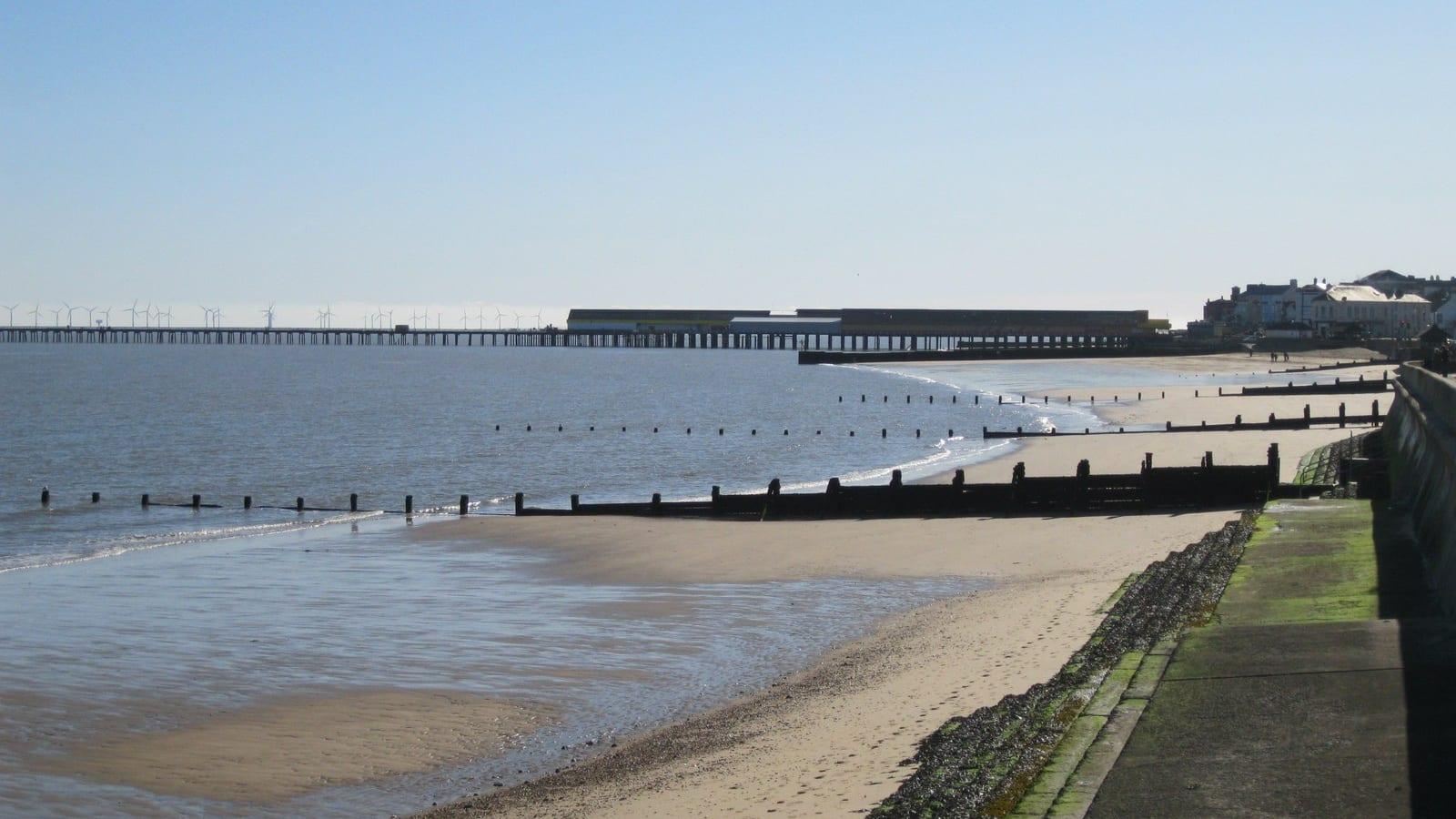
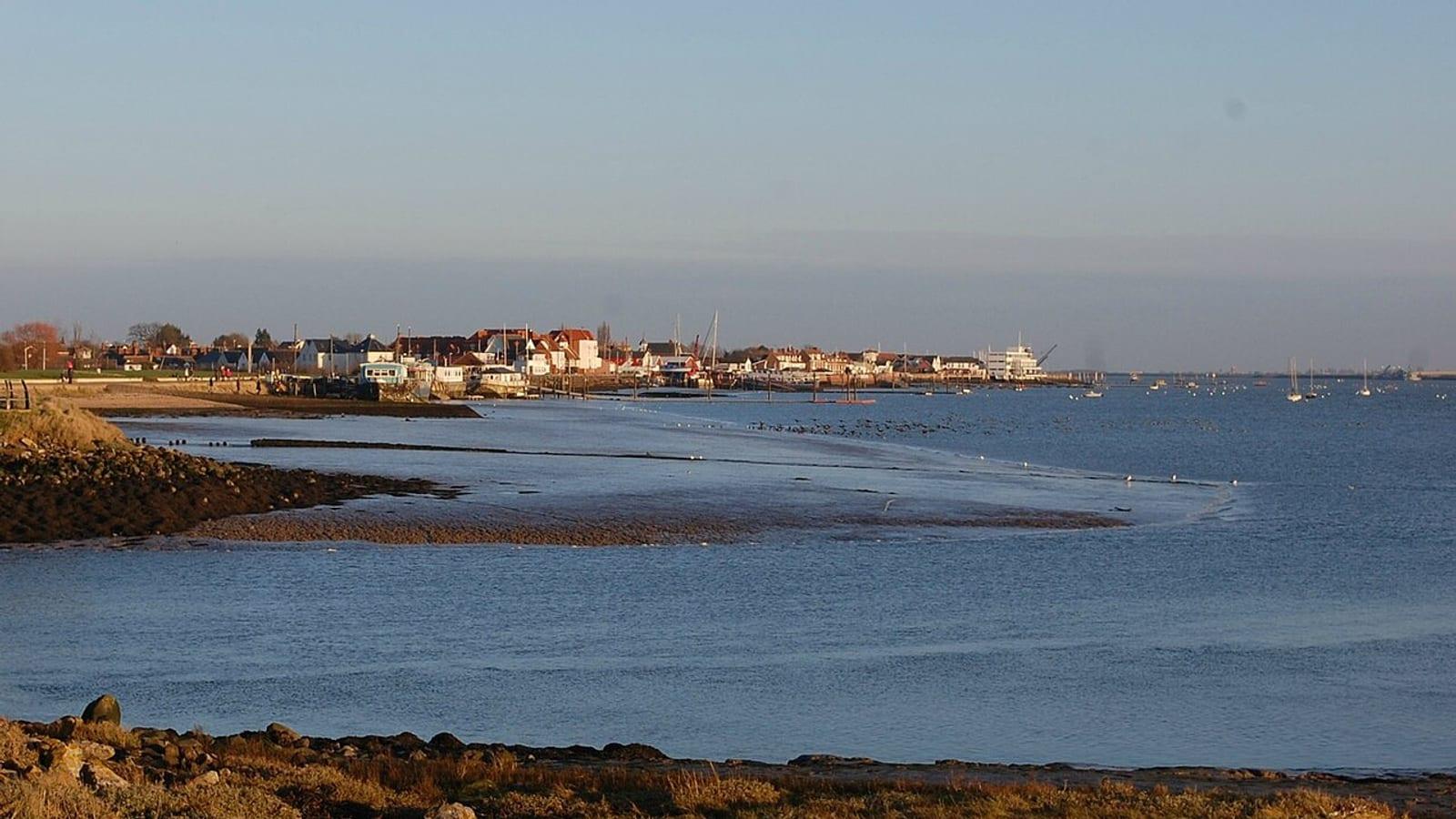
Image: Bob Jones (CC BY-SA 2.0)
Walton-on-the-Naze in Essex exposes Eocene London Clay and Pliocene Red Crag, yielding shark teeth, molluscs, pyritised wood, and rare bird fossils. SSSI collecting guide.
By Edward Chen · Updated 30 July 2026
Introduction
Walton-on-the-Naze in Essex offers two entirely separate fossil-bearing sequences in the same clifftop exposure, and the combination makes it the most productive coastal fossil site in East Anglia. The lower cliffs expose the Eocene London Clay Formation, approximately 54 to 50 million years old, which is the source of pyritised fossil wood, shark teeth, fish bones, and the bird fossils that have made this one of the richest Eocene avian fossil sites in the world. Above the London Clay, separated by a significant time gap, the Pliocene Red Crag Formation was deposited approximately 3.2 to 2.4 million years ago and yields abundant mollusc shells, fish fragments, and occasional mammal remains. The cliffs are eroding at 1 to 2 metres per year, constantly exposing fresh material on the beach below.
The site is designated as an SSSI and managed partly by Essex Wildlife Trust. The Naze Nature Discovery Centre at the end of Old Hall Lane is the starting point for visiting, and a 2-mile circular trail leads from there to the cliff and beach. This guide covers the two-formation sequence in detail, what each yields, how to plan a visit around the tides, and the current collecting rules.
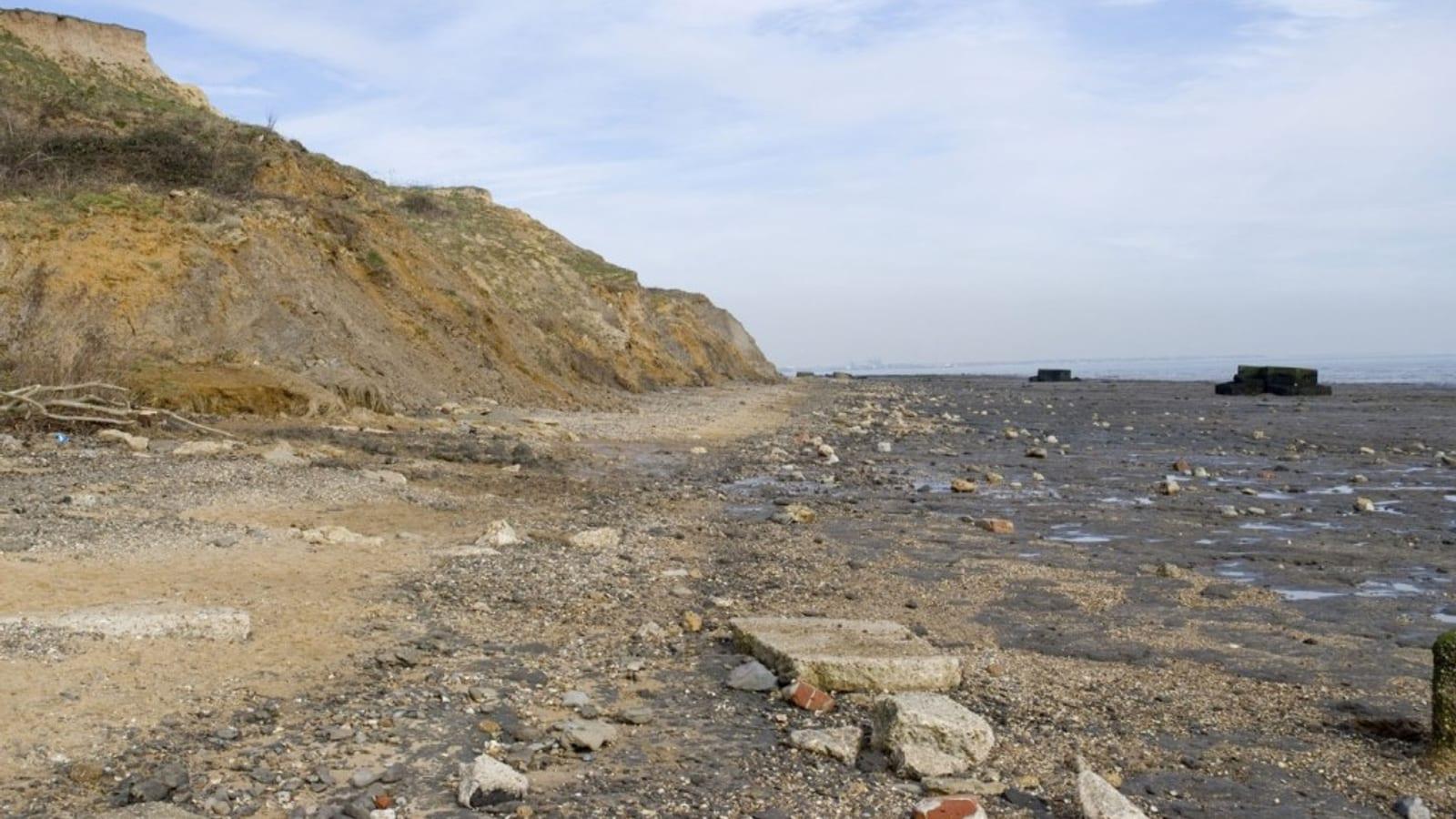
 Photo: Derek Voller, CC BY-SA 2.0, via Wikimedia Commons
"The eastern side of the peninsula forms the famous cliffs, which are fifty million years old and designated a Site of Special Scientific Interest. The 70-foot-high cliffs are made up of London Clay, Red Crag, and Thames Sands and Gravels, and fossilised shark teeth, shells, and wood are found on the beach daily.". Essex Wildlife Trust
Location and Directions
Address
The Naze, Old Hall Lane, Walton-on-the-Naze, Essex, CO14 8LE, England.
Directions and Parking
From the A120 or A133, follow the signs to Walton-on-the-Naze. In Walton, follow signs to The Naze and Naze Tower. Turn onto Old Hall Lane and follow it to the end, where the Naze Nature Discovery Centre and car park are located. Parking charges apply. From the car park, follow the trail guides toward the cliffs. Steep metal steps descend from the clifftop to the beach. These are impassable with pushchairs or buggies. The beach and lower foreshore disappear at high tide and the access steps may be submerged or cut off. Always check local tide times before descending. The 2-mile circular trail can be walked along the clifftop without descending to the beach if tidal conditions are not suitable. The Naze Tower, a historic octagonal lighthouse built in 1720, is a prominent landmark visible throughout the site. No facilities are available on the beach itself. The Discovery Centre has toilets.
What Fossils You'll Find
London Clay Formation (Eocene)
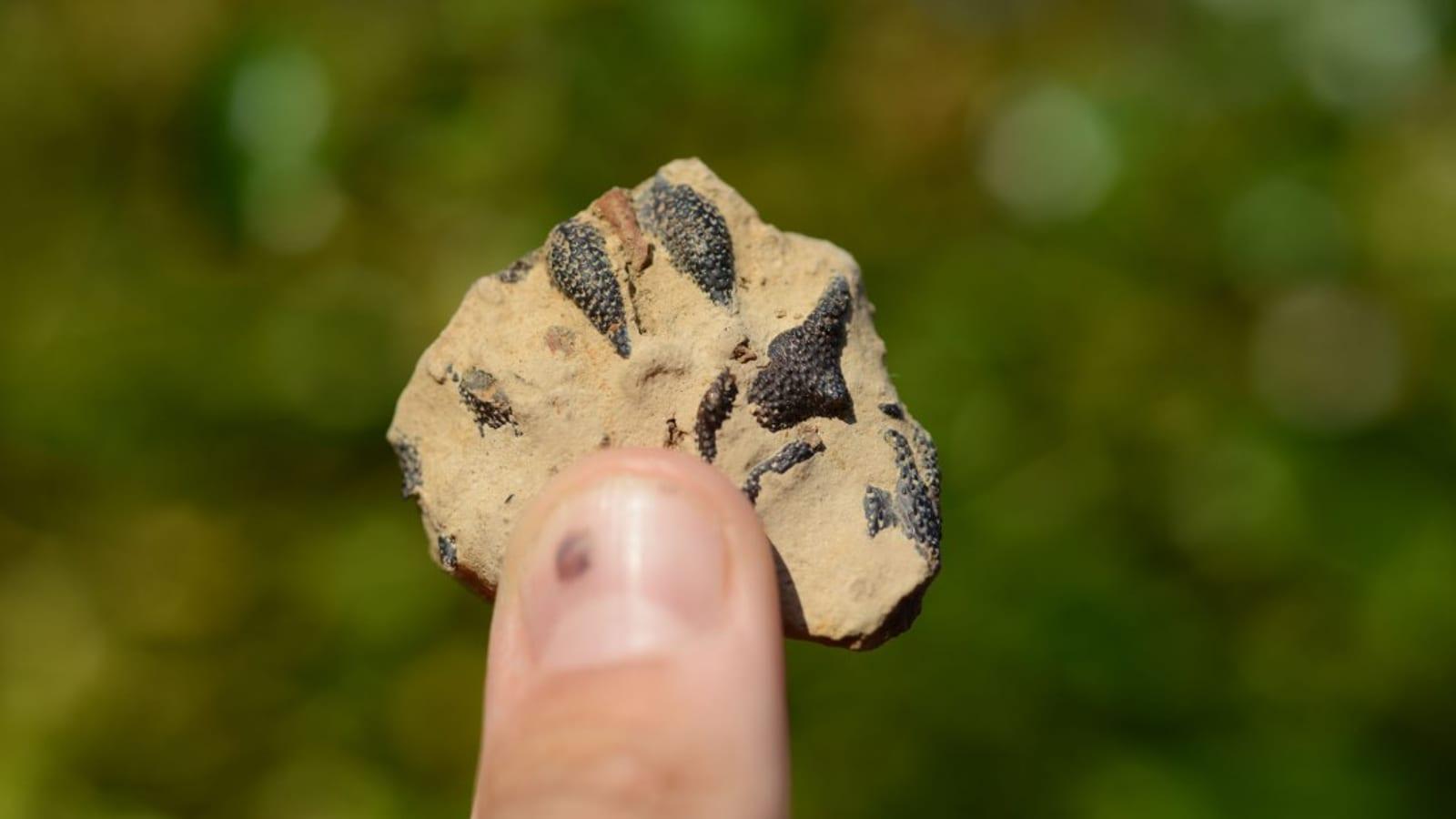
The London Clay at Walton-on-the-Naze has produced over 150 species of bird fossil, making it one of the most important Eocene avian fossil sites in the world. These tiny bird bones are rare individual finds but have accumulated into a significant scientific record over decades of collecting and reporting. For the visiting collector, the more reliably findable London Clay material includes shark teeth from species including Striatolamia macrota and other lamnid sharks, pyritised wood preserved in iron sulphide with a metallic golden or bronze surface, and fish bones and vertebrae. Turtle remains, including shell fragments and limb bones, have also been found in the London Clay here.
 Photo: Niels Stensen (Steno), Public domain, via Wikimedia Commons
The distinctive Junction Bed between the London Clay and Red Crag is a phosphatic nodule layer containing reworked Miocene material. This bed has produced some of the best finds at the Naze, including very rare teeth of Carcharocles megalodon, the giant shark of the Miocene. These teeth are reworked from Miocene deposits that have since been almost entirely eroded. The Junction Bed represents what survived. Finding a megalodon tooth here is genuinely rare but documented.
Red Crag Formation (Pliocene)
The Red Crag sits above the Junction Bed and produces large quantities of mollusc shells, many of them still three-dimensional and well-preserved in the orange-brown shelly sand. Over 300 shell species have been recorded from the Red Crag at this site. Gastropods and bivalves dominate, and the Neptunea contraria whelk, which spirals in the opposite direction to almost all other whelk species, is one of the characteristic and sought fossils of the Red Crag here. Fish fragments including teeth and bone material occur through the formation. Occasional mammal teeth and bones from Pliocene mammals appear. These are rarer but this is one of the few sites in England where they have been found in the Red Crag context.
Geologic History
The Ancient Environment
The London Clay Formation at Walton-on-the-Naze was deposited approximately 54 to 50 million years ago during Division A of the Eocene epoch (Ypresian stage). Britain at this time lay at approximately 40 degrees north, about 10 degrees south of its current position, and the climate was warm and tropical to subtropical with annual temperatures roughly 10 degrees Celsius higher than today. A shallow, warm sea covered much of southern and eastern England. The nearest significant land was 10 to 20 miles away. The undisturbed offshore setting allowed fine clay to accumulate, building up the dark grey to blue-grey laminated formation that characterises the London Clay across the London and Hampshire basins. Pale volcanic ash bands (bentonites) within the London Clay record intense volcanic activity in western Scotland during this period.
The abundant life preserved in the London Clay, including the bird fauna, reflects the productivity of a warm tropical sea with lush mangrove and tropical forest on the surrounding coastal margins. Lush tropical vegetation covered the landmasses, hosting a diverse community of mammals, birds, and insects whose remains occasionally fell or washed into the sea.
The Red Crag Formation was deposited approximately 3.2 to 2.4 million years ago during the Pliocene epoch, separated from the London Clay by a major unconformity representing roughly 47 million years of missing geological record, during which Miocene deposits were laid down and then entirely removed by erosion. The Pliocene sea was cool and shallow, 15 to 25 metres deep, with shell bank dunes on the seabed near the shoreline during a period of marine transgression across Essex. The climate had cooled substantially from the Eocene warmth, and the Pliocene Red Crag records conditions transitioning toward the Pleistocene ice ages that followed.
How Walton-on-the-Naze Became a Fossil Collecting Site
The cliffs at The Naze have been eroding at 1 to 2 metres per year for as long as records have been kept. The 21-metre cliff face is composed of relatively soft London Clay at the base and loose shelly Red Crag sand above, making it highly susceptible to wave undercutting, slumping, and storm erosion. The Crag Walk Platform built in 2011 in front of the iconic Naze Tower was constructed specifically to protect the cliff section directly in front of the tower. The erosion that destroys the cliff is the same process that delivers fresh fossils to the beach below, so the Naze has been a reliable collecting site since Victorian times when the geology was first studied systematically. Essex Wildlife Trust now manages much of the site as a nature reserve.
Collecting Rules and Regulations
Is Fossil Collecting Allowed?
The Naze is a SSSI managed by Essex Wildlife Trust. Collecting loose fossils from the beach and foreshore for personal use is permitted. You must not undercut or excavate the cliff face, both because this is prohibited under the SSSI designation and because it creates a direct risk of cliff collapse. The Essex Wildlife Trust and Natural England ask that the site be treated with respect and that collecting be kept to reasonable personal quantities. Significant vertebrate finds, including any bird bones, mammal material, or megalodon teeth, should be reported to Essex Wildlife Trust or a local museum.
Recommended Tools
For the Red Crag, a small trowel or garden fork is useful for sieving through the loose shelly sand where it accumulates at the cliff base, though this must be done only on already-fallen material and not by excavating the cliff itself. For the London Clay and Junction Bed, a geological hammer and chisel for splitting nodules are appropriate. A sieve is very useful for recovering small teeth from loose Red Crag sand. Bring bags for finds and cushioning material for fragile specimens.
Safety
The cliffs at The Naze are actively eroding and unpredictable. The soft Red Crag sand can collapse without warning from above. The London Clay below it is prone to slumping. Do not stand at the cliff base under any circumstances. The beach disappears at high tide and the metal access steps can be submerged. Check the tide before descending and allow sufficient time to return before high water. The foreshore is accessible to the south along the beach toward Walton seafront at most states of the tide if you need an alternative exit route.
Sources
Nearby sites


Sources & further reading
On this page
- Introduction
- Location and Directions
- Address
- Directions and Parking
- What Fossils You'll Find
- London Clay Formation (Eocene)
- Red Crag Formation (Pliocene)
- Geologic History
- The Ancient Environment
- How Walton-on-the-Naze Became a Fossil Collecting Site
- Collecting Rules and Regulations
- Is Fossil Collecting Allowed?
- Recommended Tools
- Safety
- Sources