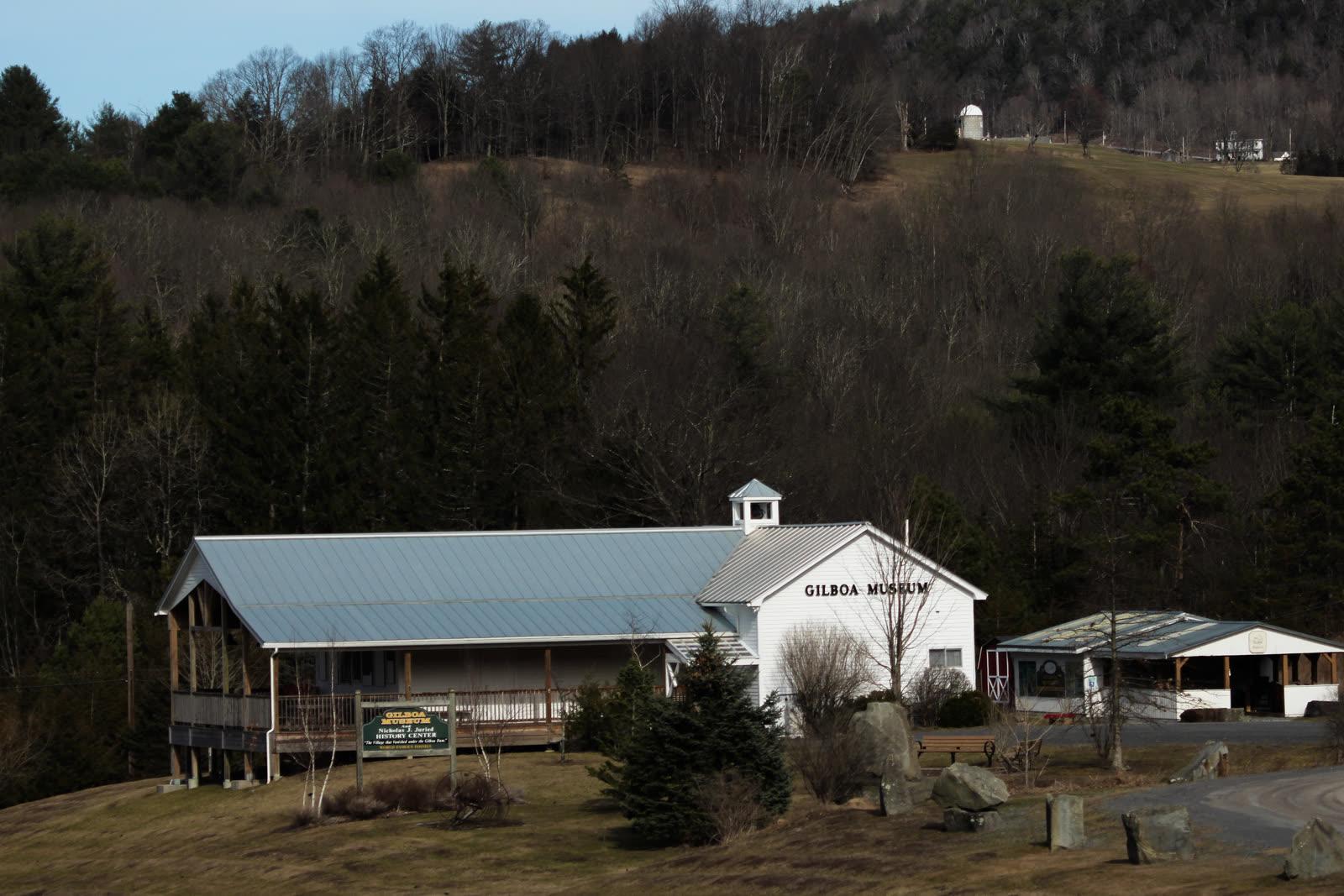
Gilboa Fossil Forest Fossil Hunting Guide
Image: Tyler A. McNeil (CC BY-SA 4.0)
Gilboa in Schoharie County, New York, holds the stump casts of the oldest known fossil forest, 385 million years old and preserved in the Devonian Manorkill Formation. Visitors can see nine stumps outdoors beside Gilboa Town Hall and more at the Gilboa Museum. Collecting is not allowed.
By Edward Chen · Published 1 October 2026
 Photo: Tyler A. McNeil, CC BY-SA 4.0, via Wikimedia Commons
Introduction
Gilboa is a viewing-only site in Schoharie County, New York. It holds the stump casts of the oldest known fossil forest, about 385 million years old. You cannot collect here and you cannot enter the quarries. You can walk up to nine real fossil stumps outdoors on State Route 990V, and the Gilboa Museum shows more.
An amateur naturalist found the first cast in Schoharie Creek in 1850, after a large flood. John W. Dawson of McGill University described it. The Gilboa Historical Society calls this the first documented find of fossil tree stumps in North America.
The big finds came in 1920. The City of New York claimed the village to build Gilboa Dam and the Schoharie Reservoir. The New York State Museum then ordered a full search for stumps. Crews recovered about 50. Some went to the State Museum, the dam contractor Hugh Nawn shipped others around the world, and nine stayed in Gilboa.
In 1927 the State Museum and the New York City Board of Water Supply set up a roadside exhibit of stumps near the quarry. It was the first exhibit of its type in the state. The outdoor display of today follows the same idea.
Location and Directions
The Gilboa Museum is at 122 Stryker Road, Gilboa, NY 12076. Its coordinates are 42.400 degrees north and 74.450 degrees west. The museum holds stump casts and local historical objects.
The outdoor display is on State Route 990V, beside Gilboa Town Hall. It stands about 400 m south-east of the museum. A 2010 local news report describes the display as always open, with an information kiosk. This guide found no published fee for the outdoor display.
A 2000 city press release described the move of nine stumps to land owned by the Town of Gilboa. The Gilboa Historical Society exhibits them under a loan agreement.
The museum is open on weekends only. Hours are 12:00 to 16:00, Saturday and Sunday, from Memorial Day weekend to Columbus Day weekend. This guide found no published admission fee for the museum. Telephone (607) 588-6894 in season or (607) 437-7132 year round to check.
What Fossils You'll Find
 Photo: Skye McDavid, CC BY 4.0, via Wikimedia Commons
The fossils at Gilboa are casts and molds of tree bases, not bones or shells. The stump genus is Eospermatopteris, and Eospermatopteris eriana is the named species. The stumps in Gilboa measure from 15 to 55 cm across at the base, based on eight stumps in a 1997 study.
Scientists first knew the crown of the Eospermatopteris tree as a separate fossil. A 2007 paper in Nature linked it to the genus Wattieza. This tree is a cladoxylopsid, an early relative of ferns and horsetails.
The 2010 excavation at Riverside Quarry exposed a forest floor. Researchers mapped about 1,200 square meters of Eospermatopteris root systems in life position. A paper in Nature on 1 March 2012 described three kinds of tree on that floor. They were the cladoxylopsid Eospermatopteris, aneurophytalean progymnosperms with woody rhizomes, and one tree-sized lycopsid.
Visitors see the casts on display, not the forest floor. The New York State Museum in Albany and the Blenheim-Gilboa Visitor Center also show Gilboa specimens.
Geologic History
The Gilboa forest grew on a coastal plain about 385 million years ago, in the Givetian age of the Middle Devonian. The land lay about 20 degrees south of the equator. Long dry spells alternated with monsoon rain and flood.
Storms buried the forest in sand. The trunks rotted, and sand filled the empty molds. That is why Gilboa has casts and not petrified wood. The stumps stand in gray-green, disturbed mudstone, near the point where the marine Moscow Formation gives way to the red beds of the Manorkill Formation.
The Manorkill Formation belongs to the Catskill clastic wedge in the Appalachian foreland basin. It is about 190 m thick and consists of red beds with gray sandstones. Four separate forested soils with stump casts are known in the Manorkill Formation in the Catskill Mountains.
Three main localities are known. They are Riverside Quarry, Gilboa Dam and Manorkill. Winifred Goldring of the New York State Museum called Gilboa the oldest known petrified forest in 1927. Researchers have rarely had access to the sites in 150 years.
Collecting Rules and Regulations
Collecting is prohibited. No source describes any public collecting program at Gilboa. The City of New York owns the stumps and leases them to the Gilboa Historical Society for educational use.
Do not climb on the stumps, scrape them or chip them. Photographs are welcome. Place a coin or a pen beside a cast to show its size.
Do not enter the quarries or the dam grounds. The Department of Environmental Protection owns the Riverside Quarry land, and this guide found no public access program for it. Gilboa Dam is active water supply infrastructure.
If you find a loose piece of rock near Gilboa that looks like a stump cast, leave it in place. Tell the Gilboa Museum where you found it.
Safety
Take care at the roadside display. State Route 990V carries traffic, and the stumps stand beside the highway. Look both ways before you cross. Keep children and pets away from the road.
Telephone ahead if you travel far to see the museum. The in-season number is staffed on weekends only. The year-round number takes messages.
Do not enter the dam grounds or any quarry. Gilboa Dam and its approaches have restricted ground. Obey every posted sign.
Sources
https://www.gilboafossils.org/gilboa-today/ https://www.gilboafossils.org/visit/ https://www.gilboafossils.org/contact-us/ https://nysm.nysed.gov/exhibitions/ancient-devonian-forest-385-million-year-old-forest-finally-uncovered-gilboa-new-york https://nysm.nysed.gov/bibcite/reference/20106 https://nysm.nysed.gov/sites/default/files/an_outdoor_exhibit_of_the_gilboa_fossil_trees_a.pdf https://gsa.confex.com/gsa/2002NC/webprogram/Paper32218.html https://watershedpost.com/node/77099 https://www.nyc.gov/html/dep/html/press_releases/00-49pr.shtml https://en.wikipedia.org/wiki/Gilboa_Fossil_Forest