Powder Hill Dinosaur Park Fossil Guide
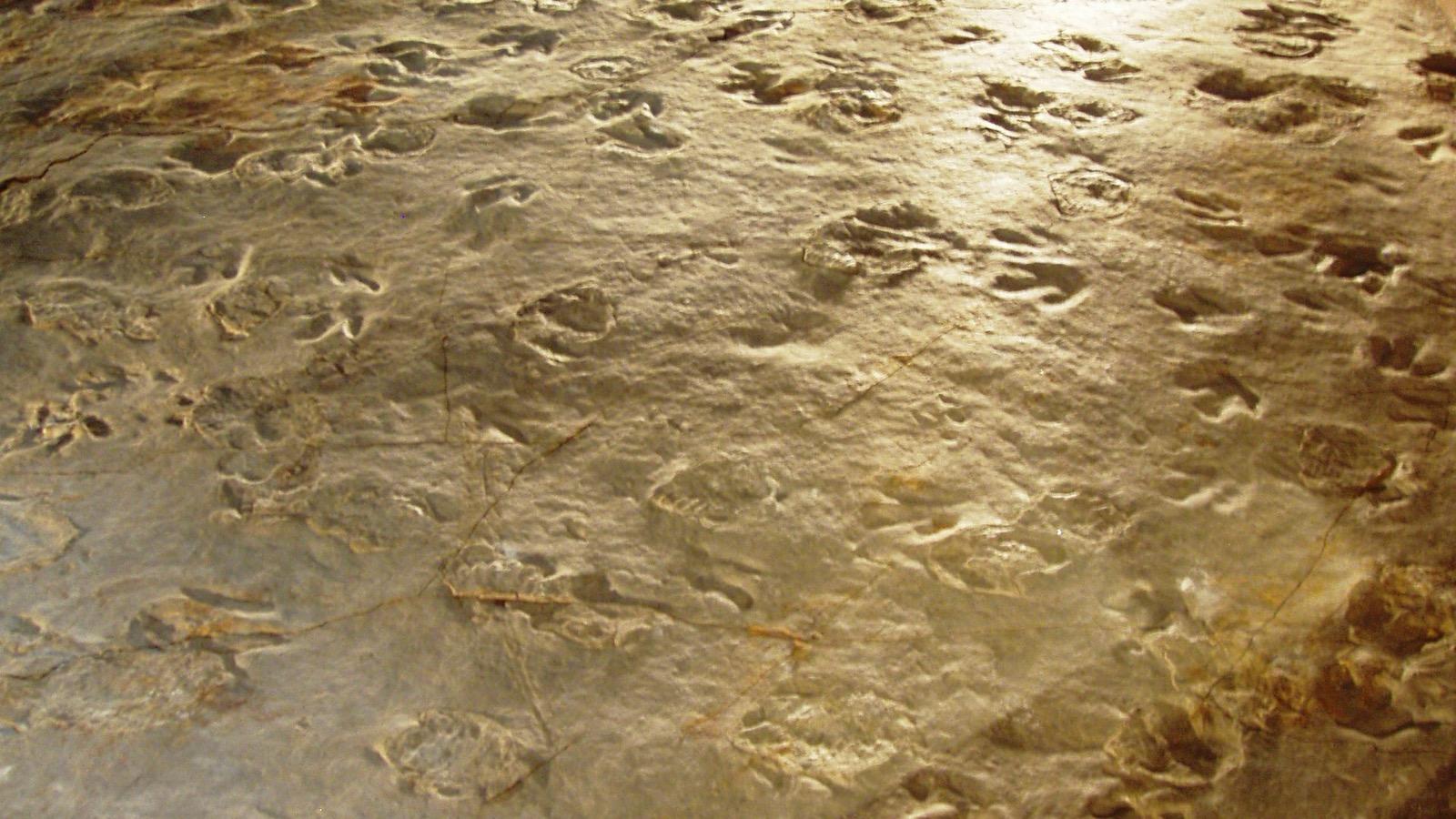
A former brownstone quarry in Middlefield, Connecticut, owned by the town and free to visit. Four beds of the Early Jurassic East Berlin Formation carry the tracks of 71 dinosaurs, 32 of them large enough to be called Eubrontes giganteus.
By Edward Chen · Published 12 October 2026
Introduction
Four separate rock beds at Powder Hill Dinosaur Park carry dinosaur tracks. Patrick Getty, Laurel Hardy and Andrew Bush numbered them one to four from the quarry floor upward. They published the work in the Bulletin of the Peabody Museum of Natural History in 2015.
Their count is the number worth knowing. They identified the tracks and trackways of 71 dinosaurs across those four beds. Thirty-two of the animals left tracks large enough to be called Eubrontes giganteus.
This is a small town park, not a museum. Middlefield owns it, entry is free, and the rock sits in the open air rather than under a roof. There is no visitor center, no admission desk and no staff.
The quarry itself is older than the science. Getty and his co-authors describe it as a small brownstone quarry active in 1848 and 1849. Their source is the 1883 History of Middlefield and Longhill by Thomas Atkins.
One correction worth making early. Powder Hill is not part of the official Connecticut Dinosaur Trail. The Connecticut Department of Energy and Environmental Protection names four partners in that trail, and this park is not among them.
Location and Directions
Powder Hill Dinosaur Park lies on Powder Hill Road in Middlefield, Middlesex County, Connecticut. GPS: 41.5032°N, 72.7302°W.
Those coordinates come from the site table in the 2017 Geosciences paper by Getty and five co-authors. It lists the park at 41 deg 30 min 11.48 sec N, 72 deg 43 min 48.73 sec W. A reverse geocode of that point against OpenStreetMap returns Powder Hill Road, in the Baileyville part of Middlefield, postcode 06455.
Middlefield sits between Meriden and Middletown in central Connecticut. The park is about 15 km southwest of Dinosaur State Park at Rocky Hill, which is a separate and much larger site.
The town publishes nothing about this park. The Town of Middlefield website lists its facilities, and Powder Hill Dinosaur Park does not appear among them. No opening hours, no parking information and no park rules are published for it. Call the town on 860-349-7114 before you travel if any of that matters to your trip. The town offices are at 393 Jackson Hill Road, Middlefield.
What is on the ground is a quarry floor with the track-bearing beds exposed, enclosed by a fence. Getty and co-authors note that the beds are exposed discontinuously, which made mapping a single surface across the whole floor difficult. Expect to walk between separate patches of rock rather than to see one clean pavement.
What Fossils You'll Find
Nothing here is collectable. The tracks are trace fossils in bedrock on town land, and the town grants access to study them rather than to remove them.
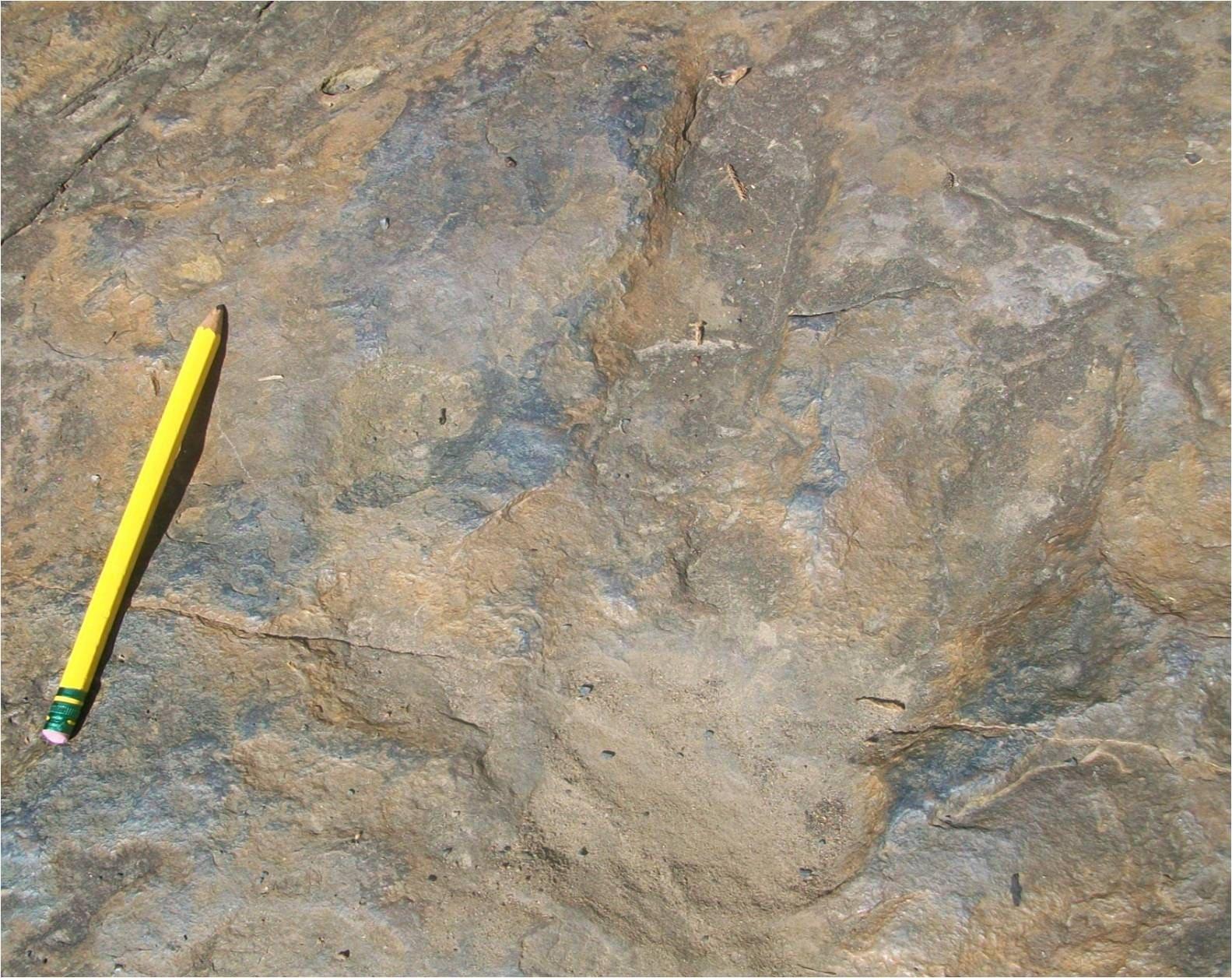
Eubrontes giganteus is the track to look for. It is a three-toed theropod footprint, and 32 of the 71 animals recorded at the park left tracks in that size class. The published work divides them by bed.
- Bed 1 carries four trackways. Two run off to the north and two to the west.
- Bed 2 carries 17 trackways, the richest surface at the site. Five of them cluster toward the east. Statistical testing of the orientations returned a p-value above 0.05 for all 17 trackways, so the cluster does not stand up.
- Bed 3 carries four E. giganteus tracks, with three trackways running north.
- Bed 4 carries seven trackways in three loose groups, running northeast, south and northwest. Testing those seven returned a p-value above 0.05 as well.
Thirty-nine of the 71 animals left tracks too small to fall in the Eubrontes size class. The published work on this site does not assign those smaller tracks to named ichnogenera, so this page does not name them either.
One detail repays close looking. On bed 2 the tracks are a mixture of true tracks and undertracks. A true track is the surface the foot actually pressed. An undertrack is the deformation transmitted into the layer below, which is blurrier and shallower. The mixture matters because it proves the animals crossed at different times rather than together.
Geologic History
The park sits in the Hartford Basin, one of a set of rift basins in eastern North America called the Newark Supergroup. Those basins opened in the Late Triassic and Early Jurassic as Pangea broke apart and the Atlantic began to form.
The rock is the East Berlin Formation. It underlies the Portland Formation and is separated from it by lava flows of the Hampden Formation. The National Park Service dates the track layers of this formation to about 200 million years, just after the start of the Jurassic. It explains that the figure comes from basalt flows about 140 feet above the track beds.
The four track beds at Powder Hill are muddy, fine-grained sand. Two sedimentary features on them tell the story of the environment. Oscillation ripple marks formed under shallow standing water. Desiccation cracks then cut across those ripples, which means the water went away and the mud dried in the sun.
Getty and co-authors classify the depositional setting here as a playa lake, a shallow body of water that filled and dried repeatedly. That classification carries weight for the behavioural question, because the trackway orientations at Powder Hill come out random under statistical testing.
The quarry walls add a second element. Beds of coarse-grained, channeled sand are exposed in cross section in the faces. Rivers therefore fed sediment into this part of the basin alongside the lake deposits.
Why the trackway directions matter
The original argument that these theropods moved in herds rested on parallel trackways at Dinosaur Footprint Reservation in Holyoke, Massachusetts. Those tracks lie in the overlying Portland Formation.
Getty, Hardy and Bush tested that argument at Powder Hill in 2015 and found no preferred direction of travel. A larger 2017 study by Getty and five co-authors extended the test to five sites across the Hartford Basin. Parallel trackways turned out to be prominent only in the permanent lake rocks at Holyoke, where the two directions approximate the old shoreline.
Their conclusion is that a lake acting as a physical barrier explains the parallel trackways better than herding does. Powder Hill is one of the sites that makes the argument work. It holds many trackways in a playa setting and shows no alignment at all.
Collecting Rules and Regulations
Collecting is not permitted. Do not remove, hammer or pry anything. The tracks are in bedrock on land the Town of Middlefield owns, and the fence around the quarry floor marks the park as a protected exhibit.
Getty and his co-authors thank the town in print for granting access to study the tracks in its care. Scientific work here goes through the town. Casual removal of rock does not.
The town publishes no written park rules for this site, so treat the following as the sensible baseline for an unstaffed outdoor track exhibit.
- Do not chalk, paint, trace or cast any track. These methods damage sandstone surfaces and are banned at comparable sites.
- Do not pour water on a track to improve a photograph. Use low sun angles instead.
- Stay off the track surfaces where you can. Repeated foot traffic wears a bedding plane down.
- Do not climb the quarry walls or move loose blocks.
- Take litter home. There is no staffed facility here.
If you want to collect East Berlin Formation material legally, this is the wrong place. Ask a private landowner or a working quarry outside the park, in writing, and expect most to say no.
Safety
This is an unstaffed site with no services. There is no visitor center, no restroom and nobody on duty. Plan accordingly, and tell someone where you are going.
The exposures are a former quarry floor and quarry walls. Rock faces cut for stone do not weather into safe slopes. Keep away from the base of the walls, do not climb them, and watch for loose blocks.
The track surfaces are uneven and get slippery. Bedrock holds water in hollows, and wet sandstone with algae on it is treacherous. Winter brings ice onto the same surfaces. Boots with grip are worth the trouble.
Connecticut is a Lyme-endemic state. Ticks are active in the grass and leaf litter around the quarry through the warm months. Wear long trousers, use repellent and check yourself afterwards. Poison ivy grows widely in central Connecticut.
The road access is rural and the park sits directly off it. Park clear of the carriageway, and watch for traffic when you get in and out of the car.
Sources
https://doi.org/10.3374/014.056.0109 https://doi.org/10.3390/geosciences7010013 https://res.mdpi.com/geosciences/geosciences-07-00013/article_deploy/geosciences-07-00013.pdf https://www.nps.gov/articles/000/paleontology-of-dinosaur-trackway-national-natural-landmark.htm https://portal.ct.gov/deep/geology/get-outside-and-explore https://www.middlefieldct.org/ https://www.middlefieldct.org/Facilities