Naracoorte Caves Fossil Hunting Guide
Image: Kerm22 (CC BY-SA 4.0)
Naracoorte Caves National Park sits on the limestone plain of South Australia's Limestone Coast, about 100 km north of Mount Gambier and 340 km southeast of Adelaide.
By Edward Chen · Updated 1 August 2026
 Photo: Feral Arts, CC BY 2.0 via Wikimedia Commons

Introduction
Naracoorte Caves National Park sits on the limestone plain of South Australia's Limestone Coast, about 100 km north of Mount Gambier and 340 km southeast of Adelaide. The park preserves a network of solution caves cut into Oligocene marine limestone, and within those caves are bone deposits that include some of the richest and best-preserved Pleistocene megafauna assemblages in the southern hemisphere. The signature site, Victoria Fossil Cave, contains a three to four metre deep bone bed accumulated over more than 200,000 years, with over 90 vertebrate species identified, including the marsupial lion Thylacoleo carnifex, the rhino-sized Diprotodon optatum, the short-faced kangaroo Procoptodon goliah, the giant flightless bird Genyornis newtoni, the giant goanna Varanus priscus (formerly Megalania), and the snake Wonambi naracoortensis that gave the park's fossil interpretation centre its name. UNESCO inscribed Naracoorte and Riversleigh together as the Australian Fossil Mammal Sites World Heritage Area in 1994. The park is managed by South Australia's Department for Environment and Water. Everything inside the caves is protected. This guide covers how to reach the park, what tours are available, the geology that produced the natural pit traps, and the rules that keep collecting off the table.
Location and Directions
Naracoorte Caves National Park is located on Wonambi Road, about 12 km southeast of the town of Naracoorte, in the southeast corner of South Australia.
From Adelaide, the drive takes roughly 3.5 to 4 hours. Take the South Eastern Freeway (M1) and then the Dukes Highway (A8) southeast through Tailem Bend and Keith to Naracoorte. In Naracoorte, follow signs east on the Riddoch Highway and then south on the Naracoorte to Penola Road. Turn onto Wonambi Road to reach the park entrance. From Mount Gambier, the drive is about 1 hour 15 minutes north on the Riddoch Highway. Parking is free at the Wonambi Fossil Centre.
The park is open daily. The Wonambi Fossil Centre, which houses the visitor reception, life-size reconstructions of the megafauna, and the ticket desk, is generally open from 9:00 am to 5:00 pm. Tours of the show caves run on a fixed daily timetable. Confirm times when you arrive or check the Parks South Australia listing before you drive out, since schedules change seasonally.
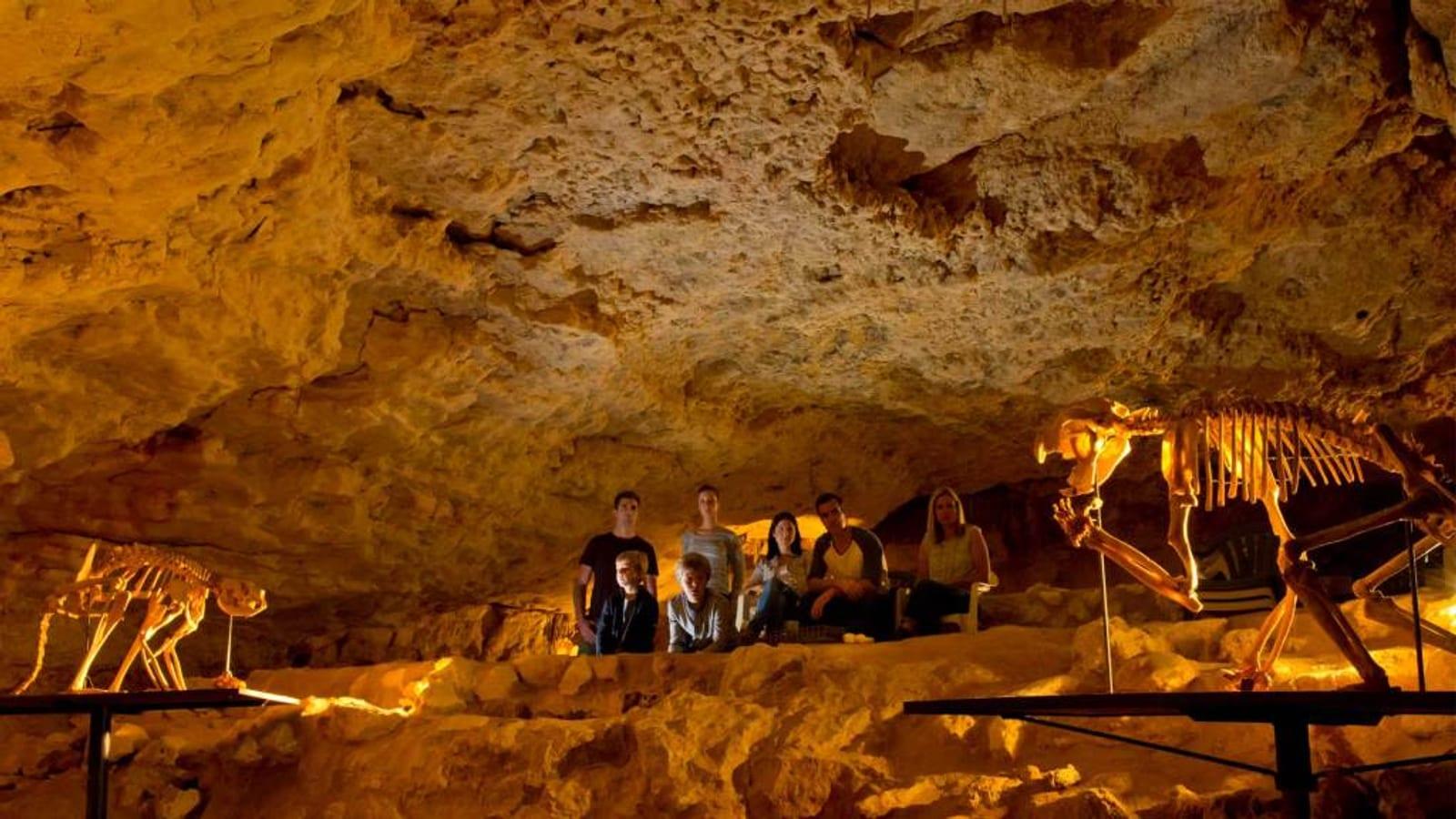
The headline tour for fossil visitors is Victoria Fossil Cave, typically run at 10:15 am and 2:15 pm. The tour follows about 400 metres of paved cave path with around 50 steps and a steep climb at the exit, and the highlight is roughly 30 minutes in the Fossil Chamber, where the bone bed is exposed in section behind low railings.
Alexandra Cave runs short (about 30 minute) family-oriented tours, often at 9:30 am and 1:30 pm. Stick-Tomato Cave is self-guided and open daily 9:00 am to 5:00 pm, with a short loop through two well-lit chambers. The Bat Cave tour at Blanche Cave, run as part of the Bat Centre experience, runs at 11:30 am and 3:30 pm and lets visitors watch the maternity colony of critically endangered southern bent-wing bats on closed-circuit video, with the option to see live evening bat flights in summer.
Camping is available within the park at the Wirreanda Campground. The town of Naracoorte has the closest fuel, groceries, and accommodation.
What Fossils You'll Find
 Photo: Owen, P., No restrictions via Wikimedia Commons
%20(14740873916).jpg)
You will not collect anything at Naracoorte. The bone material is protected as part of a World Heritage Site, and the only way to see it is on a guided tour. What the Victoria Fossil Cave tour shows is one of the best Pleistocene megafauna bone beds anywhere in the world, with vertebrate material exposed in cross-section in the Fossil Chamber wall and floor:
- Thylacoleo carnifex, the marsupial lion. The most famous Naracoorte fossil. Skulls, jaws, and partial skeletons of this leopard-sized predator have come from the cave, including the most complete specimens of the species.
- Diprotodon optatum, the largest marsupial known to science. Rhino-sized herbivore. Isolated teeth, limb elements, and partial skulls.
- Procoptodon goliah and other sthenurine "short-faced" kangaroos. Browsers that stood up to 2 metres tall and weighed more than 200 kg.
- Zygomaturus trilobus, a smaller relative of Diprotodon.
- Genyornis newtoni, a flightless bird about 2 metres tall and 230 kg.
- Varanus priscus (the giant monitor lizard formerly known as Megalania) and the giant constrictor Wonambi naracoortensis.
- Smaller vertebrates. Bats, native rodents, marsupial carnivores, snakes, lizards, and frogs make up most of the bone count and provide the climate proxy data that drives much of the research at the site.
The Wonambi Fossil Centre displays articulated reconstructions and full-scale dioramas of the Pleistocene fauna, and is well worth time before or after the cave tour.
Geologic History
The caves are dissolved out of the Gambier Limestone, a soft, friable marine limestone deposited during the Oligocene to early Miocene (about 33 to 23 million years ago) when southern Australia lay beneath a warm shelf sea. The limestone is rich in bryozoan and echinoid debris and was uplifted slowly through the Neogene as Australia drifted north. The water table fell as sea level dropped, and acidic groundwater began dissolving the limestone along joints and bedding planes, opening a network of subhorizontal caves through the Pliocene and Pleistocene.
The bone deposits inside the caves are far younger than the rock that contains them. From at least 500,000 years ago through the late Pleistocene, sinkholes and small surface entrances opened into the cave roofs. Animals fell through the openings into chambers below or were washed in by surface water during storms. Once on the cave floor, bones were buried in clay and silt that washed in through the same openings. Some chambers continued to receive material for tens of thousands of years, building up the three to four metre Victoria Fossil Cave bone bed.
The climate during the Pleistocene swung between cooler, drier glacial intervals and warmer, wetter interglacials. A 2024 study in Nature, "Elevated southern hemisphere moisture availability during glacial periods," presented evidence that Australian glacial intervals were wetter than once assumed, which has implications for how megafauna populations responded to climate change. Most Australian megafauna species disappear from the fossil record by about 40,000 years ago, and the relative roles of climate and human arrival in those extinctions remain actively debated. The Naracoorte sequence is one of the central datasets in that debate.
"The Caves preserve the most complete fossil record we have for this period of time, spanning several ice ages, the arrival of humans in the area and the extinction of Australia's iconic Megafauna roughly 60,000 years ago.". Naracoorte Caves National Park
How Naracoorte Caves Became a Fossil Collecting Site
Local farmers found the first bones in cave entrances in the 1850s, and limited excavation occurred over the next century. The bone bed in what is now Victoria Fossil Cave was rediscovered in 1969 by cavers Grant Gartrell and Rod Wells, who broke into the previously sealed Fossil Chamber and recognised the extent of the deposit. Wells and colleagues at Flinders University began systematic excavation, which continues today as a long-running research programme.
The site was added to Australia's National Estate, then jointly inscribed with the much older Riversleigh site in Queensland as the Australian Fossil Mammal Sites World Heritage Area in 1994. Naracoorte Caves National Park is managed by the South Australian Department for Environment and Water, with visitor operations centred on the Wonambi Fossil Centre. The Fossil Chamber is open to the public as part of the Victoria Fossil Cave tour, with research-only sections sealed off behind low barriers. Excavation seasons happen periodically and are visible to tour groups when they are active.
Collecting Rules and Regulations
Collecting is prohibited. Naracoorte Caves is a national park, a UNESCO World Heritage Site, and the bone bed is protected under both the National Parks and Wildlife Act 1972 (South Australia) and the federal Environment Protection and Biodiversity Conservation Act 1999. Removing, damaging, or disturbing any fossil, rock, sediment, or biological material from the park is a serious offence.
Practical rules:
- Cave access is by guided tour only, with the single exception of Stick-Tomato Cave (self-guided, well-lit, no fossil material on display).
- Photography for personal use is permitted in the show caves. Tripods and flash may be restricted in some chambers, so ask your guide.
- Children must stay with the tour. The Victoria Fossil Cave tour includes 50 steps and a steep climb out, and is not stroller-accessible.
- Tour fees apply for all guided caves and for the Wonambi Fossil Centre. Combined-tour passes are typically available. Confirm current prices with Parks South Australia.
- The caves stay at around 17 degrees Celsius year round. Bring a light jacket even in summer.
- Bushfire restrictions apply in the surrounding park in summer. Check fire-danger ratings before you travel.
- The Bat Cave is closed to direct entry to protect the maternity colony. The experience is via remote camera.
Safety
Naracoorte is visited on guided cave tours, and the guides manage most of the risk. The things to know concern the cave environment itself.
Underground footing is uneven and the light is low. Cave floors are damp, irregular, and slippery in places, and the walkways include steps and low sections where you will need to duck. Wear closed shoes with grip rather than sandals, watch your head as well as your feet, and use the handrails. Tell your guide beforehand if you have limited mobility, since tours vary considerably in difficulty and some involve a good deal of stair work.
The caves are cool and constant. The temperature underground stays low year-round regardless of the weather on the surface, so bring a layer even on a hot South Australian day.
If you are claustrophobic, ask about the specific tour before booking, as some passages are narrow and low. Adventure caving options, where offered, are a different proposition again and require you to be comfortable in confined spaces.
Do not touch cave formations. Skin oils damage them permanently, and this is a World Heritage site whose value lies in what is preserved intact.
On the surface, the park is exposed and South Australian summers are hot, so carry water and sun protection for the walks between cave entrances. Snakes are active in the warmer months in the surrounding bushland, so stay on the paths.
Sources
- Parks South Australia, "Naracoorte Caves National Park." https://parks.sa.gov.au/parks/naracoorte-caves-national-park
- UNESCO World Heritage Centre, "Australian Fossil Mammal Sites (Riversleigh / Naracoorte)." https://whc.unesco.org/en/list/698/
- Department of Climate Change, Energy, the Environment and Water (Australia), "Australian Fossil Mammal Sites World Heritage Area." https://www.dcceew.gov.au/parks-heritage/heritage/places/world/fossil-mammal-sites
- Reed, E.H., and Bourne, S.J., 2000. "Pleistocene Fossil Vertebrate Sites of the South East Region of South Australia." Transactions of the Royal Society of South Australia, 124(2).
- Lopez-Arbarello, A. et al., 2024. "Elevated southern hemisphere moisture availability during glacial periods." Nature. https://www.nature.com/articles/s41586-023-06989-3
Nearby sites
 Hamilton Grange Burn Fossil Hunting GuideMacropodids, Diprotodontids
 Beaumaris Bay Fossil Site Melbourne Fossil Hunting Guideshark teeth, Carcharocles megalodon
 Mungo National Park Fossil Hunting GuideMungo Lady, Mungo Man
 Flat Rocks Inverloch Dinosaur Dig Site Fossil Hunting GuidePolar dinosaurs, Early mammal teeth